

Key Takeaways
Fix your relationship with God before any relationship with a person
Connect to a source before you become a drain. Stuart opens with a diving accident: a scuba partner panics when his oxygen fails, rips out his buddy's mouthpiece, and nearly drowns her while trying to climb her like a ladder to safety. His lesson: scarcity breeds desperation, and desperation breeds exploitation. When you bring God-sized needs (for meaning, worth, unconditional love) to another human, you inevitably use them up.
The beloved love. Drawing on 1 John 4, Stuart argues love flows downhill: because God first loved you, you have an inexhaustible supply to give others rather than extract from them. Only people connected to a life-source can be a source of life instead of a sucker of life.
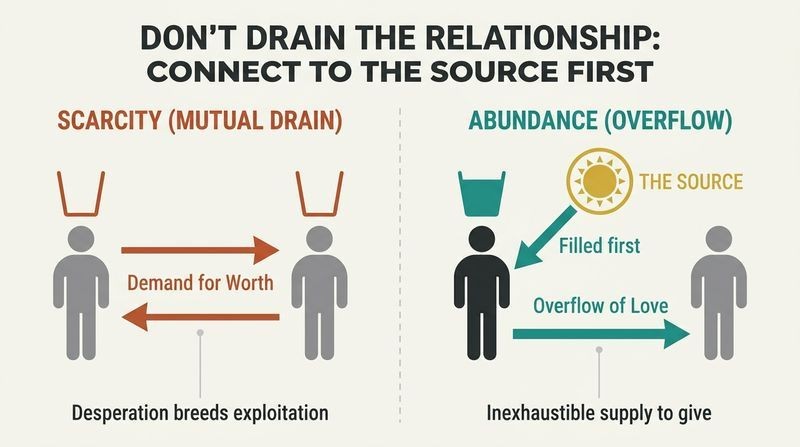
The framing echoes attachment theory: secure individuals, having internalized a reliable caregiver, love without clinging, while the anxiously attached grasp and exploit. Stuart secularizes cleanly into a warning against outsourcing self-worth to a partner, a pattern therapists call codependency. The steelman is strong. The nuance worth adding: this can tip into spiritual bypass, where people delay healthy intimacy indefinitely, waiting to feel perfectly whole. Secure attachment research suggests humans partly build wholeness through relationship, not entirely before it. The dependency and the giving often develop together rather than strictly in sequence.
Singleness is a gift of undistracted time, not a waiting room
Time and freedom are perishable assets. Stuart reframes singleness using Paul's claim in 1 Corinthians 7 that being unmarried is a gift, given for a specific purpose: undistracted devotion. He compares receiving stock as a boy over a titanium slingshot, only realizing decades later the boring gift paid his tuition. Singleness feels underwhelming precisely because its value compounds over time.
Married life is heavier than singles imagine. He lists the encumbrances: pleasing a spouse, choosing duvet covers, higher insurance, minivans loaded for hours before a trip. A single staffer had six discretionary hours a day; Stuart, a father of three, had thirty minutes. The prescription: pour freedom into scripture study and serving the needy rather than logging 10,000 hours of video games by age 21.
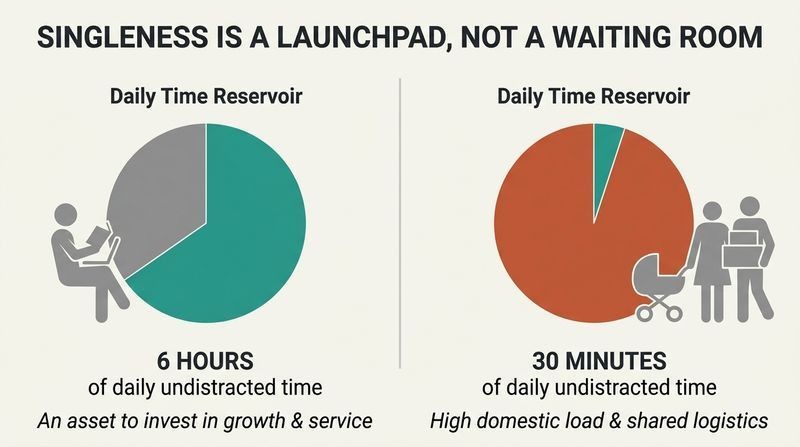
Stuart inverts the cultural script that treats singleness as deficiency, aligning with research showing married people are not uniformly happier and that unmarried adults often report richer friendship networks and civic engagement. His framing resembles Cal Newport's deep work: unstructured time is a rare resource most people squander. The weakness is a subtle bait-and-switch. He sells singleness as intrinsically purposeful yet frames it largely as preparation or productivity, which can leave the involuntarily single feeling their worth is instrumental. A fuller account would affirm that rest, play, and simple presence are also legitimate uses of a season, not only ministry output.
Date to evaluate one question: could I marry this person?
Dating is a process, not a status. Stuart's central reframe: dating exists for evaluation, discerning whether to marry someone, not a comfortable zone to camp in indefinitely collecting privileges. He compares it to crossing an ocean rather than assembling IKEA furniture: you need principles and a compass, not step-by-step instructions, because the terrain is dynamic.
God recognizes only two categories: sibling or spouse. There is no biblical middle tier called boyfriend or girlfriend that grants access to someone's body. Confusion arises when couples invent rules (you're supposed to text me daily) for a status God never established. His counsel: if you cannot reasonably marry within six months, do not rush to lay claim on someone. Evaluate as quickly as you can but as long as it takes.
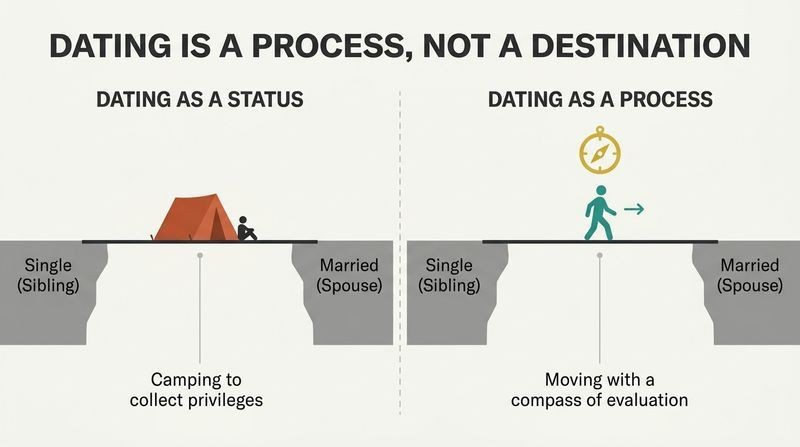
The evaluation frame is genuinely useful, cutting through what sociologists call stalled relationships, where couples drift for years without deciding. It resembles the venture capital principle of failing fast: gather information efficiently, then commit or exit. The binary sibling-or-spouse category is theologically tidy but practically contested even among committed Christians, since prolonged evaluation requires some intermediate relational reality. Stuart's insistence that a dating relationship confers no claim is a healthy antidote to possessiveness, yet critics note it can understate the real emotional bonds and obligations that form well before a wedding. The honesty about ambiguity being the seedbed of anxiety is the chapter's most transferable insight.
Marry for character and chemistry, never a checklist of traits
Reject the consumer mentality. Stuart warns against customizing an ideal mate like a burger order (tall, funny, six-pack abs). He gives four reasons it backfires: it sets impossible standards nobody meets, it assumes you know what you want (Match.com found zero correlation between stated preferences and who people actually dated), it bases permanent commitment on transient traits like looks, and it dehumanizes people into products.
Seek character plus chemistry. Character means someone actively pursuing God, not just assenting to belief, sharing your allegiance, pace, and direction. Chemistry means you genuinely enjoy their company, since most of married life is conversation, not sex. He cites the unequally yoked metaphor: binding an ox to a donkey means neither reaches the destination. Aim for a ten in character and an eight in looks over the reverse.
The Match.com finding Stuart cites reflects a robust behavioral science result: humans have poor introspective access to their own preferences, a theme in Dan Gilbert's affective forecasting research showing we routinely mispredict what will satisfy us. His attack on the consumer mentality anticipates critiques of dating apps as choice-overload machines that promote what psychologist Barry Schwartz calls maximizing, which correlates with lower satisfaction. The character-over-chemistry hierarchy is wise, though the framework leans heavily on shared faith as the master variable. Secular readers can still extract the durable point: optimize for shared values and enjoyable companionship, the traits that survive aging, over surface metrics engineered to fade.
Ambiguity is the seedbed of anxiety, so lead with clarity
Say what you mean; end guessing games. Stuart's research found women almost universally hate being asked to hang out and actually prefer the word date, plus face-to-face invitations over text. His personal practice with his wife Donna: he ended every evening with a clear I had fun, I'll call you, and every few weeks named where the relationship stood. She later said the greatest gift was always knowing where she stood.
Provide clarity in three zones:
1. Initiation (state your interest plainly, not vaguely)
2. Process (periodically name where things are headed)
3. Exit (make it easy and gracious to end it, and never ghost)
He frames ghosting as neither godly nor gracious, and honest rejection as a relief, not an insult.
Stuart converges with communication research on uncertainty reduction theory, which holds that ambiguity in early relationships generates measurable anxiety and that direct information exchange builds trust. His anti-ghosting stance is increasingly validated: studies link being ghosted to elevated rumination and lowered self-worth, precisely because the absence of closure denies the brain a coherent narrative. The gendered survey data (women preferring the word date, face-to-face asks) may be culturally contingent and shifting, so readers should treat it as a directional nudge rather than law. The core principle, that clarity is a form of kindness, transcends any dating era or demographic.
Sex bonds you chemically, so it sabotages honest evaluation
Sex is a fire that warms or burns depending on the boundary. Stuart, echoing a childhood story of dousing a brush pile in gasoline and nearly torching the property, argues sex within marriage brings life and outside it brings destruction. Neurologically, orgasm releases dopamine (linked to romantic attachment) and oxytocin (the bonding hormone released in breastfeeding), which is why anthropologist Helen Fisher says there is no such thing as casual sex.
Premarital sex distorts the data. Introduce sex early and the chemical buzz makes you addicted to a body before you have assessed whether you even like the person. That is why couples with little in common stay stuck together, and why breakups feel like withdrawal. He also documents pornography's toll: divorce lawyers citing it in 56% of cases, and young men reporting porn-induced erectile dysfunction.
The neuroscience Stuart marshals (oxytocin, dopamine, pair-bonding) is real and increasingly mainstream, though he presses it further than the evidence strictly warrants. Fisher's work does show sex can trigger attachment, but individual variation is enormous, and the claim that premarital sex reliably wrecks evaluation is contested by longitudinal data showing mixed outcomes. His strongest, least deniable material is on pornography: the addiction dynamics, escalating tolerance, and desensitization he describes align with Norman Doidge's neuroplasticity research. The reframe of desires revealing design is philosophically loaded, assuming teleology many readers reject, but the practical caution against letting brain chemistry outrun judgment stands independent of theology.
You know you're ready by four signals: commitment, communication, confession, community
Four waypoints replace the useless you'll just know. Stuart offers concrete evidence a couple is ready for engagement:
1. Commitment: a resolve to stay through trials and resist temptations, tested like Navy SEAL training where 75% quit not from physical failure but eroded will
2. Communication: the ability to disagree by naming actions and your feelings, never guessing the other's motives
3. Confession: surviving one honest conversation revealing your broken past and being met with mercy
4. Community: wise friends who not only approve but adore the relationship
Play the percentages. Stuart admits emotions fluctuate; if you feel confident 90% of the time, that is a strong sign. Fifty-fifty odds mean do not marry.
The four Cs are a practical decision framework that maps neatly onto relationship science. Communication (naming behavior and emotion rather than attributing motive) is essentially John Gottman's antidote to criticism and the harsh startup that predicts divorce. The confession element parallels research on self-disclosure and vulnerability driving intimacy, echoing Brene Brown. The community signal reflects the network effect finding that couples embedded in approving social webs show greater stability. The 90% confidence heuristic is refreshingly candid, puncturing the romantic myth of certainty. One caution: the SEAL-style commitment framing risks glorifying endurance in relationships that should end, so the temptation-and-trial test works only alongside honest assessment of fit.
Engagement merges three lives: family, finances, and future
Being engaged is a verb: you are engaged in a merger. Stuart, who learned his father-in-law was a mortician when invited to dress a corpse hours after announcing his engagement, frames engagement as fusing two independent lives, work on the marriage, not just the wedding. The three merger zones are family, finances, and future.
Win the family by showing character and chemistry. A father meeting a suitor instinctively sees a threat to the daughter he swore to protect; the young man's job is proving he is a protector, not a predator. On finances, Stuart urges couples to build an actual budget with an accountant or mentor, since money is the leading source of marital stress. He and Donna reserved one weekly night to discuss the marriage, holidays, kids, and money, not the wedding.
Stuart's insistence on pre-marital financial planning is strongly evidence-backed: financial disagreement is among the most robust predictors of divorce, and couples who align on money values early report higher satisfaction. His father-as-threat-detector framing is evolutionarily intuitive but culturally variable, and some readers will find the win-the-parents emphasis dated in an era of later, more autonomous marriage. The genuinely portable insight is the reframe of engagement as merger work rather than party planning. Behavioral economists would note that the weekly marriage-not-wedding conversation is a form of prospective hindsight, surfacing future friction points while they are still cheap to resolve rather than discovering them mid-crisis.
Marriage is a living picture of Christ's love for humanity
Design determines fulfillment. Stuart argues that just as an iPhone reaches its potential used as designed, marriage flourishes when engaged per its Maker's intent. He cites sociologist W. Bradford Wilcox's finding that theologically conservative, churchgoing Protestants are 35% less likely to divorce than peers, evidence the design works.
Two roles create the portrait. He redefines the loaded word submit as ordering oneself under another's leadership, a military-rank structure about organization, not inferior worth (Jesus himself submitted to parents). Wives receive and affirm a husband's initiative. Husbands get the harder charge: love as Christ loved the church, meaning initiate and sacrifice so your wife flourishes. His model of leadership is a good boss who resources your success, not a tyrant who crushes it.
This is the book's most contested territory. Stuart works hard to defang complementarianism, distinguishing submission from subjugation and loading husbands with the heavier burden of sacrificial initiative, which softens the hierarchy considerably. His good-boss analogy reframes authority as service, resonant with servant-leadership literature (Robert Greenleaf) and even Jim Collins's Level 5 leadership. Egalitarian readers will still object that assigning roles by gender rather than gifting is the core problem no reframing solves, and social science on marital equity generally finds that shared decision-making, not designated headship, predicts satisfaction. Stuart's strongest move is the 35% divorce statistic, though selection effects (who joins committed communities) complicate the causal story.
A shared mission bonds a marriage stronger than gazing inward
Marriage is safest when it's on mission. Stuart's capstone: couples are meant to link arms and run toward a common purpose, not merely stare into each other's eyes. He borrows C.S. Lewis's insight that friendship requires a shared object outside itself; those going nowhere can have no fellow travelers.
Priscilla and Aquila model it. This New Testament couple, tentmakers exiled from Rome, hosted the apostle Paul for eighteen months, quietly corrected a gifted-but-mistaken preacher in private rather than shaming him publicly, and risked their lives for the mission across multiple cities over decades. Stuart distills three traits: hospitable (leverage your home and work), game (see problems as opportunities to help, not complain), and faithful (never retire from the mission until death). Camaraderie under a shared cause forges bonds soldiers say they miss from the battlefield.
The shared-mission thesis is the book's most psychologically durable claim, well supported outside any faith frame. Research on relationships shows couples who pursue novel, meaningful shared goals report higher satisfaction, and Arthur Aron's self-expansion theory holds that partners bond by growing together toward challenges rather than merely coexisting. The soldier-camaraderie analogy tracks Sebastian Junger's work in Tribe on how shared purpose and adversity generate belonging. The practical takeaway survives secularization intact: a marriage organized around a cause larger than itself resists the boredom and drift that erode inward-facing couples. The critique is only that mission can become an escape from intimacy if partners hide in busyness rather than connect.
Analysis
Ben Stuart, a pastor who spent over a decade leading a college ministry at Texas A&M, writes a thesis-driven Christian relationship guide organized around four sequential life stages, each assigned a single purpose: singleness for devotion, dating for evaluation, engagement for union, marriage for mission. The governing metaphor is nautical: modern daters are lost at sea, and Scripture provides fixed stars to navigate by. This staged architecture is the book's structural innovation and its main value: it gives readers a mental model for locating themselves and extracting the specific advantages of their current season rather than pining for the next.
The book's intellectual strength lies in Stuart's willingness to marshal social science alongside Scripture. He cites Pew data on delayed marriage, Match.com's algorithm failures, Helen Fisher's neurochemistry of bonding, Norman Doidge on pornography and neuroplasticity, and Wilcox's divorce statistics. This gives the counsel more empirical texture than typical devotional fare. His most transferable insights, the evaluation frame for dating, clarity as kindness, the four Cs of readiness, and the shared-mission thesis, hold up independent of theology and align with mainstream relationship research from Gottman, Aron, and Schwartz.
The book's limitations are predictable given its genre and audience. The complementarian model of marriage, however carefully Stuart softens it, rests on gender-assigned roles that egalitarian readers and much marital-equity research will reject. His claims about premarital sex reliably sabotaging evaluation press the neuroscience beyond what the evidence strictly supports. And the framing of singleness as purposeful can subtly instrumentalize the involuntarily single. The prose is warm, self-deprecating, and story-rich, with Stuart's own bumbling dating history and eventual courtship of Donna threaded throughout. For its target reader, a young Christian navigating relationships, it is unusually practical, honest about difficulty, and refreshingly free of formulaic steps in favor of principles.
Review Summary
Single, Dating, Engaged, Married received mostly positive reviews, praised for its biblical approach to relationships and practical advice. Readers appreciated Stuart's insights on each relationship stage and his use of scripture. Some found it particularly helpful for singles and those considering marriage. However, a few critics felt it was too stereotypical or simplistic in its gender portrayals and theology. Overall, many readers recommended it as a valuable resource for Christians navigating relationships, though some suggested it may be most suitable for younger audiences or new believers.
People Also Read








FAQ
What's Single, Dating, Engaged, Married about?
- Navigating Relationship Stages: The book explores the four main stages of relationships: singleness, dating, engagement, and marriage, each with a God-given purpose.
- Biblical Framework: Ben Stuart uses Scripture to provide a framework for understanding relationships, integrating personal stories and statistics.
- Focus on God: Emphasizes that a relationship with God is foundational before pursuing romantic relationships.
Why should I read Single, Dating, Engaged, Married?
- Practical Guidance: Offers practical advice for navigating modern relationships, making it valuable for anyone at any stage of their romantic journey.
- Spiritual Insight: Provides a spiritual perspective, encouraging readers to seek God’s will and purpose in their love lives.
- Real-Life Applications: Shares relatable anecdotes and insights that resonate with young adults, making the content engaging and applicable.
What are the key takeaways of Single, Dating, Engaged, Married?
- Purpose in Singleness: Singleness is a time for devotion to God, not just a waiting period.
- Evaluation in Dating: Dating is a process of evaluating compatibility and character, not just seeking romance.
- Importance of Community: Stresses the need for community involvement and accountability in relationships.
What are the best quotes from Single, Dating, Engaged, Married and what do they mean?
- “You do not need romantic interest to discover your life’s purpose.” Emphasizes seeking fulfillment in God rather than romantic relationships.
- “Dating is not a status to dwell in, but a process to move through.” Highlights dating as a journey toward marriage.
- “Where there is no vision, the people perish.” Underscores the necessity of having clear goals and direction in relationships.
What does Ben Stuart say about the purpose of singleness in Single, Dating, Engaged, Married?
- Devotion to God: Singleness is a time for undistracted devotion to the Lord.
- Freedom and Opportunity: Encourages maximizing time in singleness by engaging in meaningful activities and serving others.
- Gift Perspective: Frames singleness as a gift from God, leading to personal growth and spiritual maturity.
How does Single, Dating, Engaged, Married define dating?
- Evaluation Process: Describes dating as a process of evaluating compatibility and character.
- Clarity in Intentions: Emphasizes the importance of clear intentions and expectations in dating.
- Not a Status: Asserts that dating should be viewed as a journey toward marriage.
What advice does Ben Stuart give for successful dating in Single, Dating, Engaged, Married?
- Be Prayerful: Encourages inviting God into the dating process for guidance.
- Seek Clarity: Emphasizes clear communication about intentions and feelings.
- Involve Community: Advises involving trusted friends and mentors for accountability and wisdom.
What are the characteristics to look for in a partner according to Single, Dating, Engaged, Married?
- Shared Faith: Stresses the importance of finding someone who shares a commitment to God.
- Character and Chemistry: Highlights the need for strong character and good chemistry.
- Compatibility in Values: Essential to evaluate shared values and life goals for long-term success.
How does Single, Dating, Engaged, Married address the topic of sexuality?
- Sex as a Gift: Presents sex as a beautiful gift within marriage, emphasizing God’s boundaries.
- Cultural Challenges: Discusses the hyper-sexualized culture and its impact on young people.
- Importance of Purity: Encourages maintaining sexual purity during dating to avoid unhealthy attachments.
What is the significance of community in relationships as discussed in Single, Dating, Engaged, Married?
- Accountability: Emphasizes the importance of a supportive community for guidance and accountability.
- Wisdom from Others: Encourages seeking counsel from trusted friends and mentors.
- Shared Experiences: Engaging with a community fosters growth and understanding in relationships.
How does Single, Dating, Engaged, Married define a successful marriage?
- Mutual Commitment: Characterized by a mutual commitment to love and support one another.
- Shared Mission: Couples should pursue a common mission together, strengthening their bond.
- Continuous Growth: Highlights the importance of continuous personal and relational growth.
What does Ben Stuart say about the importance of character in a partner in Single, Dating, Engaged, Married?
- Foundation of Relationships: Character is the foundation of any healthy relationship.
- Long-Term Compatibility: Crucial for long-term compatibility and navigating challenges.
- Reflecting God’s Love: A partner’s character should reflect the love and grace of God.
Download PDF
Download EPUB
.epub digital book format is ideal for reading ebooks on phones, tablets, and e-readers.








































