

Key Takeaways
Chronic overwhelm and resentment are boundary problems in disguise
The symptom is not the disease. Nedra Tawwab, a therapist with fourteen years of practice, argues that most people never walk into therapy saying they have a boundary issue. Instead they arrive complaining about burnout, anxiety, time management, or toxic relationships. Beneath nearly all of it sits the same root: a failure to set expectations and limits.
Read your body and emotions as data. The tells are consistent: feeling perpetually overwhelmed, resenting people for asking favors, dodging calls from anyone who might need something, fantasizing about dropping everything and disappearing, and having zero time for yourself. Tawwab defines boundaries simply as the expectations and needs that let you feel safe and comfortable in relationships. When resentment shows up, it is a signal that a limit went unspoken.
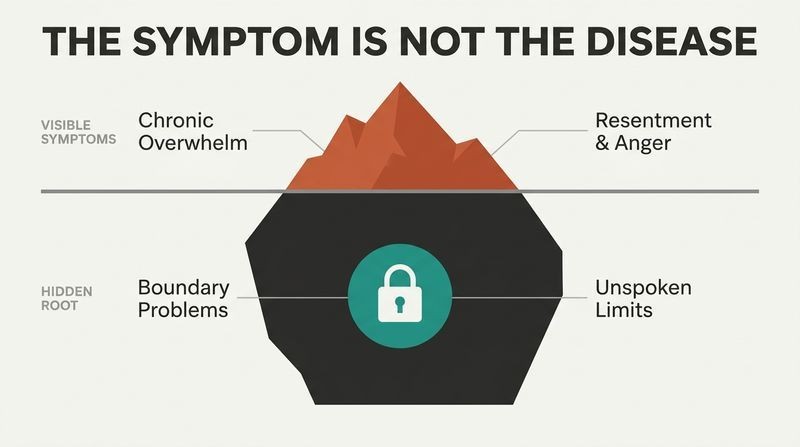
What's compelling is the diagnostic reframe: treating resentment as information rather than a character flaw. This aligns with Marshall Rosenberg's Nonviolent Communication, which holds that anger points to an unmet need. It also echoes clinical work on burnout by the Nagoski sisters, who separate the stressor from the physiological stress it triggers. One caveat worth naming: not every instance of overwhelm is a boundary failure. Structural realities like poverty, caregiving without resources, or discriminatory workplaces can overwhelm even the most boundaried person. The framework is powerful precisely because it restores agency, but agency has limits when the constraints are systemic rather than interpersonal.
Your boundaries are either porous, rigid, or healthy
Three settings on the dial. Tawwab sorts boundary styles into a spectrum. Porous boundaries are too weak: chronic yes-saying, oversharing, people-pleasing, inability to say no, and accepting mistreatment. Kim, a newlywed determined to be the best at everything, was so porous she believed saying no was selfish. Rigid boundaries are the opposite defense: walls that lock everyone out, never sharing, cutting people off, refusing help even in crisis. Both extremes create one-sided relationships.
Healthy sits in the middle. Healthy boundaries require awareness of your emotional, mental, and physical capacity plus clear communication. They look like saying no without apology, hearing no without taking it personally, and sharing selectively with people who have earned trust. The goal is flexibility calibrated to each situation, not a single rigid rule applied to everyone.
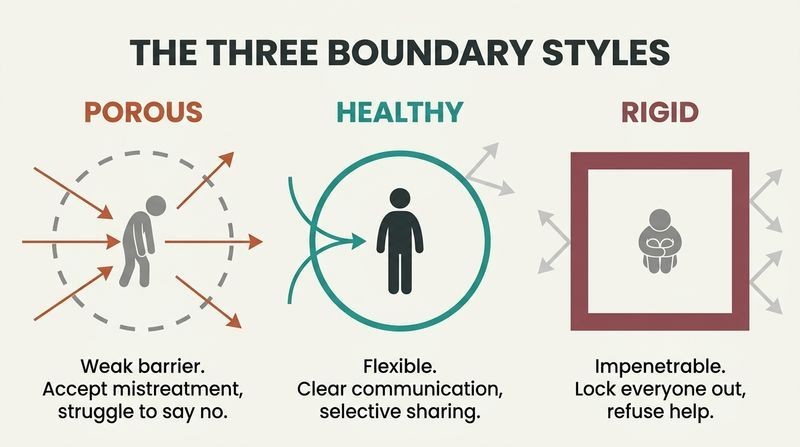
The porous-rigid-healthy triad maps neatly onto attachment theory: porous resembles anxious attachment, rigid resembles avoidant, and healthy resembles secure. That parallel gives the model empirical backbone beyond clinical anecdote. It also resonates with Aristotle's golden mean, where virtue sits between deficiency and excess. A useful nuance: the same person can be porous in one domain (money with family) and rigid in another (emotional vulnerability in romance). Boundaries are not a fixed personality trait but a context-dependent skill. This means the self-assessment is less about labeling yourself and more about auditing specific relationships where the dial is misset.
A boundary without follow-through action is just a wish
Two parts, not one. Tawwab insists boundaries have two components: communication and action. Most people do the first and skip the second. You verbally state the need ("text me a few hours ahead if you need to change plans"), then you must uphold it behaviorally when it is violated. If a friend cancels last minute anyway and you accommodate them, you have taught them the boundary is negotiable.
People take their cues from your behavior. If you ask guests to remove their shoes but keep yours on, they will follow your action, not your words. Tawwab's own turning point came when a relative asked her to help fix a struggling family member and she replied that fixing people was not her job, and not theirs either. Action, including consequences and ultimatums tied to real follow-through, is what converts a stated limit into a respected one.
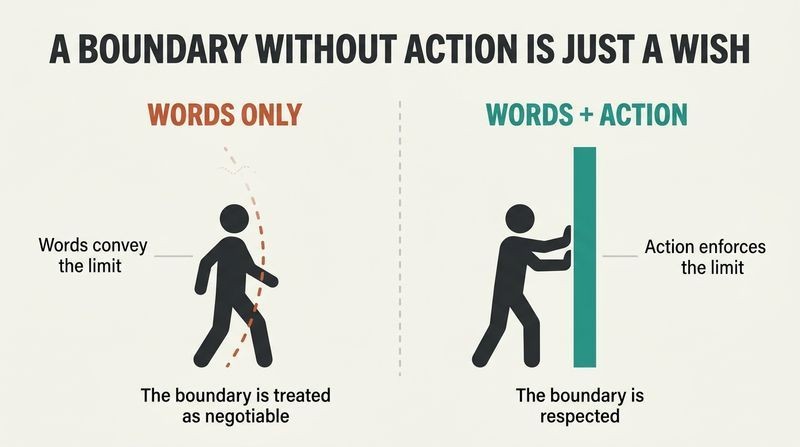
This is behaviorism applied to relationships. Intermittent reinforcement, the psychology behind slot machines, explains why inconsistent enforcement is worse than none: if a boundary holds nine times out of ten, the violator learns that persistence occasionally pays, which strengthens the very behavior you want to extinguish. The insight also connects to game theory's credible commitment problem: a threat only works if the other party believes you will carry it out. Tawwab's distinction between a threat (empty) and an ultimatum (backed by a consequence you will actually impose) is precisely this. The hard part is emotional, not intellectual: enforcing consequences on people you love feels like cruelty.
Guilt-free boundaries do not exist, so expect the discomfort
The most-asked question has an unwelcome answer. Clients constantly ask Tawwab how to set boundaries without feeling guilty. Her reply: you cannot. Guilt is baked into the process, largely because many of us were trained as children to feel bad for having needs, forced to hug relatives we did not want to touch and told we were mean when we resisted.
Feel it, but do not obey it. The skill is carrying on while guilty rather than waiting for guilt to vanish. Tawwab compares it to excitement: you do not cancel your whole day because you feel excited, and you need not cancel a boundary because you feel guilty. She reframes the emotions that arise (guilt, sadness, fear, remorse, awkwardness) as temporary passengers, not stop signs. Short-term discomfort beats long-term resentment every time.
This directly contradicts the wellness-culture promise that healthy choices should feel good. Tawwab's honesty is refreshing and clinically sound. Acceptance and Commitment Therapy makes the same move: the aim is not to eliminate uncomfortable feelings but to act on your values while feeling them. Guilt in this frame is often what psychologists call a false-alarm emotion, triggered by an outdated internal rule rather than an actual moral transgression. Distinguishing appropriate guilt (you genuinely wronged someone) from conditioned guilt (you simply disappointed someone) is the crucial diagnostic the book gestures toward. Naming that difference explicitly would sharpen the advice even further.
Assertiveness is the only communication style that actually works
Four ways that fail, one that succeeds. Tawwab lays out five communication modes. Passive means swallowing your needs to keep others comfortable. Aggressive means attacking, demanding, and demeaning. Passive-aggressive, which she calls the single most common style, means acting out your feelings while denying them: sulking, ignoring calls, hoping people will guess. Manipulation means guilting or coercing someone into compliance without their awareness.
Assertiveness names the need directly. Only assertiveness clearly and calmly states what you want without attacking anyone. Use "I want," "I need," or "I expect" statements, drop the word "because," and resist over-explaining. Eric, raised by an alcoholic father, had convinced himself that hinting to his mother and ignoring his dad's calls counted as boundaries. Tawwab showed him these were passive-aggressive dodges. Real change came only when he told his father directly he would not talk to him while he was drunk, then hung up when he was.
The four-failure taxonomy is clarifying because most people believe they are being assertive when they are actually being passive-aggressive. The instruction to drop "because" is subtle but shrewd: explanations invite negotiation and hand the other person a thread to pull. This mirrors research on over-justification, where offering reasons signals that your position is up for debate. One tension: assertiveness advice often assumes relatively equal power. For someone economically dependent on an abuser, or an employee facing a retaliatory boss, blunt assertiveness can carry real risk. Tawwab acknowledges this in her workplace and trauma chapters, but the general prescription works best among people who can afford to lose the relationship.
Family is the hardest arena because the rules were written in childhood
We learn boundaries at home first. Tawwab argues our capacity to set and honor limits is forged by how our caregivers responded to our needs. Children have boundaries (food preferences, not wanting to hug a stranger) until they are taught those preferences do not matter. Parents who override them teach kids that their limits are unimportant, seeding adult people-pleasers.
Parentification does lasting damage. Justin was told at twelve he was now "the man of the house" after his parents divorced, becoming caretaker and emotional confidant for his mother and brothers. At twenty-nine he could only attract "project" partners who needed him and could not receive care himself. This is emotional neglect: the absence of enough emotional attention, often unintentional and therefore confusing. Adult children setting boundaries with parents is not disrespect; it is the developmental act of becoming an adult.
The intergenerational transmission of boundary patterns is well supported by attachment and family-systems research, particularly Murray Bowen's concept of differentiation of self, the ability to stay connected to your family while remaining a distinct individual. Parentification is a recognized adverse childhood experience with documented links to later anxiety and codependency. Tawwab's insistence that children possess legitimate boundaries is a quietly radical parenting stance, echoing consent educators who argue that forcing affection teaches kids their bodily autonomy is negotiable. The steelman: honoring a child's no about hugging Grandma is not permissiveness, it is rehearsal for recognizing coercion later in life.
Codependency dressed up as kindness keeps both people sick
Helping and rescuing are not the same. Tawwab distinguishes healthy support from the tangle of macro-level violations: enmeshment (no separate identity, absorbing others' emotions as your own), codependency (compulsively rescuing and enabling), trauma bonding, and counterdependency. In codependent relationships you clean up others' messes, make excuses for them, and treat their problems as your own, mistaking this for love.
Both parties lose. The enabler's needs go permanently unmet; the enabled never learns to meet their own. Tawwab points to the TV show Intervention, where families discover that giving an addict money or shelter fueled the addiction. The recovery coach's message is always the same: codependency must stop for the loved one to have a chance. Support without doing the work for someone, and waiting to be asked instead of rushing in, is the corrective.
The codependency concept originated in addiction treatment and has since been stretched, sometimes too far, to pathologize ordinary caregiving. The sharpest version of Tawwab's point survives that critique: enabling protects people from the natural consequences that would otherwise motivate change. This is why Al-Anon built an entire program around detaching with love. There is a cross-cultural nuance worth flagging. In collectivist family systems, deep interdependence and pooling of resources is a norm, not a dysfunction, and the Western therapeutic ideal of the autonomous, individuated self is not universal. The useful test is not how entangled you are but whether the entanglement is mutual and sustainable or one-sided and depleting.
Trauma turns rigid boundaries into a survival strategy
Survival mode rewires connection. Tawwab uses the Adverse Childhood Experiences (ACE) study, which scores exposure to abuse, neglect, and household dysfunction, to explain why trauma sabotages boundaries. Scores above four correlate with higher rates of health, relationship, and mental-health problems. Amber, abandoned as an infant, shuttled among relatives, and molested, scored an eight of ten. She built rigid walls, ghosting partners and refusing help, convinced she was "the sort of person who needs to be alone."
Rigid and porous both trace to fear. Trauma produces two unhealthy attachment styles. Avoidant attachment relies on rigid walls to prevent closeness; anxious attachment produces porous, validation-seeking clinginess. Counterdependency, Amber's pattern, is the inability to be vulnerable or ask for help, disguised as fierce independence. Tawwab's reassurance: attachment styles can change once you become aware and willing to practice sharing, asking, and accepting help.
Grounding the discussion in the ACE study lends real scientific weight; the original Felitti and Anda research is among the most cited in public health. The claim that attachment styles are malleable is supported by work on earned secure attachment, where people develop security in adulthood through therapy or a stable relationship despite rough childhoods. What deserves emphasis is that willpower alone rarely reworks a trauma-formed nervous system; the body keeps the score, as Bessel van der Kolk put it, and somatic or professional intervention often matters more than insight. Tawwab's referral of counterdependent Amber to sustained therapy models the appropriate humility about what self-help can and cannot fix.
The strictest boundaries you need are the ones with yourself
Point the lens inward. Tawwab argues boundaries are not only about managing other people; the hardest limits are self-imposed. Self-boundaries govern your finances, time, self-care, self-talk, reactions, and who you allow into your life. Kyle earned raises but lived paycheck to paycheck under twenty-five thousand dollars of credit card debt because he could not tell himself no. He had held the same financial goals for five years with zero progress.
Saying no to yourself is a gift. The remedy was concrete self-rules: save ten percent before any purchase, budget to curb impulse buys, refuse to inflate spending just because income rose. Tawwab extends this to self-talk (speak to yourself as gently as to a small child), reactions (anger does not require yelling), and self-sabotage (replace "I can't" with "I can"). Keeping your word to yourself is the foundation everything else rests on.
This is the book's most underappreciated pivot: relocating the locus of control from others to the self. It converges with Roy Baumeister's research on self-regulation as a trainable resource and with James Clear's identity-based habits, which Tawwab cites directly. The reframe that a rule is not a restriction but a scaffold toward your goals echoes the paradox behavioral economists call commitment devices, where voluntarily limiting your future choices (like locking away savings) produces more freedom, not less. The challenge is that self-boundaries lack an external enforcer, so they demand the very self-trust that people with porous boundaries most lack. Starting absurdly small is the honest workaround.
You control your tech habits, not the algorithm
The problem is the user, not the device. Tawwab, who grew from two thousand to a hundred thousand Instagram followers in six months, refuses to demonize technology. Citing Nir Eyal's Indistractable, she insists screens and social media are neutral; the issue is how and why we engage. The average adult spends roughly three hours a day on a phone, teens closer to nine on media.
Curate ruthlessly and question the why. Practical limits include not sleeping with your phone in the room, unfollowing accounts that spark envy or drain you, designating news-checking times, and setting app timers. When she wants to save money, she stops following fashion influencers. Tawwab celebrates JOMO, the joy of missing out, as a legitimate alternative to FOMO. For couples, unspoken tech expectations breed conflict and even infidelity, so boundaries around exes and DMs should be discussed, not assumed.
Placing responsibility on the user is empowering but incomplete. Persuasive-design researchers like Tristan Harris document how platforms engineer variable rewards and infinite scroll specifically to defeat self-regulation, which means the playing field is not neutral. The honest synthesis: individual boundaries are necessary but insufficient against systems built by thousands of engineers to capture attention. That said, Tawwab's curation advice has real evidence behind it. Studies link envy-driven passive scrolling, not active social use, to declines in wellbeing, so her instruction to unfollow envy triggers targets the precise mechanism. Reframing FOMO as JOMO is also a neat cognitive-reappraisal move, turning a perceived loss into a chosen gain.
If a boundary ends a relationship, the relationship was already broken
Boundaries do not damage healthy bonds. Tawwab's reassurance for the terrified: a well-set limit will not disrupt a relationship that was actually working. When someone responds to a reasonable boundary with cutoffs, silent treatment, manipulation, or cruelty, the boundary did not cause the rupture; it merely exposed problems that were already there. This reframe removes the crushing sense of responsibility that keeps people silent.
Ending is sometimes the ultimate boundary. After communication and consequences fail with a chronic violator, the last resort is accepting and letting go, which Tawwab says mimics grief: expect anger, sadness, bargaining, and eventually acceptance. She distinguishes healthy cutoffs from indiscriminate walls: a wall keeps everyone out on principle, while a boundary is decided case by case. Grieve the loss, practice self-compassion, forgive yourself for not leaving sooner, and stop waiting for the relationship to magically repair itself.
This is arguably the book's most liberating and most double-edged claim. As a tool against self-blame it is excellent; it dismantles the fear that asserting a need makes you the destroyer of a bond. But taken too literally it risks becoming unfalsifiable: any conflict a boundary triggers gets retroactively labeled proof the relationship was doomed, which can shade into rationalizing premature exits. Healthy relationships do sometimes weather genuine friction and rupture-and-repair, which relationship researcher John Gottman identifies as central to lasting bonds. The wiser reading is Tawwab's own distinction between people adjusting to a new limit (normal pushback) and people fundamentally refusing to respect you (a real signal).
Analysis
Set Boundaries, Find Peace is a practitioner's field manual rather than a work of original theory, and that is its strength. Tawwab, a relationship therapist turned Instagram phenomenon, translates concepts scattered across attachment theory, family-systems work, and addiction counseling into a single, repeatable operating system: notice the discomfort, name the need, communicate it assertively, and enforce it with action. The book's engine is the recurring composite client story, a device that lets abstract ideas land as recognizable human dilemmas: the exhausted overachiever, the parentified son, the enabling sister, the traumatized loner.
The central thesis is deceptively simple, that the sprawling category of relationship suffering (burnout, resentment, anxiety, codependency) reduces to a single skill deficit that can be trained. This reductiveness is both the book's clarity and its limitation. By routing nearly everything through boundaries, Tawwab hands readers extraordinary leverage and agency. But the frame can obscure the cases where suffering is driven by economic dependence, systemic discrimination, or a nervous system so trauma-shaped that insight alone cannot rewire it. To her credit, she flags these edges, referring the hardest cases to therapy and legal help, and refusing the fantasy of guilt-free change.
What distinguishes the book from the crowded self-help shelf is its emotional honesty. Tawwab does not promise that boundaries will feel good; she promises they will work, and that guilt is the toll, not a red light. Her two-part insistence on communication plus action inoculates readers against the common failure of stating a limit and then abandoning it, a point behavioral science backs through the logic of intermittent reinforcement. The weakest sections lean on borrowed statistics and pop-culture illustrations that add little. The strongest reframe (that a boundary cannot break a healthy relationship) is genuinely liberating, provided readers hold it alongside her subtler distinction between ordinary pushback and true disrespect. The book succeeds because it makes an intimidating word concrete, scriptable, and, above all, practiceable.
Review Summary
Set Boundaries, Find Peace receives mixed reviews. Many praise its practical advice on setting boundaries in various relationships, finding it life-changing and accessible. Some appreciate the specific examples and scripts provided. However, critics argue the book is oversimplified, repetitive, and lacks nuance in addressing complex situations. Some reviewers feel it doesn't adequately consider systemic issues or power dynamics. The book's structure and writing style are criticized by some as disorganized and lacking depth. Overall, readers' experiences vary widely based on their prior knowledge and personal circumstances.
People Also Read






Glossary
Boundaries
Expectations and needs for safetyTawwab's core term, redefined as the expectations and needs that help you feel safe and comfortable in relationships. Boundaries communicate acceptable and unacceptable behavior, define roles, and protect against overextension. She stresses they are not unspoken rules others should guess but limits that must be verbally stated and then upheld through action.
Porous, rigid, and healthy boundaries
The three boundary stylesTawwab's spectrum of boundary functioning. Porous boundaries are too weak, marked by people-pleasing, oversharing, and inability to say no. Rigid boundaries are walls that shut everyone out to avoid vulnerability. Healthy boundaries fall between, combining awareness of your capacity with clear communication, flexible and calibrated case by case.
Little b and Big B violations
Micro versus macro boundary breachesTawwab's classification of boundary violations. Little b are micro violations, small everyday breaches like a rude cashier or an oversharing stranger, low emotional impact unless repeated. Big B are macro violations that erode the fabric of relationships over time, including enmeshment, codependency, trauma bonding, and counterdependency.
Counterdependency
Rigid avoidance of needing othersA pattern, often rooted in emotional neglect or trauma, of using rigid boundaries to keep people at a distance. Signs include difficulty being vulnerable, refusal to ask for or accept help, a strong preference for doing everything alone, emotional distance, and persistent loneliness masked as fierce independence.
Trauma bonding
Attachment to an abuserOccurs when someone is manipulated into believing they deserve mistreatment or caused it. Marked by cycling between harsh treatment and kindness, making excuses for the abuser, feeling unable to leave, and hiding the abuse from others. It severely limits boundary-setting because the victim feels responsible for the perpetrator's actions.
Adverse Childhood Experiences (ACE) survey
Childhood trauma scoring toolA questionnaire measuring exposure to abuse, neglect, and household dysfunction in childhood. Scores range from zero to ten; a score above four correlates with elevated risk of health problems, relationship difficulties, and mental-health challenges like anxiety and depression. Tawwab uses it to explain how early trauma shapes adult boundary capacity.
JOMO
Joy of missing outTawwab's counter to FOMO (fear of missing out). The deliberate contentment found in stepping away from social media and constant connectivity, accepting being out of the loop as a benefit rather than a loss, and reclaiming time and mental energy for offline life.
FAQ
What's Set Boundaries, Find Peace about?
- Focus on Boundaries: The book emphasizes the importance of setting healthy boundaries in various aspects of life, such as personal relationships, work, and family dynamics.
- Personal Growth: It guides readers in reclaiming themselves by teaching how to communicate needs and expectations clearly.
- Therapeutic Insights: Written by therapist Nedra Glover Tawwab, it combines personal anecdotes with professional advice to help readers navigate boundary issues.
- Addressing Trauma: The book also discusses how childhood trauma can impact one's ability to set boundaries and form healthy relationships.
Why should I read Set Boundaries, Find Peace?
- Comprehensive Guide: It is described as a comprehensive, relevant, and relatable guide to setting boundaries, making it valuable for anyone struggling with this issue.
- Practical Guidance: Offers actionable steps and exercises to help readers identify and implement their boundaries effectively.
- Empowerment: Empowers readers to take control of their lives by establishing limits that promote mental and emotional well-being.
- Expert Insights: As a licensed therapist, Tawwab provides professional insights into the psychological aspects of boundary-setting.
What are the key takeaways of Set Boundaries, Find Peace?
- Understanding Boundaries: Boundaries are defined as expectations and needs that help you feel safe and comfortable in your relationships.
- Types of Boundaries: Tawwab outlines six types of boundaries—physical, sexual, intellectual, emotional, material, and time.
- Communication is Key: Effective communication is essential for setting and maintaining boundaries, focusing on being assertive rather than passive or aggressive.
- Boundaries Are Essential: Without boundaries, individuals may experience burnout, resentment, and anxiety.
What are the six types of boundaries discussed in Set Boundaries, Find Peace?
- Physical Boundaries: Involve personal space and physical touch, dictating how close others can get and what types of touch are acceptable.
- Sexual Boundaries: About consent and appropriate sexual behavior, emphasizing that no one should touch another without explicit permission.
- Intellectual Boundaries: Relate to thoughts and ideas, ensuring that one’s opinions are respected and not belittled or dismissed.
- Emotional Boundaries: Involve how feelings are shared and validated, stressing the importance of not invalidating someone’s emotions.
- Material Boundaries: Pertains to possessions and how they are treated, including expectations around borrowing and returning items.
- Time Boundaries: Manage how time is allocated and respected, helping to maintain a healthy work-life balance.
How does childhood trauma affect boundary-setting according to Set Boundaries, Find Peace?
- Impact on Development: Childhood trauma can hinder an individual’s ability to set and respect boundaries, leading to difficulties in forming healthy relationships in adulthood.
- Adverse Childhood Experiences (ACE): The book references the ACE survey, which measures the impact of childhood trauma on adult health and relationships.
- Healing Through Awareness: Recognizing the connection between trauma and boundary issues is the first step toward healing.
- Exploration Encouraged: Tawwab encourages readers to explore their past experiences to understand their current relationship dynamics.
How can I identify if I need to set boundaries according to Set Boundaries, Find Peace?
- Feeling Overwhelmed: Frequent feelings of overwhelm or resentment towards others for their requests may indicate a need for clearer boundaries.
- Avoidance Behavior: Avoiding interactions with people who typically ask for favors can be a sign that your boundaries are being violated.
- Neglecting Self-Care: If you find yourself neglecting your own needs to accommodate others, it’s a strong indicator that boundaries need to be established.
What are some common boundary violations mentioned in Set Boundaries, Find Peace?
- Ignoring Requests: When someone disregards your requests or continues behavior you’ve asked them to stop, it’s a clear boundary violation.
- Emotional Manipulation: Using guilt or emotional pressure to get someone to comply with your wishes is a form of manipulation that violates their boundaries.
- Overstepping Personal Space: Physically invading someone’s personal space without consent is a violation of their physical boundaries.
How do I communicate my boundaries effectively according to Set Boundaries, Find Peace?
- Be Clear and Direct: Use straightforward language to express your needs without ambiguity.
- Use “I” Statements: Frame your boundaries using “I” statements to take ownership of your feelings.
- Stay Consistent: Once you’ve communicated a boundary, it’s crucial to uphold it consistently to reinforce its importance.
What should I do if someone reacts negatively to my boundaries according to Set Boundaries, Find Peace?
- Stay Firm: If someone pushes back against your boundaries, restate them calmly and assertively.
- Don’t Take It Personally: Remember that their reaction is about their discomfort with your boundary, not a reflection of your worth or value.
- Evaluate the Relationship: If the negative reaction continues, consider whether the relationship is healthy and if it’s worth maintaining.
How can I manage the discomfort that comes with setting boundaries according to Set Boundaries, Find Peace?
- Acknowledge Your Feelings: Recognize that feelings of guilt, fear, or sadness are normal when setting boundaries.
- Practice Self-Care: Engage in self-care activities that help you feel grounded and supported.
- Reframe Your Thoughts: Shift your perspective to view boundaries as a form of self-respect rather than a source of guilt.
What are the best quotes from Set Boundaries, Find Peace and what do they mean?
- "Boundaries will set you free.": Establishing boundaries is crucial for personal freedom and peace of mind.
- "Clarity saves relationships.": Clear communication is vital for maintaining healthy relationships, preventing misunderstandings.
- "You don’t have to be boundaryless to be loved.": Reassures readers that they can still be loved and accepted while asserting their needs and limits.
- “You can’t pour from an empty cup.”: Emphasizes the importance of self-care and prioritizing your own needs before helping others.
How can I deal with guilt when setting boundaries according to Set Boundaries, Find Peace?
- Acknowledge Your Feelings: Recognize that feeling guilty is a natural part of setting boundaries.
- Reframe Your Thoughts: View boundaries as necessary for your well-being rather than mean or selfish.
- Practice Self-Compassion: Be kind to yourself as you navigate the discomfort of setting boundaries.
About the Author
Other books by Nedra Glover Tawwab

Download PDF
Download EPUB
.epub digital book format is ideal for reading ebooks on phones, tablets, and e-readers.








































