
Plot Summary
Echoes of Arrival
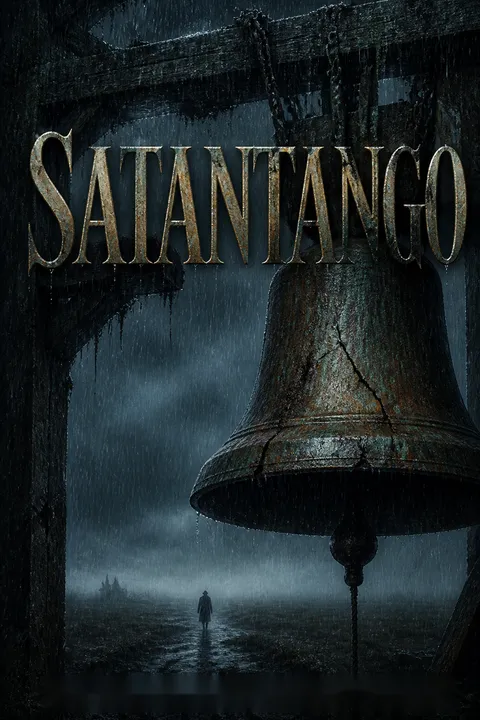
In the bleak, rain-choked estate, Futaki wakes to mysterious bell sounds, invisible yet undeniably real. The community, worn and fractious, is bound together by poverty and failing hope, dreading the coming of change. Their leader, Irimiás, rumored dead, seems to return, turning the air heavy with promise and dread. As the villagers whisper about money and betrayal, they are trapped by both their environment and their cyclical despair. Every object and sound feels charged with omens. The estate's decay mirrors their lives as rounds of failed enterprise and petty betrayals bubble beneath the surface, all while the weather hammers futility into their bones. Futaki, haunted by the sound, senses oncoming disaster as clearly as the rain—everyone waits for something to change, but fear and inertia rule.
Broken Trusts Unveiled
In the cramped kitchens and dark alleys, money and suspicion divide the remnant villagers. Futaki, Schmidt, and Kráner scheme over illicitly kept cash—the rewards of their past joint labor. Yet, every exchange boils with paranoia: trust has eroded so far that every gesture is weighed for ulterior motive. Plans for escape—pack up, split the spoils, try somewhere new—fizzle into inertia as each is paralyzed by dread and suspicion of the others. Hopes for leaving this dead-end place are cancelled out by fear: the world beyond the estate is just as hostile, only less known. Futaki's yearning for escape is palpable, but he—like the rest—remains shackled by his own fear of betrayal and loss. No one dares move until darkness hides their leaving.
Bleak Watch at the Window
The doctor, a figure shrouded in loneliness, sits at his window recording every movement on the estate—his notebooks are all that order the chaos. He trusts neither his memory nor his neighbors and insulates himself with routine, alcohol, and meticulous observation. Isolated physically and emotionally, his concern for control becomes a defense against decay, but it also leaves him paralyzed, unable to act in his own defense or anyone else's. He interprets every shift in the estate as a portend—each person's movement, even animals and weather, are noted with anxious thoroughness. Yet, his knowledge brings no power, only further entrenchment in fear and alcohol-fueled passivity as the world beyond his window steadily decays.
Scheming Shadows and Bells
The promise of Irimiás's return throws the estate's crumbling social order into further chaos. Old alliances dissolve, suspicion reigns, and no one is sure if the "dead" Irimiás lives or if it's just another trick. Hopelessness intermingles with a desperate hope for salvation or revenge; joy and dread become indistinguishable. Everyone longs for an escape, but all movement is fraught with risk—whether from physical mud or from the moral quicksand of betrayal. The community awaits a signal to act, but each new rumor only deepens their confusion. Every action is haunted by the possibility that they will be found out, swindled, or left more isolated than before.
Possessed by Waiting
Through the long autumn rains, the villagers are locked in rooms and kitchens, waiting—for money, for a reprieve, for Irimiás. Time stretches unbearably, and the mud outside becomes a physical symbol of their helplessness. Each resident anxiously calculates what little they possess, casting nervous glances at neighbors, as dreams of new beginnings are continually deferred. Waiting becomes ritualized, full of nervous rituals and small conflicts—food is prepared but uneaten, conversations circle around the same anxieties. The tension is endlessly sustained, with the hope for resurrection mingled with the certainty of decay.
Descent into Darkness
Through rain and chaotic darkness, the characters' boundaries break down. Villagers fight, fall ill, are haunted by dreams and hallucinations. The doctor, inspired by a cryptic geological text, is swept by visions of time and insignificance; Esti, the lonely child, acts out rituals of violence and longing in the attic, projecting her pain on a cat. The line between reality and delirium thins—hostile nature invades every thought and movement. Driven into the darkness or stuck inside, each individual wrestles with the desire for control and the inevitability of powerlessness, culminating in pointless acts of cruelty and fleeting, shameful victories.
The Cat and the Child
Esti, neglected and misunderstood, struggles to find purpose and validation in her brother's eyes. Duped into believing in the magic of a "money tree," she is betrayed and ridiculed, her loneliness spiraling into violence against her cat and, ultimately, herself. Her ritualized actions, half imitation, half desperate assertion of agency, end in the cat's death and her own suicide. Her journey through the mud becomes a metaphor for the broader downfall of the estate—a hope for miraculous escape that ends in desolation. Her death, unnoticed and misinterpreted by the adults, is at once a private tragedy and a symbol of the community's utter failure.
The Dance of Despair
As the night drags on, the bar becomes the heart of the estate's sad carnival—filled with quarrels, dancing, confessions, and insults. The villagers, arms locked in the satantango, are swept up in a frenzy—momentarily alive, if only in their hopelessness and intoxication. Every relationship is fraught; each gesture of intimacy or aggression echoes deeper resentments. Desire, lust, envy, and frustration are unleashed, never resolved. The night, sweaty and filled with music and shouting, gives the illusion of renewal but cannot stave off the encroaching collapse and the certainty of morning's hangover, both literal and existential.
Resurrection and Paranoia
When Irimiás finally returns, the villagers are primed for salvation or destruction. His presence, part messiah and part manipulator, brings collective confession and a promise of a new order. He spins their failures into a narrative of hope, offering the dream of a model community at the ruined manor. The crowd, susceptible to any story that might free them from responsibility, showers him with trust and their meager cash. Irimiás's sermon capitalizes on their guilt and need; he deftly turns Esti's death into a symbol of communal sin, binding his power to their need for meaning, exquisitely aware that belief is their last asset.
Irimiás Returns, Hope Revived
With Irimiás as their leader again, the villagers physically and symbolically destroy their old lives—smashing furniture, breaking windows, purging their homes for departure. They embark on an exodus to the manor, euphoric and exhausted, each hoping to be "reborn." The journey is both literal and metaphoric; burdens are heavy and tempers fray. The manor, in reality a ruin, becomes an object of fantasy—yet when morning breaks, the hollowness of their hopes is exposed. The pattern of disappointment is re-enacted, but the momentum of movement obscures the emptiness at the journey's end.
Sermon of Damnation
At the ruined manor, Irimiás punctures any remaining illusions, orchestrating a ritualistic confession, assigning blame, and narrating Esti's death as both punishment and redemption. His speech is equal parts manipulation and nihilism, granting absolution so long as they obey, surveil, and scatter as instructed. The villagers, desperate for any sense of meaning, accept this dispersal without protest, abdicating responsibility for their own lives in favor of a new illusion: that someone else is in charge, that the ritual of suffering and confession is also their salvation.
Exile to Nowhere
In the harsh dawn, the villagers realize their new "Eden" is desolate and that they have been conned again. Bitterness erupts; accusations fly, and violence flares between former friends. Yet, even as the illusion collapses, most cannot bear to accept their gullibility, clinging instead to rituals of blame. When Irimiás reappears, he shifts the narrative anew: they must scatter and work elsewhere, isolated and monitored, under the guise of future hope. The cycle of suffering continues, and bonds fracture further—each character more desperately clinging to the false promise of eventual salvation.
The Ruined Manor's Promise
Their dreams of prosperity and unity at the manor dissolve into squalor, sickness, and mutual suspicion. Old resentments resurface and new alliances crumble. Mrs. Schmidt's longing, Schmidt's rage, Futaki's skepticism—all curdle into mutual disappointment. Irimiás is both absent and omnipresent, his influence lingering as a ghostly authority. Suspicions poison every interaction; the community realizes it was never truly a community at all—just individuals clinging to the same inexplicable promise.
Fractures of Faith
In the aftermath, each villager is left alone with their loss—of faith, love, future, or self-respect. Night brings haunting dreams and hallucinations: fears of betrayal, regret over lost possibilities, and the relentless, mocking presence of the failed messiah. Despair, barely kept at bay by mutual reassurance, surges again as hunger and exhaustion bite. Morning reveals the full extent of their isolation and the irony of their hope—a new order, perhaps, but one built only on their willingness to believe and obey.
Ghosts in the Haze
Irimiás assigns each group a destination and "mission," scattering them to menial jobs across the landscape, tasked with reporting and observing on his behalf. Their new roles are as informers and laborers—under surveillance, without agency. Futaki, wounded and defeated, opts out; the rest are too broken or bound to protest. They are shuffled like pawns to new squalor, each silently harboring the knowledge that nothing will change, and that their new future is merely another cage. The circle of humiliation and exploitation continues apace.
The Circle Closes
Alone on the abandoned estate, the doctor restarts his solitary rituals of observation and writing. Hoping for control and meaning by documenting the minutiae around him, he is once again drawn into the pattern—recording, imagining, half-believing his power to order events. The sound of bells is revealed as the work of a mad vagrant, not a sign of redemption. Yet, despite this final disillusionment, the doctor musters a kind of grim acceptance. He imagines himself beginning the story anew—a futile gesture, but the only one left against the infinite recurrence of decay and delusion that mark both his life and the story's world.
Analysis
Satantango stands as a devastating parable of collective self-delusion, the hunger for authority, and the futility of escaping entrenched hopelessness. Krasznahorkai's world is one where individual will dissolves—characters long for change but sabotage every chance through suspicion, habit, or credulity. Irimiás exemplifies the dangers of charismatic leadership: his shifting promises, manipulative oratory, and ultimate indifference reveal how desperate communities transform suffering into a myth of redemption, only to be abandoned anew. The villagers' journey is both picaresque and existentially circular; no action or belief—migrating to the manor, confessing sins, smashing the past—can break the cycle of longing and despair. The narrative's recursive, sentence-heavy style and the proliferation of rumination, observation, and administration foreground language's insufficiency as a tool for real change. In the modern context, the estate's economic collapse and the rise of bureaucratic surveillance suggest political allegory (about both communism and late capitalism), psychological allegory (about repression and denial), and existential allegory (about meaning's absence). Ultimately, Satantango argues that freedom and renewal are always deferred; every hope for salvation becomes a new entrapment, and the only "circle" completed is that of futile repetition. The lesson is harsh but profound: without the courage for self-awareness and genuine action, communities are doomed to dance eternally between self-destruction and hollow resurgence.
Review Summary
Reviewers of Satantango largely praise its hypnotic, demanding prose style — long, unbroken paragraphs that mirror the novel's themes of cyclical despair and stagnation. Set in a decaying Hungarian village, the book follows desperate inhabitants awaiting a possibly fraudulent savior, serving as both political allegory and universal meditation on human weakness. Comparisons to Kafka, Beckett, and Bernhard are frequent. Some readers find the deliberately oppressive style rewarding; others find it impenetrable. The 2025 Nobel Prize award brought renewed attention to this widely considered masterpiece.
People Also Read
Characters
Irimiás
Irimiás is both a messianic figure and a conman, manipulating the desperate villagers with promises of renewal. His return from presumed death destabilizes the community—he radiates leadership, offers hope, and constructs elaborate narratives to control others. His psychoanalysis reveals a man both deeply nihilistic and acutely aware of human weakness; he views manipulation as both a burden and an opportunity. His promises are always deferred; he thrives in ambiguity, giving meaning to the villagers' suffering while covertly exploiting their need for guidance. Yet behind proclamations and schemes, Irimiás is hollow—his true aim is survival and power, not redemption. His development shows mounting cynicism: the more he's obeyed, the starker his indifference becomes, embodying the futility of seeking salvation through false prophets.
Futaki
Futaki, lame and world-weary, is the novel's existential observer, keenly aware of the absurdity and futility that defines life on the estate. He dreams of leaving but recoils at the risk; his indecision is a product of deep suspicion and inability to trust others. Futaki's psychoanalysis reveals profound loneliness, a need for safety, and an awareness that hope is just another trap. As the estate's schemes unravel, Futaki stays at the margins, driven by inertia rather than ambition. His skepticism isolates him, but it also grants insight—he recognizes the false promise of Irimiás, but is too broken to resist, becoming a spectator to his own disappointments. In the end, he is left with nothing but his own enduring disillusionment.
Mrs. Schmidt
Mrs. Schmidt is driven by hunger—for love, change, and meaning. She attaches her hopes and desires to Irimiás, reading messianic meaning into every gesture. Psychologically, she is willing to abandon the past and embrace self-destruction for a new beginning, convincing herself that suffering is a prelude to transformation. Her relationship to others is defined by disappointment; her sexual power is both an assertion and a deflection of her vulnerability. In the rush to the manor and subsequent abandonment, her faith crumples into shame and rage, exposing the cost of believing in the fantasies peddled by others.
The Doctor
The doctor is a solitary chronicler, obsessively organizing and documenting the estate's decay from his window. His rituals—writing, smoking, drinking—are desperate bulwarks against chaos and loss of memory. The world's meaning, for him, is only what he can record and control. Yet, his notebooks only deepen his isolation; his professional detachment is a mask for helplessness. Psychologically, he is consumed by anxiety and a desire for control but plagued by a sense of futility. His only act of agency is narration—a recursive, potentially delusional attempt to master reality with words, ultimately exposing the limits of observation and language.
Petrina
Petrina is Irimiás's subordinate and confidant; garrulous, foolish, and at times comic, he oscillates between sycophancy and skepticism. He longs for purpose and belonging, so he clings to Irimiás, mimicking his bravado and internalizing his logic. Psychologically, Petrina is needy, quick to fear, and easily moved from euphoria to despair. He represents the human capacity to follow charismatic authority, providing uncritical support but also moments of anxiety and resistance—ultimately reflecting the vices and frailties of his leader and, by extension, of humanity.
Schmidt
Schmidt's life is circumscribed by anger, suspicion, and a need for dominance, especially over his wife. His is a masculinity haunted by impotence: too weak to leave, yet too proud to accept his failures. Every interaction becomes a contest—over money, respect, or women. He yearns for the revival promised by Irimiás, yet his inability to trust even his closest partners keeps him locked in cycles of aggression and defeat. His psyche is restless, inflamed by shame and envy, and he is ultimately scapegoated by the group's failures.
Mrs. Halics
Mrs. Halics turns to religious mania and visions to endure the estate's decline. Her faith is both a structure and a consuming madness; she condemns the others' sins while suppressing her envy and longing. Isolation enhances her self-righteousness. Psychologically, she needs order and moral certainty, but her obsessions make her blind to her complicity in the community's collective failures. Her relationship with others is alternately sanctimonious and desperate for connection.
Kráner
Kráner plays at leadership with bravado, quick with jokes and toasts, but fundamentally driven by fear and groupthink. He is happiest amid noise and action—smashing furniture or shouting "Hurrah!"—but incapable of independent thought. His relationship with his wife typifies a marriage of bickering routine; together, they participate enthusiastically in the migrations and rituals that promise meaning. Psychologically, he is the archetype of the weak-willed follower, clinging to the group in terror of solitude.
Esti
The youngest Horgos child, Esti, represents the abandoned, misinterpreted innocence of the estate's children. Neglected by her family, she seeks validation through magical thinking, rituals, and attempts to ingratiate herself with her cruel brother. Her inner world is vivid but warped by abuse; her fumbling quest for meaning leads to violence against her pet and, eventually, herself. Esti's suicide is the literal and symbolic culmination of the estate's failures—a death that is both unnoticed and universal in its implication.
The Landlord
The bar landlord (innkeeper) is an entrepreneur of squalor—greedy, servile, always calculating the cost of everything. His relationships with the villagers are defined by contempt and self-protection; he enjoys the power to serve, or deny, but is terrified of loss. Psychologically, he is driven by a sense of scarcity and threat—his paranoia about debts, spiders, and fate symbolize the estate's doomed economy and the futility of small ambitions.
Plot Devices
Cyclical, Fractal Structure
Satantango's structure mimics the tango, both cyclical and spiraling. Chapters progress and fold back, mirroring the villagers' inability to escape their circumstances. The book begins and ends with Futaki, the bells, and futility; narrative events—schemes, promises, departures—repeat with variations, denying resolution and reinforcing themes of entrapment and fatalism.
Collective Hallucination and Manipulation
Both the characters and the narrative constantly shift between belief and skepticism, vision and delusion. Irimiás exploits this ambiguity, using sermon-like speeches to cast events as meaningful judgments. The oscillation between the supernatural (bells, resurrections, visions) and the mundane (mud, paperwork, alcoholism) enacts a world where nothing is certain, and where truth is pliable and power is manufactured through language.
Surveillance and Documentation
The doctor's compulsive observation, the bureaucratic reports on each character, and Irimiás's demand for vigilance all expose a world in which watching and writing are confused with agency. Narration becomes a substitute for action, but in the end, all documentation is futile: the records distort, the observer is powerless, and nothing is saved from entropy.
Doppelgängers, Reflections, and Identity Erosion
Characters often glimpse their own faces (in windows or flashes), project fantasies onto others, or conflate their desires with collective hopes. Irimiás both is and is not a savior; villagers are both victims and collaborators. The slaughtered cat, Esti's suicide, and the doctor's recursive writing all mirror the central question: can identity persist in a world so given to repetition and dissolution?
Symbolic Weather and Decay
The relentlessly hostile environment—endless mud, pouring rain, decaying houses—maps directly onto the characters' spiritual and mental decay. Weather is both literal and emotional, determining movement, mood, and outcome. Hope for renewal always founders on the literal and figurative groundlessness of life on the estate.
Download PDF
Download EPUB
.epub digital book format is ideal for reading ebooks on phones, tablets, and e-readers.








































