
Key Takeaways
1. The U.S. is profoundly polarized by place, not just ideology.
This fault line changed politics on either side, so that many people not only vote differently but also view one another as political opponents, or even as members of hostile tribes or sects.
A stark divide. Beginning in the late 1990s, a vast gulf emerged across the political landscape, dividing white rural Americans from urban Americans in cities and suburbs. This divide is not merely between "coastal elites" and the heartland or "red states" and "blue states," but permeates nearly every state and down-ballot elections. This profound polarization by place means people vote differently and view each other as hostile political opponents.
Beyond policy differences. While many assume political polarization reflects fundamental differences in values or policy positions, extensive analysis of public opinion surveys suggests this is not the primary driver of the rural-urban divide. On most spending and social issues—such as education, healthcare, policing, gun control, and abortion—rural and urban white Americans hold surprisingly similar views, with only modest percentage point differences. The divide is less about ideological disagreement and more about a general antipathy towards those in the opposing political party.
Social polarization. Instead of policy disagreements, the rural-urban divide is characterized by "social polarization," where individuals feel solidarity with their "in-group" and hostility towards the "out-group." White rural Republicans rate Democrats dismally low on a feeling thermometer, and white urban Democrats reciprocate similar low ratings for Republicans. This "us" versus "them" mentality, rather than deep ideological rifts, underlies the bitter division, making society seem like a struggle between hostile tribes.
2. Historically, American politics avoided a national rural-urban divide.
Throughout the United States’ first two centuries, each of the two major political parties routinely managed to score some victories among both rural and urban dwellers in different parts of the country.
No historical cleavage. Despite the U.S. being born rural and experiencing significant urbanization, a pervasive national rural-urban political division did not emerge for its first two centuries. Even when tensions arose, such as the late-nineteenth-century Populist movement, they were localized or regional, failing to crystallize into an enduring national divide. The nation's two "big tent" political parties, with their decentralized character, accommodated diverse constituencies and subsumed potentially explosive cleavages, including rural-urban differences.
Party structure mattered. The American two-party system, fostered by single-member districts, relied on building internal coalitions across various interests. This decentralized structure meant that party policy agendas and stances varied by state and region, allowing both major parties to gain support from both rural and urban areas. This fluidity prevented rural and urban populations from consolidating into opposing partisan blocs, unlike in many other nations where city-periphery cleavages were consequential.
New Deal's integrating role. Even when a severe rural-urban cleavage seemed imminent during the Great Depression and the 1920s farm crisis, the New Deal policies actively integrated rural people into the American political economy.
- Roosevelt's administration prioritized rural needs, viewing rural and urban economies as intertwined.
- Policies like the Agricultural Adjustment Act and the Rural Electrification Administration visibly benefited rural communities.
- These efforts fostered long-lasting support for the Democratic Party among many rural dwellers, preventing a national rural-urban split for over half a century.
3. Economic transformation ignited the rural-urban political cleavage.
Place-based economic inequality spurred the beginnings of this deep rift.
Rural economic decline. Starting in the 1990s, dramatic economic changes and crucial policy decisions ravaged rural economies while many urban areas flourished.
- Deregulation in sectors like transportation and finance, combined with relaxed antitrust enforcement, disadvantaged smaller, remote businesses.
- Agriculture saw consolidation, with family farms replaced by agribusiness, leading to job losses and despair.
- Deindustrialization, accelerated by trade policies like NAFTA and the "China Shock," caused manufacturing jobs to hemorrhage from rural areas.
Paragraph 2: Urban economic boom. Simultaneously, many urban areas became powerhouses of the new "knowledge economy," driven by technology, business services, and finance. Policymakers, including prominent Democrats, actively promoted these sectors, attracting highly educated workforces and exacerbating the economic disparity between urban and rural places. This created a new form of geographic inequality, cordoning off rural areas from the nation's economic center.
Political consequences. As rural economies stagnated and urban economies boomed, rural white Americans, who had often supported the Democratic Party, felt abandoned. They increasingly turned to the Republican Party, perceiving Democrats as responsible for policies that harmed their economic interests. This shift, particularly evident from 1992 to 2004, marked the initial opening of the rural-urban political divide, driven by the rise of place-based economic inequality.
4. Rural resentment of "overbearing urban elites" intensified the divide.
Ironically, it’s not that rural Americans disagreed so much with the policies on their merits; rather, what turned them further against the Democrats was the sense that they were imposing something on them—without listening, acknowledging their communities, or treating them with respect.
Perception of elite overreach. After experiencing economic decline, rural white Americans increasingly viewed Democrats as an "overbearing elite" from urban areas. This perception stemmed from a belief that urbanites, who were materially better off, sought to impose their preferences nationwide through government policies without consulting rural communities or understanding their way of life. This dynamic, particularly from 2008 onward, deepened the rural-urban divide.
Education gap and policy imposition. A widening educational gap between rural and urban areas contributed to this resentment. Highly educated urbanites, increasingly aligning with the Democratic Party, were seen as wielding their "formal, technocratic expertise" to dictate policies.
- Environmental policies, such as renewable energy projects, were often perceived as being "foisted upon them" without local input, with rural areas bearing burdens while urban areas reaped benefits.
- Gun control measures, like New York's SAFE Act, were enacted with speed and secrecy, alienating rural residents who felt their lifestyles were being attacked by outsiders.
Racism and nativism's role. While anti-Black attitudes were historically similar across rural and urban whites, a divergence emerged post-2008. Rural white Americans began to view the Democratic Party's agenda as catering to people of color—often stereotyped as urban—while neglecting their own plight. This "us" versus "them" dynamic, fueled by a sense of being "looked down upon" and a perception of government unresponsiveness, further pushed rural whites towards the Republican Party, which overtly catered to these sentiments.
5. Conservative organizations cemented the rural shift to the Republican Party.
Evangelical churches, antiabortion organizations, and gun groups conveyed messages about the changing circumstances in rural places and put the blame squarely on Democrats.
Organizational dynamics. The shift of rural voters to the Republican Party was not automatic; it was cemented by organizational dynamics. While both major parties have weakened as organizations over time, the Republican Party benefited from the rise and politicization of conservative grassroots groups. These organizations effectively interpreted economic and social changes for their members, cultivated shared political identities, and mobilized voters.
Decline of Democratic allies. The Democratic Party suffered from the decline of its traditional organizational backbone: labor unions. As deindustrialization decimated private-sector union membership, particularly in the Midwest, Democrats lost a crucial ally that had historically connected working-class voters to the party. This left a void in rural areas, where workers' allegiances became "up for grabs."
Rise of conservative groups. In contrast, conservative organizations disproportionately concentrated in rural areas stepped in to fill this void and bolster the GOP.
- Christian conservatives: Evangelical churches, prevalent in rural areas, became powerful mobilizing forces, especially from 2008 onward, solidifying rural white support for Republicans.
- Anti-abortion groups: Organizations like Right to Life, with numerous active local chapters in rural Michigan, engaged members and fostered commitment to conservative political stances.
- Gun groups: The National Rifle Association (NRA) cultivated a distinct social identity around gun ownership, with its affiliated clubs heavily concentrated in rural areas, effectively channeling members' political engagement towards the Republican Party.
These groups, combined with the strategic use of term limits to unseat long-serving rural Democrats, effectively cemented the rural-urban divide.
6. The rural-urban divide has deeply polarized the U.S. Congress.
Congress had become polarized by place.
From moderation to extremism. The rural-urban divide has profoundly transformed the U.S. House of Representatives. Historically, rural districts were often represented by moderate Democrats or Republicans who focused on constituent economic concerns and facilitated compromise. However, since the 1994 "Republican Revolution" and intensified by the 2010 Tea Party ascendance, rural areas now reliably send some of the most conservative and uncompromising Republicans to Congress.
Consequences for lawmaking. This shift has made it significantly harder for Congress to pass major legislation addressing broad public needs.
- Challenging votes: During the Clinton years, rural Democrats faced difficult votes on issues like the BTU tax and the assault weapons ban, often leading to their defeat in subsequent elections.
- ACA passage: The Affordable Care Act's passage in 2010 relied crucially on the swing votes of many rural Democrats, many of whom subsequently lost their seats to more conservative Republicans.
- Policy reversal: The change from moderate rural Democrats to conservative rural Republicans has swung policymaking from "reforms for the many to benefits for the few," as seen in the 2017 tax cuts favoring the wealthy.
Threat to democratic norms. The rural-urban divide has also imperiled basic democratic norms. In the aftermath of the 2020 presidential election, the "Sedition Caucus"—139 Republican House members who sided with Trump's claims of fraud—were overwhelmingly from the most rural districts. This indicates a politics within the Republican Party, fueled by its rural base, that prioritizes power over democratic procedures and threatens the integrity of elections.
7. Institutional biases amplify rural voters' consolidated power for the GOP.
The United States’ uniquely place-biased electoral institutions, combined with the rural-urban divide, are converging to imperil democracy.
Senate's disproportionate power. U.S. political institutions, particularly the Senate, inherently grant disproportionate influence to less-populated places. Each state receives two senators regardless of population, meaning residents of smaller, often more rural states like Wyoming wield significantly more power per capita than those in populous, urban states like California. Historically, this bias was diffused by varied partisan leanings across states, but now, with rural voters consolidated in the Republican Party, this institutional advantage accrues almost entirely to the GOP.
Minority rule in the Senate. This malapportionment allows the Republican Party to control the Senate without representing a majority of the American population.
- Since 1980, Republicans have controlled the Senate in nearly half of all Congresses, yet they represented a majority of the population only twice, and by slim margins.
- The Republican-controlled Senate during the first Trump administration represented only 44-46% of the U.S. population, enabling the blocking of popular reforms and the confirmation of conservative judicial nominees.
- The Senate's filibuster rule further empowers a minority of senators to obstruct legislation, shrouding responsibility and stymying responsive government.
Judicial branch and House bias. The Senate's power over judicial appointments, combined with its rural bias, has led to the confirmation of conservative Supreme Court justices by senators representing a minority of Americans.
- Five of the current conservative justices were confirmed by senators representing barely half or fewer of Americans.
- In the House, despite "one person, one vote" principles, the "efficiency gap" shows Republicans benefit from the geographically inefficient distribution of Democratic voters, who are often "packed" into urban districts.
This consolidation of institutional advantages within one party, driven by the rural-urban divide, allows the GOP to wield disproportionate power, enact unpopular policies, and potentially undermine democratic norms.
8. Public policy alone cannot mend the deep rural-urban divide.
What is clear is that in the 2024 election, rural counties shifted even more toward supporting Trump than they had previously.
Policy's limited impact. While public policy can address material needs, it has proven insufficient to mitigate the deep rural-urban political divide. Historically, federal policies sustained rural economies, but the shift away from market regulation and towards social transfers has had mixed political effects. Rural dwellers, despite benefiting from increased federal social welfare programs like Social Security, Medicare, and Medicaid, often express antipathy towards them, preferring gainful employment and viewing such aid as a "suboptimal solution" or even stigmatizing.
Unacknowledged benefits. Even when federal policies provide valuable resources to rural communities, their impact on reducing polarization is limited if they are not visible or traceable to government action.
- The Biden administration's significant investments in rural areas through the American Rescue Plan, Infrastructure Investment and Jobs Act, CHIPS and Science Act, and Inflation Reduction Act aimed to spur economic development and address issues like the "digital divide."
- However, these initiatives often go unacknowledged by rural residents, partly because local Republican officials, who voted against them, refrain from highlighting their existence or crediting the administration.
Entrenched anger. In a highly polarized environment, public policies, even well-intentioned ones, run "headlong into entrenched anger with the federal government in general and with policy initiatives associated with Democratic leaders in particular." The lack of local organizations or media to "connect the dots" between federal aid and local benefits means that even substantial infusions of resources fail to shift political loyalties or reduce resentment. This underscores that policy alone cannot overcome deeply ingrained political distrust and identity-based divisions.
9. Rebuilding relationships and grassroots party organizing is the path forward.
For democracy to thrive, the United States needs vibrant party competition that flourishes in both rural and urban areas.
Beyond quick fixes. Mending the rural-urban divide requires more than institutional changes or messaging tweaks; it demands rebuilding relationships and sustained political engagement. The Democratic Party, in particular, must reestablish a meaningful, year-round presence in rural communities, actively listen to residents, and work to foster understanding. This grassroots party building is crucial for revitalizing two-party government at the local level, combating polarization, and countering extremism.
Lessons from the past and present. Historical examples, like Elsie Tassler's organizing in rural North Dakota, show the power of consistent, face-to-face engagement. Contemporary rural Democratic chairs, despite facing significant headwinds—including hostility, dwindling membership, and lack of state/national party support—demonstrate resilience and ingenuity.
- Strategies include "being the face" of the party, "losing by less" in local elections to aid statewide candidates, and innovative community engagement (e.g., luau parties, street cleanups, fair booths).
- These efforts aim to break down stereotypes and build trust, showing that Democrats are present and care about local concerns.
A call for sustained investment. The Democratic Party's past "fifty-state strategy" under Howard Dean, which revitalized state and local parties, offers a model for sustained investment. However, subsequent national party decisions to prioritize short-term victories and centralize operations in Washington, D.C., led to the atrophy of grassroots efforts. To move forward, the party must:
- Hire full-time, year-round organizers from local regions.
- Support county chairs with resources and training.
- Ensure statewide candidates campaign in rural areas.
- Actively recruit candidates for all rural districts, even if running as independents is a more viable initial step.
As Bill Whittaker's conversations illustrate, bridging the divide starts with listening and building authentic relationships, one conversation at a time.
Review Summary
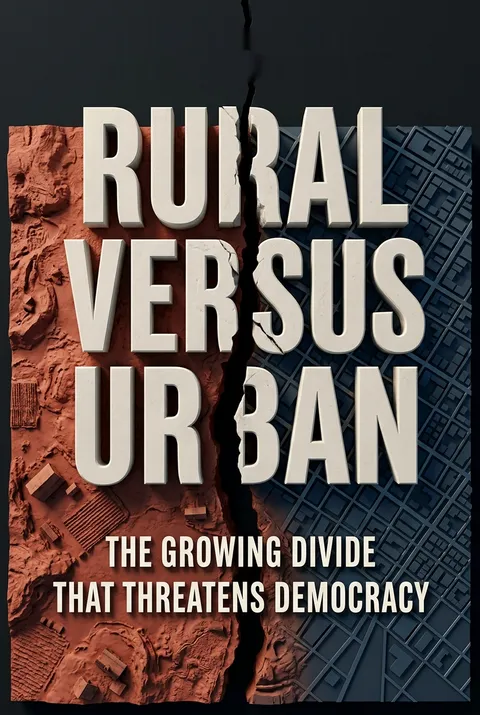
Rural Versus Urban examines political polarization between rural and urban voters, receiving mixed reviews averaging 4.36/5. Critics praise its data-driven approach and insights into rural institutions like gun clubs and evangelical churches. However, one reviewer criticizes its one-sided focus on rural perspectives, weak explanation of voting shifts, and outdated analysis missing 2024 election trends. Multiple reviewers found it informative for understanding America's political divide, though some note missing discussions of Citizens United and international contexts. Several recommend it for those seeking to understand hyperpolarization.
People Also Read







Download PDF
Download EPUB
.epub digital book format is ideal for reading ebooks on phones, tablets, and e-readers.








































