
Key Takeaways
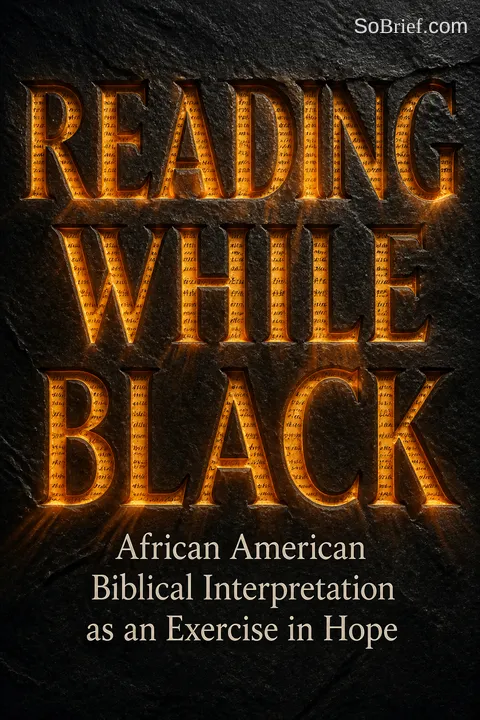
1. Black ecclesial interpretation is a distinct, orthodox, and hopeful theological path.
I am speaking of the ways in which the Christian tradition fights for and makes room for hope in a world that tempts us toward despair.
A unique theological space. Black ecclesial interpretation represents a "fourth way" that refuses to be squeezed into the binary conflict between white progressives and white evangelicals. It is a tradition rooted in the historic Black church that combines a deep, orthodox belief in the authority of Scripture with an unwavering commitment to social justice and the liberation of the oppressed. This approach honors the theological instincts of Black ancestors who read the Bible not as a tool of subjugation, but as a life-giving message of hope.
Orthodoxy meets orthopraxy. Unlike theological movements that abandon historic Christian doctrines to achieve social relevance, this tradition finds the very catalyst for social change within orthodox theology. It asserts that the triune God is inherently a liberator who cares deeply about both the salvation of souls and the physical liberation of bodies. Key characteristics of this interpretive method include:
- An unapologetically canonical and theological reading of the text.
- A socially located perspective arising from the Black experience.
- A willingness to let Scripture critique and redirect our cultural assumptions.
- A hermeneutic of trust that patiently wrestles with the text for a blessing.
Fighting against nihilism. This interpretive framework serves as a vital shield against the creeping despair and nihilism that often threaten marginalized communities. By viewing the Bible through the lens of the Black church's historical struggle, readers discover a resilient faith that has sustained people through centuries of suffering. It proves that the Christian faith is not a "white man's religion," but a universal truth that belongs to all who seek the God of justice.
2. A biblical theology of policing demands structural justice and the elimination of fear.
A Christian theology of policing, then, must grow out of a Christian theology of persons.
Human dignity as foundational. A robust biblical theology of policing must begin with the recognition that every individual is an image-bearer of God, possessing inherent dignity that the state is obligated to protect. When the state uses its policing power—symbolized by the "sword" in Romans 13—to terrorize rather than protect, it violates its divine stewardship. The Bible presents the state not as an absolute authority, but as a temporary servant accountable to the ultimate justice of God.
Addressing systemic fear. For many Black Americans, encounters with law enforcement are marked by a deep, historically justified fear rather than a sense of security. Paul’s ideal in Romans 13 is a society where those who do good have no reason to fear the authorities. To actualize this biblical vision, we must address the structural and historical realities of policing:
- Acknowledging the historical role of police in enforcing racial subjugation.
- Holding elected officials accountable for the actions of state agents.
- Reforming systemic practices that treat Black bodies as inherent threats.
- Demanding that the state's power never be used to exploit the vulnerable.
The call to integrity. In the Gospel of Luke, John the Baptist provides direct ethical instructions to soldiers, who functioned as the police force of the Roman Empire. He commands them to refrain from extortion, false accusations, and greed, pointing to the personal responsibility of those who hold the power of the sword. A biblical model of law enforcement requires both structural accountability from the state and moral integrity from individual officers.
3. The political witness of the church requires active peacemaking and speaking truth to power.
Peacemaking, then, cannot be separated from truth telling.
A prophetic public presence. The New Testament does not advocate for a passive, politically silent church, but rather summons believers to a bold public witness. Jesus himself modeled this by publicly criticizing political rulers, famously calling Herod Antipas "that fox" in response to his threats. The church's political engagement is not about partisan alignment, but about testifying to the in-breaking kingdom of God, which stands in direct opposition to the "present evil age."
The cost of peacemaking. True biblical peacemaking is far more than the avoidance of conflict or the maintenance of an unjust status quo. It is an active, disruptive pursuit of right relationships that requires naming systemic sins and advocating for the marginalized. This prophetic peacemaking involves several key practices:
- Mourning the brokenness and injustices of our contemporary society.
- Hungering and thirsting for the holistic justice of God's kingdom.
- Rejecting false compromises that prioritize order over righteousness.
- Entering the messy public square to speak on behalf of the vulnerable.
An evangelistic pursuit. When the church engages in the work of justice and peacemaking, it is not distracting from the gospel, but rather demonstrating it. By showing the world what the reign of King Jesus looks like in practice, the church's public witness becomes deeply evangelistic. It invites a watching world to experience the healing, reconciling power of a Savior who is making all things new.
4. The Gospel of Luke reveals a divine vision of justice that prioritizes the marginalized.
The testimony of Mary is that even in the shadow of the empire there is a space for hope and that sometimes in that space, God calls us from the shadows to join him in his great work of salvation and liberation.
The Magnificat's revolutionary hope. In the Gospel of Luke, the coming of the Messiah is heralded not as a private spiritual escape, but as a massive social and political upheaval. Mary’s song, the Magnificat, celebrates a God who actively brings down the mighty from their thrones and exalts the humble. This divine inversion reveals that God’s glory is uniquely manifested when He turns His compassionate attention toward those whom the world has cast aside.
Good news to the poor. When Jesus begins His public ministry in Nazareth, He defines His messianic mission by quoting Isaiah's promise of good news to the poor and release to the captives. This programmatic sermon establishes that the kingdom of God is fundamentally concerned with the holistic restoration of the marginalized. The Lukan narrative consistently highlights this theme through:
- The faithful endurance of Zechariah and Elizabeth in the face of delayed hope.
- Jesus' physical and spiritual healing of the socially outcast.
- A sharp critique of wealth and religious practices that exploit the vulnerable.
- The call for a community where the last are placed first.
A holistic gospel. Jesus refuses to separate the spiritual needs of the poor from their physical and social realities. He treats the marginalized as full moral agents capable of repentance, while simultaneously demanding the dismantling of the yokes that oppress them. For Black Christians, this Lukan vision is a powerful reminder that their longing for social justice is woven into the very fabric of the gospel.
5. Scripture affirms and celebrates ethnic identity as an eternal aspect of God's glory.
God’s eschatological vision for the reconciliation of all things in his Son requires my blackness and my neighbor’s Latina identity to endure forever.
An inherently diverse kingdom. The biblical narrative rejects the modern concept of "colorblindness," which seeks to erase cultural and ethnic differences in the name of unity. From the call of Abraham, God's plan was always to bless all the families of the earth, creating a multiethnic family of faith. This diversity is not a temporary concession to human history, but an eternal, celebrated feature of the kingdom of God.
African presence in redemptive history. People of African descent are not latecomers to the Christian story, but have been active participants from its very inception. The Old and New Testaments contain numerous accounts of African figures who played crucial roles in God's redemptive plan:
- Ephraim and Manasseh, the half-Egyptian sons of Joseph, who became tribes of Israel.
- The "mixed crowd" of various ethnicities that participated in the Exodus.
- Simon of Cyrene, the North African who carried the cross of Jesus.
- The Ethiopian eunuch, whose conversion represents the gospel reaching the ends of the earth.
Eschatological glory. In the book of Revelation, the final picture of the redeemed community is a countless multitude from every nation, tribe, people, and language. This proves that our ethnic and cultural identities are preserved in the resurrection, serving as unique instruments to praise the Lamb. Rather than erasing our differences, the gospel unites us in our diversity, showing that the church is incomplete without every cultural voice.
6. The cross of Christ provides a redemptive space to process and heal Black anger.
What reaches out and grabs the heart of the Black Christian is not simply that Christ was innocent of the charges levied against him.
Validating human grief. The experience of systemic oppression and historical trauma naturally produces a deep, burning rage within marginalized communities. The Bible does not condemn this anger, but provides a language for it through the raw, honest cries of the lament psalms. In passages like Psalm 137, the traumatized are permitted to express their desire for vengeance to a sovereign God who can handle their pain.
The cross as divine solidarity. The ultimate biblical answer to human suffering and rage is not an abstract philosophical explanation, but the personal presence of a suffering Savior. On the cross, God in Christ enters into our pain, experiencing state-sponsored injustice, mockery, and physical degradation. This profound act of divine solidarity offers unique comfort to those who suffer:
- It shows that God understands the plight of the innocent sufferer firsthand.
- It reveals a Savior who was despised and rejected by the powerful.
- It assures us that our pain is seen and valued by the Creator.
- It provides a safe, redemptive space to deposit our anger.
Breaking the cycle of vengeance. While validating our anger, the cross also prevents it from turning into destructive, cyclical violence. By taking the weight of human sin and injustice upon Himself, Jesus breaks the endless wheel of retaliation and makes costly forgiveness possible. This does not mean accepting ongoing abuse, but it frees the oppressed from the prison of hatred, allowing them to work for restoration from a place of spiritual victory.
7. The overarching narrative of Scripture fundamentally undermines and opposes slavery.
The Bible, taken in its entirety, remains a light in a dark and broken world.
Creational intent over sinful allowance. To understand the Bible's stance on slavery, we must follow Jesus' own interpretive method of prioritizing God's original creational intent over laws that merely limit human sin. Just as Jesus argued that divorce was a concession to human hard-heartedness rather than God's ideal, slavery must be viewed as a tragic consequence of the fall. From the beginning, humans were created in the image of God, designed for freedom and mutual flourishing, not subjugation.
A trajectory of liberation. While the ancient biblical world was filled with slavery, the laws of the Torah and the teachings of the New Testament consistently worked to undermine the institution. Rather than endorsing chattel slavery, the Scriptures established radical boundaries that recognized the humanity of the enslaved:
- Mandating the release of Hebrew slaves after six years of service.
- Providing absolute sanctuary and freedom to runaway slaves.
- Demanding the immediate release of any slave who suffered physical injury.
- Commanding masters to receive escaped slaves back as beloved brothers in Christ.
The gospel's subversion. In his letter to Philemon, Paul does not merely ask for a slave to be treated kindly; he subverts the entire institution by calling the slave Onesimus a "beloved brother." This radical redefinition of social relationships made the continuation of slavery within the Christian community ultimately untenable. The overarching trajectory of Scripture points toward a day of universal liberation, a truth that the enslaved in America recognized and claimed as their birthright.
8. Reading the Bible faithfully is an active exercise in hope that connects us to our ancestors.
It is an assertion of a claim, namely that the Black ecclesial tradition has something to say that strikes a different note than the standard options often given to students of the Bible and theology.
A legacy of hope. For centuries, the Black church has practiced a way of reading the Bible that has served as a source of life, dignity, and hope in the face of systemic oppression. This tradition was not handed down by slave masters, but was discovered by enslaved people who looked past the distorted interpretations of their oppressors to find the true, liberating God of the Bible. By continuing this practice today, we honor the faith of our ancestors who refused to let go of the text until it blessed them.
Wrestling with the text. Faithful biblical interpretation is not a passive acceptance of easy answers, but an active, sometimes painful wrestling with difficult passages. Like Jacob at the Jabbok, the Black ecclesial tradition adopts a hermeneutic of trust, believing that a careful, sympathetic reading of Scripture will ultimately yield a blessing rather than a curse. This patient engagement with the text involves:
- Refusing to let the Bible be weaponized by those in power.
- Bringing our deepest cultural questions and pains directly to the text.
- Trusting that the Holy Spirit speaks a coherent, life-giving word through Scripture.
- Drawing strength from the historical cloud of witnesses who walked before us.
A gift to the global church. The insights gleaned from the Black experience are not meant to isolate us, but to enrich the global body of Christ. By adding the unique voice of the Black ecclesial tradition to the chorus of believers throughout history, we help the church achieve a fuller, more accurate understanding of the gospel. This interpretive journey is ultimately an exercise in hope, pointing us toward the day when every tribe, tongue, and nation will stand united under the reign of King Jesus.
Review Summary
People Also Read