


Key Takeaways
You already read people hundreds of times a day — sharpen it
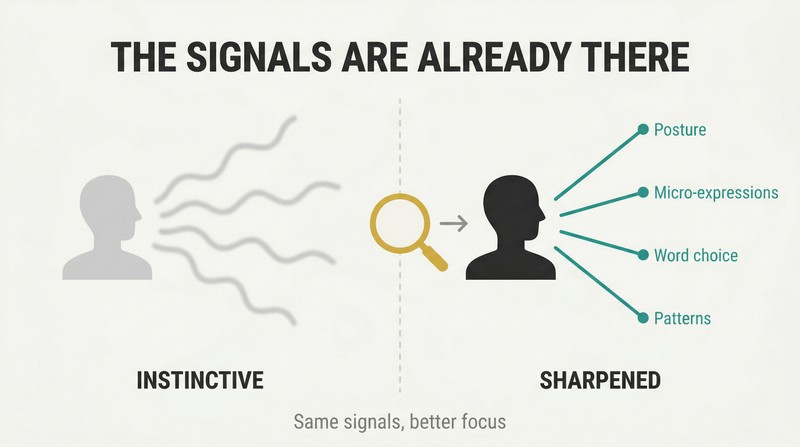
Oz Pearlman has fooled everyone from Tom Brady to Richard Branson into believing he can access their innermost thoughts. His confession: he can't actually read minds. What he does is read people — interpreting body language, word choice, patterns, and micro-expressions to predict behavior. You already do this instinctively. Over two-thirds of communication is nonverbal. As a baby, you decoded your parents' faces before understanding a single word.
Mentalism is psychology, observation, memory, and communication. The question isn't whether you have these skills — you do. Pearlman's career, from a 14-year-old restaurant magician in suburban Detroit to performing for billionaires on private islands, was built entirely on systematically upgrading what's already hardwired into your brain.
Voice what others are thinking before they realize it
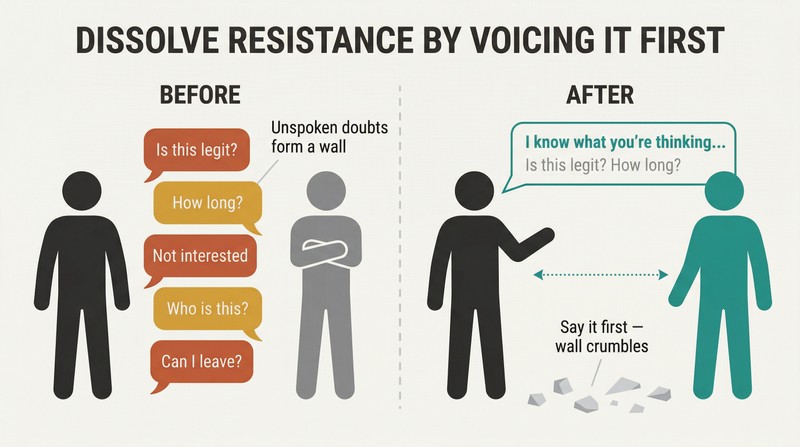
At age 14, Pearlman approached restaurant tables knowing diners silently asked at least ten questions: Is he any good? How long will this take? Will he leave soon? His challenge was answering all ten in ten seconds. He'd open with "The owners have a treat for you tonight!" — instantly countering their default assumption that he was an interruption, not a gift.
Pearlman calls this applied Theory of Mind — stepping into someone else's head to predict their reactions. Whether you're asking for a raise, pitching a client, or opening a first date, consider what the other person is silently thinking. When Pearlman opens his stage show, he voices the audience's skepticism aloud: "Mind reading? Gimme a break — I don't buy it either." Verbalizing their inner monologue dissolves resistance before it hardens.
Create an alter ego that absorbs rejection so you don't
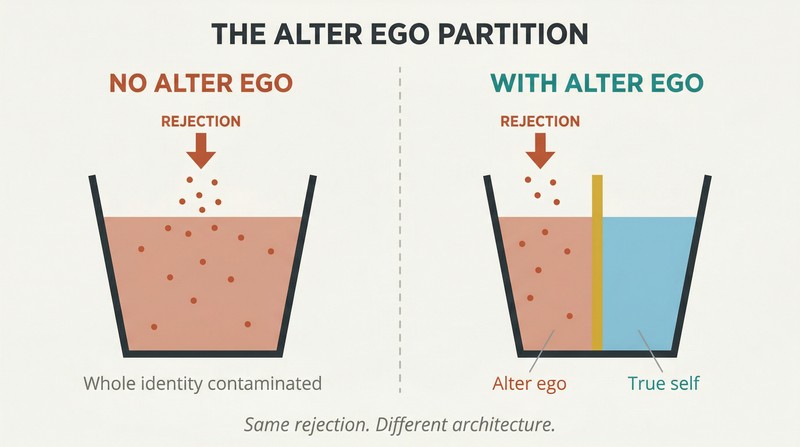
As a teenager, Pearlman developed "magic mode" — mentally separating his identity from his performance. When diners rejected his act, he told himself they weren't rejecting Oz Pearlman; they simply didn't like Oz the Entertainer's tricks. That distinction was everything.
Think of it like a bucket of fresh water. Dump salt in and the whole thing is ruined. But add a divider — a silo — and the contamination stays contained. Research confirms the stakes: UCLA's Naomi Eisenberger found that social rejection activates the anterior cingulate cortex, the same brain region that processes physical pain. The emotional sting is neurologically identical to a stubbed toe. Magic mode gives you psychological armor without numbing your ambition — they're never rejecting you, just one compartmentalized piece.
Rehearse failure scenarios more obsessively than success
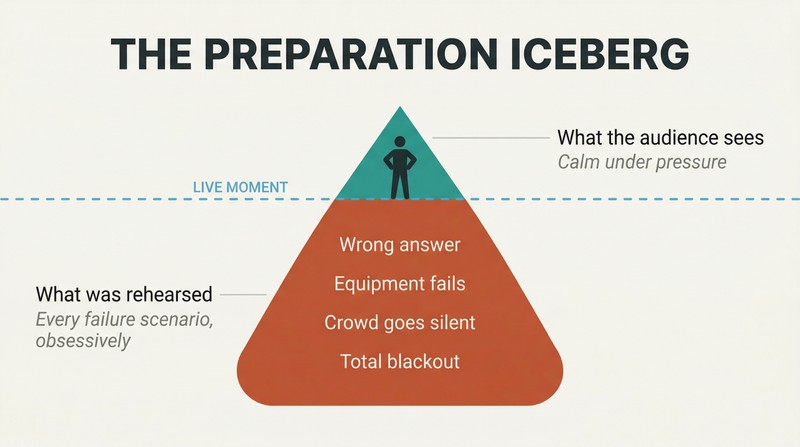
On the Today show, Pearlman asked Al Roker to name a celebrity who could be president — wearing a hidden Taylor Swift T-shirt for the reveal. Roker said "George Clooney." With thirty seconds of airtime left and millions watching, Pearlman's body language betrayed nothing. He calmly steered Roker to reconsider, landing on Swift — because he'd spent a month gaming out exactly this scenario.
Contingency planning rewires your brain. The prefrontal cortex (your decision-maker) and hippocampus (your memory librarian) work together to run mental simulations, improving recall and split-second judgment. Michael Phelps's coach had him visualize every disaster — goggles flooding, equipment failing — so his body responded on autopilot. Jim Gaffigan once bombed horribly; four nights later, he sold out Madison Square Garden. The variable isn't talent. It's preparation for when things go sideways.
Shine your spotlight on others — it always reflects back
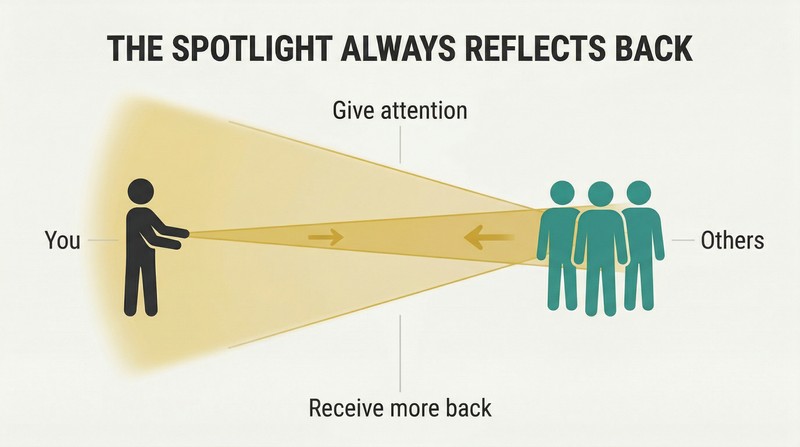
Performing at Steven Spielberg's father's 99th birthday, Pearlman prepared a thousand questions for his childhood idol. In their 25-minute conversation, he asked precisely zero. Spielberg turned the mirror around — asking about Oz's craft, his family, his life — making the mentalist feel like the most important person on earth. "He left me wanting so much more," Pearlman writes. "That was his gift."
At corporate events, Pearlman deliberately humanizes the CEO by pairing them onstage with a junior employee who'd never normally get face time. After one post-merger show, nearly a hundred employees who'd been too nervous to approach leadership walked up to joke and laugh. The invisible hierarchy shattered. Making others the star doesn't diminish you — it doubles the light cast your way.
Record every detail people share — recall compounds over time
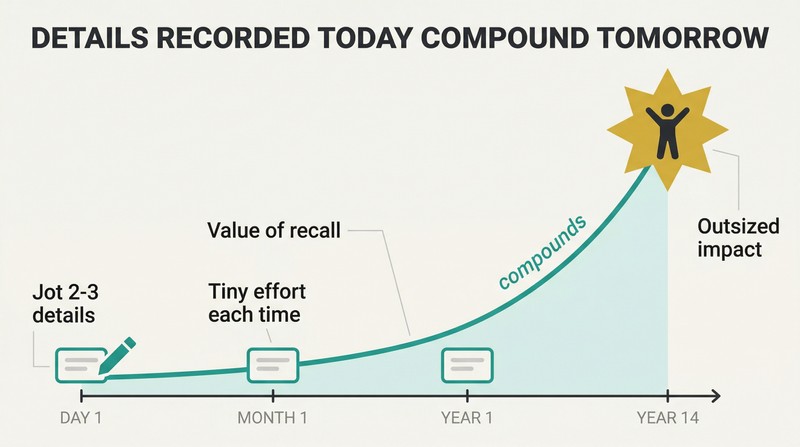
After every show, Pearlman logs everything while it's fresh — names, conversations, personal details. If he guessed someone's banking PIN last year, he writes it down. A year later he casually asks, "It's not still 2172, is it?" The person is floored. Not by magic, but by attention.
This costs nothing and pays exponentially. When meeting anyone worth remembering, jot down two or three details immediately — kid's sport, upcoming vacation, pet's quirky name. Most people assume their details are forgotten, so recalling them creates what Pearlman calls "points for free." One man texted him about a personalized thank-you card from his son's bar mitzvah — fourteen years later. Pair this with Pearlman's name technique: Listen, Repeat, Reply (say it back), Reply (ask about the spelling or give a compliment to anchor it).
When the urge to quit hits, set a ten-minute timer
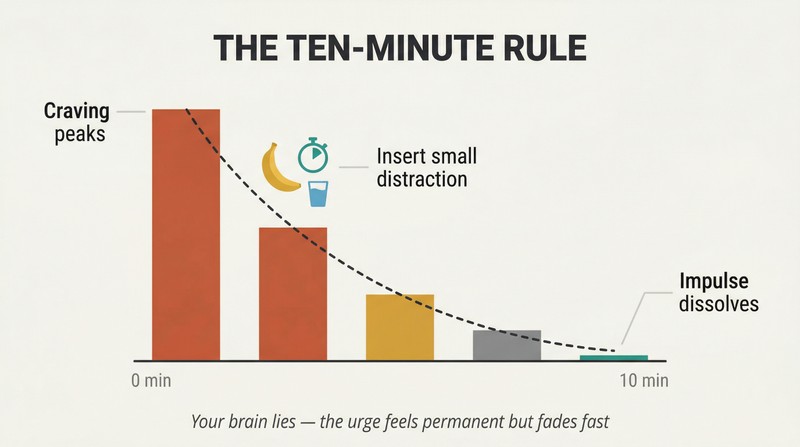
While training for ultramarathons, Pearlman cuts junk food — and his brain rebels. Rather than white-knuckling, he borrows "time misdirection" from his magic toolbox. Craving cake and a burrito, he tells himself: I will absolutely eat that. But first — banana, glass of water, ten-minute timer. If I still want it at zero, it's mine. Almost every time, the impulse dissolves.
He calls the first two weeks of any habit the hardest. Your brain is literally rewiring neural pathways — like moving a trash can from the left side of your desk to the right. For about fourteen days, you'll instinctively throw trash the wrong way. Then something clicks. The trick: the clock only starts once you actually move the can. Figure out what your "banana" is — the small, healthy distraction that bridges you past the craving.
Work backward from the finish, then take one tiny step today
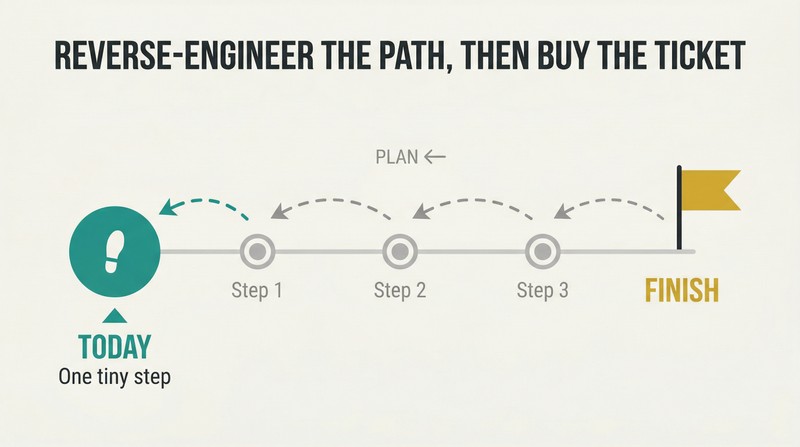
Pearlman designs every trick backward — starting with the audience's reaction and reverse-engineering the path to get there. He applies the same method to goals. When ESPN hired him needing twelve new tricks, his solution: one per month, starting immediately. By showtime, he had a surplus. When he wanted to break 2:30 in the marathon, he stacked micro-goals — heart rate monitor, incremental speed work, gradual weight loss — dropping from 3:21 to 2:23 over years.
Neuroscience rewards this approach. When you challenge yourself with something new, your brain produces myelin — a protective sheath that speeds neural transmission. Like trudging through three feet of snow to your mailbox, each repetition carves an easier path. The trick is buying the ticket: run around the block, register the domain name, make the call. You can't win if you don't play.
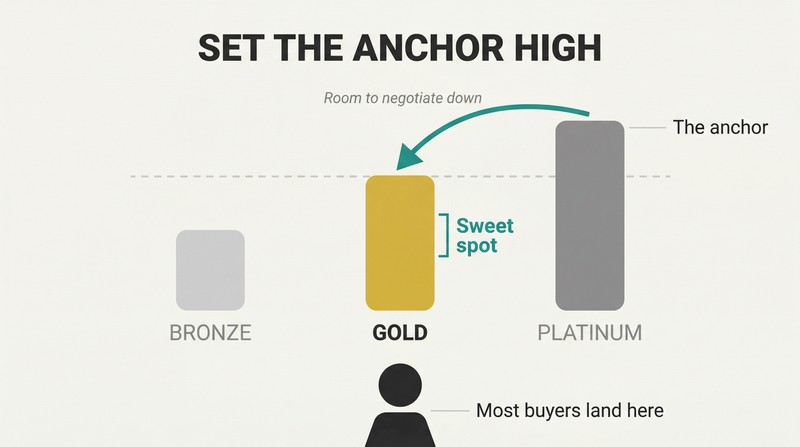
Anchor your price absurdly high — you can only negotiate down
For years, Pearlman undercharged because he loved performing and feared hearing "no." Then a billionaire client insisted he cancel an ultramarathon for a birthday party. After declining four times, Pearlman quoted an outrageous figure — confident the answer would be no. The client said yes within thirty seconds. He performed, then channeled his fitness into a Central Park world record: 116 miles, raising $116,000 for Ukrainian children's relief, landing on the front page of The New York Times.
The principle extends beyond money. Pearlman structures packages as bronze, gold, and platinum — knowing people gravitate to the middle. His gold "add-on" of mingling with guests is something he'd happily do for free, but pricing it as premium increases revenue. Set the anchor high. Give yourself room to come down, and both parties walk away feeling like winners.
Write your finish-line speech, never your DNF excuse
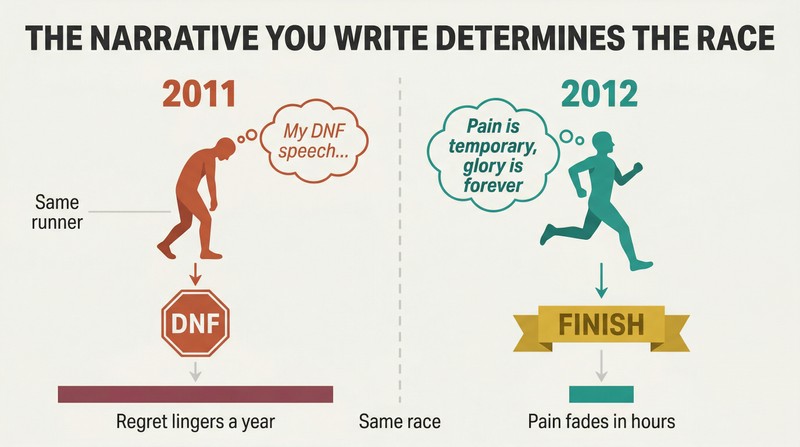
The Spartathlon is a 153-mile ultramarathon from Athens to Sparta with a 36-hour cutoff — retracing an ancient Greek messenger's run that changed the course of civilization. In 2011, Pearlman was vomiting by mile 54. Instead of focusing on the next step, he began mentally composing his quitting speech — his DNF, "did not finish," excuse. That mental surrender, not his body, killed his race.
He returned the next year transformed. He wrote "Pain Is Temporary, Glory Is Forever" on his forearms. It was the hottest year in race history — only 19% of runners finished. After a five-minute roadside nap at mile 100 and twenty hours of suffering, Pearlman crossed the finish line in tears, bowed before King Leonidas's statue, and drank ceremonial river water. The agony of quitting in 2011 haunted him for a year. The agony of finishing faded in hours.
Analysis
Pearlman's book occupies an unusual niche in self-help: it's written by someone whose literal profession is manipulating attention and perception in real time. This gives it a distinctive strength — his insights about human psychology aren't academic abstractions but battle-tested techniques refined across tens of thousands of live performances where failure was immediately and publicly visible. The tension, however, is that 'mentalism' largely serves as a branding wrapper around well-established social psychology concepts (Theory of Mind, negativity bias, cognitive behavioral therapy techniques) that readers may encounter in purer form elsewhere.
What genuinely distinguishes the book is Pearlman's dual identity as performer and extreme endurance athlete. The ultramarathon narratives — particularly the Spartathlon — provide the most emotionally compelling material and the deepest insight: that mental collapse always precedes physical collapse. His observation that composing a DNF speech in your head is itself the mechanism of failure, not merely a symptom, is genuinely powerful and applicable far beyond racing. The time misdirection concept — borrowing a magician's technique for self-control — is similarly original and immediately deployable.
The book would benefit from acknowledging what behavioral science makes clear: individual grit narratives, while inspiring, can obscure structural advantages that determine outcomes. Pearlman's safety net from his boat dock business, his Wall Street salary, and his social capital weren't incidental to his career leap — they were foundational. Yet the book's most honest moment may be the jail story in its final chapter, a reminder that the same impulsivity and confidence driving extraordinary achievement can, without guardrails, produce spectacularly poor decisions. That willingness to include genuine failure — not just setbacks reframed as growth opportunities — elevates it beyond typical performer-turned-guru territory into something more trustworthy and human.
People Also Read







Glossary
Magic mode
Performer alter ego absorbing rejectionPearlman's technique for handling rejection by mentally separating your identity from the task at hand. You create a 'character' who performs or takes action, so that any negative response is directed at that character rather than your core self. Rooted in the psychological shift from being the 'actor' in a situation to being the 'observer,' allowing you to compartmentalize negative feedback without internalizing it.
Theory of Mind
Predicting others' mental statesA concept from psychology that Pearlman applies to everyday interactions: the ability to attribute mental states to others and understand that their thoughts, beliefs, and feelings differ from your own. In Pearlman's usage, it means actively imagining what someone is thinking—their objections, fears, and desires—before they voice them, then addressing those unspoken thoughts preemptively to control the interaction.
Time misdirection
Delayed impulse control trickBorrowed from magic terminology where performers manipulate the audience's sense of time. Pearlman repurposes it as a self-control technique: when an urge to break a habit strikes, you commit to a small healthy action first (eating a banana, drinking water) and set a ten-minute timer. If the craving persists after the timer, you indulge—but nearly every time, the emotional trigger dissolves during the delay.
Two-week rule
Habit rewiring takes fourteen daysPearlman's framework asserting that the first two weeks of forming any new habit are the most difficult period, during which your brain is actively rewiring neural pathways. He compares it to moving a trash can from one side of your desk to the other—for about fourteen to sixteen days, you instinctively throw trash in the wrong direction. After that threshold, the new behavior begins to feel automatic.
Listen, Repeat, Reply
Three-step name recall techniquePearlman's method for never forgetting a name again, built on the insight that most 'forgetting' is actually poor listening. Step one: blank your mind completely and truly hear the name. Step two: repeat it back immediately ('Ashley, great to meet you'). Step three: reply with a follow-up—ask about the spelling, offer a compliment using their name, or make a personal connection to create a psychological anchor.
Pedestal effect
Idealizing people in authorityA cognitive bias Pearlman identifies where we create idealized versions of people in positions of power, authority, or fame, which makes us feel 'less than' by comparison. His strategy is to deliberately humanize authority figures—for example, by involving a CEO in an onstage trick alongside a junior employee—to break down invisible hierarchies and create bonding across power imbalances.
Compare and despair
Measuring worth against others' successPearlman's term for the destructive mental habit of evaluating your own progress by comparing it to others' perceived success, especially on social media. He notes that research shows the average person in 2009 was 75 percent less empathetic than in 1979, partly due to social comparison. His antidote is to compare only against past versions of yourself and to use others' success as fuel rather than a mirror for insecurity.
Silo technique
Compartmentalizing rejection from identityPearlman's method of preventing one failure from contaminating your entire self-image. Visualized as placing a divider in a bucket of fresh water: if you dump salt (rejection) into a compartmented section, the rest of the water stays clean and drinkable. Applied practically, it means treating a rejection of your pitch, performance, or idea as feedback about that specific effort—not as a verdict on your worth as a person.
Defensive listening
Strategic information gathering while listeningPearlman's approach to listening not just to understand, but to strategically prepare for negotiations and future interactions. When fielding booking calls, he would gather information about how clients found him, what events they attended, and who referred them—then research their backgrounds before calling back. This allowed him to tailor his pitch, anticipate objections, and enter conversations with an informational advantage.
FAQ
1. What is Read Your Mind: Proven Habits for Success from the World's Greatest Mentalist by Oz Pearlman about?
- Core premise: The book reveals how mentalism techniques—such as observation, psychology, memory, and communication—can be applied to everyday life for personal and professional success.
- Demystifying mentalism: Pearlman clarifies that mentalism is not about supernatural mind reading, but about reading people through subtle cues and psychological insight.
- Practical transformation: Readers learn to channel their "inner mentalist" to improve relationships, influence others, and achieve goals, with actionable exercises and real-life stories.
2. Why should I read Read Your Mind by Oz Pearlman?
- Unique perspective: Pearlman blends insights from mentalism and endurance sports, offering a fresh approach to self-improvement grounded in real-world experience.
- Overcoming obstacles: The book addresses common challenges like fear of rejection, procrastination, and negative self-talk with innovative, actionable strategies.
- Relatable storytelling: Pearlman’s personal journey—from restaurant magician to TV performer—makes the lessons engaging and easy to apply in daily life.
3. What are the key takeaways from Read Your Mind by Oz Pearlman?
- Mindset shapes results: Your internal dialogue and beliefs directly impact your ability to achieve goals; Pearlman encourages writing the “finish line” speech, not the “giving up” one.
- Preparation and planning: Success comes from controlling variables, anticipating obstacles, and using visualization and mental rehearsal.
- Relationships and vulnerability: Building a supportive team, asking for help, and embracing vulnerability accelerate growth and foster trust.
- Turning weaknesses into strengths: Deliberately pursuing discomfort and reframing failures as growth opportunities are essential for transformation.
4. How does Oz Pearlman define and teach “channeling your inner mentalist” in Read Your Mind?
- Instinctual skills: Everyone has the innate ability to interpret nonverbal cues and emotions; Pearlman teaches how to sharpen these instincts through observation and psychology.
- Beyond tricks: Mentalism is about understanding human nature and communication patterns, not magic tricks or deception.
- Practical benefits: Developing mentalist skills helps predict others’ thoughts, improve timing, and build rapport, leading to success in negotiations, leadership, and relationships.
5. How does Read Your Mind by Oz Pearlman explain overcoming fear of rejection?
- Rejection as real pain: Pearlman explains that social rejection activates the same brain regions as physical pain, making it a powerful emotional experience.
- Magic mode technique: He introduces “magic mode,” a mental shift that separates self-worth from outcomes, allowing you to try again without internalizing failure.
- Failing up: The book encourages reframing rejection as a necessary step toward success, using exposure therapy and stories of famous figures who persisted through setbacks.
6. What is the role of Theory of Mind in Read Your Mind by Oz Pearlman?
- Definition and importance: Theory of Mind is the ability to attribute mental states to oneself and others, foundational for effective communication and mentalism.
- Building rapport: Pearlman uses practical scenarios to show how imagining others’ perspectives helps win trust and ease tension in social interactions.
- Planning and influence: Anticipating reactions and planning responses based on others’ likely thoughts is crucial for persuasion and successful outcomes.
7. What strategies does Oz Pearlman recommend for overcoming procrastination in Read Your Mind?
- Understanding the brain: Procrastination is a battle between the pleasure-seeking limbic system and the disciplined prefrontal cortex, often fueled by fear of failure.
- Break tasks down: Pearlman advises breaking goals into small, manageable steps and starting immediately to build momentum and trigger dopamine rewards.
- Habit formation: Pushing through the initial resistance, using external accountability, and employing “time misdirection” can help establish productive routines.
8. What does “stack the deck in your favor” mean in Read Your Mind by Oz Pearlman?
- Preparation and timing: Pearlman emphasizes controlling variables, choosing the right moments, and being persistent to increase your chances of success.
- Flow state: Quieting the inner monologue and achieving a flow state are essential for peak performance, as illustrated by elite athletes.
- Calculated risks: Taking small, realistic steps and learning from setbacks helps eliminate excuses and play the long game toward your goals.
9. How does Oz Pearlman in Read Your Mind stress the importance of focusing on others?
- Be interested, not interesting: Pearlman advises making interactions about others, as people love to feel seen and heard.
- Empathy and connection: Leading with empathy, active listening, and emotional storytelling creates intimacy and engagement.
- Remembering details: Noting and recalling personal information builds trust and rapport, transforming relationships and opening doors.
10. What is the “Listen, Repeat, Reply” memory technique in Read Your Mind by Oz Pearlman?
- Listen actively: Focus fully on hearing someone’s name without distractions to ensure proper encoding.
- Repeat immediately: Say the name back right away, possibly spelling it out, to deepen the memory imprint.
- Reply with connection: Use the name in a compliment or question to anchor it to a memorable detail, making it harder to forget.
11. How does Oz Pearlman recommend managing your inner critic in Read Your Mind?
- Recognize negative self-talk: Awareness of the inner critic is the first step; Pearlman uses the “snowy driveway” analogy for persistent negative loops.
- Catch, check, change: Challenge the validity of negative thoughts and replace them with positive, realistic affirmations to rewire your mindset.
- Behavioral activation: Engaging in positive actions, like exercise, boosts endorphins and helps counteract negativity.
12. How does Read Your Mind by Oz Pearlman explain the power of storytelling for influence and communication?
- Engage emotions: Stories activate brain chemicals that aid memory, attention, and empathy, making messages more impactful.
- Control the narrative: Storytelling allows you to guide listeners’ experiences, making complex information relatable and compelling.
- Inspire action: Well-told stories motivate generosity and cooperation, and are effective tools in presentations, negotiations, and building connections.
Download PDF
Download EPUB
.epub digital book format is ideal for reading ebooks on phones, tablets, and e-readers.








































