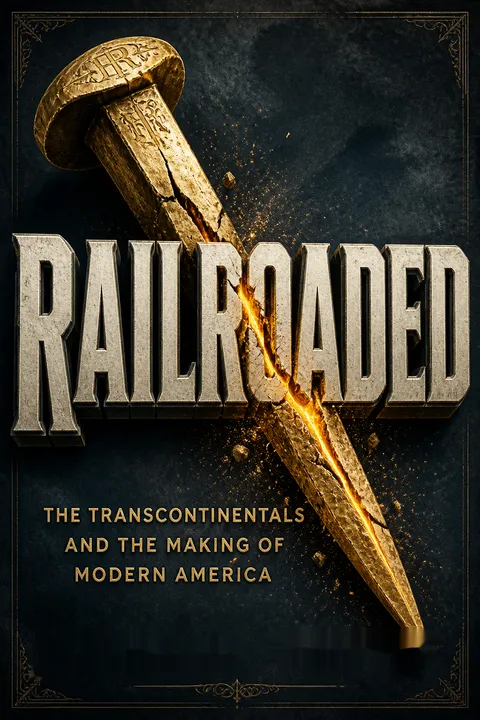

Key Takeaways
1. Transcontinental Railroads: A Paradox of Failure and Modernity
All I would change is that they created modernity as much by their failure as their success.
Paradoxical progress. The transcontinental railroads, while hailed as epitomes of progress, nationalism, and civilization, were often monumental failures. Their creation of modern America stemmed not just from their triumphs but equally from their profound shortcomings. This "hothouse capitalism," heavily subsidized by governments, led to rapid, often unsustainable, expansion.
Systemic collapse. Many of these railroads were built far ahead of any real demand, resulting in financial collapse, frequent receiverships, and reliance on state bailouts. This wasn't merely an economic misstep; it was a political and social failure, luring settlers to unproductive lands and flooding markets with unneeded goods. The costs, both short-term and long-term, frequently outweighed the benefits.
A contrarian view. The traditional narrative of Western expansion often overlooks the corporate mistakes and dysfunctions inherent in this process. The celebrated "creative destruction" often enriched individuals—the entrepreneurs—at the expense of the corporations themselves and the broader society, fostering widespread discontent and fueling powerful reform movements.
2. Corruption and Insider Fortunes: Building with Other People's Money
It is easier, more delightful, and more profitable to build with other peoples’ money than our own.
Self-serving schemes. Promoters like Thomas Durant and Collis P. Huntington mastered the art of building railroads with minimal personal investment. They established insider construction companies, such as the Crédit Mobilier and the Contract and Finance Company, which charged exorbitant rates for construction. These companies then paid the promoters in railroad securities, effectively allowing them to own the railroads they built with other people's capital.
Financial alchemy. The system was designed for personal enrichment. Stock was often given away or sold at deep discounts, while bonds were issued with ambiguous terms that allowed the government to pay interest for decades. This "taxless finance" generated immense personal wealth for insiders, even as it burdened the railroads with unsustainable debt and "watered stock" – securities with a face value far exceeding the actual assets.
Scale of deception. The Crédit Mobilier, for instance, yielded profits of 480% to 610% for its organizers. The Central Pacific's annual reports were notoriously fraudulent, claiming millions in paid stock subscriptions that never materialized. This pervasive deception prioritized the personal fortunes of a few over the long-term financial health and public utility of the railroad corporations.
3. The State's Embrace: Railroads as Political Animals
The transcontinentals, more obviously than other railroads, were entwined with the state.
Government as midwife. From their inception, transcontinental railroads were deeply intertwined with government at all levels. Governments in the United States, Canada, and Mexico provided lavish subsidies, vast land grants, and crucial loan guarantees, often justifying these as essential for military necessity, national unity, or economic development. This created a unique hybrid of public and private enterprise.
The currency of friendship. This deep entanglement fostered widespread political corruption. Railroads cultivated "friends" within legislative bodies, bureaucracies, and courts through:
- Direct payments and "loans"
- Disguised favors and investment opportunities
- Strategic sharing of information
- Free passes for politicians and their families
Lobbying evolved into a sophisticated mechanism for inter-corporate warfare, with rival companies battling each other in the halls of power.
Political puppetry. The scale of railroad political influence was immense. They influenced committee assignments, delayed or advanced legislation, and even attempted to intervene in presidential elections, as Tom Scott did in 1876. This constant maneuvering, often involving bribery and blackmail, blurred the lines between public service and private gain, leading to public outrage and the perception of a republic corrupted by corporate power.
4. Space as a Political Battleground: Rates, Discrimination, and Monopoly
Virtually all of the bitter political and economic conflicts that followed the construction of railroads in the vast region... were in some sense quarrels over the organization and production of space.
The fluid geography of cost. Railroads fundamentally reshaped the perception of space, making it a political construct. Distance was no longer merely measured in miles but, more critically, in time and cost. This "relational space" was inherently unstable, with freight rates constantly shifting, causing some places to become economically "closer" and others "farther" at the whim of the corporations.
Discriminatory power. The power to set rates became a central political issue. Railroads routinely discriminated:
- Among people: Offering secret rebates to favored shippers.
- Among places: Charging more for short hauls to non-competitive points than for longer hauls to competitive ones.
- Among commodities: Pricing goods based on "what the traffic would bear," often favoring bulk goods over manufactured items.
This ability to levy what antimonopolists termed a "private tax" without legislative authority fueled widespread outrage, seen as a violation of republican equity and individual freedom.
The Octopus's reach. In California, the Southern Pacific strategically manipulated rates to eliminate river transport competition in the San Joaquin Valley, effectively "erasing" the river's natural advantage. Its "special contract system" coerced merchants into exclusive rail shipping, demanding the right to inspect their books. This blatant control over economic geography solidified the railroad's image as a predatory "Octopus," dictating the terms of commerce and sparking fierce political opposition.
5. Dysfunctional Giants: The Reality of Railroad Management
The organizations I describe here not only failed to institute the order they desired; they also just plain failed and repeatedly needed rescuing by the state and the courts.
Chaos beneath the veneer. Despite the impressive organizational charts and rhetoric of efficiency, many western railroad corporations were deeply dysfunctional. They were less tightly centralized bureaucracies and more collections of fiefdoms, plagued by internal conflicts, incompetence, and corruption. Executives often struggled to impose authority, and job classifications were porous, leading to cronyism and a lack of clear standards.
Culture of conflict. The management culture, often shaped by Civil War veterans, was characterized by personal pride, rivalry, and a combative "manliness." This led to destructive internal competition and even sabotage. Charles Francis Adams, a prominent reformer and president of the Union Pacific, privately lamented that the railroad was "the worst school for railroad management" he knew, rife with "incompetency, lying, stealing and betraying."
Operational disarray. This internal chaos manifested in tangible ways:
- Departments refused to cooperate, leading to inefficiency.
- Managers were often inept or corrupt, prioritizing personal gain.
- Basic operational standards were lacking, with deteriorating infrastructure.
The Southern Pacific, for example, was described as a "mutinous and ill-rigged ship" due to constant infighting among its owners (Huntington, Stanford, Crocker), resulting in fragmented administration and a stark contrast between its fearsome public image and its chaotic internal reality.
6. Antimonopoly's Complex Fight: Reformers, Rivals, and Racism
For all its failings, antimonopoly opposition to the corporation was significant.
A fractured front. The antimonopoly movement was a powerful force, rooted in republican ideals of economic democracy and opposition to special privilege, targeting railroads as the embodiment of corporate power. However, it was often fragmented, with reformers sometimes forming paradoxical alliances with one railroad against another, or with competing business interests.
Racialized anxieties. A tragic flaw of the movement, particularly in the American West, was its deep entanglement with racism, especially Sinophobia. Chinese workers were demonized as "coolies" and "unfree labor," becoming a convenient scapegoat for broader anxieties about wage labor, corporate exploitation, and the perceived threat to "white manhood" and republican values.
Legislative success, social cost. This racialized dimension led to legislative victories like the Chinese Exclusion Act (1882) and the Foran Act (1885), which banned contract labor. However, these laws also criminalized Chinese immigrants and fueled horrific violence, such as the Rock Springs Massacre. While achieving specific legislative goals, this racism ultimately weakened the broader labor movement by dividing workers along racial lines.
7. Labor's Struggle: Work, Wages, and the Price of Progress
The details of work killed men.
A deadly profession. Railroad work was inherently dangerous, and the "details of work" often proved fatal. Long hours, primitive and unsafe equipment (like link-and-pin couplers and manual brakes), and a pervasive lack of safety standards led to thousands of deaths and injuries annually. Workers fought desperately for control over their labor, demanding safer conditions, fair wages, and recognition of their skills and experience.
Rise and fall of unions. Labor organizations, from specialized brotherhoods to the broader Knights of Labor, sought to "engraft republican principles into our industrial system." They aimed for democratic control over work, achieving early successes against figures like Jay Gould. However, internal divisions, aggressive management tactics, and the increasing intervention of the state ultimately contributed to their decline.
The Pullman crucible. The Pullman Strike of 1894 became a pivotal moment. Eugene Debs's American Railway Union (ARU) launched a nationwide boycott, but faced a formidable alliance of railroad managers (the General Managers' Association) and ruthless federal intervention. Attorney General Richard Olney, using sweeping injunctions and federal troops, crushed the strike. This decisive defeat for organized labor solidified the state's role in protecting corporate interests and suppressing worker actions.
8. Environmental and Economic Catastrophes: The Cost of "Dumb Growth"
In attempting to cut economic losses, the railroads helped create both what might be called dumb growth and environmental catastrophes.
Unsustainable expansion. Built ahead of demand, railroads desperately needed to generate traffic, leading to "dumb growth" – the promotion of settlement and resource extraction in unsustainable ways. The near-extermination of the bison, for example, was facilitated by railroads providing market access for hides, yet yielded economically insignificant cargo for the roads, leaving vast plains littered with rotting carcasses.
The cattle boom and bust. The open-range cattle industry was another railroad-staged tragedy. Railroads enabled the long drive and the rapid expansion of cattle onto the Great Plains, but this was based on speculative "book counts" rather than sustainable grazing practices. Overgrazing, combined with devastating winters like the "Great Die-Up" of 1886-87, led to massive cattle losses, widespread bankruptcies, and severe environmental degradation.
Agricultural mirages. Railroads aggressively promoted farming in arid regions, propagating the myth that "rain follows the plow." This lured thousands of settlers into areas unsuitable for conventional agriculture, leading to overproduction of wheat and corn. When droughts and falling prices inevitably struck in the late 1880s and 1890s, thousands of farmers were ruined, highlighting the fragility of railroad-driven settlement and the high social costs of unsustainable expansion.
9. Bankers and Panics: The Financial Instability of the Gilded Age
The railroads, for their part, continued their own rush toward receivership, and here they had no one to blame but themselves and the perverse conditions of their industry.
A house of cards. Transcontinental railroads were inherently unstable, overcapitalized, and heavily indebted, relying on a constant influx of new capital to meet their obligations. Investment bankers, far from being impartial arbiters, were often complicit in fraudulent practices, selling dubious securities and bolstering them with misleading financial reports.
Global tremors. The financial fragility of American railroads was exposed by international events. European investors, seeking higher returns, poured capital into these ventures but were easily spooked by crises like the Argentinean default of 1890 and the passage of the Sherman Silver Purchase Act. This led to capital flight, plummeting security prices, and margin calls, pushing already precarious railroads towards collapse.
The Panic of 1893. The Panic of 1893 was largely a railroad-induced crisis. Decades of overexpansion, ruinous rate wars, and massive debt culminated in most transcontinentals (including the Union Pacific, Northern Pacific, and Atchison) falling into receivership. This systemic failure, rooted in mismanagement and speculation, demonstrated how corporate collapse could still yield immense personal wealth for insiders, even as it devastated the broader economy.
10. The Illusion of Control: From Octopus to Squabbling Men
The Octopus was the dominant metaphor of the corporation well before Frank Norris ever made it the title of his railroad novel, but I have had trouble finding Octopi.
A chaotic leviathan. Frank Norris's terrifying "Octopus" metaphor for the Southern Pacific, while capturing its immense power, belied its internal reality. Far from being a ruthlessly efficient, centrally controlled entity, the corporation was deeply dysfunctional, plagued by constant infighting, incompetence, and conflicting agendas among its owners—Huntington, Stanford, and Crocker.
Internal sabotage. Huntington's "coup" to oust Stanford from the Southern Pacific presidency in 1890 resulted in a "mutinous and ill-rigged ship." Executives engaged in personal vendettas, undermined each other, and prioritized individual gain over corporate health. This fragmented administration led to constant disorganization, with departments refusing to cooperate and basic operational standards often ignored.
Survival by subterfuge. The Southern Pacific's political machine, the "Octopus," was often inept, relying on bribery, blackmail, and shifting alliances rather than strategic competence. Its finances were so opaque that even its own bankers struggled to understand them. The company survived the 1893 panic not through managerial efficiency, but through Huntington's desperate financial maneuvers, personal loans, and sheer luck, revealing a stark contrast between its fearsome reputation and its chaotic reality.
11. Contingency, Not Inevitability: A Different West Was Possible
To deny the contingency of the past deprives us of alternative futures, for the present is the future’s past.
A chosen path. The development of the American West and its railroads was not an inevitable historical trajectory. The past contained alternative choices and outcomes. The rapid, extensive, and heavily subsidized overbuilding of the transcontinental railroad network was a deliberate policy choice, not a natural or unavoidable progression.
A counterfactual West. Imagining a West where railroads were built "as demand required" suggests a different history:
- Less waste of capital and labor.
- Reduced suffering for settlers lured to unproductive lands.
- Less environmental degradation from unsustainable resource extraction.
- More time for indigenous peoples to adapt to changing conditions.
Regional lines could have served productive areas, delaying development in arid or sparsely populated regions until it was economically viable and sustainable, as seen in parts of South Dakota.
Enduring lessons. The transcontinental railroads, as "transformative failures," reveal how powerful, inept, and corrupt entities can survive and even prosper through state intervention and financial manipulation. Recognizing this contingency allows us to challenge the "inevitability of the present" and envision alternative futures. It underscores that economic systems are shaped by choices and political will, not merely by immutable "natural" forces.
Review Summary
Railroaded examines the transcontinental railroads built after the Civil War, arguing they were constructed prematurely, corruptly financed, and incompetently managed. Author Richard White challenges both "robber baron" and entrepreneurial interpretations, portraying railroad magnates as bumbling yet personally enriched despite corporate failures. Reviews praise the book's extensive research, wit, and contemporary relevance to modern financial crises, though many criticize its dense writing, disorganized structure, and slow pacing. Readers appreciate White's critical analysis of government subsidies, environmental damage, and labor exploitation, but several found the financial details overwhelming and the narrative difficult to follow.
People Also Read

About the Author
Other books by Richard White

Download PDF
Download EPUB
.epub digital book format is ideal for reading ebooks on phones, tablets, and e-readers.








































