

Key Takeaways
America's true empire was built on wealth, not weapons
The thesis reframes American power. Gordon argues the United States conquered the world economically, not militarily. With just 6 percent of the world's land and people, it commands roughly 30 percent of global GDP, more than triple any rival. Unlike Rome, which ruled by force, or Britain, which governed a quarter of the globe's people who mostly rejected British identity, America spread its influence through desire.
Others adopt American ways because they want what America has. Blue jeans, Hollywood, Coca-Cola, the Internet, and the English language pervade the planet not through occupation but through appeal. Gordon calls this a conquest more subtle and permanent than any before, powered not by armies but by the collective self-interest of millions operating under the rule of law.
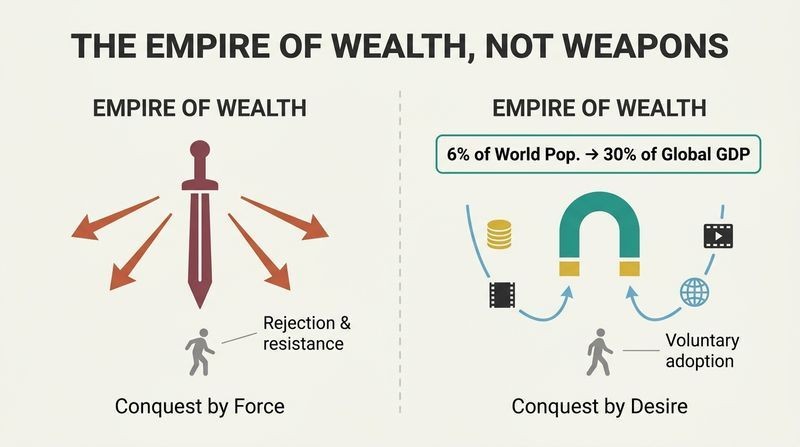
The framing is seductive but worth pressure-testing. Joseph Nye's concept of 'soft power' names the same phenomenon, and Gordon essentially argues that economic dynamism generates cultural gravity. Yet the claim that this conquest is 'welcomed' understates friction: anti-globalization movements, trade wars, and cultural backlash suggest the empire of wealth provokes resistance too. Gordon's comparison with Argentina, a nation equally blessed with land and resources yet stuck in stagnation, is his strongest evidence that institutions, not endowments, determine prosperity. That insight anticipates Acemoglu and Robinson's 'Why Nations Fail,' which similarly locates national fortune in inclusive versus extractive institutions.
English liberty and the supremacy of law seeded American prosperity
Geography gave England a head start. Twenty-three miles of Channel water made invasion nearly impossible, so England could stay a low-tax, lightly governed society that plowed resources into growth rather than armies. Its fluid class structure, with no closed aristocracy, let talent rise. Napoleon's insult, a 'nation of shopkeepers,' was worn as a badge.
The colonists inherited a radical idea: law, not the state, is supreme. Individuals held inherent rights, including property rights, that could not be arbitrarily seized. Gordon contrasts this with Argentina, which inherited Spain's control-from-the-top imperial model that repeatedly destroyed or blocked wealth creation. Same natural bounty, opposite outcome. The lesson: political and legal frameworks, transmitted from England and adapted to a vast secure continent, mattered more than soil or minerals.
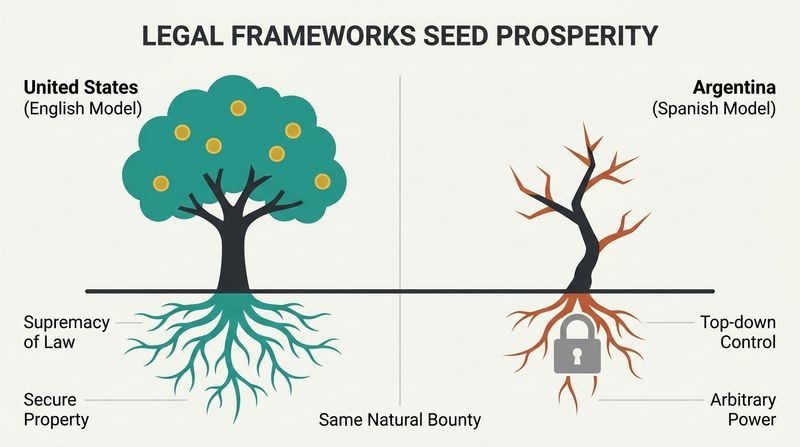
Gordon's institutional determinism is broadly persuasive and echoes Douglass North's work on how property rights and low transaction costs enable growth. The Channel-as-destiny argument, though, flirts with geographic determinism that Jared Diamond popularized and many historians distrust. Plenty of island nations never developed representative government. What Gordon underweights is contingency: the English liberty tradition survived civil wars, a beheaded king, and a Glorious Revolution, none of them inevitable. Still, the Argentina counterfactual is analytically sharp. It isolates institutions as the variable by holding resources roughly constant, a natural experiment that undercuts any purely materialist explanation of American success.
Chronic labor scarcity made America inventive and, tragically, enslaved
Land was abundant; hands were not. From Jamestown onward, the defining constraint on the American economy was too few workers for too much fertile land. Virginia's headright system gave 50 acres to anyone who paid their passage, luring indentured servants despite a 25 percent first-year death rate. The promise of owning land drove immigration for centuries.
The same scarcity birthed both Yankee ingenuity and slavery. Labor shortage pushed Americans to mechanize relentlessly, from the cotton gin to McCormick's reaper. But it also created demand that, once life expectancy rose, made lifelong slaves cheaper than temporary servants. A slave costing 25 to 30 pounds outlasted a servant costing 15. Gordon calls slavery the nation's gravest moral failure, acquired 'innocently and without forethought' as a fix for an economic problem.
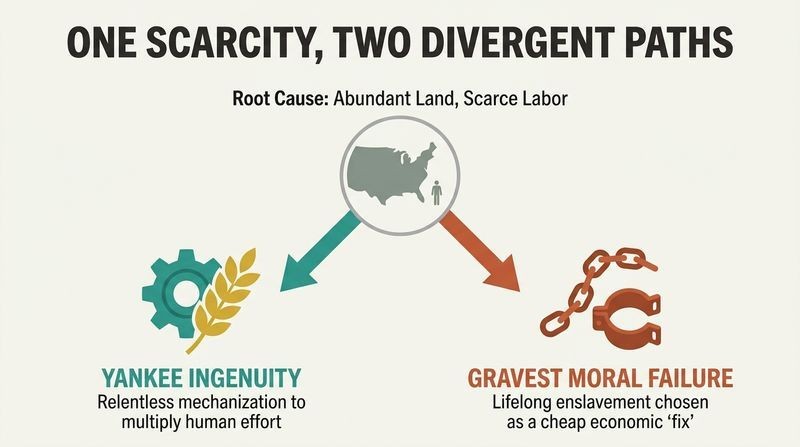
The dual legacy of labor scarcity is one of the book's most uncomfortable and honest threads. Economic historians like Evsey Domar formalized this: where land is abundant and labor scarce, free workers demand high wages, so elites turn to coercion. Gordon's phrase 'without forethought' will trouble some readers, and rightly so, since it risks softening moral agency. Yet his core mechanism holds: the mechanization that later defined American industry and the bondage that scarred it sprang from the same root. The tension between labor-saving innovation and labor exploitation recurs throughout economic history, from Roman latifundia to modern debates over automation.
Hamilton turned worthless debt into the world's best credit rating
In 1789 America was a financial basket case. Its currency was near worthless, its debts unpaid and unpayable, foreign powers treated it with contempt. Alexander Hamilton, the poor-born immigrant who grew up in a Caribbean counting house, understood public finance better than any Founder.
He built the machinery of a modern economy from scratch. Hamilton insisted the federal government honor its Revolutionary debt in full, at face value, even to speculators, because credibility mattered more than fairness. He assumed the states' debts to bind wealthy citizens to the Union's success. He created the Bank of the United States to discipline state banks and liquefy capital. By 1794 U.S. bonds carried the highest credit rating in Europe, some selling above par. That borrowing power later financed the Civil War and Great Depression response.
Hamilton's genius, as Gordon presents it, was recognizing that a national debt, properly funded, is a national asset. This inverts the intuition that debt is weakness. Britain had proven it: its debt-financed navy let a small nation punch far above its resource weight, exactly as Cicero's 'infinite money is the sinews of war' suggested. Modern sovereign finance rests on Hamilton's insight that a government's reputation for repayment is its most valuable possession. The critique to keep in mind: cheap credit also enables reckless borrowing, and Hamilton's own system did not prevent the boom-bust cycles that plagued the century after his death.
Jefferson's hatred of banks cost America 80 years of stability
One brilliant man's blind spot became a national wound. Thomas Jefferson, born rich and cavalier about money, loathed banks and cities with near-religious fervor. His vision of a rural republic of yeoman farmers was fundamentally at odds with the industrializing nation actually emerging.
The consequences were brutal and recurring. Jefferson's followers dismantled Hamilton's regulatory system and replaced it with nothing. Andrew Jackson finished the job in the 1830s by destroying the Second Bank of the United States, leaving America with no central bank for nearly 80 years. The result: financial panics roughly every 20 years, each deeper than it needed to be, because no institution could inject liquidity when sellers' panics struck. Not until the Federal Reserve's creation in 1913, and its maturation in the 1930s, was the wound finally closed.
Gordon's villain-hero framing of Jefferson versus Hamilton is vivid but one-sided. Jefferson's fear that concentrated financial power could corrupt republican government was not paranoid; the Gilded Age arguably vindicated some of it. The deeper lesson is about the danger of ideology outliving its context: a philosophy fitted to an agrarian 1790s republic was applied dogmatically to a machine-age economy it could not describe. Behavioral economics would note that Jefferson's aversion functioned like an identity-protective cognition, immune to disconfirming evidence. The recurring 20-year panics Gordon cites are a sobering case study in how institutional vacuums, not just bad actors, generate systemic fragility.
The Erie Canal made New York the metropolis of a continent
A single infrastructure gamble reordered a nation's geography. In 1817 New York bet an amount equal to three-quarters of the entire federal budget on a 363-mile ditch through wilderness, dug entirely by hand, requiring 83 locks. Jefferson called it 'little short of madness.' It was finished in eight years, ahead of schedule.
Transportation cost is a transaction cost, and collapsing it transforms everything. Before the canal, shipping a ton of flour from Buffalo to New York City cost 120 dollars and took three weeks. After, it cost 6 dollars and took eight days. New York City's population exploded from 123,700 in 1820 to 814,000 by 1860, and its share of national exports leapt from 9 percent to 62 percent. The canal welded the Midwest to the Northeast.
The Erie Canal is a textbook demonstration of how reducing transaction costs, expenses that add no intrinsic value to a good, unleashes disproportionate economic effects. This principle scales across history: containerized shipping, the Internet, and fiber-optic cable each collapsed a cost and rewired trade patterns. Gordon's framing rewards attention because it explains why New York, not Philadelphia or Boston, became the financial capital. The counterpoint economic geographers raise is path dependence: once a hub achieves critical mass, network effects lock in its dominance even after the original advantage fades. New York kept its crown long after canals became obsolete, illustrating how first-mover infrastructure can compound into permanent supremacy.
Scandals, not foresight, wrote the rules of American capitalism
Reform is reactive, and always lags the schemers. Gordon argues that in a free economy driven by self-interest, individuals innovate faster than society can regulate. The law perpetually trails new opportunities for both wealth creation and fraud. So the rules get written only after disaster exposes the gap.
Each scandal became an engine of reform. The Erie Wars of the 1860s, where Drew, Fisk, and Gould printed fraudulent stock to defeat Vanderbilt, led the stock exchanges to require registration and disclosure. The Crédit Mobilier railroad-construction fraud and the Tweed Ring courthouse graft spurred bar associations and anti-bribery laws. The 1929 crash produced the SEC. The savings-and-loan collapse of the 1980s, which cost taxpayers 200 billion dollars, led to banking reform. Corruption, painful as it is, clears the path for better institutions.
This is one of Gordon's most useful mental models: treat scandal as the immune response of a market economy rather than proof of its rot. It aligns with Hyman Minsky's financial-instability hypothesis, which holds that stability itself breeds the risk-taking that produces crises, generating a natural cycle of excess and correction. The optimistic reading is Darwinian: systems that survive scandals emerge more robust. The pessimistic caveat is that reform is often captured or hollowed out, as Gordon himself shows with the Interstate Commerce Commission becoming a government-enforced railroad cartel. Regulation written in the heat of scandal can enshrine the very interests it meant to check.
The steam engine and computer both cratered the price of a fundamental input
Great technologies work by making the once-expensive nearly free. Gordon draws a precise parallel across two centuries. The steam engine, perfected by Watt in 1784, collapsed the price of work-doing energy, letting it be applied to countless tasks previously too costly or impossible. It birthed railroads, steamboats, and the Industrial Revolution.
The computer did the identical thing for information. The microprocessor, first sold commercially by Intel in 1971, collapsed the cost of storing, retrieving, and manipulating data. Computing power that cost a thousand dollars in the 1950s costs a fraction of a cent today, following Moore's Law of doubling every 18 months. Just as the steam engine spun off the railroad as its great secondary technology, the computer spun off the Internet. Both revolutions weaponized abundance against tyranny.
The input-price-collapse framework is genuinely illuminating and generalizes well. Economists call these 'general purpose technologies,' innovations that ripple through every sector rather than one. Electricity, cited elsewhere in the book, is the third member of this club. Gordon's insight about the 'installed base problem,' that new technology only pays off once old capital wears out, explains the productivity paradox that puzzled economists in the 1980s and 1990s: computers were everywhere except the productivity statistics, until suddenly they weren't. One extension worth noting: each input collapse also destroys livelihoods, from hand weavers to clerks, a creative destruction that the aggregate gains conceal but that individuals feel acutely.
Two world wars bled Europe white and crowned America the creditor king
The twentieth century's catastrophes were America's coronation. Gordon calls World War I the seminal catastrophe of the century. Europe lost a generation: France 1.36 million dead, Germany 1.77 million, Britain 908,000. America lost 126,000 and its economy boomed on Allied orders. In four years the United States flipped from the world's largest debtor, owing 3.7 billion dollars, to a net creditor owed 12.6 billion.
World War II completed the transfer. America turned its capitalist economy into a centrally planned war machine overnight, producing more war material than any nation in history. Ford's Willow Run plant built a B-24 bomber every 63 minutes. By 1945 the United States produced fully half the world's output and held 80 percent of its monetary gold. Financial supremacy moved from London's Lombard Street to Wall Street.
Gordon's observation that America emerged stronger from all three great-power conflicts of the century, without adding sovereign territory, is a striking counterpoint to classical imperial models. The mechanism was distance plus productive capacity: an ocean shielded American industry while Europe's was bombed flat. This echoes Paul Kennedy's 'The Rise and Fall of the Great Powers,' which ties geopolitical rank to economic base. A sharper critique is that America's postwar generosity, the Marshall Plan and Lend-Lease, was enlightened self-interest, not pure altruism: a creditor needs solvent customers. Rebuilding rivals created markets for American exports, a lesson in how hegemons sustain themselves by growing the pie rather than hoarding it.
Deregulation and tax cuts predated Reagan and rescued a stalling economy
The 1970s revealed that New Deal machinery had outlived its context. Stagflation, a word coined in 1970 for the impossible combination of rising inflation and rising unemployment, broke Keynesian assumptions. Nixon's wage and price controls failed exactly as Diocletian's had in third-century Rome, because fixed prices produce shortages, not stability.
Reform began under Carter, not Reagan. Airline deregulation in 1978 ended a cartel that kept fares artificially high. The Steiger capital-gains tax cut of 1978 revived venture capital from 39 million dollars raised in 1977 to 1.3 billion by 1981. Wall Street's 'Mayday' in 1975 ended fixed commissions, cutting trading costs 40 percent overnight. Reagan extended the trend, and Volcker's brutal interest-rate medicine finally broke inflation, from 13.5 percent in 1980 to 4.1 percent by 1983.
Gordon's point that deregulation was bipartisan and began under a Democrat is a useful corrective to partisan mythology. The Laffer Curve claim, that excessively high rates can reduce total revenue, is real but frequently overstated; it holds only at extreme rates, and Gordon's capital-gains data is his cleanest evidence. The deeper theme is that policy regimes have expiration dates. Rules calibrated for the 1930s depression became straitjackets in a globalizing, information-driven economy. Yet the same deregulatory wave that revived venture capital also enabled the savings-and-loan disaster, a reminder that dismantling rules without rebuilding appropriate guardrails invites its own catastrophe. Deregulation is a scalpel, not a hammer.
A free currency market can now overrule any government's economic policy
In 1981 markets fired a warning shot heard round the world. When France's new socialist president Mitterrand raised taxes and nationalized banks, the franc plunged on the international currency market until his government reversed course. Gordon calls it a pivotal moment: for the first time, a free market dictated policy to a Great Power.
The old gold standard was replaced by a global currency standard. Collapsing communication costs, from a million overseas calls from America in 1950 to 6.3 billion by 2001, knitted the world's financial markets into one seamless machine trading around the clock, a trillion dollars a day even in 1980. This standard is more flexible, more exacting, and more democratic than gold ever was. Governments that once controlled information and capital found their power slipping away.
This is Gordon at his most provocative: markets as a disciplining force on democratic governments. The framing as 'more democratic' is debatable and worth interrogating. Bond and currency traders are not voters, and their collective judgment reflects wealth-weighted preferences, not one-person-one-vote. Critics from the left see this as a democratic deficit, where unelected capital vetoes elected mandates. Yet Gordon's underlying observation is sound and echoes the 'bond vigilantes' of the 1990s and the eurozone crises of the 2010s. The structural point endures: in a world of instant capital mobility, no economy is an island, and policy autonomy shrinks. Whether that constrains folly or democracy depends on one's vantage point.
American fortunes churn constantly because primogeniture never took root
No dynasty survives the American economy for long. Gordon notes that new fortunes relentlessly supplant old ones. John Jacob Astor died the richest American in 1848 with 25 million dollars. Commodore Vanderbilt left 105 million by 1877. Carnegie sold out for 480 million in 1901. Rockefeller was worth 2 billion by 1916. Bill Gates's fortune dwarfed them all.
Because inheritance splits among heirs, wealth disperses within a few generations. America never adopted primogeniture, the practice of the eldest son inheriting everything, so it never bred a permanent aristocracy. Of the 400 richest Americans in 2000, nearly two-thirds built their fortunes from scratch; only 19 percent inherited enough to qualify. Except for Rockefeller and Hearst, no name legendary for Gilded Age wealth appears on the modern list. The super-rich are perpetually nouveau riche.
This churn is Gordon's strongest evidence for American economic dynamism, and it aligns with Schumpeter's creative destruction: the same forces that topple firms topple family fortunes. The self-made statistic is genuinely striking. Yet the picture is contested. Recent work by Thomas Piketty argues that when returns on capital exceed growth, inherited wealth reasserts itself, and studies of surname persistence by Gregory Clark find social mobility slower than headline numbers suggest across many societies. The tension is real: entrepreneurial churn at the very top can coexist with sticky advantage in the broad upper-middle class. Gordon's optimism captures the dynamism of frontier capitalism but may understate how durably the merely affluent transmit privilege.
Analysis
Gordon's 'An Empire of Wealth' is popular narrative economic history in the grand style: thesis-driven, anecdote-rich, and unapologetically pro-market. Its organizing argument is that American power flows from economic dynamism rather than military conquest, and that this dynamism was itself the product of inherited institutions, English liberty, the rule of law, secure property rights, and a lightly governed continent, interacting with a chronic labor shortage that drove both mechanization and, tragically, slavery. The book's great strength is its command of illustrative detail and its recurring analytical motifs: transaction costs, the input-price-collapse theory of transformative technology, the necessity of a central bank, and the reactive nature of regulatory reform. These give a sprawling 400-year story genuine intellectual spine.
The book's ideological posture deserves scrutiny. Gordon writes squarely in the Hamiltonian, market-friendly tradition, casting Jefferson and Jackson as economic villains and celebrating financiers as institution-builders. This lends clarity but flattens complexity. His treatment of slavery, described as acquired 'innocently and without forethought,' will strike many modern readers as morally evasive, even as his economic mechanism (life expectancy shifting the cost calculus from servants to slaves) is analytically valuable. His faith that markets 'work in the long term' and that scandals reliably produce reform underplays regulatory capture, which he himself documents with the Interstate Commerce Commission.
Written in 2004, the book's confident closing note, that infinite money is the sinews of war and America can supply them, reads differently after the 2008 financial crisis it did not anticipate. Its celebration of deregulation sits uneasily beside the savings-and-loan disaster it recounts. Yet these tensions are instructive rather than disqualifying. Gordon offers a coherent, testable thesis about why nations prosper: institutions and incentives, operating under law, harness self-interest for collective wealth. Read alongside more skeptical works like Piketty or Acemoglu and Robinson, it forms one pole of an essential debate about the sources and durability of American economic power.
Review Summary
An Empire of Wealth receives mostly positive reviews for its comprehensive economic history of the United States. Readers appreciate its readability, insightful anecdotes, and focus on technological innovations and financial developments. Some criticize the author's conservative bias, especially in later chapters, and wish for more depth on certain topics. The book is praised for its coverage of colonial and early American history, though some find the treatment of recent events less satisfactory. Overall, it's considered a valuable overview of American economic development.
Glossary
Empire of wealth
Influence spread through economic appealGordon's central concept: American global dominance achieved not through military conquest or territorial rule but through economic success and the cultural products and ideas that success generates. Others adopt American ways voluntarily because they desire American prosperity, making it a subtler, more pervasive, and more permanent form of influence than any prior empire based on force.
Transaction cost
Expense adding no intrinsic valueA cost that adds to a product's price without adding to its intrinsic worth, such as transportation, advertising, sales, and packaging. Gordon uses it to explain the Erie Canal's impact: by collapsing the cost of moving goods from Buffalo to New York from 120 dollars to 6 dollars a ton, it dramatically lowered final prices and unleashed far-reaching economic transformation.
Yankee ingenuity
American knack for practical inventionGordon's recurring term for the distinctively American talent for practical mechanical innovation, first exemplified by a 1646 patent at the Saugus Iron Works. He argues it was driven by chronic labor scarcity, which made labor-saving devices like the cotton gin, mechanical reaper, and integrated flour mill especially valuable, and it later found institutional form in the industrial research laboratory.
Fiat money
Money valuable only by decreeCurrency that has value only because the government declares it legal tender, rather than being made of or backed by a valuable commodity like gold or silver. Gordon notes it costs almost nothing to produce, which historically made it irresistible to politicians facing fiscal pressure, leading repeatedly to inflation, as with Revolutionary continentals and Confederate paper money.
Stagflation
Simultaneous inflation and unemploymentA term coined in 1970 to describe the unprecedented and, under Keynesian theory, supposedly impossible combination of rising inflation and rising unemployment occurring at the same time. It characterized the American economy in the 1970s and signaled that New Deal-era economic assumptions no longer fit the changed economic environment.
Installed base problem
Old capital delays new technologyThe economic principle that new technology's full productivity benefits are delayed because existing equipment is already paid for, making it uneconomical to replace until it wears out. Gordon uses it to explain why electricity's and the computer's productivity gains arrived decades after their invention, and why the obsolete Erie Canal still carried freight as late as 1970.
Moore's Law
Chip power doubles every 18 monthsThe prediction by Intel founder Gordon Moore that the number of transistors on a computer chip, and thus its computing power, would double roughly every eighteen months. Gordon cites it to illustrate how the microprocessor collapsed the cost of information processing, from a thousand dollars per calculation in the 1950s to a fraction of a cent, transforming the world economy.
FAQ
What’s An Empire of Wealth by John Steele Gordon about?
- Epic economic history: The book traces the rise of American economic power from colonial times through the late 20th century, focusing on how money, innovation, and policy shaped the nation.
- Interplay of forces: Gordon explores the dynamic relationships between technological advances, financial institutions, political decisions, and social changes in building the U.S. economy.
- Key milestones covered: Major events such as the Industrial Revolution, Civil War, Great Depression, World War II, and the digital age are woven into a continuous economic narrative.
Why should I read An Empire of Wealth by John Steele Gordon?
- Accessible and engaging: Gordon’s lively prose makes complex economic history understandable and entertaining for both general readers and history buffs.
- Comprehensive coverage: The book spans over four centuries, providing deep insight into the forces that shaped modern America’s economic landscape.
- Lessons for today: Understanding historical economic cycles, innovations, and policy decisions offers valuable context for current economic challenges and opportunities.
What are the key takeaways from An Empire of Wealth by John Steele Gordon?
- Innovation as a driver: Technological advances like the steam engine, electricity, and computers consistently fueled economic growth and transformed industries.
- Institutions and policy matter: Legal frameworks, government intervention, and financial institutions played crucial roles in stabilizing and expanding the economy.
- Consumer and market power: The rise of mass markets and consumer credit democratized wealth and shifted business models, making consumers central to economic development.
How did English legal and political traditions influence the American economy in An Empire of Wealth by John Steele Gordon?
- Law over state supremacy: The English tradition of law protecting property and individual rights was transplanted to America, fostering economic security.
- Decentralized governance: England’s flexible social structure and decentralized government allowed talent and capital to flourish, a pattern repeated in the colonies.
- Geographic advantages: Both England’s and America’s relative security allowed resources to be invested in economic development rather than defense.
What role did joint-stock companies and corporations play in early American economic development according to An Empire of Wealth by John Steele Gordon?
- Financing colonization: Joint-stock companies like the Virginia Company pooled investor capital, enabling costly exploration and settlement.
- Risk-sharing and innovation: The corporate form allowed for shared risks and rewards, encouraging economic experimentation in uncertain environments.
- Foundation for growth: These early corporations established trade networks and economic structures that became the backbone of the U.S. economy.
How did technological innovations such as the steam engine, cotton gin, railroads, and electricity shape the U.S. economy in An Empire of Wealth by John Steele Gordon?
- Productivity leaps: Inventions like the cotton gin and steam engine drastically increased productivity and expanded markets.
- Transportation revolution: Canals, steamboats, and railroads lowered costs, integrated national markets, and facilitated westward expansion.
- Electrification impact: Electricity transformed factories, homes, and lifestyles, enabling mass production and consumption, and boosting living standards.
How did Alexander Hamilton’s financial policies shape the early American economy in An Empire of Wealth by John Steele Gordon?
- Restoring public credit: Hamilton’s assumption of state debts and funding of the national debt attracted investment and stabilized government finances.
- National bank creation: The Bank of the United States centralized funds, regulated currency, and provided a stable banking system.
- Industrial promotion: Protective tariffs and support for manufacturing laid the groundwork for America’s industrial growth, despite political opposition.
How did the Civil War and its aftermath transform the American economy according to An Empire of Wealth by John Steele Gordon?
- Massive government spending: The war required unprecedented fiscal strategies, including bond drives and the issuance of paper money.
- Financial modernization: The creation of a national banking system and the use of greenbacks stabilized currency and financed the war.
- Industrial expansion: War demands stimulated manufacturing and infrastructure, accelerating the North’s economic dominance and unifying the national economy.
How did major industrialists like Andrew Carnegie and John D. Rockefeller impact the U.S. economy in An Empire of Wealth by John Steele Gordon?
- Carnegie and steel: Carnegie’s adoption of the Bessemer process and vertical integration made U.S. Steel the world’s largest producer, exemplifying efficiency and innovation.
- Rockefeller and oil: Rockefeller built Standard Oil into a near-monopoly through consolidation and efficiency, lowering prices and pioneering the trust structure.
- Philanthropy and legacy: Both men donated vast fortunes to public causes, but their business practices sparked debates about monopoly power and regulation.
What caused the Great Depression and how did the New Deal respond, according to An Empire of Wealth by John Steele Gordon?
- Complex causes: The Depression resulted from global debt cycles, high tariffs, Federal Reserve missteps, and widespread bank failures.
- Banking collapse: The failure of major banks and loss of public confidence led to economic contraction and soaring unemployment.
- New Deal reforms: Roosevelt’s administration introduced banking reforms, social safety nets, and economic recovery programs to stabilize and revive the economy.
How did World War II and the postwar era reshape the American economy in An Empire of Wealth by John Steele Gordon?
- Industrial mobilization: The U.S. economy shifted to massive wartime production, leading to rapid growth and full employment.
- Social transformation: Women and minorities entered the workforce in large numbers, and the GI Bill expanded education and home ownership.
- Global dominance: Postwar, the U.S. emerged as the world’s economic leader, with the dollar as the reserve currency and a booming consumer economy.
What is the significance of computers and the Internet in the modern American economy according to An Empire of Wealth by John Steele Gordon?
- Technological revolution: The development of transistors, microprocessors, and the Internet exponentially increased computing power and reduced costs.
- Economic transformation: Computers and the Internet reshaped industries, democratized information, and changed consumer and business behavior.
- Global and military impact: Originating from military research, these technologies enhanced U.S. military capabilities and contributed to America’s continued economic leadership.
Download PDF
Download EPUB
.epub digital book format is ideal for reading ebooks on phones, tablets, and e-readers.








































