
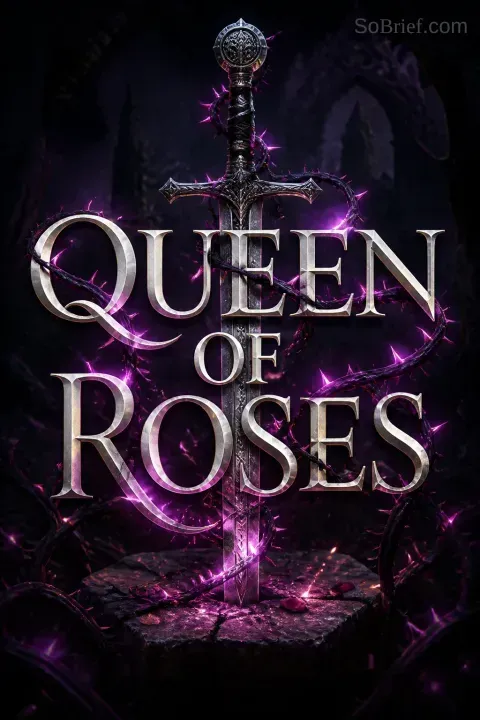


Plot Summary
Prologue
A dagger whistles through the air. Morgan1 is held fast, unable to move, as battle sounds echo from the chamber beyond. She closes her eyes, smelling the familiar sticky scent of blood. His voice rings in her mind, shouting her name, more powerful than the sea and more primordial than the stars, promising unspeakable darkness to any who come between them.
She longs to fight at his side but her body is too weak to rise. She thinks of how she hated him at first, how perhaps a part of her still does. Yet one certainty remains: he is the air she breathes. She cannot live without him. The clash of blades grows nearer.
The prologue establishes the romantic stakes in medias res before the story proper begins, creating a narrative loop that only closes in the final chapters. Morgan's physical helplessness contrasts with the emotional intensity of the moment: she hears Draven's voice in her mind, a telepathic promise of violent protection. The paradox that opens the book (she hated him, yet he is now essential to her existence) economically frames the entire enemies-to-lovers arc. The blood imagery and battle sounds place this firmly in dark fantasy territory, while the confession of emotional dependency foreshadows the bond that will ultimately save her life.
Under the Bed
Five-year-old Morgan1 lies beneath her mother's heavy four-poster bed, reading a book of fae creatures, when King Uther stumbles in reeking of mead. He accuses Ygraine of humiliating him, of trapping him in a faerie marriage, of becoming undesirable now that younger human women catch his eye.
Ygraine's voice stays gentle as she tries to redirect him toward the gardens. Uther's hand strikes her face. Blood streams from her lips and nose. Morgan1 bites her own lip raw, tasting iron, willing her mother to look at her. When Ygraine's sapphire eyes finally meet hers, the silent message is for Morgan1 alone: an apology and a farewell.
Uther's next blow smashes her head against the stone wall. Her body crumples, crimson skirts pooling like scattered rose petals. Morgan1 stays frozen. Uther runs to the door, already shouting for servants, already crafting the lie of a tragic accident.
This scene establishes Morgan's foundational trauma with brutal economy. The child's perspective limits what she understands but sharpens sensory details: the smell of mead, the sound of fist on flesh, the sight of blood on crimson fabric. Ygraine's refusal to fight back, despite being full fae, suggests she chose passivity to avoid revealing her nature before her daughter. The bed becomes the central symbol of Morgan's life for the next fifteen years: a hiding place where she watches horror unfold without power to intervene. The fact that Uther immediately constructs a cover story teaches Morgan that power determines truth.
The King's Justice
Fifteen years later, Morgan1 trains in the castle yard when she collides with Kairos Draven,2 a towering new recruit who dismisses her without apology. Later, in the Great Hall, Arthur3 presides over an impromptu court session. Guards drag in a young part-fae boy, his back already striped with whip marks.
The charge: stealing a single apple from the market. Arthur3 escalates it to spying, a capital offense. Merlin,9 the High Priestess, tries to claim the boy for the temple; Lord Agravaine,14 Arthur3's closest advisor, argues for harsh retribution. Arthur3 nods. A guard's sword falls.
The boy's head rolls across rose petals strewn on the stone floor. Courtiers scream as blood splatters their fine garments. Morgan1 watches Draven,2 pressed against a pillar, his face contorted with undisguised revulsion. The reaction unsettles and intrigues her in equal measure.
Arthur's first onstage act as king is the judicial murder of a child, establishing the novel's political stakes with visceral immediacy. The escalation from petty theft to execution reveals Arthur's need to demonstrate absolute power through theatrical cruelty. The fae-blooded boy functions as a dark mirror for Morgan: both are part-fae in a court that increasingly despises their kind, and both are disposable before the throne. Draven's visible revulsion at the execution complicates his earlier rudeness, suggesting a man who masks deeper feelings beneath callousness. Morgan's habit of watching without intervening is her childhood coping mechanism calcified into adult paralysis.
The Boar Hunt
At night, Morgan1 secretly joins a band of poachers who steal game from the king's forest to feed hungry families. During a boar hunt, the beast wounds two men before Morgan1's arrow buries itself in its throat. The boar charges her anyway.
Draven2 appears from the darkness, kills it with a single spear thrust, then tells Morgan1 and Kaye,5 who followed her, that they are weak and should stay home. Later, Morgan1 goes to the marketplace to find the next hunt's meeting details.
Baudwin, the group's leader, lures her into an alley where two other men seize her, planning to ransom her to Arthur.3 A knife opens her throat just before Draven2's crossbow bolt kills her captor. He slaughters all three men, then forces Morgan1 onto his horse and rides her back through the dark streets.
This section establishes the central tension of Morgan's character: her desire to act and help is constantly thwarted by circumstances and her own limitations. The poachers represent grassroots resistance to Arthur's regime, but Morgan's presence inadvertently destroys them. Draven's violence is excessive: he kills Baudwin, who may have been an unwilling participant in the kidnapping. His contempt for Morgan's 'weakness' masks something more complex, as his later discovery of her bruises from Florian will reveal. The alley ambush demonstrates that Morgan is seen by the desperate populace not as an ally but as a tool, a piece of royal leverage.
The Name on Her Chest
For years, Florian Emrys7 has stalked and tormented Morgan.1 Now he escalates. He slips a paralytic into the medicine a servant brings to her room. Morgan1 wakes tied to her own bed, Florian7 astride her, his weight pinning her down. He taunts her about her gray hair, her dead mother, her uselessness.
He reveals his father will petition Arthur3 to annul her temple vows so Florian7 can marry her and possess her completely. Then he lifts a small dagger and carves his name in shallow cuts above her breast, calling it a token of his affection.
Morgan1 cannot move, cannot scream, can only blink as tears of rage roll down her cheeks. The next morning, Arthur3 summons her and mentions with casual indifference that he knows about Florian7's so-called devotion. He suggests she might have encouraged it.
Florian's attack is sexual violence as property claim: he literally overwrites Morgan's identity with his name on her skin. The drug-induced paralysis recapitulates her childhood paralysis under the bed, but now the threat is explicitly sexual. Arthur's response adds institutional betrayal to personal violation: the king knows his advisor's son is assaulting his sister and treats it as a matter of mild curiosity rather than outrage. Morgan's body has never truly been her own; it belongs to her father's decree, her brother's political calculations, and now Florian's knife. The branding is a perverse mirror of the magical runes that will later appear on her arms.
A Chest of Severed Heads
At a spring gala, Sir Ector8 pulls Morgan1 aside with devastating news: her two traveling companions on Arthur3's mysterious quest will be Ragnar Whitehorn,12 Agravaine's brutal enforcer, and Kairos Draven,2 whose true identity is Void's Edge,2 a notorious assassin who slaughtered the entire royal family of Rheged, children included.
Arthur3 knew Draven2's identity from the start. Later, Arthur3 summons Morgan1 to a private chamber. On a table sits a rough wooden chest. He commands her to open it. Inside, seven severed heads stare with dead eyes. Morgan1 recognizes Yaryna, the russet-haired huntress.
Arthur3 has slaughtered her poacher comrades, accusing Morgan1 of organizing sedition. He reveals her true purpose: she will journey south to the abandoned fae kingdom of Valtain to retrieve Excalibur, the Blade of Perun, an ancient weapon capable of making its wielder invincible. Kaye5 will remain in Camelot as Arthur3's hostage.
The severed heads are Arthur's ultimate power move: he demonstrates that he can kill anyone Morgan cares about and will do so without hesitation. His simultaneous threat to Kaye and acknowledgment of Draven's identity as an assassin make the quest a death sentence disguised as a mission. Sir Ector's earlier revelation about Draven tested Morgan's trust in her only protector, but Arthur's box of heads leaves her no room to refuse the quest. The stakes shift from personal survival to the survival of everyone Morgan loves. Arthur's belief in Excalibur reveals a chilling theological ambition: he wants god-level power to complement his political authority.
The Rose Earring
After the gala, a storm rages. Morgan1 seeks the stables' quiet, but Florian7 is already there, his face battered and bruised from a recent beating. He blames her and attacks, tearing at her gown, pressing her against a pillar. His mouth is on her throat, his knife in his hand.
But unlike the night in her room, Morgan1 is not drugged. She reaches up, pulls the ruby rose earring from her ear, and drives the long silver stem into Florian7's throat. Blood sprays her face, her dress, the straw. Florian7 staggers, chokes, and collapses.
Draven2 appears in the stable doorway, soaked from the storm. He takes one look at the corpse, then tells Morgan1 to wash off the blood and pack. They are leaving tonight. He stays to dispose of the body. Morgan1 says a tearful goodbye to a sleeping Kaye5 and rides out into the rain.
The rose earring transforms a feminine ornament into an instrument of liberation. Morgan's killing of Florian is intimate, bloody, and unequivocal: she does not hesitate or falter. The act is self-defense, but it also carries the weight of years of torment finally avenged. Draven's response (no questions, no judgment, only practical assistance) cements his role as her protector in a way that transcends his mercenary contract. The storm into which they ride functions as a dark baptism: Morgan leaves Camelot not as a princess but as a fugitive and killer, washed clean of the blood she has just spilled.
Iron in the Blood
On the road, Whitehorn12 forces Morgan1 to take her fae-suppressing medicine daily instead of every other day. The mixture contains iron shavings. Morgan1 grows weaker with each dose, unable to eat, unable to sleep, her head splitting with pain.
She falls from her horse and cannot rise. Draven2 snatches the medicine bag from Whitehorn,12 discovers the iron, and throws the entire supply into the fire. That night, Whitehorn12 gags Morgan1 and tries to abduct her, first slitting Draven2's horse's throat.
Draven2 wakes, fights him into the forest, and kills him. But Whitehorn12's blade was poisoned with bloodwraith. Draven2 hides the festering wound beneath his tunic. Morgan,1 free of the medicine for the first time since childhood, begins to change in ways she cannot yet name.
The medicine, which Morgan accepted her entire life as necessary to suppress her 'tainted' fae blood, is exposed as literal poison. Whitehorn's compliance with Arthur's orders to increase the dose suggests Arthur wanted Morgan either dead or so weakened she could not function independently. Draven's destruction of the medicine is an act of rebellion against the king and a declaration of allegiance to Morgan's survival. The iron shavings weaponize folklore against fae physiology: what humans consider a protective ward becomes a murder weapon when ingested. Morgan's body, freed from suppression, begins a transformation that will redefine her identity.
Silver and Gold
Days without the medicine bring startling changes. Morgan1's dull gray hair brightens to gleaming silver. Her skin takes on a translucent golden undertone. Swirling silver runes appear on her arms, glowing faintly in the dark.
But Draven2's hidden wound worsens; bloodwraith poison blackens the gash below his ribs. When they reach the outlaw town of Nethervale and the magically concealed Noble Knight inn, Draven2 collapses with fever. That night, mercenaries attack through the windows.
Morgan1's terror triggers an eruption: fire jets from her palms, incinerating two men. A shockwave of energy blows out the inn's wall. When she touches Draven2's forehead in desperation, light floods the room and his wound seals closed. She collapses, drained but triumphant.
Morgan's physical transformation externalizes her internal liberation. The silver hair and golden skin invoke classical fae aesthetics, suggesting she was never monstrous but rather deliberately dulled by the medicine. Her powers manifest first as destruction (fire, the blown wall) and then as healing, implying a dual nature she has not yet learned to control. The healing of Draven through touch creates an invisible bond between them that neither acknowledges. Her magic responds to emotional urgency rather than conscious command, making it as dangerous to her as to her enemies. The inn attack introduces the question of who is hunting them and why.
The Lute Player's Charm
The lute player Vesper,4 who fought the mercenaries alongside them, joins the party. He is part-fae, golden-eyed, impossibly beautiful. He makes Morgan1 laugh, cooks her elaborate breakfasts, and plays his lute each night. His music seems to reach inside her, making her heart race and her body respond. In moonlit clearings, he kisses her, touches her, brings her to her first climax without taking her virginity.
Morgan,1 who has never been desired by anyone, falls completely. Draven2 grows increasingly suspicious but says little, retreating into brooding silence. Morgan1 and Vesper4's midnight trysts continue, his fingers on her body, his mouth on her skin, his whispered promises building a world she desperately wants to believe in.
Vesper's seduction operates as both genuine romance and magical manipulation. The enchantment in his music amplifies Morgan's natural attraction, but the desire itself is real: she has been starved of affection her entire life, and Vesper offers what she has never had. The physical intimacy, stopping short of full consummation, creates an emotional dependency that will make his eventual betrayal devastating. This section also represents Morgan claiming agency over her own pleasure despite her temple vows, a small rebellion against the celibate future that was forced upon her. Draven's silent withdrawal hints at emotions he refuses to name.
Lancelet's Warning
Lancelet6 appears in the night, having ridden through a fae portal arch that Merlin9 activated beneath the Temple of the Three. She is gaunt and exhausted. Her news is catastrophic: Arthur3 has invaded Lyonesse with Rheged's help, but Rheged withdrew, and Tintagel joined Lyonesse in retaliation. Pendrath now fights a two-front war.
Arthur3 has imposed martial law, drafted citizens, and executes dissenters daily in public hangings. He whipped Merlin9 publicly for protesting his violation of sacred law. He has conscripted Kaye5 into the army and plans to send him to the front lines. Lancelet6 was sent by Merlin9 and Sir Ector8 with one directive: Morgan1 must not give Excalibur to Arthur.3 The sword in his hands would make him unstoppable.
Lancelet's arrival transforms the quest from a personal survival mission into a geopolitical crisis. Arthur's war-making reveals him as an expansionist tyrant, not merely a cruel but locally contained king. The detail that Rheged was an ally who withdrew suggests Arthur is being manipulated by larger forces he cannot control. The threat to Kaye raises the stakes to their highest point: if Morgan fails, her brother dies. If she succeeds in retrieving the sword but gives it to Arthur, countless others die. Merlin's secret mastery of the fae portals reveals that the High Priestess has been hiding substantial magical knowledge from the crown.
The Hungry Dead
The group enters the fae ruins of Meridium. Along the way, they rescue a silent little girl, Odelna,13 from a fenrir-ravaged caravan. Draven2 insists on bringing her. In the ruins' great crossroads chamber, Draven2 reveals the city's history: a fae civil war ended when one faction released a plague that killed every fae child in Meridium.
That night, the children return. Not spirits, but undead horrors with rotting flesh, blackened eyes, and scissored teeth. Hundreds pour from every passage.
In the chaos, the creatures overwhelm Lancelet,6 dragging her limp body into the darkness. Draven,2 forced to choose between saving Odelna13 or Lancelet,6 saves the child. Vesper4 pulls Morgan1 away down a dark tunnel, fleeing the fight. She screams for her friend until her voice breaks.
The undead children literalize the novel's recurring theme of childhood destroyed by adult violence. These creatures are victims twice over: killed by plague, then reanimated as monsters that perpetuate the horror. Lancelet's apparent death is the quest's most devastating cost, and it happens because Morgan trusted Vesper, whose priority was getting Morgan to the sword rather than protecting anyone else. Draven's impossible triage choice (the innocent child over the trained warrior) reflects a moral code that values the helpless above the capable, with brutal consequences. The children also embody the novel's underlying question about fae nature: capable of both sublime beauty and unspeakable atrocity.
The Lady in the Lake
Vesper4 drags Morgan1 through tunnels to a vast underground lake. He drugs her with eleusia, then confesses everything: he was Arthur3's backup plan all along. His music enchanted her emotions. The inn attack was staged to win her trust.
He has a younger sister in Camelot whom Arthur3 threatened, but he also wanted the reward money for himself. He slashes Morgan1's wrist and pushes her into the lake. She falls through enchanted water into a crystalline chamber where the fae princess Orcades11 has been imprisoned for over a century.
Orcades,11 with amethyst hair and violet eyes, tells Morgan1 the sword is hers by bloodright. Morgan1 pulls Excalibur from its stone pedestal. Orcades11 touches Morgan1's forehead, commanding her to remember. Morgan1 sees her mother fleeing the fae city of Numenos with an infant in her arms. Then she surfaces, blade held aloft.
Vesper's confession retroactively poisons every tender moment, revealing the entire romance as calculated manipulation. His sister provides a sympathetic motivation (coerced cooperation), but his greed and callousness are entirely his own. The eleusia drugging mirrors Florian's earlier violation: both men used substances to strip Morgan of autonomy. The lake chamber is the novel's mythic core: a sleeping fae princess, a sword in a stone, a suppressed identity restored. Orcades's command to remember cracks open Morgan's childhood amnesia, suggesting her entire past has been deliberately obscured by the medicine and by her family's lies.
Ashes and Silence
Vesper4 pulls Morgan1 from the lake, taking Excalibur for himself. He stabbed her shallowly, he explains, to keep her compliant but not dead. He hears Draven2 approaching through the tunnels and readies a garrotte wire to ambush him. Morgan,1 bleeding onto the stones, forces herself upright.
She summons her power for the first time deliberately, begging it to rise not from fear but from desperate love. The magic erupts in a shockwave, slamming Vesper4 against a pillar. His body convulses in an aura of white light, then collapses into a pile of ash.
Orcades11 materializes, retrieves Excalibur, and hisses the word 'Siabra' with recognition and hatred before vanishing with the blade. Morgan1 collapses, hearing Draven2 shout her name, his voice filling her fading consciousness with impossible warmth.
Morgan's final magical act is her first fully intentional use of power. She kills Vesper not for herself (she is already dying) but to save Draven, completing her transformation from protected object to active protector. The callback to the prologue (Draven's voice promising darkness) creates a narrative loop that brings the book full circle. Orcades's cryptic reference to 'Siabra' and her theft of Excalibur introduce new mysteries even as the quest's initial objective dissolves: the sword was never meant for Arthur or Morgan, and Draven belongs to a fae subspecies that Orcades considers mortal enemies.
Epilogue
The exmoor pads into the chamber carrying Draven2 and the child Odelna13 on her broad back. Draven2 finds Morgan1 dying on the cold stones and lets out a string of curses. The little girl speaks for the first time, her voice the dry rasp of an ancient crone.
She has been a vessel for a goddess all along, testing him. She offers Draven2 a choice: claim Morgan1's dormant power for himself, or bind his life to hers through a blood ritual that can never be undone. Draven2 does not hesitate. He bends over Morgan,1 blood on his lips, and light envelops them both.
His human glamor strips away, revealing his true form: silver-tipped claws, sharp horns of black bone, pointed fae ears. He is Siabra, a dark fae warrior. The goddess pronounces the bond unbreakable. Morgan1's chest rises with steady breath. Draven2 lifts her into his arms.
The epilogue recontextualizes the entire novel. Draven's unexplained knowledge of fae history, his rapid healing, his uncanny senses, and his facility with violence all make sense once his Siabra identity is revealed: he is not a human assassin but a dark fae warrior who has been hiding in plain sight. Odelna's true nature as a goddess in a child's body explains her eerie survival and silence, and her 'test' reframes their rescue of her as a trial of character that Draven passed. The blood bond is presented not as coercion but as Draven's free choice: he could have taken Morgan's power for himself but chose to save her instead. For Morgan, this bond means she is no longer alone in her otherness, though she does not yet know what she has become.
Analysis
Queen of Roses operates on two intertwined levels: as a dark fantasy quest narrative and as a psychological study of identity suppression and recovery. Morgan1's journey from Camelot to the ruins of Meridium is simultaneously geographical and existential: she travels toward a mythical sword but also toward the self she was chemically prevented from becoming. The novel's central metaphor is the suppression potion itself, a substance that keeps Morgan1 acceptably human at the cost of chronic pain and near-fatal poisoning. Her family did not merely hide what she was; they poisoned her slowly, teaching her that her true nature was monstrous enough to warrant self-erasure. This pattern extends to her mother, Ygraine, who took the same potion and who died because she would not use her fae power to defend herself against a mortal man. The novel asks what happens when a woman stops making herself small for the comfort of those around her. The answer is explosive: fire from her palms, walls blown outward, men reduced to ash. Morgan1's magic is not gentle or beautiful; it is terrifying, destructive, and entirely her own. The romance plot reinforces this theme through contrast. Vesper4 offers Morgan1 the illusion of being loved for who she is, but his affection is revealed as another form of manipulation (magically amplified seduction in service of Arthur3's agenda). Draven,2 by contrast, consistently sees Morgan1 clearly (noticing her hidden injuries, recognizing her strength beneath her self-doubt) and protects her autonomy even when it inconveniences him. He destroys the potion that was killing her. He disposes of Florian7's body without asking for anything in return. His eventual choice to bind himself to her through blood is framed not as possession but as sacrifice: he gives up his freedom to save her life. The novel's political dimension is equally sharp. Arthur3's Camelot is a study in how tyranny escalates when unchecked: it begins with the execution of a single child for a minor crime and ends with full-scale war, public hangings, and the conscription of children into the army. The fae civil war backstory (one faction annihilating the other's children through biological warfare) serves as a cautionary parallel: hatred of the other, when given power, leads to atrocities that reverberate for centuries. The undead children of Meridium are the literal embodiment of this: innocent victims transformed into monsters by adult hatred, still hungry and still suffering a hundred years later. The novel leaves multiple threads unresolved by design (Orcades11's war, Draven2's Siabra people, the fate of the sword, Arthur3's reign, Kaye5's survival), positioning itself as the first movement in a larger symphony. Its central achievement is making Morgan1's transformation feel earned: every step from suppressed princess to fire-wielding fae warrior is paid for in pain, loss, and irreversible choice.
Review Summary
Queen of Roses is a dark fantasy romance retelling of Arthurian legend with fae elements. Readers praised the world-building, intriguing plot, and slow-burn romance between Morgan and Draven. Many enjoyed the unique take on familiar characters and the captivating writing style. However, some found the pacing slow and the main character naive. The book ends on a cliffhanger, leaving readers eager for the sequel. Overall, it received mostly positive reviews, with readers appreciating the blend of Arthurian lore and fae fantasy.
People Also Read
Characters
Morgan Pendragon
Disinherited fae-blooded princessTwenty-year-old eldest child of King Uther Pendragon, stripped of her birthright due to the fae blood inherited from her mother Ygraine. Since childhood, she has been forced to drink a bitter medicine that suppresses her fae traits, turning her hair prematurely gray. She was promised to the Temple of the Three upon her twenty-first birthday, denying her the throne, marriage, or children of her own. Morgan has spent her life hiding: under beds, beneath hoods, behind compliance. She trains secretly with Sir Ector8 in swordplay, finding rare moments of agency through physical combat. She is fiercely protective of her youngest brother Kaye5, the only family member who loves her unconditionally. Her deepest wound is the childhood memory of watching her father beat her mother to death while she hid, paralyzed, unable to intervene. That paralysis has shaped her: she has learned to endure, to witness, to swallow rage, but not yet to truly fight for herself. When the medicine is stripped away, long-dormant fae magic awakens within her, forcing her to confront the identity she was taught to despise.
Kairos Draven
Royal Guard captain with dark secretsA towering, raven-haired warrior recruited into Camelot's Royal Guard under false pretenses. Draven is brusque, arrogant, and infuriatingly capable. He dismisses Morgan1 as weak when they first meet, yet repeatedly saves her life with ruthless efficiency. Raised on what he claims was a farm, his actual past is far more violent: he is a legendary mercenary and assassin, rumored to have single-handedly eliminated the entire royal family of Rheged, including children. Arthur3 knew Draven's true identity and hired him deliberately. Draven's motivations remain opaque: he claims to want Excalibur for himself rather than Arthur3, but his growing protectiveness toward Morgan1 suggests loyalties more complex than simple self-interest. He notices her hidden injuries when no one else does, demands to know who hurt her, and disposes of a body for her without hesitation. His green eyes miss nothing, and his uncanny healing and knowledge of fae history hint at a nature far older and stranger than he admits.
Arthur Pendragon
Cruel young king of PendrathMorgan1's half-brother, Uther's illegitimate son by Ettarde, legitimized and placed above Morgan1 in the line of succession. Now nineteen and crowned, Arthur rules with theatrical sadism that escalates throughout the story. He executes a starving fae-blooded boy for stealing an apple. He knows his advisor's son Florian7 is assaulting Morgan1 and does nothing. He slaughters a group of poachers trying to feed the hungry and shows Morgan1 their severed heads in a chest. He sends Morgan1 on a likely fatal quest for an ancient weapon while holding their younger brother Kaye5 as a hostage. His invasion of Lyonesse, betrayal of sacred guest-right, and public whipping of the High Priestess9 reveal him as a tyrant who answers to no law but his own ambition. Arthur was not always like this: Morgan1 remembers a boy she loved and protected from their father's beatings, once throwing herself at Uther to save Arthur's life. That boy is now unrecognizable.
Vesper
Charismatic part-fae minstrelA golden-eyed, amber-haired lute player with otherworldly beauty who crosses Morgan1's path first at a festival in Grimhold, then during a deadly attack at an inn. He claims to be a wandering minstrel and treasure hunter headed to the same destination. His music has an entrancing quality that makes Morgan1's heart race and her body respond; he cooks her elaborate meals and spins romantic tales. Vesper is part-fae, which he uses to position himself as someone who understands Morgan1's otherness. He is also lethally skilled with throwing knives, moving across rooftops with feline grace. He speaks of a younger sister he supports, painting himself as a man driven by family loyalty. His easy charm and open admiration offer Morgan1 the affection she has been starved of her entire life, but his presence in their party is far from the happy coincidence he claims it to be.
Kaye Pendragon
Morgan's innocent younger brotherThe eleven-year-old son of Uther and his third wife Enid, who died giving birth to him. Kaye is gentle, sweet-natured, and utterly adoring of Morgan1, the only person who has consistently shown him love. He follows her on the secret boar hunt, eager to prove himself useful, and helps tend wounded hunters. When Morgan1 flees Camelot, she makes him promise to reveal nothing about the hunt to Arthur3 and to stay safe. Arthur3 later conscripts Kaye into the army and plans to send him to the front lines, using him as both a hostage against Morgan1 and a potential sacrifice. Kaye represents everything worth protecting in Morgan1's world.
Lancelet de Troyes
Morgan's fierce best friendA bold, brash knight-in-training with short blonde hair, mischievous blue eyes, and an unapologetic appetite for beautiful women. Lancelet is Morgan1's sparring partner and closest friend, unafraid to call her out for hiding under hoods. She is ferociously loyal and skilled with a blade. When Arthur3's tyranny escalates, she volunteers to ride through a dangerous fae portal to warn Morgan1 not to give Excalibur to the king. Her journey nearly kills her. Lancelet represents the life Morgan1 might have chosen: a woman who lives openly, loves freely, and refuses to be diminished by anyone else's expectations. Her fate in the Meridium ruins becomes one of the quest's most painful costs.
Florian Emrys
Morgan's sadistic stalkerThe handsome, cold-eyed son of Lord Agravaine14, Arthur3's most trusted advisor. Florian has tormented Morgan1 for years: destroying her books, stealing her clothes, cornering her in corridors. His obsession escalates to drugging her medicine, tying her to her bed, and carving his name into her chest with a dagger while she lies paralyzed. He claims he finds her 'strangely desirable' despite her gray hair and fae blood, framing his fixation as something she has bewitched him into feeling. His father plans to petition Arthur3 to annul Morgan1's temple vows so Florian can marry her. He represents the entitlement of powerful men who treat women's bodies as territory to be claimed and marked.
Sir Ector Prennell
Morgan's fatherly mentorA dark-skinned, grizzled knight who trains Morgan1 and Lancelet6 in swordplay against the court's disapproval. He treats Morgan1 with genuine affection, praising her skill and worrying about her safety. He is the father of Galahad10 and a man of quiet integrity in a court increasingly devoid of it. When he discovers Draven2's true identity as Void's Edge, he warns Morgan1 immediately. He later works with Merlin9 and Dame Halyna to oppose Arthur3's tyranny behind the scenes, organizing Lancelet6's mission to find Morgan1. Sir Ector represents the honorable father figure Morgan1 never had in Uther.
Merlin
High Priestess with hidden powerThe handsome, middle-aged High Priestess of the Temple of the Three Sisters, with ebony and silver hair and sharp, soul-searching eyes. She has long pressed Morgan1 about whether she possesses magic, each time receiving the same denial. Born of obligation rather than faith, Morgan1 has resisted Merlin's mentorship. Yet Merlin proves far more powerful and subversive than she appears: she secretly operates the ancient fae portals beneath the temple, scries Morgan1's location through water, and defies Arthur3's edicts publicly, for which she is publicly whipped. She sends Lancelet6 on a desperate mission to prevent Arthur3 from obtaining Excalibur. Merlin represents institutional faith that is more pragmatic and politically engaged than Morgan1 ever realized.
Galahad Prennell
Devout temple acolyteSir Ector8's gentle-hearted son, an acolyte at the Temple of the Three who has pledged himself to a life of celibate service. He is Morgan1's other closest friend, unfailingly kind and faithful, with a small gift for charming animals. He repairs Morgan1's vandalized portrait of her mother and offers her unwavering emotional support. When Arthur3 begins purging those with 'impure' natures from temple and army, Galahad's devotion to the goddesses makes him a target. His quiet faith stands in contrast to Morgan1's skepticism, yet his loyalty to her never wavers.
Orcades
Imprisoned fae princessA full-blooded fae of breathtaking beauty, with amethyst and silver hair, luminous pale skin, and violet eyes. She wears a gown of pomegranate silk embroidered with diamonds and has been trapped for over a century in a crystalline chamber beneath the lake in Meridium. She carries a long list of titles: Princess of the High Fae Court, Mistress of Lights, Slayer of the Siabra. She greets Morgan1 with unsettling amusement, revealing that Morgan1's blood was the key to her release. She claims Excalibur belongs to Morgan1 by bloodright but then takes it for herself, vanishing to wage her own war. Her recognition of Draven2 as 'Siabra' and her immediate hatred suggest an ancient enmity between her people and his.
Ragnar Whitehorn
Agravaine's brutish enforcerA surly, gray-bearded man in his mid-forties who serves as Lord Agravaine14's right hand. Arthur3 assigns him to accompany Morgan1 on the quest, with instructions to increase her medicine dose until she is too weak to resist. He poisons and kills a mother exmoor and her cubs for their pelts, demonstrating casual cruelty toward magnificent creatures. He attempts to abduct Morgan1 when Draven2 interferes with the poisoning. Whitehorn represents the banality of Arthur3's evil: men who follow monstrous orders without question, for whom cruelty is just another day's work.
Odelna
Mute child of mysteryA small girl of about five or six, with rich bronze skin and tight black curls, found alone and silent among the wreckage of a fenrir-ravaged caravan in the Bloodlands. A name tag hangs around her neck. She does not speak, does not cry, barely eats, and watches everything with unnervingly blank eyes. Draven2 refuses to leave her behind despite the danger, insisting she ride with them all the way into Meridium. Her survival of the fenrir attack with no visible injuries and her unchildlike stillness hint that she is far more than she appears.
Lord Agravaine Emrys
Arthur's manipulative advisorA sleek blond nobleman and Arthur3's closest counselor. He encourages Arthur3's cruelest impulses, arguing for the execution of the fae-blooded boy when Merlin9 pleads for mercy. He is the father of Florian7 and either ignores or enables his son's abuse of Morgan1. He petitions Arthur3 to annul Morgan1's temple vows so Florian7 can marry her, seeking to bind his family's power to the throne. Agravaine represents the courtier who thrives by feeding a tyrant's worst instincts.
Caspar Starweaver
Master of Potions and Morgan's uncleUther's illegitimate elder brother, an elderly apothecary who lives in the castle's underground laboratory. He is the one who brews Morgan1's fae-suppressing medicine, a formula her mother also drank. He reveals that Ygraine insisted on taking it to fit in among humans. He provides Morgan1 with extra supplies and oblique warnings about Arthur3's interest in blood rites and the god Perun. His knowledge of potions borders on the magical, though he claims his skill is purely scientific.
Plot Devices
Excalibur, the Blade of Perun
God-forged weapon of absolute powerAn ancient sword created by the gods, said to make its wielder utterly invincible in battle. According to legend, the fae stole it from humanity and hid it in the ruins of Meridium within the abandoned fae kingdom of Valtain. The sword's blade is made of a dark, light-absorbing metal etched with silver leaves and thorns; its hilt is pale, radiant metal with a filigree of vines; and its pommel bears a blood-red ruby carved into a rose. It is guarded by a lake that only opens to the blood of a specific fae lineage. Arthur3 believes the sword will make him unstoppable in his wars of conquest. Merlin9 and Sir Ector8 believe it must be kept from him at all costs. When Morgan1 retrieves it, the imprisoned fae princess Orcades11 takes it for her own purposes, revealing that the sword's true history and allegiance are far more complex than human legends suggest.
The Suppression Potion
Concoction that represses fae traitsA bitter herbal mixture brewed by Caspar Starweaver15 and given to Morgan1 since childhood, originally taken by her mother Ygraine before her. The potion suppresses any fae physical traits and magical abilities from manifesting, keeping Morgan1's appearance acceptably human: her hair turns a dull gray rather than the luminous silver it becomes without the medicine, and her innate powers remain completely dormant. The potion causes debilitating headaches and nausea as side effects. When Morgan1's dosage is secretly increased during the journey (with iron shavings added), it begins poisoning her, nearly killing her before Draven2 destroys it. The medicine represents systemic suppression of identity: Morgan1 was taught that her true self is so monstrous it must be chemically erased. Her mother took the same potion, suggesting a generational pattern of fae women muting themselves to survive in human courts.
Fae Portal Arches
Ancient gateways for instant travelMassive marble arches built by the fae centuries ago, lining the ancient stone road through Cerunnos and beyond. They function as magical portals allowing instantaneous travel across vast distances when activated. Merlin9 reveals she can operate a hidden arch beneath the Temple of the Three, using it to send Lancelet6 across the continent to intercept Morgan1. However, the arches are dangerous for mortals: Lancelet6's horse dies within days of transit, and Merlin9 warns of potential consequences for human travelers. The arches in Valtain itself have been deliberately destroyed, cutting off the easiest route to the fae ruins. The portal network represents the lost infrastructure of a more magically integrated world, now fragmented and decaying.
Vesper's Enchanted Lute
Music that bewitches listenersVesper4's lute playing carries a subtle fae enchantment that amplifies attraction and lowers resistance in those who hear it. The music does not create feelings from nothing but magnifies existing inclinations, making Morgan1 more receptive to his advances than she would be otherwise. The enchantment is insidious precisely because it is not total mind control: Morgan1's desire for Vesper4 is real, rooted in her genuine loneliness and longing, but the music artificially intensifies it and suppresses her natural caution. Draven2 seems partially immune or resistant, reacting to the music with irritation rather than entrancement. The device explores questions of consent and manipulation: how much of Morgan1's attachment to Vesper4 is her own choice, and how much is magical coercion?
The Blood Bond
Ancient Siabra life-binding ritualA forbidden fae ritual that permanently binds two lives together through an exchange of blood. When Draven2 finds Morgan1 dying from Vesper4's stab wound, the goddess inhabiting Odelna13's body offers him a choice: he can absorb Morgan1's dormant power for himself or bind his life force to hers to save her. He chooses the bond without hesitation. The ritual reveals his true Siabra form (horns, claws, pointed ears) which had been hidden beneath a human glamor. The bond is pronounced unbreakable by the goddess. Its full implications are not explained, but it seems to tether Morgan1's continued life to Draven2's, creating a magical marriage that neither can escape. The device introduces the novel's central romantic resolution while raising new questions about Draven2's people and their relationship to the other fae.
FAQ
Synopsis & Basic Details
What is Queen of Roses about?
- A Princess's Perilous Quest: Queen of Roses follows Morgan Pendragon, a disinherited princess of Camelot, whose fae blood makes her an outcast in her own court. Forced to take a mysterious medicine that suppresses her true nature, Morgan navigates a treacherous world ruled by her cruel brother, King Arthur.
- Journey for a Legendary Blade: Arthur sends Morgan on a perilous quest to retrieve Excalibur, a mythical sword of immense power, from the ancient, abandoned fae kingdom of Valtain. This journey is fraught with danger, from monstrous creatures and hidden enemies to the surfacing of Morgan's own suppressed magic.
- Unraveling Betrayals and Identity: Accompanied by the enigmatic assassin Kairos Draven and the charming minstrel Vesper, Morgan uncovers layers of betrayal, confronts her past traumas, and grapples with her true identity and burgeoning fae powers, leading to a climactic confrontation that reshapes her destiny.
Why should I read Queen of Roses?
- Deep Character Transformation: Readers should delve into Queen of Roses for Morgan Pendragon's compelling journey from a suppressed, traumatized princess to a powerful, self-accepting woman. Her internal struggles with identity, loyalty, and burgeoning magic offer a rich psychological depth.
- Intricate World-Building & Lore: The novel weaves a dark fantasy tapestry with unique fae lore, ancient prophecies, and a pantheon of gods that influence the mortal realm. The exploration of abandoned fae cities and the revelation of their brutal history add layers of mystery and intrigue.
- Complex Relationships & Moral Ambiguity: The story excels in its nuanced portrayal of relationships, particularly the antagonistic yet deeply intertwined dynamic between Morgan and Kairos Draven, and the deceptive charm of Vesper. It challenges readers to question loyalty, trust, and the nature of good versus evil in a world where even heroes have dark pasts.
What is the background of Queen of Roses?
- A Kingdom's Fae Prejudice: The story is set in Pendrath, a kingdom where fae bloodlines, once mingled with humans, are now feared and suppressed. This prejudice, particularly strong under King Arthur's reign, forms the core political and social backdrop, influencing character destinies and conflicts.
- Ancient Fae History & Abandonment: The narrative delves into a forgotten history of the fae, revealing their advanced civilization in Valtain and Numenos, their internal conflicts, and a devastating plague that led to their mysterious abandonment of Eskira centuries ago. This historical context explains the ruins, creatures, and lingering magic encountered on Morgan's quest.
- Shifting Religious and Political Power: Pendrath's traditional worship of the Three Sisters (Devina, Zorya, Marzanna) is being subtly undermined by King Arthur's renewed interest in Perun, the god of war, and his blood rites. This religious shift reflects Arthur's tyrannical ambitions and foreshadows the kingdom's descent into war and moral decay.
What are the most memorable quotes in Queen of Roses?
- "He was the air I breathed. I could not live without him." (Prologue): This enigmatic line, spoken by Morgan, powerfully foreshadows a deep, almost primal connection to a male figure, hinting at a bond that transcends hatred and becomes essential for survival, ultimately revealed to be with Draven.
- "You are a princess of royal blood and the future high priestess of all of Pendrath. But you like to 'blend in.'" (Chapter 5): Merlin's astute observation perfectly encapsulates Morgan's core conflict – her desire for invisibility and normalcy versus her inherent, powerful, and increasingly undeniable identity as a fae-blooded royal.
- "Blood calls to blood. You know what to do." (Chapter 35): Spoken by Nedola, the goddess of fate, this quote seals the unbreakable bond between Morgan and Draven, signifying not just a magical connection but a fated destiny rooted in their shared fae heritage and the sacrifices made for love and survival.
What writing style, narrative choices, and literary techniques does Briar Boleyn use?
- First-Person Introspection: Boleyn employs a close first-person perspective through Morgan's eyes, allowing readers deep access to her internal thoughts, fears, and emotional turmoil. This narrative choice emphasizes Morgan's psychological journey and the subjective experience of her trauma and awakening.
- Sensory-Rich and Visceral Prose: The author uses vivid, often visceral, sensory details to immerse the reader in Morgan's experiences, from the "sticky scent of blood" in the prologue to the "sickening stench of decay" in the ruins. This creates a raw, immediate atmosphere, particularly during moments of violence or discomfort.
- Foreshadowing and Symbolic Imagery: Boleyn masterfully weaves subtle foreshadowing throughout the narrative, such as the "nuggle" creature in Lorea's book hinting at shapeshifting, or the recurring motif of roses and thorns symbolizing beauty intertwined with pain and Arthur's oppressive rule. This enriches the plot and thematic depth, rewarding careful reading.
Hidden Details & Subtle Connections
What are some minor details that add significant meaning?
- The Nuggle's Foreshadowing: Lorea of Anselme's Booke of Beastes, Marvelouse and Rare (Chapter 1) introduces the "nuggle," a sly shapeshifting water horse always depicted as male. This seemingly throwaway detail subtly foreshadows Draven's true nature as a siabra, a dark fae capable of transformation, and his deep connection to water and primal forces.
- The Rose Court's Thorns: Beyond mere decoration, the "exquisitely carved pattern of thorns and roses" on Arthur's throne and the "ring of red roses" with "thorns" on the royal coat of arms (Chapter 2) symbolize Arthur's reign. The roses represent the superficial beauty and tradition of the court, while the thorns explicitly denote his cruelty, pain, and the oppressive nature of his rule.
- Caspar's "Overpowering Magic": Morgan's uncle, Caspar Starweaver, claims his skill is "the ability to overpower magic, if anything" (Chapter 10), rather than possessing it. This subtle detail hints at the true nature of the medicine he provides, not just as a suppressor of fae traits, but as a counter-agent designed to neutralize or control fae power, explaining its debilitating effects on Morgan.
What are some subtle foreshadowing and callbacks?
- Ygraine's Medicine and Fate: Caspar reveals Morgan's mother, Ygraine, also took the same medicine, insisting it would "keep her safe" (Chapter 10). This subtly foreshadows that Ygraine, like Morgan, was suppressing her fae nature, and implies that her death might not have been a simple accident, but a consequence of her hidden identity or a failure of the medicine's "protection."
- Draven's Animalistic Traits: From his initial "snort rudely" (Chapter 2) and "guttural growl" (Chapter 8) to his "cat-like crouch" (Chapter 17) and later connection with the exmoor, Draven's subtle animalistic behaviors foreshadow his eventual reveal as a siabra, a dark fae with primal, beast-like qualities.
- The Fae Mosaics' Dual Nature: The ancient fae mosaics in the temple (Chapter 5) depict fae as both "beautiful" and "monstrous," with "horns, claws, feathers, fur, and scales." This visual foreshadowing hints at the diverse and often terrifying forms of fae, including Draven's siabra form, challenging Morgan's idealized perception of her heritage.
What are some unexpected character connections?
- Laverna and Vesper's Past: The innkeeper Laverna's familiarity with Draven and her later reveal of a past "contract" with Vesper in Valtain (Chapter 29) suggests a deeper, more complex network of mercenary and fae-connected individuals operating outside Camelot's direct influence, hinting at a hidden underworld.
- Odelna's True Identity as Nedola: The mute child Odelna, rescued from the Bloodlands, is unexpectedly revealed to be Nedola, the goddess of fate (Chapter 35). This transforms her from a simple victim into a powerful, ancient entity, whose presence and actions throughout the journey were a deliberate test and manipulation of events.
- Arthur's Knowledge of Draven's Past: Sir Ector's
Blood of a Fae Series
About the Author


Download PDF
Download EPUB
.epub digital book format is ideal for reading ebooks on phones, tablets, and e-readers.








































