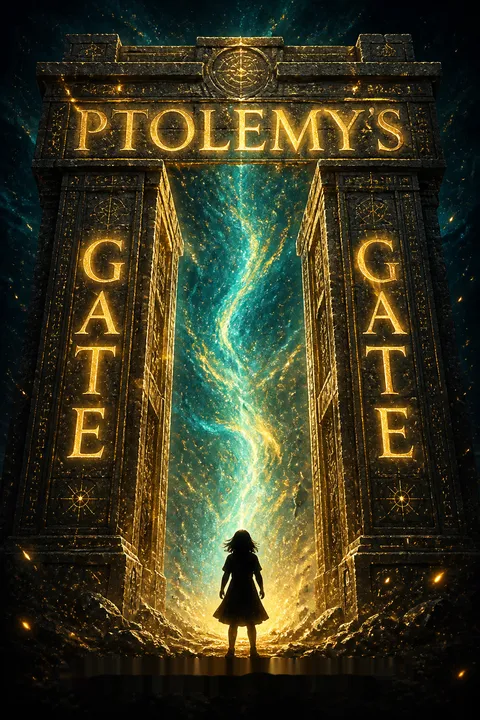

Plot Summary
Assassins in the Moonlight
In ancient Alexandria, young Ptolemy survives a midnight assassination attempt by four elite killers. With the help of his djinni, Bartimaeus, he outwits and defeats the attackers, revealing both his magical prowess and the unique bond he shares with his spirit servant. This opening scene sets the tone for the novel's exploration of trust, power, and the blurred lines between master and slave. The moonlit palace, the silent tension, and the sudden violence all evoke a sense of vulnerability and destiny, foreshadowing the dangers that will haunt Ptolemy and, centuries later, the modern magicians of London.
Bartimaeus: Fallen and Fading
Bartimaeus, once a mighty djinni, now finds himself weak, overworked, and trapped on Earth by his master, John Mandrake. Humiliated in battle and pinned beneath a public lavatory, Bartimaeus's essence is eroding, his powers waning. The world has changed, and so has he—no longer the fearsome spirit of legend, but a weary, sarcastic servant. His relationship with Mandrake is strained, built on mutual need and old secrets. Bartimaeus's vulnerability and wit shine through, making his suffering both tragic and darkly comic, and setting the stage for his desperate need for freedom.
Mandrake's Burden
John Mandrake, once Nathaniel, is now a powerful, isolated minister in a crumbling British Empire. Surrounded by rivals and enemies, he juggles propaganda, war, and the growing unrest among commoners. His only confidant is Bartimaeus, whose knowledge of Mandrake's birth name is both a threat and a lifeline. Mandrake's ambition has cost him his innocence and connections, leaving him emotionally numb and haunted by the past. The pressures of leadership, paranoia, and the fear of betrayal weigh heavily, driving him to ever more desperate measures to maintain control.
Kitty's Secret Apprenticeship
Kitty Jones, presumed dead, lives in hiding, driven by a need to understand magic and the spirits that wield it. She apprentices herself to the eccentric magician Mr. Button, learning the history and mechanics of summoning. Her resilience and curiosity set her apart—she is determined to bridge the gap between commoners and spirits, seeking a new way forward. Kitty's journey is marked by loneliness, danger, and a growing sense of purpose, as she prepares for a summoning that could change everything.
Conspiracies and Council
The British government is beset by internal and external threats. In council, ministers bicker over the failing war in America, the rise of commoner resistance, and the mysterious disappearances of magicians. Mandrake and his rival Jane Farrar uncover a plot involving low-level magicians and the enigmatic scholar Hopkins. The council's arrogance and infighting blind them to the true dangers, while the seeds of rebellion and betrayal take root. The atmosphere is tense, with power plays and secrets threatening to unravel the fragile order.
The Resistance Reborn
In the shadows of London, commoners meet in secret, debating resistance and revolution. Kitty, under an assumed name, listens as old friends and new agitators argue about the futility of protest and the need for real change. The mood is grim—demons are everywhere, and the magicians' grip seems unbreakable. Yet Kitty's presence, and her hidden knowledge, hint at a new kind of resistance—one that might involve the spirits themselves. The chapter pulses with frustration, fear, and the faintest glimmer of hope.
The Scholar's Plot
Hopkins, the elusive scholar, is revealed to be part of a radical experiment: summoning demons not just into circles, but into living human hosts. The playwright Makepeace and his circle of disaffected magicians plan to seize power by merging with spirits, gaining their abilities without the pain of traditional summoning. Bartimaeus, investigating, discovers that Hopkins is already possessed by Faquarl, a cunning djinni. The boundaries between human and spirit, master and slave, begin to blur dangerously, setting the stage for catastrophe.
The Playwright's Masquerade
At a lavish, mandatory play celebrating the Prime Minister, Makepeace springs his trap. Demons, disguised as imps and djinn, flood the theater, binding and gagging the entire government. The coup is swift and theatrical, with Makepeace and his conspirators taking control. Mandrake and Kitty are captured, their fates uncertain. The scene is both absurd and terrifying, as the trappings of power are stripped away and the true nature of the conspirators' plan is revealed.
The Demon Within
Makepeace and his followers summon powerful spirits into themselves, seeking ultimate power. But the experiment goes awry: the demons quickly overpower their hosts, turning the magicians into grotesque hybrids. Nouda, a legendary marid, takes control of Makepeace's body, while Faquarl and others revel in their new freedom. The possessed magicians begin a campaign of terror, consuming their former colleagues and preparing to unleash chaos on London. The line between human and demon dissolves, and the city teeters on the brink of annihilation.
Kitty's Summoning
Desperate to find a way to stop Nouda, Kitty attempts the impossible: she uses Ptolemy's ancient method to summon herself into the Other Place, the realm of spirits. Her journey is disorienting and perilous, as she struggles to maintain her identity amid the chaos of pure essence. There, she finds Bartimaeus, and through trust and sacrifice, convinces him to return and help save humanity. Kitty's act of faith echoes Ptolemy's, forging a new kind of bond between human and djinni.
Ptolemy's Gate
Kitty's journey through the Other Place is both a literal and symbolic crossing. She experiences the unity and fluidity of spirit existence, but also the pain of separation and the cost of individuality. Her willingness to trust Bartimaeus, and his response, fulfill the ancient promise of Ptolemy's Gate—a moment of true partnership between human and spirit. This chapter is the emotional heart of the novel, blending memory, identity, and the hope for reconciliation.
The Other Place
In the Other Place, Kitty and Bartimaeus confront the meaning of self, the wounds of slavery, and the possibility of change. Kitty's presence is both a wound and a wonder to the spirits, and her struggle to maintain her form mirrors the djinni's struggle on Earth. Through their dialogue, the novel explores the costs of power, the pain of division, and the redemptive potential of empathy. Kitty's sacrifice is real—she risks her life and identity for a chance at understanding and peace.
The Fall of the Magicians
With the government destroyed and Nouda's army unleashed, London descends into chaos. Demons, now free from pain and compulsion, hunt and kill indiscriminately. Mandrake, fused with Bartimaeus, uses Gladstone's Staff to battle the hybrids, but the cost is immense. The city's destruction is both physical and moral—a reckoning for centuries of oppression and arrogance. Amid the flames, the survivors—commoners and magicians alike—must confront the consequences of their choices.
The Final Alliance
Mandrake and Bartimaeus, now truly partners, face Nouda in a final, desperate confrontation. Their alliance, born of necessity and trust, is the culmination of Ptolemy's vision. Together, they wield the Staff, not as master and slave, but as equals. The battle is fierce, and the cost is high—Mandrake is mortally wounded, and Bartimaeus risks annihilation. Yet their unity proves decisive, breaking the cycle of vengeance and opening the possibility of a new order.
The Last Stand
In the shattered Glass Palace, Mandrake and Bartimaeus make their final stand against Nouda. Knowing he is dying, Mandrake dismisses Bartimaeus at the crucial moment, ensuring the Staff's power is unleashed and Nouda is destroyed. This act of selflessness fulfills the promise of Ptolemy's Gate—true trust between human and spirit. Mandrake's death is both tragic and redemptive, a final gesture that saves the city and honors the bonds he once denied.
Aftermath and New Dawn
In the wake of the battle, London is devastated, its government in ruins. Kitty, changed by her journey, helps form a new, more inclusive council, advocating for commoners and the possibility of coexistence. The surviving magicians are humbled, and the era of absolute power is over. The city begins to rebuild, haunted by loss but buoyed by hope. Kitty's personal journey ends with the promise of travel and renewal, her faith in change unbroken.
The Cost of Trust
The novel closes on the theme of sacrifice—what it costs to trust, to change, to bridge the gap between worlds. Kitty bears the scars of her journey, both physical and emotional. Bartimaeus, freed at last, returns to the Other Place, carrying the memory of Ptolemy and the hope that, one day, humans and spirits might meet as equals. The story ends not with triumph, but with the hard-won knowledge that true change is possible, but never easy.
Analysis
Jonathan Stroud's Ptolemy's Gate is a masterful conclusion to the Bartimaeus Trilogy, blending thrilling fantasy with profound philosophical inquiry. At its heart, the novel interrogates the nature of power, the costs of oppression, and the possibility of reconciliation between fundamentally different beings. Through the intertwined journeys of Bartimaeus, Mandrake, and Kitty, Stroud explores the corrosive effects of fear, ambition, and mistrust, as well as the redemptive potential of empathy and sacrifice. The device of Ptolemy's Gate—a literal and metaphorical crossing between worlds—serves as a powerful symbol for the risks and rewards of true understanding. The novel's humor, historical depth, and psychological insight elevate it beyond conventional fantasy, offering a meditation on the cycles of history and the fragile hope that individuals, by acts of trust and courage, can break them. In a world where the oppressed and the oppressors are locked in endless conflict, Ptolemy's Gate suggests that real change is possible—but only at great personal cost, and only when we dare to see the other as ourselves.
Review Summary
People Also Read


Characters
Bartimaeus
Bartimaeus is a fourth-level djinni whose long history of servitude has left him both cynical and deeply wounded. Once a mighty spirit, he is now weakened by years of forced service, especially under John Mandrake. His relationship with Mandrake is complex—marked by mutual dependence, old grudges, and a grudging respect. Bartimaeus's wit and irreverence mask a profound longing for freedom and dignity. His bond with Ptolemy, and later with Kitty, reveals his capacity for trust and loyalty, rare among spirits. Over the course of the novel, Bartimaeus evolves from a reluctant servant to a willing partner, risking everything for the hope of reconciliation between humans and spirits.
John Mandrake (Nathaniel)
John Mandrake, born Nathaniel, rises from a vulnerable apprentice to a powerful, but emotionally isolated, minister. Haunted by his past and the knowledge that Bartimaeus holds his true name, Mandrake is driven by ambition, fear, and a desperate need for control. His relationships—with Bartimaeus, with Kitty, and with his own lost innocence—define his psychological arc. As the world collapses around him, Mandrake is forced to confront his own complicity and the emptiness of power. His final alliance with Bartimaeus, and his self-sacrificing death, mark his redemption—a return to the ideals he once abandoned.
Kitty Jones
Kitty is a former Resistance member who survives by wit, courage, and an unyielding desire to understand magic and spirits. Her journey from fugitive to secret apprentice, and finally to the first commoner to open Ptolemy's Gate, is one of self-discovery and sacrifice. Kitty's empathy and determination set her apart—she seeks not just to fight the magicians, but to change the world's very structure. Her bond with Bartimaeus, forged in trust and mutual respect, is the novel's emotional core. Kitty's scars, both literal and figurative, are the price she pays for hope and change.
Ptolemy
Ptolemy, the young prince of ancient Alexandria, is a magician unlike any other—curious about the nature of spirits, compassionate, and willing to risk everything for understanding. His bond with Bartimaeus is unique, built on trust and equality rather than domination. Ptolemy's invention of the Gate—a method for humans to enter the Other Place—embodies his dream of reconciliation. His early death is a tragedy, but his legacy endures, inspiring Kitty and Bartimaeus to attempt what he could not finish.
Faquarl
Faquarl is Bartimaeus's old rival, a djinni who embraces the new order by possessing a human body and orchestrating the demons' revenge. His intelligence and ruthlessness make him a formidable antagonist. Faquarl's willingness to abandon the Other Place and become fully "human" is both a strength and a tragic flaw—he loses his essence in the pursuit of vengeance. His confrontations with Bartimaeus highlight the dangers of hatred and the cost of abandoning one's true nature.
Quentin Makepeace
Makepeace is a playwright and magician whose desire for recognition and power leads him to orchestrate the government's downfall. His charm and creativity mask a deep insecurity and recklessness. Makepeace's experiment with demon possession unleashes Nouda and the other spirits, with catastrophic results. His fate is a cautionary tale about the perils of unchecked ambition and the seductions of novelty.
Nouda
Nouda is a legendary spirit, summoned into Makepeace's body, who quickly overpowers his host and leads the demons' rampage. His hunger for destruction and inability to adapt to human limitations make him both terrifying and pitiable. Nouda embodies the ultimate consequence of the magicians' arrogance—a force that cannot be controlled, only unleashed. His defeat requires the ultimate sacrifice from both human and djinni.
Jane Farrar
Farrar is a senior police official, Mandrake's rival and occasional ally. Her beauty and intelligence are matched by her cold pragmatism. Farrar's attempts to control the chaos are ultimately futile—she is swept aside by the very forces she helped unleash. Her fate underscores the fragility of power and the dangers of underestimating both commoners and spirits.
Clem Hopkins
Hopkins is a minor magician and scholar whose curiosity and ambition make him the perfect vessel for Faquarl's possession. His transformation from conspirator to puppet illustrates the dangers of meddling with forces beyond one's understanding. Hopkins's fate is a warning about the costs of intellectual arrogance and the ease with which humans can become tools of greater powers.
Ms. Piper
Ms. Piper is Mandrake's assistant, a minor magician who survives the upheaval and helps form the new government. Her practicality and willingness to listen make her a bridge between the old order and the new. Piper's evolution from subordinate to leader reflects the novel's theme of change and the possibility of renewal.
Plot Devices
Dual Narratives and Shifting Perspectives
The novel alternates between Bartimaeus's sardonic first-person narration, Mandrake's third-person perspective, and Kitty's intimate journey. This structure allows readers to experience the story's events from radically different angles, highlighting the misunderstandings, prejudices, and hidden motives that drive the characters. The shifting perspectives create dramatic irony, as each character's limited knowledge and flawed assumptions are revealed. The interplay of voices also mirrors the novel's central theme: the difficulty—and necessity—of true understanding between individuals and worlds.
Foreshadowing and Historical Parallels
The story is laced with flashbacks to Ptolemy's Egypt, drawing explicit parallels between past and present. The repeated failures of empires, the cycles of oppression and rebellion, and the tragic fate of visionaries like Ptolemy all foreshadow the collapse of London's magical regime. The use of prophecy, legend, and historical allusion deepens the sense of inevitability, while also offering hope that the cycle can be broken through trust and sacrifice.
The Motif of Names and Identity
Throughout the trilogy, the knowledge of true names is both a source of power and a profound vulnerability. Mandrake's fear that Bartimaeus will reveal his birth name drives much of his paranoia and cruelty. Kitty's refusal to use false names, and her quest to understand the true nature of spirits, marks her as different. The motif culminates in the act of trust at Ptolemy's Gate, where names are set aside in favor of genuine connection.
The Inversion of Summoning
The central plot device—the reversal of the summoning ritual—serves as both a literal and symbolic bridge between worlds. By sending a human into the Other Place, the novel upends the traditional hierarchy of master and slave, challenging the very foundations of magical society. This inversion is mirrored in the characters' personal journeys, as they learn to trust, to relinquish control, and to see the world through another's eyes.
The Use of Humor and Footnotes
Bartimaeus's irreverent humor, often delivered through footnotes, provides both comic relief and incisive commentary on the action. His jokes and asides undercut the pretensions of the magicians, expose the absurdities of power, and invite the reader to question the official version of events. The humor is not merely decorative—it is a survival mechanism, a way of coping with pain, and a tool for truth-telling.
Bartimaeus Series
About the Author
Other books by Jonathan Stroud

Download PDF
Download EPUB
.epub digital book format is ideal for reading ebooks on phones, tablets, and e-readers.








































