Key Takeaways
1. The Primacy of Preaching: God's Essential Method
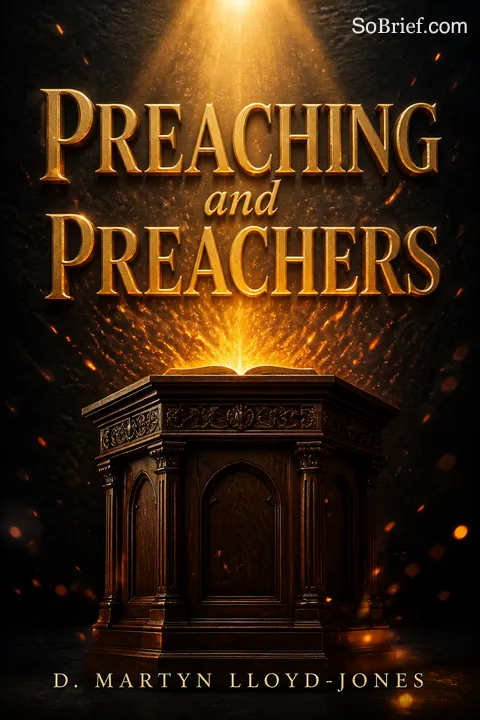
I would say without any hesitation that the most urgent need in the Christian Church today is true preaching; and as it is the greatest and the most urgent need in the Church, it is obviously the greatest need of the world also.
Preaching is paramount. The decline in the Church's effectiveness and the world's spiritual state can be directly attributed to the diminishing role of true preaching. Historically, periods of spiritual decadence have always coincided with a decline in preaching, while every reformation and revival has been heralded by a resurgence of powerful, biblical proclamation.
Modern substitutes fail. Many contemporary approaches, such as "quiet talks," excessive liturgy, entertainment, or a focus on social work, are inadequate substitutes for preaching. These methods often address superficial symptoms rather than man's fundamental spiritual condition, and past attempts like the "social gospel" have proven ineffective in truly transforming lives or building the Church.
Biblical mandate. Christ's ministry prioritized teaching and preaching, with miracles serving as "signs" to authenticate His message. The Apostles, despite having spent three years with Jesus, were commanded to "tarry... until ye be endued with power from on high" to be effective "witnesses." Their primary task, as articulated in Acts 6:4, was "prayer and the ministry of the Word," establishing a timeless priority for the Church.
2. Man's True Need: A Theological Justification for Preaching
Man’s real trouble is that he is a rebel against God and consequently under the wrath of God.
Beyond symptoms. The ultimate justification for the primacy of preaching is theological, rooted in a correct understanding of man's condition. Man's deepest need is not merely psychological sickness, unhappiness, or being a victim of circumstances; these are but symptoms of a more profound spiritual malady: rebellion against God, resulting in spiritual blindness, darkness, and ignorance.
Salvation is knowledge. The biblical remedy for this condition is "a knowledge of the truth," which addresses man's fundamental ignorance and reconciles him to God. Other agencies like medicine, psychology, or political movements can only offer temporary relief for symptoms, but they cannot deal with the root problem of sin or provide true reconciliation with God.
Peculiar task. The Church, through its preachers, has the unique and peculiar task of making this truth known. To focus on palliating symptoms without addressing the underlying disease is akin to a doctor treating pain with morphine while ignoring a life-threatening condition; it offers temporary ease but conceals the real danger and ultimately does a disservice to the soul.
3. The Sermon: Content, Form, and Expository Integrity
A sermon should always be expository.
Not debate or essay. Preaching is not a casual discussion or debate about God, nor is it merely an academic lecture or a literary essay. God is not a subject for debate, and the eternal destiny of souls is too serious for light-hearted exchanges. The natural man, being spiritually blind, cannot truly engage in such discussions on equal terms, and what he needs most is to be humbled by the declaration of God's truth.
Preach the Word. The content of the sermon must be "the Word," the message of the Bible, delivered as an ambassador for Christ. This means preaching the Gospel itself, not merely talking about the Gospel, and presenting the "whole counsel of God" in its personal, social, and cosmic dimensions. Every sermon should be theological, even evangelistic ones, with systematic theology serving as a controlling background, ensuring consistency and depth.
Form and honesty. A sermon must have a definite form, like a symphony, with clear progression, leading to a climax and application. It should always be expository, meaning the doctrine arises directly from the text and its context, not imposed upon it. Crucially, the preacher must be utterly honest with the text, never manipulating it to fit a preconceived idea or a sentimental story, but diligently seeking its main thrust and spiritual meaning.
4. The Act of Preaching: Personality, Passion, and Power
Preaching is theology coming through a man who is on fire.
Whole person engaged. The act of preaching involves the entire personality of the preacher, not just the intellect. It requires a sense of authority, not born of self-confidence but of being a commissioned messenger of God. This authority should control the proceedings, not be dictated by the congregation.
Freedom and zeal. Despite careful preparation, the preacher must maintain spiritual freedom, remaining open to the Holy Spirit's inspiration and even receiving from the congregation. This freedom allows for spontaneous insights and a dynamic interplay. Preaching demands seriousness, liveliness, and zeal—the preacher must be gripped by his message, concerned for souls, and act as a witness, not merely an advocate.
Warmth and urgency. True preaching is characterized by warmth and pathos, reflecting a deep love for the people and a profound understanding of God's truth. It is urgent, recognizing the fleeting nature of life and the eternal stakes involved. Ultimately, preaching is "logic on fire," a "demonstration of the Spirit and of power," where God uses the preacher as a channel to give men and women a sense of His presence.
5. The Preacher: Called, Qualified, and Continually Prepared
The only man who is called to preach is the man who cannot do anything else, in the sense that he is not satisfied with anything else.
A divine call. Not all Christians are called to preach; it is a distinct, divine call, not a career choice. This call begins as an inner spiritual pressure, often confirmed by others, and includes a deep concern for lost souls. A crucial test is a sense of constraint—the feeling that one "cannot do anything else" but preach, coupled with a profound sense of inadequacy and unworthiness, echoing Paul's "weakness, fear, and much trembling."
Church confirmation and training. This personal call must be confirmed by the Church, which looks for exceptional spirituality, assurance in the truth, godly character, wisdom, patience, and an understanding of human nature. Essential abilities include natural intelligence and the "gift of speech." Training should encompass general knowledge and life experience, a disciplined mind, thorough biblical and systematic theological knowledge, and a deep study of Church history, particularly its revivals and heresies.
Lifelong discipline. The preacher is always preparing, maintaining a rigorous self-discipline, especially safeguarding mornings for study. Prayer is vital, not just a routine, but a continuous turning to God, responding to every impulse to pray as the Spirit's leading. Bible reading must be systematic and for personal nourishment, not merely for sermon texts, with insights immediately recorded as "skeletons" for future use.
6. The Congregation: Assess, Don't Be Dictated By
I would lay it down as being axiomatic that the pew is never to dictate to, or control, the pulpit.
Pulpit's authority. While the preacher must assess the condition of the congregation, the pew should never dictate the message or method. Modern trends that prioritize "what modern man can accept" or demand discussions over declarations are fundamentally flawed. The preacher's role is to deliver God's truth, not to pander to perceived intellectual or cultural preferences.
False assumptions. A common and fatal blunder is assuming all church members are Christians. Many may intellectually assent to the faith but lack true conversion, making evangelistic preaching essential even for regular attendees. Preachers must avoid rigid classifications and be prepared to challenge the self-satisfied, reminding all of their common need for Christ.
Spiritual hunger. Listeners who are listless, dictate sermon length, or resent convicting messages often reveal a lack of spiritual life. True Christians, like "newborn babes," instinctively desire the Word and long for corporate worship. The Church's authority is restored not through external pomp or mere scholarship, but when the preacher is "filled with the Holy Spirit," commanding attention through spiritual power, not human cleverness.
7. What to Avoid: Professionalism, Manipulation, and Pride
Self is the greatest enemy of the preacher, more so than in the case of any other man in society.
Professionalism's peril. The greatest danger for a preacher is professionalism—preaching out of routine rather than divine compulsion. This manifests as formality, studied gestures, a focus on techniques, and a desire to display knowledge or cultivate a "character." Such self-consciousness detracts from the message and hinders the Spirit's work.
Subtle snares. Preachers must guard against relying on their preparation alone, as this can lead to disappointment and ineffectiveness. Natural gifts, such as a good voice or charisma, can become temptations to pride and self-display. The antidote to pride is constant humility, fostered by reading biographies of great saints and remembering one's utter dependence on God.
Balance in delivery. In sermon content, avoid excessive intellect that "overtaxes" the congregation, but also shun sentimentality or mere exhortation without foundational truth. Polemics have a place in defending truth, but too much can be divisive and destructive, appealing to a carnal love for argument rather than building up the Church. The goal is balance: "defence and the propagation of the Gospel," with an emphasis on the positive.
8. Calling for Decisions: Trust the Spirit, Not Techniques
A sinner does not ‘decide’ for Christ; the sinner ‘flies’ to Him in utter helplessness and despair.
Historical context. The practice of making immediate appeals for decisions, such as the "altar call" or "anxious seat," was introduced by Charles G. Finney in the 1820s and sparked significant controversy. This method, though often well-intentioned, is rooted in a theological approach that differs from earlier Reformed and even Arminian practices.
Pressure on the will. Direct pressure on the will is problematic because true conversion involves the mind grasping truth, the affections being moved, and then the will responding. Appeals that bypass this order risk producing superficial "decisions" based on emotional manipulation, fear, or the evangelist's personality, rather than genuine conviction by the Holy Spirit.
Spirit's work. Separating the call for decision from the preaching of the Word, or relying on techniques like music and lighting to "condition" the audience, implies a distrust of the Holy Spirit's power. The Spirit's work of conviction and regeneration is thorough, spontaneous, and cannot be manipulated or predicted. True converts "fly" to Christ in helplessness, a response far deeper than a mere "decision."
9. The Romance of Preaching: Unpredictable, Powerful, and God-Given
There is nothing like it. It is the greatest work in the world, the most thrilling, the most exciting, the most rewarding, and the most wonderful.
Unspeakable joy. The preacher experiences an unparalleled "romance" in his calling, especially when delivering a fresh message from God. This joy is unique to a regular, long-term ministry in one place, fostering a deep relationship between preacher and people. It's a thrilling, unpredictable journey where the preacher is never fully in control, constantly amazed by God's working.
Divine surprises. Preaching often brings unexpected experiences: a sermon that falls flat despite careful preparation, or conversely, a powerful service despite personal weakness. Sermons themselves can "grow and develop" through repeated delivery, revealing new insights and becoming more effective. The Spirit may even restrain a preacher from delivering a full sermon, only to use the "reserved" portion for a specific individual at a later, unforeseen time.
Eternal impact. The romance culminates in the knowledge that preaching can be a turning point in someone's life, leading to conversion, regeneration, and eternal change. People often testify that a sermon spoke directly to their deepest needs, even when the preacher knew nothing of their circumstances. This profound sense of being used by God, standing between souls and eternity, fills the preacher with amazement, gratitude, and unspeakable joy.
10. The Unction of the Holy Spirit: The Ultimate Essential
It is the Holy Spirit falling upon the preacher in a special manner.
The greatest essential. While diligent preparation is crucial, the ultimate essential in preaching is the "unction and anointing of the Holy Spirit." This is not an alternative to preparation but complements it, much like Elijah building the altar before calling down fire. Preachers must actively seek and expect this divine empowerment.
Access of power. Unction is the Holy Spirit falling upon the preacher in a special manner, an "access of power" that lifts the work beyond human effort. It enables the preacher to be a channel through whom the Spirit works, as seen in John the Baptist, Jesus Himself (anointed to preach), and the Apostles who received repeated fillings for specific tasks and crises.
Demonstration of power. Paul's preaching was "not with enticing words of man’s wisdom, but in demonstration of the Spirit and of power," emphasizing that "the kingdom of God is not in word, but in power." This unction brings clarity of thought and speech, ease of utterance, a sense of authority, confidence, and an "indescribable sense of joy," making the preacher a "man possessed" by God's mighty working.
Review Summary
Preaching and Preachers receives high praise from most readers, earning 4.49/5 stars. Many consider it essential reading for preachers, celebrating Lloyd-Jones' passionate defense of Spirit-empowered, expository preaching and his deep knowledge of church history. Readers appreciate his bold, unapologetic opinions, even when disagreeing with specifics like his views on illustrations or altar calls. Warren Wiersbe's advice to read it twice — once to disagree, once to be helped — resonates throughout the reviews. Critics find it dated or overly self-vindicating, but most agree its core vision of preaching remains timeless and transformative.
People Also Read






About the Author
Other books by D. Martyn Lloyd-Jones


Download PDF
Download EPUB
.epub digital book format is ideal for reading ebooks on phones, tablets, and e-readers.








































