

Key Takeaways
Repetition doesn't make perfect; it makes permanent, wrong technique included
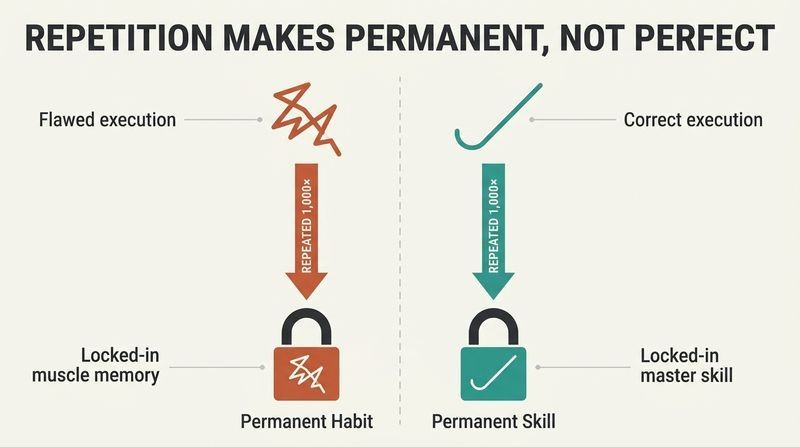
The core inversion of the book. Lemov's team argues the folk wisdom "practice makes perfect" is dangerously incomplete. Whatever you rehearse gets burned into muscle memory and mental circuitry, correct or flawed. A nine-year-old soccer player who dribbles a hundred times with locked knees isn't improving; they're getting expert at doing it wrong. Michael Jordan's warning captures it: eight hours of shooting with broken form just makes you very good at shooting badly.
Encode success, not failure. The takeaway is to engineer practice so people succeed reliably, simplifying the task if needed until they get it right, then adding difficulty. Beware the romanticized "I failed 99 times before I got it" story (Uncle Lou); struggle builds character but is an inefficient teacher of skill.
This reframing aligns with motor-learning research on "contextual interference" and Anders Ericsson's deliberate practice, which stresses correct repetition over mere volume. The claim usefully punctures the 10,000-hour mystique popularized by Gladwell: quantity without quality entrenches error. One nuance worth flagging: some domains genuinely require productive failure, as in scientific experimentation or improvisation, where exploring wrong paths generates insight. The book's own concession is that a 100% success rate signals the task is too easy. The sweet spot, echoing Vygotsky's zone of proximal development, is challenge just beyond current ability where small corrections still land, not sink-or-swim difficulty that breeds panic and random flailing.
Obsessively drill the 20% of skills driving 80% of results
Apply the vital few to practice. Borrowing the Pareto principle, the authors argue greatness comes from practicing the handful of skills that matter most, over and over, rather than sampling many merely useful ones. Spanish soccer's dominance, midfielder Xavi says, rests on one drill done daily: the rondo, players passing a ball rapidly in a circle while others chase it. The value of a top-tier skill does not plateau at competence; it keeps rising toward automaticity and even creativity.
Practice past proficiency. Most coaches stop once someone "knows how." That's the mistake. Keep drilling the vital few until they're unstoppable, like a football team running five plays so well that everyone knows what's coming and still can't stop them. Use data or the wisdom of crowds to identify your 20%.
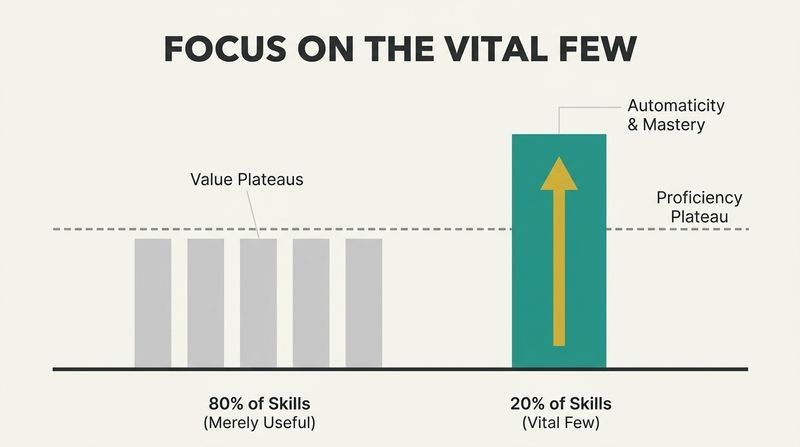
The counterintuitive core here is that the returns on practicing a critical skill increase after mastery, contradicting the usual assumption of diminishing returns. This resonates with research on overlearning in aviation and surgery, where rehearsing beyond initial competence protects performance under stress and cognitive load. There is a tension worth naming: Pareto concentration risks neglecting the "long tail" of rare but catastrophic situations, exactly the black-swan scenarios that separate adequate from elite performers in medicine or aviation. The authors partly address this by noting the 20% shifts over time and needs periodic reassessment. Xavi's rondo example is powerful precisely because one drill trains passing, spatial awareness, and composure simultaneously.
Automate the fundamentals so your conscious mind is freed to create
Let the mind follow the body. Once a skill is drilled to automaticity, the body executes before conscious thought catches up. A baseball fastball reaches the plate in roughly 0.4 seconds, but conscious awareness takes about half a second, so a batter literally cannot think the swing; it must be a built habit. Customer service reps stay calm with angry callers not by choosing calm in the moment but by having rehearsed calm until it's automatic.
Creativity is often practice in disguise. Wooden held that drilling builds the foundation on which imagination flourishes. When players say the game "slows down," their automated skills have freed up mental bandwidth to spot the open teammate. Soccer legend Cruyff attributed his creativity not to inspiration but to executing core skills automatically under pressure.
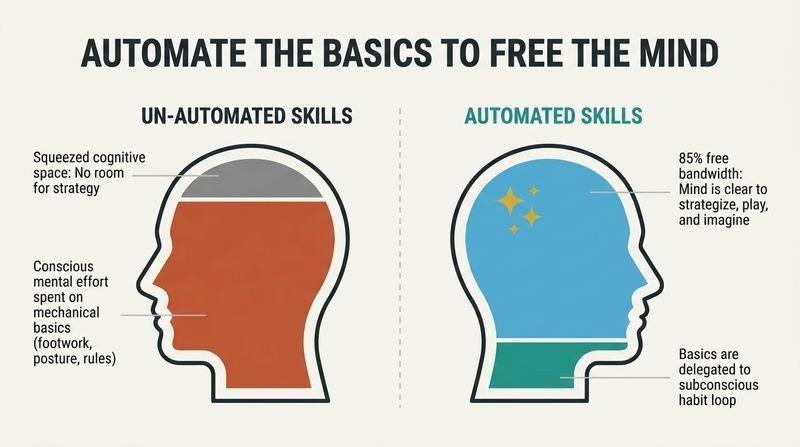
This directly challenges the "drill and kill" critique common in progressive education, which frames rote practice as the enemy of higher-order thinking. Cognitive scientist Daniel Willingham, cited in the book, provides the backbone: working memory is severely limited, so offloading fundamentals to long-term automatic retrieval frees capacity for novel problem-solving. This is why chess masters see board patterns, not individual pieces (chunking, per Chase and Simon). The insight that creativity requires a rote substrate deserves emphasis in an era romanticizing raw innovation. A caveat: automaticity can also ossify into rigidity, the "Einstellung effect," where over-learned solutions blind experts to better novel approaches. Deliberate variation guards against this.
Trade vague purposes for measurable, pre-planned objectives with mastery cues
A purpose is not an objective. "We're going to work on passing" is a purpose. An objective is measurable, manageable, made in advance, and comes with mastery guidance: "players will pass accurately on the ground over twenty yards so the receiver doesn't adjust, eight of ten tries, by locking the ankle and following through." You can actually see whether you hit it.
Objectives before activities. One champion teacher spent 80-90% of planning time defining the objective and only 10-20% on activities, the exact inverse of his average peers. Coach Caleb Porter's rule that players must win the ball back within six seconds beats "work hard to get it back" because it's objective and lets him give "feedback with a number": we hit it 40% of the time, we need 60%.
The distinction maps onto decades of goal-setting research by Locke and Latham showing specific, measurable goals outperform vague "do your best" exhortations. The "feedback with a number" idea connects to the psychology of accountability: objective standards depersonalize criticism, shifting it from the coach's judgment to a shared external metric, which reduces defensiveness. This is why six-second rules and Apgar scores work. One caution from organizational behavior: measurable objectives can induce goal-fixation and Goodhart's Law, where the metric becomes the target and gets gamed at the expense of the underlying aim. The authors' insistence that objectives build in sequence toward integration is the antidote to myopic checklist-chasing.
Distort the game with drills; save scrimmage for testing readiness
Drill and scrimmage do different jobs. A drill deliberately warps real conditions to isolate one skill and cram in maximum repetitions (density), like a new principal flipping note cards of hypothetical staff comments to rehearse active listening. A scrimmage replicates the game's full complexity and unpredictability to evaluate whether skills hold up, like running the whole meeting with a colleague playing difficult participants.
Counterintuitively, drill more as you get better. Wooden chose twenty players with five balls in engineered drills over ten players scrimmaging with one ball, and considered it central to his success. Most people assume elite performers should mostly scrimmage; the authors argue the opposite. Scrimmage is fun and easy, which makes it a seductive substitute for the harder, higher-yield work of targeted drilling. Success in scrimmage is the truest test of mastery.
The drill-versus-scrimmage framing generalizes elegantly beyond sports into any performance domain, and it exposes a common organizational failure: businesses default to "scrimmage" (real client meetings, live launches) as their only practice mode, then wonder why people don't improve. The parallel to spaced, isolated skill rehearsal in music pedagogy (practicing one difficult measure, not playing the whole piece) is strong. The deeper point about density, maximizing productive repetitions per minute, is what makes drills efficient. A limitation: over-isolating can create the "transfer problem" where drilled skills don't generalize to messy reality, which is precisely why the authors insist on eventually integrating skills and simulating game conditions.
Don't just critique the error; make them redo it correctly, immediately
Correction beats critique. Telling someone what they did wrong ("your cut wasn't sharp") does little; having them go back and do it right does everything. Practice inscribes habits through repetition, so the fix must itself be repeated. The authors reorganized their teacher drills so participants went to the front of the line, not the back, closing the gap between feedback and redo.
Speed of feedback beats strength of feedback. The brain's neural circuits have little sense of time; do it right once and wrong once and both encode equally. So correct in multiples: after a fix, do it five more times to overwhelm the wrong memory. Mammographers actually get less accurate with experience because their feedback loop stretches weeks. British WWII plane spotters trained novices with instant yes/no feedback, and it worked even though no one could explain what they heard.
The mammography example is a striking counter to the assumption that experience equals expertise, echoing Kahneman and Klein's work on when intuition can and cannot be trusted: skilled intuition requires environments with rapid, unambiguous feedback. The neural point about time-blindness aligns with reinforcement learning, where the tightness of the action-reward coupling determines learning speed. The plane-spotter case is remarkable because it demonstrates procedural learning without declarative knowledge, the tacit knowing-how that Michael Polanyi described. One practical tension: instant redo works beautifully for discrete motor skills but can short-circuit the reflective processing that consolidates complex conceptual learning. The book's own sequencing (apply first, reflect later) tries to balance this.
When you model a skill, first tell watchers exactly what to look for
Call your shots before modeling. Novices don't yet know what excellence looks like, so unguided observation misleads them. A new salesperson shadowing a veteran might read a masterful strategic silence as an awkward bad day, and a warm, pleasant meeting as a success when the veteran actually failed to deliver a hard message. Without a preview, learners fixate on the wrong details, like a teacher noticing classroom posters instead of how directions were given.
Model plus describe, believably. Pair showing with explaining: modeling helps learners replicate, description helps them understand and adapt. Make models believable by demonstrating in conditions close to the learner's reality ("push-in modeling," teaching the struggling teacher's own students). And model "skinny parts," breaking complex skills into tiny steps, the way you'd teach a child to tie shoes one loop at a time rather than all at once.
The shadowing critique is quietly devastating for corporate onboarding, where "follow the top performer around" is standard and largely useless without framing. This connects to research on perceptual expertise: experts and novices literally fixate on different regions when viewing the same scene (eye-tracking studies of radiologists, chess players, and pilots confirm it). Telling learners where to look accelerates the transfer of expert attention. The "walk this way" rule (imitate exactly before improvising) usefully rehabilitates copying, which adults resist due to originality norms, though infants learn almost entirely through imitation. A nuance: premature exact imitation can suppress the productive experimentation through which some learners discover personal style, so the sequence (imitate, then individualize) matters.
Getting feedback is easy; practicing using it right away is the skill
Using feedback is its own trainable skill. People get good at receiving feedback, nodding, taking notes, appearing grateful, while quietly ignoring it. The authors rebuilt their workshops so a "coach" gives one positive and one "delta" (something to change), then the person immediately restarts from the top and applies it. Public, instant application makes deflection socially impossible and lets people feel small changes working.
Apply first, then reflect. The instinct is practice, feedback, discussion. The better sequence is practice, feedback, redo, redo again, then reflect. Reflection before application becomes a sophisticated way to avoid practice; when a group is deep in fascinating debate, the authors simply ask, "Whose turn is it?" Feedback is often counterintuitive, so judging it before trying it is premature. Limit yourself to two things at a time; nine simultaneous corrections paralyze the learner.
This addresses a real gap in the feedback literature, which obsesses over how to deliver feedback (praise sandwiches, radical candor) while ignoring the receiver's execution. The "apply first, then reflect" reversal is the most contrarian move here and cuts against reflective-practice orthodoxy (Schon, Kolb's learning cycle), which places reflection at the center. The authors' point is subtler than it appears: reflection is valuable but should be data-rich, informed by having actually tried the change. The "limit yourself" rule tracks working-memory constraints (Miller's magic number, Sweller's cognitive load). Buckingham's finding that people grow fastest by amplifying strengths, not fixing weaknesses, adds a productive counterweight to deficit-focused coaching.
Normalize error so people take the risks that actually build skill
Failure and skill level are independent variables. An expert skier realized she almost never fell, meaning she'd stopped pushing her edge, so she deliberately skied hard enough to fall while working on one specific technique. Within weeks she transformed. Joshua Foer calls the stall point the "OK Plateau," where you stop improving despite repetition; typists who let themselves make mistakes trying to go 10-20% faster broke through it.
Build a culture where mistakes are expected, not punished. Wooden warned that punishing error creates fearful, cautious performers who play "not to lose." Great teachers correct warmly and firmly without apology, using framing like "I'm glad you did that, it's the most common mistake we make with X." Get past being "nice": excessive tap-dancing around a mistake signals it's a bigger deal than it is. The goal is a safe place to fail where error is always corrected but never condemned.
The independence of failure rate and skill level is a genuinely useful mental model, echoing the growth-mindset research of Carol Dweck (cited elsewhere in the book) and the concept of "desirable difficulties" from Bjork's memory lab: conditions that feel harder and produce more errors often yield more durable learning. The corporate application is fraught, though. Amy Edmondson's psychological-safety research shows teams that report more errors often have better outcomes because they surface problems rather than hide them, yet many organizations conflate normalizing error in practice with tolerating it in high-stakes performance. The distinction the book draws, isolate failure in practice to encode success in the game, is the crucial guardrail against sloppy misapplication.
Leaders must practice publicly, badly, and ask for feedback themselves
Everybody does it, starting at the top. Senior leaders love the idea of practice while standing at the back with a laptop, thinking "I don't really do this in my job." That kills a practice culture. The authors model every activity themselves, sometimes announcing they'll do a "B+ version" with deliberate small errors, then asking, "What's one thing I could have done better?" The request is usually met with silence because people assume leaders shouldn't be corrected, so they push: "I know there were at least three things."
Hire for coachability, not just current skill. The authors would rather take a six-out-of-ten who eagerly absorbs feedback than an eight who resists it, because the six may become a nine and lift teammates. In interviews they watch how candidates respond to feedback on a sample task, not just the task itself. Erica "bombed" her sample lesson but got hired for how hungrily she reflected and revised.
The leader-vulnerability point intersects with research on psychological safety and "leader inclusiveness": when authority figures admit fallibility and invite challenge, teams speak up more and learn faster. Edgar Schein's work on humble inquiry supports the "ask for feedback and mean it" move. The B+ modeling tactic is clever behavioral design, lowering the perfectionism barrier that keeps leaders from demonstrating at all. Hiring for coachability over raw talent echoes the sports-analytics insight that trajectory can matter more than current level, and connects to Angela Duckworth's grit research. A fair challenge: coachability is hard to assess reliably in a short interview and can be performed strategically, so the sample-task-plus-feedback method, observing actual behavior, is a meaningful improvement over self-report.
During the game, only cue what was taught; never teach new skills
Coach in performance, don't teach. You cannot learn and perform simultaneously; introducing new skills mid-game only confuses and disrupts the automaticity practice built. During the real event, coaching should just cue and remind: short, positive prompts referencing what was already drilled. Lee Canter coaches teachers through a "bug in the ear" while they teach, but only with reminders like "narrate the positive," never new material. Baseball base coaches communicate entire strategies through wordless hand signals with near-zero transaction cost.
Keep the shared vocabulary alive. Naming skills ("No Opt Out," "Cruyff Turn," a specific surgical stitch) creates a shorthand that makes rapid, low-cost coaching possible in the field. Then walk the line between support and demand: be transparent that you're both a supporter and an evaluator, framing feedback not as optional advice but as something required to improve.
The teach-versus-coach split rests on the same cognitive-load logic underlying automaticity: performance already consumes working memory, so injecting new declarative instruction overloads the system and degrades output. This has practical implications far beyond sports, for example, the futility of giving detailed new guidance to an employee mid-presentation. The naming point connects to the linguistic-relativity idea that shared vocabulary shapes and speeds cognition; jargon done right compresses complex concepts into instantly transmittable tokens, though the authors rightly warn it can decay into hollow buzzwords like "synergy." The "walk the line" tension between coach and evaluator captures a genuine dual-role dilemma studied in performance management, where blurring support and judgment can erode the trust that makes feedback usable.
Skills evaporate after training unless you observe, cue, and measure them
Practice without follow-up is wasted money. The authors invent a marketing firm, NewBrands, that ran an intensive two-day retreat teaching managers to give feedback and hold hard conversations, then saw zero lasting change. Why? Managers reverted to old habits because no one observed the new skills, kept the shared vocabulary alive, or measured impact afterward. Training that doesn't "stick" is expensive theater.
Make it stick with three moves.
1. Look for the right things: observe performance using tools aligned to exactly what was practiced, and tell people in advance what you'll watch for.
2. Keep talking: use the named vocabulary in follow-up so skills stay alive.
3. Measure success: treat each performance as data points, not a vague narrative, to check both whether practice worked and whether you practiced the right things. Virginia Apgar's newborn score turned an "impressionistic" judgment into numbers that saved millions of infants.
The NewBrands parable names a massive, underdiscussed waste: the corporate training industry spends billions on events with negligible transfer, a finding consistent with decades of research showing most professional development fails for lack of follow-up, spacing, and on-the-job reinforcement. The Apgar example is a beautiful illustration of how measurement itself changes behavior, forcing careful observation and enabling comparison, which connects to the broader principle that what gets measured gets managed. The subtler claim, that measurement reveals whether you practiced the right things, closes the loop back to "analyze the game." The honest caveat the authors offer, that self-reporting after workshops is notoriously unreliable, is a useful warning against confusing satisfaction surveys with actual behavior change.
Analysis
Practice Perfect belongs to a specific and underserved niche: it is not a book about what to learn but about the mechanics of getting better at anything. Where Ericsson's deliberate practice and Gladwell's 10,000 hours describe the phenomenon of expertise, Lemov, Woolway, and Yezzi supply the missing engineering manual, 42 concrete rules for designing the practice itself. Their credibility comes from an unusual crucible: training teachers in high-poverty schools, a "performance profession" where practitioners go live several times daily with no chance to stop, revise, or phone a colleague, unlike lawyers or writers. That constraint forced a rigor most fields never demand.
The book's central intellectual move is a series of inversions of folk wisdom. Practice makes permanent, not perfect. Drill more, not less, as you improve. Automate the boring fundamentals to unlock creativity, rather than fearing rote learning kills it. Apply feedback before reflecting on it. Speed of feedback beats strength of feedback. Each inversion is defensible and grounded in cognitive science, particularly Willingham's working-memory constraints and the automaticity literature, even where the authors present intuition rather than citation.
The deepest contribution may be cultural, not technical. The authors recognized early that they were "practicing failure" in their own workshops, and the fix, encoding success, ripples through everything. Their honesty about their mistakes models the humility the book preaches.
Two limitations deserve flagging. First, the evidence base is largely anecdotal and drawn from a self-selected pool of already-committed high performers; the causal claims are plausible but not rigorously tested. Second, the framework's Pareto concentration and drill-heavy prescription fit closed, well-defined skills (surgery, free throws, classroom management) far better than genuinely open-ended creative or research work where the "right answer" is unknown. Still, for anyone responsible for developing people, coaches, managers, teachers, parents, this is among the most actionable treatments of a shockingly neglected topic: the deliberate design of the hours that make mastery.
Review Summary
Practice Perfect receives mixed reviews, with readers praising its insights on effective practice techniques but criticizing its repetitiveness and focus on teaching. Many find the 42 rules overwhelming, while others appreciate the practical advice for improving skills. The book is noted for its examples from education and sports, with some readers finding it applicable to various fields. Critics argue that the content could have been condensed, while supporters value its comprehensive approach to deliberate practice and skill development.
People Also Read







Glossary
Encode Success
Practice getting it rightThe principle that practice inscribes whatever you repeat into memory, so activities should be engineered for reliably high success rates. If a task produces too much error, simplify it temporarily until participants succeed, then add complexity. Challenging drills should end with a stretch of reliable success so people rehearse doing it right, not wrong.
Practice the 20
Drill the vital few skillsApplying the 80/20 (Pareto) rule to practice: identify the roughly 20% of skills that generate 80% of results and practice them far more than everything else combined. Crucially, the value of practicing these skills keeps rising even after mastery, so you continue drilling them toward automaticity and creativity rather than moving on.
Drill vs. Scrimmage
Isolate skills vs. replicate gameA drill deliberately distorts real conditions to isolate one skill and maximize productive repetitions per minute. A scrimmage replicates the full complexity and unpredictability of real performance. Drills develop skills; scrimmages evaluate readiness and mastery. The authors argue drilling is generally the more efficient teaching tool, so you should drill more, not less, as ability rises.
Correct Instead of Critique
Redo it right, not just toldCritique means telling someone what they did wrong; correction means having them immediately redo the action correctly, ideally multiple times, so the right version overwrites the wrong one in muscle memory. Because neural circuits weigh right and wrong repetitions roughly equally, corrections should be delivered fast and repeated in multiples.
Call Your Shots
Preview what to observeBefore modeling a skill, tell observers exactly what to watch for. Because novices cannot yet identify expertise on their own, unguided observation leads them to fixate on irrelevant details or misinterpret what they see. Previewing focuses attention on the specific technique being demonstrated.
OK Plateau
Point where improvement stallsA term from Joshua Foer's Moonwalking with Einstein describing the stage at which someone stops improving at a skill despite continuing to do it regularly, having relegated it to autopilot. The escape is to retain conscious control, push past comfortable limits, tolerate mistakes, and practice failing.
Normalize Error
Make mistakes safe and expectedBuilding a culture where failure is treated as a normal, expected part of learning rather than something shameful, so people take the calculated risks that drive improvement. Errors are always corrected warmly and firmly but never condemned or apologized around. Failure rate and skill level are treated as independent variables.
Coach During the Game (Don't Teach)
Cue, never introduce new skillsThe rule that during actual performance you should only cue and remind people about skills already learned in practice, using short positive prompts, never introduce new instruction. Because you cannot learn and perform at once, teaching mid-performance overloads working memory and disrupts the automaticity that practice built.
Look for the Right Things
Observe exactly what was practicedA post-practice rule for making skills stick: after training, observe people in real performance using tools aligned precisely to the skills that were practiced, and tell them in advance what you'll be watching for. This signals the practiced skills matter and creates accountability that turns training into lasting behavior change.
FAQ
What's Practice Perfect about?
- Focus on Improvement: Practice Perfect by Doug Lemov emphasizes the importance of deliberate practice in achieving excellence, particularly in education. It argues that practice should be structured and intentional to be effective.
- 42 Rules for Practice: The book outlines 42 specific rules designed to enhance practice routines, covering aspects like performance analysis, feedback, and modeling.
- Versatile Application: While rooted in educational practices, the principles can be applied to sports, business, and personal development, making it a versatile guide for skill enhancement.
Why should I read Practice Perfect?
- Evidence-Based Techniques: The book provides evidence-based rules and techniques grounded in research and real-world examples, making it a reliable resource for improving performance.
- Practical Application: Each rule is actionable, allowing readers to implement strategies immediately, bridging the gap between theory and execution.
- Transformative Mindset: It encourages a shift from passive to active practice, prioritizing continuous improvement and accountability.
What are the key takeaways of Practice Perfect?
- Practice Makes Permanent: Emphasizes that practicing incorrectly can reinforce bad habits, so it's crucial to practice the right techniques.
- Focus on the 20%: Advocates for the 80/20 rule, suggesting that focusing on the 20% of skills that yield 80% of results maximizes efficiency.
- Feedback is Essential: Continuous feedback is vital for improvement, with immediate application reinforcing learning and correcting mistakes.
What is the "get it/do it gap" in Practice Perfect?
- Understanding the Gap: Refers to the difference between knowing what to do and executing it effectively, highlighting the need for structured practice.
- Importance of Practice: Without sufficient practice, well-understood techniques may fail to translate into effective performance.
- Bridging the Gap: Suggests implementing practice routines that allow for repeated application of skills in realistic scenarios.
How does Practice Perfect define effective practice?
- Deliberate and Intentional: Effective practice is deliberate, focusing on specific skills with clear objectives for each session.
- Feedback and Correction: Immediate feedback and correction during practice help reinforce correct techniques and allow for quick adjustments.
- Integration of Skills: Involves integrating skills in realistic scenarios to ensure application in actual performance situations.
What are some specific rules from Practice Perfect?
- Rule 1: Encode Success: Focuses on encoding successful techniques rather than just repeating actions, ensuring skills become ingrained.
- Rule 6: Practice "Bright Spots": Encourages focusing on areas of strength to achieve greater overall improvement.
- Rule 10: Isolate the Skill: Advocates for isolating specific skills during practice to ensure mastery before integrating them into complex tasks.
What is the significance of feedback in Practice Perfect?
- Immediate Application: Feedback should be applied immediately after practice to reinforce learning and solidify correct techniques.
- Culture of Accountability: Promotes a culture where using feedback is expected, fostering a growth mindset and motivating excellence.
- Feedback Loops: Shortening the feedback loop enhances learning and prevents the reinforcement of incorrect techniques.
How does Practice Perfect suggest integrating skills?
- Game-Like Scenarios: Recommends practicing skills in game-like scenarios to prepare learners for real-world applications.
- Matching Techniques: Involves teaching learners to match the right techniques to the right moments, crucial for effective performance.
- Simulating Environments: Suggests simulating the performance environment during practice for a more authentic learning experience.
What is the "80/20 rule" mentioned in Practice Perfect?
- Focus on Key Skills: Suggests that 20% of the skills practiced will yield 80% of the results, encouraging focus on impactful skills.
- Efficient Practice: By concentrating on critical skills, practitioners can maximize efficiency and effectiveness in practice.
- Application Across Fields: Applicable in education, sports, business, and the arts, helping prioritize practice efforts.
How does Practice Perfect define "normalizing error"?
- Embracing Mistakes: Normalizing error means creating an environment where mistakes are seen as a natural part of learning.
- Supportive Feedback: Errors should be addressed constructively, helping individuals learn from mistakes and fostering resilience.
- Cultural Shift: Requires a cultural shift within organizations to support continuous improvement and innovation.
What are some examples of practice activities from Practice Perfect?
- No Opt Out Iterative Practice: Involves role-playing scenarios to ensure every student participates, allowing for immediate feedback.
- Strong Voice Lay-Up Drill: Participants practice using their "Strong Voice" to command attention and manage behavior, focusing on communication principles.
- Using Nonverbal Interventions Role Play: Teachers use nonverbal cues to redirect behavior, maintaining lesson flow and classroom dynamics.
What are the best quotes from Practice Perfect and what do they mean?
- "Speed of consequence beats strength of consequence pretty much every time.": Highlights the importance of immediate feedback to reinforce learning.
- "What people do right is as important in practice as what they do wrong.": Emphasizes recognizing strengths alongside addressing weaknesses to motivate and enhance performance.
- "Practice doesn’t happen in a vacuum.": Underscores the impact of environment and culture on practice effectiveness, fostering engagement and improvement.
About the Author



Download PDF
Download EPUB
.epub digital book format is ideal for reading ebooks on phones, tablets, and e-readers.








































