


Key Takeaways
Your inner beliefs, not your circumstances, decide whether you win
Mindset is the hidden engine. The book opens on Chris McNeely, a college football coach who once made Sports Illustrated's cover as an offensive genius, then flamed out in the NFL, declared personal bankruptcy, and now faces firing at tiny Wisconsin State. His wife is pregnant, radio callers want him gone, and he wants to quit. What changes his life is not a new playbook but a change in what he chooses to believe.
Donnelly's premise is that the world's top achievers share five inner beliefs that together form what he calls the warrior mindset. These beliefs are choices freely available to anyone. Delivered as a fable, five dead coaching legends (Wooden, O'Neil, Brooks, Bryant, Lombardi) each visit Chris to teach one belief, turning a doomed season into a championship.
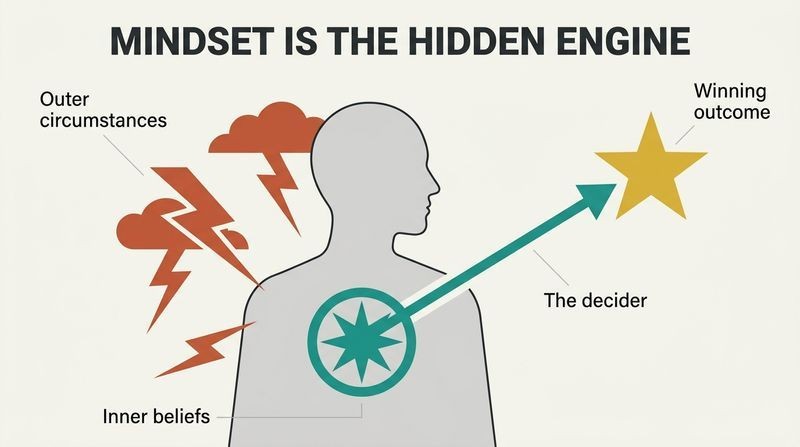
The framing echoes Carol Dweck's research on fixed versus growth mindsets and Martin Seligman's work on learned optimism, both showing that explanatory style predicts performance and resilience. Donnelly's fictional device is clever: sports offers an unforgiving scoreboard, so lessons feel earned rather than preached. The risk is survivorship bias. Five icons who won are hardly a controlled sample, and thousands who believed identically still lost. The honest reading is not that belief guarantees victory but that belief governs the inputs (effort, focus, persistence) that stack the odds. Chris's turnaround works precisely because it changes behavior, not because positive thinking bends reality.
Grade yourself on effort and attitude, never the scoreboard
Control the controllables. John Wooden, who won ten national titles yet spent 28 seasons coaching before his first, tells Chris to stop obsessing over wins, critics, and whether he keeps his job, because none of those are fully in his control. Wooden's redefinition of success: giving your maximum effort to become the best you are capable of becoming. By that measure his favorite team was the 1962 UCLA squad that lost in the Final Four but reached its full potential.
Chris tears down his WINNING IS EVERYTHING banner. When his quarterback throws a pick-six, instead of berating him, he says focus on the next play. Focusing only on effort and attitude in the present frees you from replaying the past or dreading the future, and paradoxically the results improve.
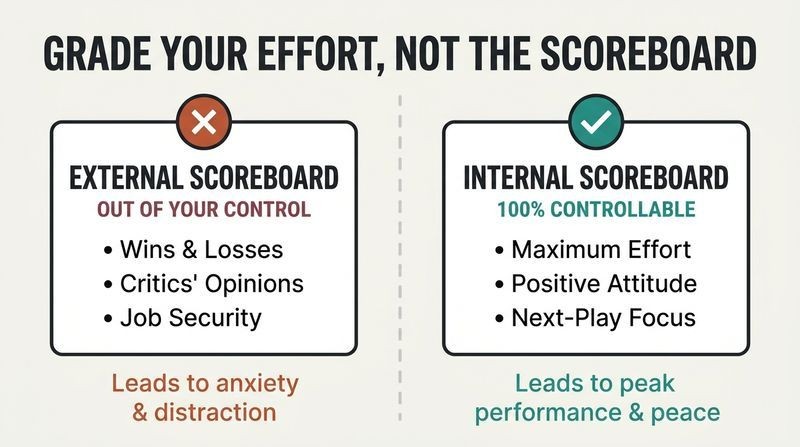
This is the ancient Stoic dichotomy of control, Epictetus repackaged in a whistle and track suit, and it maps neatly onto modern sports psychology's emphasis on process goals over outcome goals. Nick Saban's famous Process, cited in the text, is the same idea. Research on flow (Csikszentmihalyi) supports the claim: performance peaks when attention narrows to the present task rather than the stakes. One caveat worth naming: outcomes still matter in the real world, and Wooden concedes coaches are judged by wins. The insight is not indifference to results but refusing to let uncontrollable results hijack the controllable inputs that produce them.
No one can steal your passion; only you surrender it
Love the work, find the opening. Buck O'Neil, the Negro Leagues star and first Black coach in Major League Baseball, meets Chris in a phantom jazz club. His grandfather survived slavery yet stayed an optimist. Buck played in an era of segregation, slept in hobo camps, and endured Klan run-ins, but refused to let injustice rob his joy for baseball. His lesson: bitterness only hardens your own heart.
Buck reframes obstacles as opportunities. As one of the only Black scouts, he blended into crowds and won over prospects' families, turning exclusion into advantage. He urges Chris to count blessings that trounce his curses: a job millions would want, a loving family. His warning is sharp: if you do not love what you do, you will lose to someone who does.
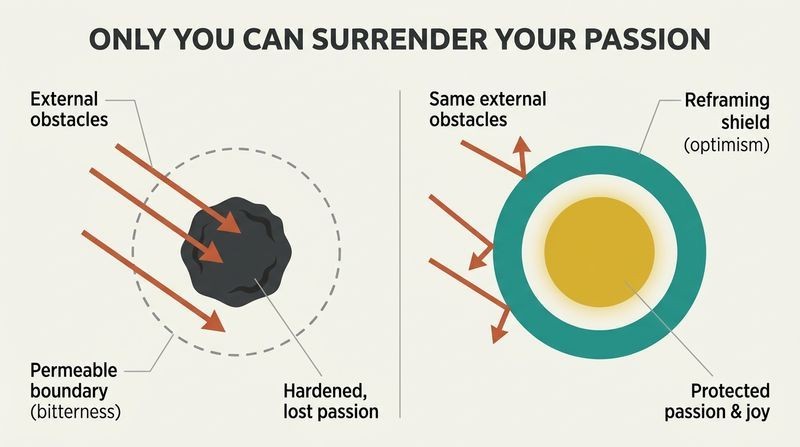
Buck O'Neil was a real figure whose radiant lack of bitterness Ken Burns immortalized, and using him to teach gratitude carries moral weight precisely because his grievances were legitimate. The insight connects to Barbara Fredrickson's broaden-and-build theory: positive emotion literally widens cognition, helping people spot the opportunities Buck describes. It also anticipates reappraisal research showing that reframing adversity lowers stress more effectively than suppressing it. The one tension: telling a person in genuine hardship that joy is purely a choice can shade into toxic positivity. Buck's version survives that critique because he acknowledges the injustice fully, then refuses to let it own him.
Playing not to lose is the surest way to lose
Leaders create; managers coast. Herb Brooks, architect of the 1980 Miracle on Ice, ambushes Chris after Chris tells his staff to merely survive a game against powerhouse Wisconsin by slowing the offense and minimizing damage. Brooks calls this cowardice disguised as realism. He distinguishes a manager, who maintains what exists, from a leader, who pushes toward new heights and accepts the risk of failure.
Brooks argues you are always moving forward or backward, never holding steady. His U.S. college kids beat a Soviet team that had crushed NHL all-stars, but only after Brooks planted the belief it was possible. His prescription: list every reason you can win, ignore the naysayers, and expect failure as a necessary step, since the only true failure is quitting. Chris changes his game plan and Wisconsin State beats a top-ten team for the first time in school history.
Brooks names a real cognitive trap: loss aversion, where the fear of losing what you have outweighs the pull of a bigger prize, often producing conservative choices that guarantee mediocrity. Behavioral economists Kahneman and Tversky documented this asymmetry precisely. The manager-versus-leader distinction rhymes with Kotter's leadership literature. Where the argument needs nuance is in survivorship framing again: the 1980 team is remembered because it won, while countless bold underdogs got blown out. Still, Brooks's deeper point holds. If your stated goal is reaching your full potential, playing safe forecloses that potential by definition, regardless of the final score.
Quitting is a habit; perseverance is a decision you make
Toughness is chosen, not gifted. Bear Bryant appears on a scorched Texas practice field, the site of his brutal 1954 Junction camp, where 115 Aggies arrived and only about 30 survived. That team went 1-9, Bryant's only losing season, yet remained his favorite because those players never quit and later built a championship. His thesis: mental toughness is a choice, and every quit makes the next one easier until surrender becomes a way of life.
Bryant's tools for toughness:
1. Treat setbacks as temporary and limited, not permanent catastrophes.
2. Refuse excuses and blame; own the outcome.
3. Convert anger into focused fuel rather than stewing on it.
4. Expect problems, then expect to beat them.
5. Commit to never quitting, which alone assures eventual success.
Bryant's temporary-versus-permanent framing is textbook Seligman: optimists explain bad events as temporary, specific, and external, pessimists as permanent, pervasive, and personal. That explanatory style predicts who persists. The anger-as-fuel advice aligns with research on approach-oriented emotions, where controlled anger can boost motivation and risk tolerance. The claim that never quitting assures success overstates the case. Persistence toward a doomed strategy is just stubbornness, and knowing when to pivot matters too. Bryant's Junction story also carries a darker footnote worth remembering: pushing humans to breaking points can cause real harm, and modern coaching rightly rejects some of his methods even while prizing the grit they forged.
Every choice springs from faith or fear; choose faith and prepare
Confidence is the ceiling. Vince Lombardi, hosting a party of the assembled legends in Chris's dream basement, delivers the fifth and, he insists, most important belief. A person rises only as high as his confidence, and confidence is how you approach the unknowable. Every action flows from either faith or fear, usually unconsciously. Lombardi clarifies his misquoted line: it was never winning is the only thing, but that the will to win, the effort to excel, is what matters.
He offers concrete confidence builders: thorough preparation, high expectations, studying those who succeeded before you, encouraging self-talk, and vivid visualization of success rather than failure. He warns that dwelling on past mistakes breeds fear, and that arrogance is itself fear in disguise. For Lombardi, faith (including faith in God) is the deepest source of the boldness needed to pursue big dreams.
Lombardi's confidence-through-preparation is well supported: Bandura's self-efficacy research shows that mastery experiences, vicarious learning, and positive self-talk are the strongest drivers of belief in one's capabilities, exactly Lombardi's list. Visualization has measurable effects on motor performance too. The faith-over-fear binary is a useful heuristic even for secular readers, since most self-sabotage does trace to fear of loss, judgment, or failure. Lombardi's explicitly religious framing may not travel for everyone, but his psychological point stands independent of theology: acting from trust rather than dread expands the range of what you attempt, and preparation is what makes that trust rational rather than reckless.
Write your beliefs down, then reread them morning and night
Repetition rewires identity. After each coaching visit, Chris feels compelled to grab a pen and write out that belief as a first-person statement, almost automatically. He collects the five into a booklet titled Think Like a Warrior and a pocket card listing the five beliefs. His routine becomes reading every word slowly each morning and each night, sitting with each page, and repeating the card's lines throughout the day, whenever worry or negativity creeps in.
He hands the booklet to every player and coach, instructing them to read it before practice, before tests, before big and small decisions alike. The goal is to make the beliefs second nature until they guide thought automatically. Star linebacker Braxton Tatum, drafted into the NFL, vows to carry the card everywhere. The beliefs stop being ideas and become identity.
This is the operational heart of the book, and it is easy to skip past. Abstract insight changes nothing without a delivery mechanism, and Donnelly's mechanism is spaced repetition plus first-person affirmation. The affirmation literature is genuinely mixed: Wood's research found that positive self-statements can backfire for people with low self-esteem, while self-affirmation theory (Steele) shows value-based affirmations buffer stress. The reconciling detail is that Chris's statements are tied to controllable behaviors and identity (I choose, I focus, I persevere) rather than empty outcome claims. That behavioral anchoring, plus the ritual timing at the malleable moments of waking and sleeping, is what gives the practice teeth.
One naysayer's lie nearly cost Chris his career and a season
Beware the confident voice. Riding high after the Wisconsin upset, Chris is summoned by Ted Mueller, a wealthy booster shooting pool at 11 a.m., who smugly claims the athletic department has already lined up his replacement and speaks for the administration. Deflated, Chris violates every lesson he has learned, loses focus, calls a rhythmless game, and gets crushed by Bowling Green. He drafts a resignation letter.
Only later does his actual boss reveal the truth: Ted spoke for no one but himself and had been pushing an unqualified high school buddy for years. The team fully intended to extend Chris's contract. A single arrogant liar had derailed a game and almost ended a career, proving Brooks's warning that naysayers, however confident, deserve none of your surrendered focus.
The episode dramatizes a real cognitive vulnerability: humans weight confidently delivered assertions far more heavily than the speaker's actual authority warrants, a bias exploited by con artists and office politicians alike. It pairs with the negativity bias, where one harsh judgment outweighs a dozen affirmations. The practical lesson is verification before reaction. Chris never checked Ted's claim against his real boss, and the unexamined story cost him a game. In an age of algorithmic outrage and anonymous criticism, the discipline of asking who actually said this, and do they actually decide anything, is more valuable than ever.
Define success on your terms: faith, family, then career
The dream must be yours. After winning the MAC championship and the school's first ten-win season, Chris is offered a lucrative Power Five job at Illinois, everything the outside world says he should chase. But his wife Cindy loves their community and wants to raise their children there. Recalling Lombardi's ordering of priorities (faith, family, then football), Chris recognizes his instinct to grab the bigger paycheck as fear talking, the fear of missing out on something better while he is already happy.
He turns down Illinois and signs the smaller Wisconsin State extension. His dream is no longer anyone else's definition of prestige. The book closes with his refusal to return to a victim mentality: circumstances will always swing up and down, but the response is a chosen mindset, and that choice is what makes a person unstoppable.
The ending quietly subverts the standard success fable, where the hero climbs to the biggest stage. Donnelly instead argues that externally defined ambition can itself be fear in costume, the fear of others' judgment. This resonates with self-determination theory (Deci and Ryan), which finds that intrinsically chosen goals produce durable well-being while extrinsically driven ones (money, status, prestige) often do not, even when achieved. The priority ordering also functions as a values pre-commitment, a way to decide in advance what wins when options conflict, so the decision is not hijacked by the emotion of the moment. It is a fitting capstone: the warrior mindset serves your life, not the reverse.
Analysis
Think Like a Warrior belongs to a distinctly American genre: the sports parable as self-help delivery vehicle, pioneered by writers like Og Mandino and refined by Jon Gordon. Donnelly's structural choice is shrewd. By wrapping five familiar success principles inside a ghost-story fable narrated by a broke, humiliated coach, he lowers the reader's defenses against advice that would sound trite in a lecture. The dichotomy of control, gratitude, bold goal-setting, grit, and confidence are hardly novel individually. Their power here comes from sequencing and embodiment: each abstract principle is fused to a real historical figure whose documented life makes the lesson unforgettable. Wooden's 28 pre-title seasons, O'Neil's grace under segregation, Brooks's impossible Soviet upset, Bryant's Junction crucible, and Lombardi's misquoted mantra are memory hooks that outlast any bullet list. The intellectual spine is coherent. Beliefs one and four (control effort, never quit) govern behavior. Beliefs two and five (love the work, choose faith) govern emotion. Belief three (dream big) governs ambition. Together they form a closed loop: aim high, love the pursuit, control only your inputs, persist through failure, and act from confidence rather than dread.
The book's limits are the genre's limits. Its evidence is anecdotal and heavily survivorship-biased. It underweights structural constraints (talent, resources, luck) that no mindset overrides, and it occasionally slides toward the seductive falsehood that belief alone bends outcomes. The financial subplot conveniently resolves. Yet the strongest through-line rescues it: Donnelly repeatedly anchors his affirmations to controllable actions and chosen identity, not magical outcome-thinking. That distinction separates his framework from mere wishful thinking and aligns it with genuine research in Stoicism, self-efficacy, and explanatory style. As a practical operating system for a discouraged person, it is well constructed, memorable, and, crucially, actionable through its daily reread ritual.
Review Summary
Think Like a Warrior receives mostly positive reviews, with readers praising its inspiring message and engaging storytelling. Many appreciate the book's sports-focused approach to personal development, finding the lessons applicable to various aspects of life. The five inner beliefs presented are frequently mentioned as valuable takeaways. Some readers note the simplicity of the message, but most find it effective. A few criticize the predictability or cheesiness of the story, but overall, readers find the book motivational and worth reading.
FAQ
What's "Think Like a Warrior" about?
- Story of Transformation: "Think Like a Warrior" by Darrin Donnelly is a fictional story about a college football coach named Chris McNeely who learns to overcome personal and professional challenges.
- Guidance from Legends: The protagonist receives guidance from legendary sports figures like John Wooden, Buck O'Neil, Herb Brooks, Bear Bryant, and Vince Lombardi.
- Five Inner Beliefs: The book focuses on five core beliefs that help individuals develop a warrior mindset, making them unstoppable in pursuing their dreams.
- Personal and Professional Growth: Through the narrative, the book explores themes of resilience, passion, dreaming big, perseverance, and faith.
Why should I read "Think Like a Warrior"?
- Inspiration and Motivation: The book provides motivational lessons through a compelling narrative, making it relatable and inspiring for anyone facing challenges.
- Practical Life Lessons: It offers practical advice on how to develop a positive mindset and overcome obstacles in both personal and professional life.
- Engaging Storytelling: The fictional story is engaging and uses sports as a metaphor for life's challenges, making it an enjoyable read.
- Universal Themes: The themes of resilience, passion, and faith are universal and can be applied to various aspects of life beyond sports.
What are the key takeaways of "Think Like a Warrior"?
- Focus on Control: Concentrate on what you can control—your effort and attitude—rather than external outcomes.
- Passion and Enthusiasm: Love what you do and approach each day with joy and enthusiasm to gain a competitive edge.
- Dream Big: Set ambitious goals and ignore naysayers who discourage you from pursuing your dreams.
- Perseverance: Be relentless and never give up on your dreams, as perseverance assures success.
- Faith Over Fear: Choose faith over fear, trusting that everything will work out if you give your best effort.
What are the best quotes from "Think Like a Warrior" and what do they mean?
- "Success is a choice." This quote emphasizes that success is determined by the beliefs and mindset you choose to adopt.
- "Focus on only the things you have total control over." It highlights the importance of concentrating on your effort and attitude, which are within your control.
- "I love what I do and I attack each day with joy and enthusiasm." This quote underscores the power of passion and a positive attitude in achieving success.
- "I choose faith over fear." It encourages readers to trust in their abilities and a higher power, rather than succumbing to fear and doubt.
How does Chris McNeely's journey unfold in "Think Like a Warrior"?
- Initial Struggles: Chris McNeely starts as a struggling college football coach facing personal and professional setbacks.
- Guidance from Legends: He receives visits from legendary coaches who impart wisdom and teach him the five inner beliefs.
- Adopting New Beliefs: Chris learns to focus on what he can control, reignite his passion, dream big, persevere, and choose faith over fear.
- Transformation and Success: By embracing these beliefs, Chris transforms his mindset, leading to personal growth and professional success.
What are the five inner beliefs in "Think Like a Warrior"?
- Effort and Attitude: Focus on what you can control—your effort and attitude in the present moment.
- Joy and Enthusiasm: Love what you do and approach each day with joy and enthusiasm.
- Dream Big: Set ambitious goals and ignore the naysayers.
- Perseverance: Be relentless and never give up on your dreams.
- Faith Over Fear: Choose faith over fear, trusting that everything will work out if you give your best effort.
How does "Think Like a Warrior" incorporate sports psychology?
- Science of Success: The book uses sports psychology principles to illustrate how mindset affects performance and success.
- Real-Life Applications: It applies these principles to real-life situations, showing how they can be used beyond sports.
- Legendary Coaches: The story features legendary coaches who embody sports psychology concepts, providing practical examples.
- Mindset and Performance: It emphasizes the connection between a positive mindset and achieving peak performance in any field.
What role do legendary coaches play in "Think Like a Warrior"?
- Mentors and Guides: Legendary coaches like John Wooden, Buck O'Neil, Herb Brooks, Bear Bryant, and Vince Lombardi serve as mentors to Chris McNeely.
- Teaching Core Beliefs: Each coach imparts a specific core belief that contributes to developing a warrior mindset.
- Inspiration and Wisdom: They provide inspiration and wisdom, drawing from their own experiences and successes.
- Catalysts for Change: Their guidance acts as a catalyst for Chris's transformation and growth throughout the story.
How does "Think Like a Warrior" address overcoming adversity?
- Resilience and Perseverance: The book emphasizes the importance of resilience and perseverance in overcoming challenges.
- Mindset Shift: It shows how changing one's mindset can lead to overcoming obstacles and achieving success.
- Learning from Setbacks: The story illustrates how setbacks are temporary and can be used as learning opportunities.
- Relentless Pursuit: It encourages a relentless pursuit of goals, regardless of the difficulties faced along the way.
What is the significance of the warrior mindset in "Think Like a Warrior"?
- Unstoppable Attitude: The warrior mindset represents an unstoppable attitude towards achieving one's goals.
- Inner Strength: It emphasizes inner strength, resilience, and the ability to overcome any obstacle.
- Empowerment: Adopting a warrior mindset empowers individuals to take control of their destiny and pursue their dreams.
- Universal Application: The principles of the warrior mindset can be applied to various aspects of life, not just sports.
How does "Think Like a Warrior" explore the theme of faith?
- Faith Over Fear: The book encourages choosing faith over fear, trusting that everything will work out if you give your best effort.
- Higher Power: It highlights the role of faith in a higher power as a source of strength and confidence.
- Trust and Assurance: Faith provides assurance that challenges can be overcome and that one is on the right path.
- Integral to Success: The theme of faith is integral to the overall message of the book, emphasizing its importance in achieving success.
What lessons can be applied from "Think Like a Warrior" to everyday life?
- Focus on Control: Concentrate on what you can control—your effort and attitude—rather than external outcomes.
- Passion and Enthusiasm: Love what you do and approach each day with joy and enthusiasm to gain a competitive edge.
- Dream Big: Set ambitious goals and ignore naysayers who discourage you from pursuing your dreams.
- Perseverance: Be relentless and never give up on your dreams, as perseverance assures success.
- Faith Over Fear: Choose faith over fear, trusting that everything will work out if you give your best effort.
About the Author


Download PDF
Download EPUB
.epub digital book format is ideal for reading ebooks on phones, tablets, and e-readers.








































