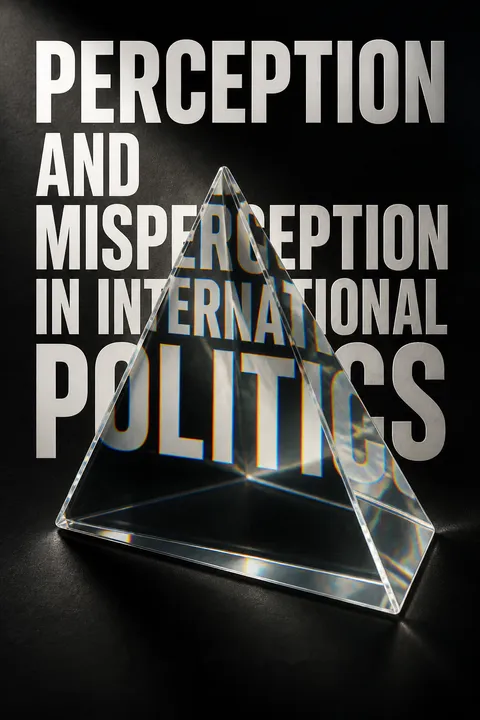

Key Takeaways
1. Perceptions are not neutral; they are patterned and influence outcomes.
Perceptions of the world and of other actors diverge from reality in patterns that we can detect and for reasons that we can understand.
Perceptions matter. Contrary to assumptions that decision-makers perceive the world accurately, misperceptions are common, predictable, and profoundly impact international relations. These aren't random errors but systematic deviations from reality, rooted in how humans process information. Understanding these patterns is vital not just for explaining specific decisions but for grasping broader international dynamics.
Beyond objective reality. While an "operational milieu" (the objective world) exists, policies are always mediated by the "psychological milieu"—the world as the actor sees it. Ignoring this subjective layer means missing the "why" behind state actions. For instance, whether a state responds to a perceived threat depends on its leaders' interpretation of that threat, not just the objective danger.
Levels of analysis. The book argues against solely focusing on external factors like the international system, domestic politics, or bureaucratic interests. While these influence behavior, they don't fully explain it. Perceptions introduce a crucial intervening variable, highlighting that even in similar objective situations, different leaders or states may act differently due to their unique interpretations.
2. Understanding others' intentions is crucial, but often misjudged.
No bit of behavior is self-explanatory or has only one plausible implication for the actor’s future conduct.
Inferring intentions. To predict how others will act, decision-makers must infer their intentions. This involves distinguishing between situational factors (compulsion) and internal processes (goals, beliefs, willingness to take risks). An act of aggression, for example, is interpreted differently if it's seen as a forced response to circumstances versus a deliberate, unprovoked choice.
Utopian vs. basic intentions. The book introduces "utopian intentions" (what a state would do without any external constraints) and "basic intentions" (the costs and risks a state is willing to tolerate to achieve its goals). Most states are not purely aggressive or status quo; their behavior is shaped by their willingness to pay a price. Misjudging this willingness can lead to disastrous policy choices, as seen in the Korean War where the US misread Soviet risk tolerance.
Mispredicting one's own behavior. Actors often fail to accurately predict their own future actions, especially in unforeseen or emotionally charged situations. This means observers might understand an actor's intentions better than the actor himself. For example, a state might commit to a strong response but back down when faced with the actual crisis, or vice versa, due to shifting values or unforeseen circumstances.
3. The security dilemma and psychological biases drive conflict spirals.
The increase of armaments, that is intended in each nation to produce consciousness of strength, and a sense of security, does not produce these effects.
Anarchy's paradox. In an anarchic international system, states seek security, but their efforts to achieve it often inadvertently threaten others. This "security dilemma" means that defensive actions can be perceived as offensive, leading to arms races and escalating hostility, even if no state initially desires conflict.
Deterrence vs. spiral. Two contrasting models emerge:
- Deterrence theory: Assumes aggressors exploit weakness; advocates firmness and strength. Concessions are seen as encouraging further demands.
- Spiral model: Emphasizes the security dilemma; argues that threats and arms increases are self-defeating, leading to counteractions and mutual insecurity. Advocates conciliation and reassurance.
Psychological reinforcement. Cognitive biases exacerbate these dynamics. States tend to assume the worst about others' intentions, interpreting their arms buildups as aggressive, while viewing their own as purely defensive. This "mirror imaging" prevents states from recognizing that their actions might be perceived as menacing, fueling a self-fulfilling prophecy of hostility.
4. Beliefs are resistant to change, often leading to irrational consistency and premature closure.
Every step of the [scientific] procedure—from the initial identification of ‘phenomena’ requiring explanation to the final decision that our explanation is satisfactory—[be] governed and directed by the fundamental conceptions of the theory.
Cognitive consistency. People strive for coherence in their beliefs. This can be rational, reflecting real-world patterns (e.g., friends of friends are often friends). However, it also leads to "irrational consistency," where favored policies are believed to serve many logically independent values, avoiding uncomfortable trade-offs.
Assimilation of information. New information is often filtered through existing beliefs. Discrepant data may be:
- Ignored or not noticed at all.
- Twisted to fit the existing image.
- Rejected as invalid, often by discrediting the source.
- Acknowledged but set aside as an unexplained puzzle.
Premature cognitive closure. This tendency means initial hypotheses, even if based on ambiguous or limited information, become entrenched. Once a belief takes hold, it becomes harder to dislodge, even when later, clearer evidence contradicts it. This can lead to decision-makers clinging to flawed policies longer than rational analysis would dictate.
5. Immediate concerns and information shape what we perceive.
Perceptions are influenced by immediate concerns ("evoked sets") as well as by more deeply rooted expectations.
The "evoked set." What is at the forefront of a person's mind—their immediate problems, recent information, or current preoccupations—heavily influences how they interpret new stimuli. This "evoked set" acts as a filter, making certain interpretations more accessible and others less so.
Miscommunication through differing sets. Actors often mistakenly assume that others share their immediate concerns and information. This leads to significant miscommunication, even between allies. For example:
- Washington's warning to Pearl Harbor before the Japanese attack was misinterpreted as referring to sabotage, not external attack, because local commanders were preoccupied with sabotage threats and lacked Washington's intelligence.
- Lord Raglan's orders during the Charge of the Light Brigade were ambiguous to his subordinates due to differing vantage points and recent experiences.
Tunnel vision. Intense focus on a particular problem can create a kind of "tunnel vision," where decision-makers interpret all external events through the lens of their primary concern, failing to recognize that others may be operating under entirely different priorities. This egocentric bias can lead to misjudging others' motivations and actions.
6. History teaches lessons, but often superficial and overgeneralized ones.
History is the best teacher but its lessons are not on the surface.
Learning from the past. Past international events provide analogies and patterns that shape how decision-makers interpret current situations. However, this learning is often superficial, focusing on "what" happened rather than a deep understanding of "why" it happened, including the specific context and causal linkages.
Overgeneralization of lessons. Decision-makers tend to overgeneralize from dramatic and personally experienced events, applying lessons too broadly to dissimilar situations. For instance:
- Truman's interpretation of the Korean War through the "Munich analogy" (appeasement leads to further aggression).
- The British navy's overreliance on Jutland (a WWI battle) for interwar training, neglecting submarine warfare lessons.
- The French military's misapplication of Franco-Prussian War lessons, leading to ill-prepared offensives in WWI.
Impact of firsthand experience. Events experienced firsthand, especially early in one's career or those with major national consequences (like revolutions or major wars), leave disproportionate impressions. This can make individuals insensitive to changes in circumstances or actors over time, leading to repeated mistakes.
7. Actors overestimate their own importance and the coherence of others' actions.
A common misperception is to see the behavior of others as more centralized, planned, and coordinated than it is.
Perceiving unity and planning. People tend to impose order on complex events, seeing others' actions as more centralized, planned, and coherent than they actually are. This bias stems from a psychological need for explanation and the principle of parsimony (Occam's Razor). Accidents, confusion, and internal conflicts are often overlooked in favor of a single, overarching plan, often a sinister one.
Underestimating internal divisions. Decision-makers frequently overestimate the degree to which foreign governments are monolithic entities, capable of imposing their will on all subordinates. They may misinterpret actions by agents or bureaucratic factions as official policy, leading to misjudgments of the other state's intentions. For example, China misread various US statements during the Korean War as a unified "aggression" plan.
Misinformation about one's own behavior. Paradoxically, decision-makers also tend to be misinformed about their own agents' actions, assuming instructions are faithfully carried out. This creates a double layer of misperception: they misinterpret the other's response because they don't accurately know what their own side has done, leading to increased conflict and illusory incompatibility.
8. Desires and fears can bias perceptions, but expectations are often more powerful.
Our stereotyped world is not necessarily the world we should like it to be. It is simply the kind of world we expect it to be.
Wishful thinking vs. expectations. While the idea that people perceive what they want to perceive ("wishful thinking") is popular, experimental evidence is often ambiguous, especially when incentives for accuracy are present. Many apparent cases of wishful thinking can be explained by expectations—people see what they expect to see, which may or may not align with their desires.
Vigilance or defense. The influence of fear on perception is nuanced:
- Perceptual vigilance: If a person believes they can effectively counter a threat, they become more alert to signs of danger.
- Perceptual defense: If they feel helpless to avoid pain, they may ignore or downplay the threat.
This suggests that the perceived efficacy of countermeasures is a key determinant of how threats are processed.
Dominance of expectations. In international relations, expectations often override desires. Statesmen may wish for a benign world but expect hostility, leading them to perceive threats even when they desire peace. This is partly due to the anarchic nature of the international system, which fosters a baseline of suspicion.
9. Cognitive dissonance reinforces decisions, increasing inertia and justifying sunk costs.
Following a decision there is an increase in the confidence in the decision or an increase in the discrepancy in attractiveness between the alternatives involved in the choice, or both.
Justifying choices. After making a significant decision, people experience "cognitive dissonance"—psychological discomfort from conflicting beliefs (e.g., knowing the chosen policy has drawbacks, or the rejected one has advantages). To reduce this, they rearrange their beliefs to strongly justify their choice, making it seem overwhelmingly correct. This is known as the "spreading apart of alternatives."
Inertia and sunk costs. This post-decision rationalization increases inertia, making decision-makers more resistant to new information that might challenge their chosen path. High costs already expended ("sunk costs") further intensify this effect, leading to:
- Overvaluing achievements.
- Perceiving failures as successes.
- Redoubling efforts to make the policy work, even when it's failing.
Compulsion and attitude change. Paradoxically, the less a decision-maker feels they had a choice (i.e., greater compulsion), the less dissonance they experience, and thus the less their private attitudes change. This means officials acting under strong orders might maintain diverse private views, while those who feel they made a free choice become more deeply committed to their decision.
10. Minimizing misperception requires explicit assumptions, diverse perspectives, and self-awareness.
Helping decision-makers be more thoughtful will not solve all our problems, but neither is it a trivial goal.
Explicit assumptions. Decision-makers should consciously articulate their beliefs, values, and the underlying assumptions of their policies. This includes:
- Identifying crucial elements of their means-ends chains.
- Considering what evidence would disconfirm their views, not just confirm them.
- Scrutinizing basic assumptions, especially when the environment changes.
Diverse perspectives. To counter inherent biases and premature cognitive closure, decision-makers should actively seek out and structure conflicting cognitive biases into the decision-making process. Employing "devil's advocates"—genuine dissenters, not just assigned roles—can expose implicit assumptions and broaden the range of considered alternatives.
Self-awareness and organizational design. Recognizing common perceptual errors (e.g., overestimating others' centralization, underestimating one's own impact) can help decision-makers compensate for them. Organizations should avoid tying their identity or mission to specific theories or images, as this can lead to rigid adherence to outdated policies, as seen in the Forest Service's resistance to controlled burning.
Review Summary
Reviews of Perception and Misperception in International Politics are largely positive, averaging 4.17/5. Readers consistently praise its importance as a foundational text in international relations, highlighting its insights into how psychological biases and cognitive factors influence decision-making among leaders. However, many note its dense, repetitive prose makes it a challenging read, particularly for practitioners seeking concise guidance. Reviewers appreciate Jervis's thorough historical examples and his exploration of deterrence and spiral theories, while acknowledging some psychological research feels outdated.
People Also Read








Download PDF
Download EPUB
.epub digital book format is ideal for reading ebooks on phones, tablets, and e-readers.








































