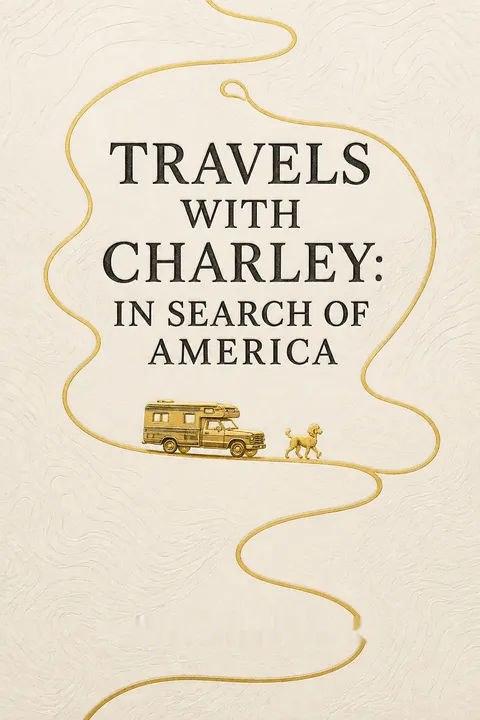

Key Takeaways
1. The Enduring American Restlessness
Nothing has worked. Four hoarse blasts of a ship’s whistle still raise the hair on my neck and set my feet to tapping.
Lifelong wanderlust. John Steinbeck, at 58, confesses to a persistent, incurable "itch" for travel, a deep-seated restlessness that maturity has failed to quell. This personal urge to be "someplace else" drives his decision to embark on a cross-country journey, seeking to reconnect with the soul of America. He views this wanderlust not as a flaw, but as an inherent part of his being, a "disease" he fears is incurable.
A journey's personality. Steinbeck learns that a trip, much like a living entity, takes on its own "personality, temperament, individuality, uniqueness." He realizes that one does not control a journey; rather, the journey controls the traveler. This understanding allows him to relax and embrace the unpredictable nature of his odyssey, much like accepting the dynamics of a marriage.
The universal yearning. Throughout his travels, Steinbeck observes this same "burning desire to go, to move, to get under way, anyplace, away from any Here" in countless Americans. From a small boy wanting to stow away to a store owner longing for escape, this pervasive hunger to move suggests a fundamental, perhaps inherited, trait of the American spirit, rooted in a history of pioneers and immigrants.
2. Rediscovering a Changing Nation
I, an American writer, writing about America, was working from memory, and the memory is at best a faulty, warpy reservoir.
Outdated perceptions. Steinbeck embarks on his journey because he realizes his understanding of America is based on outdated memories from 25 years prior. Living in New York, he feels disconnected from the true pulse of the country, unable to "hear the speech of America, smelled the grass and trees and sewage, seen its hills and water, its color and quality of light." He deems it "criminal" for a writer to write about something he no longer truly knows.
Seeking raw reality. To achieve an unvarnished view, Steinbeck decides to travel incognito, leaving his famous name and identity behind. He outfits a custom-built truck, Rocinante, as a self-contained mobile home, allowing him to be "peripatetic eyes and ears, a kind of moving gelatin plate." This anonymity is crucial to observing people as they truly are, uninfluenced by his celebrity.
A nation transformed. His journey reveals an America vastly changed. He notes the "enormous increase in population," the sprawling growth of cities, and the standardization of culture. This transformation often clashes with his nostalgic memories, leading to a complex mix of admiration and dismay at the country's evolution.
3. The Unseen American Identity
The American identity is an exact and provable thing.
More alike than different. Despite America's vast geographic range, diverse sectionalism, and interwoven ethnic backgrounds, Steinbeck concludes that Americans are fundamentally more alike than they are different. He observes a distinct "Americanness" that transcends regional, social, financial, educational, religious, and political divides. This shared identity is a "carefully observed fact," not mere patriotism.
Rapid cultural convergence. This surprising homogeneity has developed remarkably quickly, largely within the last fifty years. Steinbeck notes that:
- California Chinese, Boston Irish, Wisconsin German, and Alabama Negroes share more in common than their European counterparts.
- Regional speech patterns are disappearing due to radio and television.
- The same songs, jokes, and styles sweep across the country simultaneously.
A new breed. Steinbeck posits that Americans are a "new breed," distinct from their ancestral origins. This rapid assimilation and shared cultural experience create a collective identity stronger than any individual heritage. He finds this phenomenon astonishing, a testament to the powerful forces shaping the nation.
4. The Paradox of Progress and Waste
The mountains of things we throw away are much greater than the things we use.
Exuberant wastefulness. Steinbeck is struck by America's "wild and reckless exuberance of our production, and waste seems to be the index." He observes cities "ringed with trash," surrounded by "piles of wrecked and rusting automobiles," and "smothered with rubbish." This contrasts sharply with European cultures where every item is saved and reused.
Standardization of experience. Modern progress brings convenience but often at the cost of character. Roadside food is "clean, tasteless, colorless, and of a complete sameness," while local speech and unique cultural expressions are disappearing, replaced by "packaged, standard and tasteless" national versions. He mourns the loss of this localness, even while acknowledging the benefits of modern life.
The mobile home revolution. He notes the rise of mobile homes as a significant shift in American living, offering comfort, affordability, and flexibility. While providing privacy and easing intergenerational tensions, these units also highlight a transient lifestyle and create new challenges, such as tax burdens on fixed property owners. This mobility reflects a deeper American inclination to move rather than stay rooted.
5. The Subjectivity of Observation
What I set down here is true until someone else passes that way and rearranges the world in his own style.
Multiple realities. Steinbeck acknowledges that his account is inherently subjective, shaped by his own perceptions and feelings. He contrasts his "slipshod manner" of observation with the objective reporting of others, concluding that "there are too many realities." His "morning eyes describe a different world than do our afternoon eyes, and surely our wearied evening eyes can report only a weary evening world."
Personal lens. He recognizes that his own experiences, memories, and emotional state deeply influence what he sees and how he interprets it. For instance, his childhood experiences with a Negro family in Salinas shaped his views on race, making him "basically unfitted to take sides in the racial conflict" in the South. This self-awareness underscores the personal nature of his "truth."
The macrocosm of self. Ultimately, Steinbeck concludes that America, this "monster of a land," is a "macrocosm of microcosm me." His journey reveals that external reality is "not so external after all," and that his findings are intertwined with his own inner landscape. This profound realization highlights the deeply personal nature of understanding one's country.
6. Companionship in Solitude
A dog, particularly an exotic like Charley, is a bond between strangers.
Charley, the ambassador. Steinbeck's French poodle, Charley, proves to be an invaluable companion, serving as an "ambassador" who facilitates interactions with strangers. His unique appearance and gentle nature often initiate conversations, breaking down social barriers and providing Steinbeck with insights into local populations. Charley's presence mitigates the loneliness of solo travel.
An emotional anchor. Beyond social utility, Charley is a deep emotional support. He senses Steinbeck's moods, offering comfort during moments of desolation or illness. His unwavering presence provides a constant, non-judgmental companionship, making the long stretches of solitary driving more bearable.
A mirror to humanity. Charley's reactions, from his ecstatic sniffing of manure piles to his unexpected rage at bears in Yellowstone, offer Steinbeck moments of humor, surprise, and reflection on animal (and human) nature. His "mind-reading" abilities and distinct personality make him a character in his own right, enriching the narrative and deepening Steinbeck's understanding of loyalty and instinct.
7. Confronting Societal Ills
Here, I knew, were pain and confusion and all the manic results of bewilderment and fear.
The South's agony. Steinbeck approaches the American South with dread, anticipating "pain and violence" stemming from racial desegregation. He witnesses the "Cheerleaders" in New Orleans, a group of women screaming invectives at young Negro children entering school. This "strange drama" fills him with "shocked and sickened sorrow," revealing a "demented cruelty of egocentric children."
Fear and bewilderment. He observes that the cruelty is not spontaneous anger but a rehearsed performance, a "frightening witches’ Sabbath" driven by a deep-seated fear of change. A local man explains the difficulty of altering ingrained feelings, suggesting that the problem is not just about race but about human resistance to fundamental shifts in perception and power.
The absence of "the People." Steinbeck's political reporter friend challenges him to find "a man with guts" or "the People" – those with genuine convictions, not swayed by expediency or superficiality. The widespread political apathy and reluctance to express strong opinions he encounters suggest a deeper societal malaise, where contentious feelings are often channeled into safer targets like "the Russians."
8. The Impossibility of Returning Home
Tom Wolfe was right. You can’t go home again because home has ceased to exist except in the mothballs of memory.
Nostalgia's illusion. Returning to his native Monterey, California, Steinbeck experiences a profound sense of displacement. The town has grown exponentially, its familiar landscapes replaced by new developments and strangers. His cherished memories clash with the present reality, creating confusion and anger.
The ghost in the room. He realizes that he, the returning traveler, is the "ghost." Having left and become "fixed and unchangeable" in his memories, his return causes uneasiness for old friends who have changed with the town. They, and he, desire his absence so he can resume his "proper place in the pattern of remembrance."
A changed landscape. The physical transformation of his childhood home is stark:
- Narrow mountain roads replaced by four-lane highways.
- Woody hills shaved for television relay stations.
- Salinas, once 4,000 citizens, now 80,000 and growing.
- Carmel, once for "starveling writers," now for the "well-to-do."
This experience reinforces the painful truth that the past is immutable, and attempts to revisit it often lead to disillusionment.
9. Aging and the Quest for Vitality
I did not want to surrender fierceness for a small gain in yardage. My wife married a man; I saw no reason why she should inherit a baby.
Defying decline. Steinbeck undertakes his arduous journey partly as an "antidote for the poison of the professional sick man," resisting the societal expectation to "slow down" and "pack their lives in cotton wool" after a recent illness. He refuses to trade "quality for quantity" in his remaining years, determined to live with "fierceness."
A test of endurance. The trip, covering over ten thousand miles alone in a truck, is physically demanding. He endures:
- Hurricane Donna's fury.
- Bitter cold and endless rain.
- The nerve-wracking chaos of city traffic.
- A blown tire in a muddy Oregon downpour.
- Charley's unexpected illness.
These challenges test his resolve and physical limits, affirming his vitality.
Embracing the unknown. Despite initial qualms and the comfort of home, Steinbeck pushes through, driven by a desire to experience life fully. His willingness to face the "terrors of the uncomfortable and unknown" is a testament to his commitment to remaining engaged with the world, rather than retreating into a passive old age.
10. The Power of Human Connection
The cognac was very, very good, and from the first muttered “Santé” and the first clicking sip you could feel the Brotherhood of Man growing until it filled Rocinante full—and the sisterhood also.
Unexpected bonds. Throughout his journey, Steinbeck finds profound human connection in unexpected places. Sharing cognac with French-Canadian potato pickers in Maine transforms a cautious encounter into a moment of "triumphant human magic," filling Rocinante with a sense of "Brotherhood of Man." These brief, genuine interactions become treasured memories.
Taciturn wisdom. He encounters individuals who, despite their quiet demeanor, offer deep insights. The New Hampshire farmer, the Michigan lake guardian, and the Minnesota storekeeper all provide thoughtful perspectives on life, change, and society, often through laconic exchanges. These conversations, though brief, leave a lasting impression on Steinbeck.
Kindness of strangers. Even in moments of frustration or vulnerability, he experiences unexpected acts of kindness:
- The Maine state trooper's silent directions.
- The Michigan lake guardian's shared fishing trip and hospitality.
- The Oregon service station man's tireless effort to find new tires.
- The Amarillo vet's compassionate care for Charley.
These moments of genuine human connection underscore the warmth and generosity that exist beneath the surface of a rapidly changing America.
Review Summary
Readers widely praise Travels with Charley as a beautifully written, deeply personal travelogue capturing 1960s America. Many highlight Steinbeck's vivid descriptions of the redwoods, his haunting portrayal of New Orleans' racial tensions, and his charming bond with his poodle companion. While some feel mildly cheated by revelations that portions were fictionalized or embellished — including his wife's presence and fabricated conversations — most readers conclude the book's literary and philosophical merits outweigh its factual shortcomings. The audiobook narrated by Gary Sinise receives particular praise.
People Also Read









About the Author





Download PDF
Download EPUB
.epub digital book format is ideal for reading ebooks on phones, tablets, and e-readers.








































