

Key Takeaways
Evil is not lawlessness but a militant refusal to feel guilty
The core defect is denial, not sin. Peck, a psychiatrist, argues that everyone sins constantly (sin means simply "missing the mark," failing to be perfect). What distinguishes truly evil people is not the size of their sins but their absolute inability to tolerate the pain of feeling sinful. They cannot bear to be displeasing to themselves.
Contrast this with ordinary criminals. Peck notes that in prisons he rarely met evil people. Convicts commit destructive acts openly, admit fault, even joke that the real criminals stay out of jail. The evil, by contrast, are respectable: Sunday school teachers, bankers, PTA members. They are consumed with maintaining an image of moral purity precisely because a rudimentary conscience tells them something is wrong, and they cannot face it.
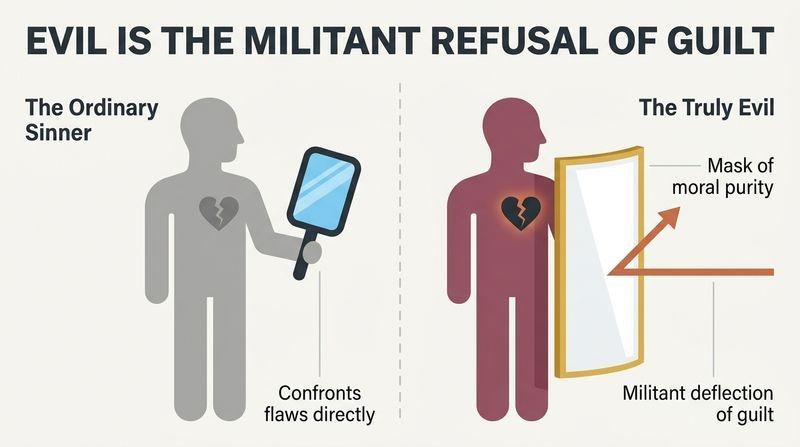
What's striking is how this inverts the popular image of evil as flamboyant villainy. Peck's evil are boringly normal, which anticipates Hannah Arendt's "banality of evil." The framing also resonates with modern research on defensiveness and cognitive dissonance: Festinger showed people rewrite reality rather than admit they were wrong. Where Peck adds value is the moral gradient. He insists sin is universal and healthy to acknowledge, making guilt a feature rather than a bug. A fair challenge: pathologizing the refusal of guilt risks circular reasoning, since anyone who denies wrongdoing could be labeled evil. Peck himself flags this danger, urging self-judgment first.
Scapegoating is evil's signature move: attack the mirror, not the flaw
Evil people project their sin outward. Because they secretly sense their own badness but cannot admit it, they must locate the badness in someone else. Peck calls the evil chronic scapegoaters who sacrifice others to preserve their self-image of perfection. His example: a father who curses in front of his son, then, when the boy innocently repeats the word, brutally punishes the child for "filthy language," washing his mouth with soap in the name of good discipline.
The weak are the targets. Evil requires power over its victim, so the most common victims are children, who are trapped in near-total dependency. The parent who cannot face their own failure destroys the child's spirit instead, all while appearing to be a devoted, disciplining guardian.
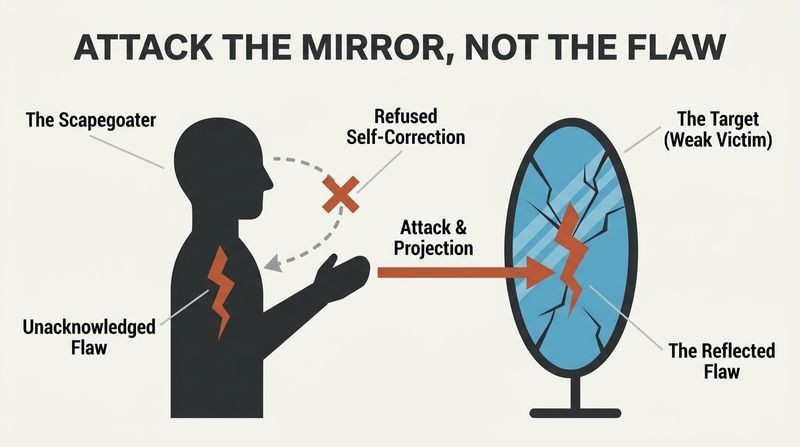
The projection mechanism Peck describes is well-established in clinical psychology, but he sharpens it into a moral diagnostic. The disturbing insight is that cruelty often masquerades as righteousness, the punisher genuinely believes he is doing good. This connects to Baumeister's work on evil, which found perpetrators usually see themselves as victims responding justly. It also illuminates political and religious persecution: inquisitions and purges are scapegoating scaled up. One nuance worth adding: not every harsh parent is evil. Peck's own criterion is consistency and pattern, not a single act, which guards against the tempting overreach of labeling every difficult person a monster.
They are called people of the lie because deceit precedes the crime
The lie is the cover-up before the fact. Peck titles the book around the observation that evil people lie constantly, chiefly to themselves. The deception is designed to hide their imperfection from their own consciousness. He describes wealthy parents, Mr. and Mrs. R., who packed roughly a dozen lies into a single consultation, then wrote afterward claiming they had "followed his advice" by sending their son to boarding school, when he had advised the opposite and urged therapy for themselves.
You can spot evil by its disguise. The velvet glove over the fist, the oily smoothness masking fury. Because the lie exists to conceal wrongdoing, the very smoothness of the pretense often betrays what lies beneath before the harmful deed is even visible.
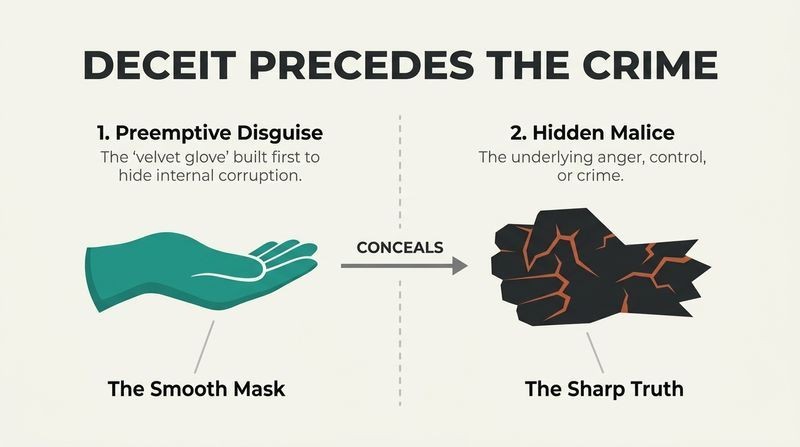
Peck's claim that lying requires a functioning conscience is philosophically sharp: you only hide what you already know is shameful. This distinguishes the evil from the psychopath, who lacks guilt entirely and lies carelessly. The idea that self-deception is the engine of moral corruption echoes Sartre's "bad faith" and Arendt's analysis of Eichmann's cliches. Modern research on self-deception (Trivers) even argues we deceive ourselves precisely to deceive others more convincingly. A useful caution: everyone rationalizes to some degree. Peck's threshold is the pervasive, structural, life-organizing quality of the deception, not the occasional face-saving fib everyone tells.
The evil mimic conscience so well psychiatrists feel revulsion, not pity
Trust your gut reaction as a diagnostic tool. Peck argues that the healthy person's instinctive response to evil is revulsion, a visceral urge to flee. When he met the parents who gave their surviving son the very rifle his brother used for suicide as a Christmas gift, he felt physically ill and could not wait to get them out of his office. He treats this revulsion as a God-given early-warning radar.
Confusion is the second signal. Because the evil are people of the lie, prolonged contact makes honest people feel disoriented, as though they've lost the ability to think clearly. Peck warns therapists that this fog is not their own stupidity but often the deliberate product of the evil person's need to muddle and control.
Elevating gut revulsion to a clinical instrument is bold and somewhat risky. On one hand, disgust research (Haidt, Rozin) confirms disgust functions as a moral and protective emotion, flagging contamination and boundary violation. On the other hand, disgust is notoriously prone to bias, historically weaponized against outsiders and minorities. Peck's own safeguard is crucial: the therapist must distinguish revulsion caused by the patient from revulsion caused by the therapist's own pathology. The confusion signal is more original and defensible; anyone who has argued with a manipulative person knows the peculiar mental fog, which gaslighting research now describes systematically.
Malignant narcissism is an unsubmitted will that bows to nothing higher
Health means submission; evil means supremacy of self. Borrowing from Erich Fromm, Peck locates the root of evil in "malignant narcissism," a self-absorption so total that the will refuses to bow to any principle beyond itself, be it God, truth, love, or the needs of others. Mentally healthy people say, in effect, "thy will be done." The evil insist their own will must always win, and guilt must always lose.
Autism of the soul. In his patient Charlene, Peck saw the extreme: she literally could not perceive other people as real. When she ran her car out of gas outside his home late at night and he siphoned fuel for her, she experienced it as a fun shared adventure, wholly blind to his irritation and sacrifice.
Peck's fusion of a theological concept (pride, refusal to submit) with a clinical one (narcissism) is the book's intellectual spine. Contemporary personality research recognizes malignant narcissism as a blend of narcissism, antisocial traits, aggression, and paranoia, so his clinical intuition has held up. The deeper claim, that mental health requires submission to something transcendent, is contestable and distinctly religious. Secular psychology would reframe "submission" as the capacity for empathy, perspective-taking, and impulse regulation. Yet the functional description converges: the evil cannot decenter from themselves. Charlene's inability to see others as real vividly captures what clinicians call a profound empathy deficit.
Children of evil parents blame themselves and absorb the poison inward
A child treated as bad concludes it is bad. Peck offers a law of child development: to a child, parents are like gods, so a child confronted with a parent's evil almost always misreads the situation and locates the evil inside itself. His case of Bobby, whose brother shot himself and who was then handed that same rifle for Christmas, shows the boy literally gouging holes in his own skin, as if trying to dig the badness out.
Rescue precedes treatment. Because the child is the trapped victim, not the sick one, Peck's first move was not therapy but protection: getting Bobby out of the home and into the care of an aunt. Only raw power, he found, moves evil people in the short run.
This is Peck at his most clinically humane and his diagnosis of the "identified patient" is a cornerstone of family systems therapy (Bowen, Minuchin): the member dragged in for treatment is often the healthiest, merely expressing the family's dysfunction. The self-blame mechanism is corroborated by attachment and trauma research showing abused children internalize shame to preserve the fantasy of good parents, since a bad-but-necessary caregiver is more survivable than a hostile one. Peck's insistence that evil yields only to power, not persuasion, is sobering and pragmatic, though it sits uneasily beside his later call for love as the ultimate cure.
Groups regress to childish morality and slaughter with clean consciences
Evil scales up through fragmented conscience. Peck analyzes the 1968 My Lai massacre, where American soldiers killed hundreds of unarmed Vietnamese civilians and then covered it up. His unsettling claim: many soldiers felt no guilt because they never registered they had done wrong. Groups, he argues, function at a more primitive moral level than the individuals composing them.
Three forces manufacture group evil:
1. Regression under stress: chronic combat stress reverts people to childlike selfishness.
2. Dependency on leaders: followers surrender conscience to authority, echoing Milgram's obedience experiments.
3. Specialization: when everyone handles only one cog, the moral buck is endlessly passed, and no one owns the whole act.
The cure, Peck says, is holding each individual responsible for the entire organism they belong to.
Peck's My Lai analysis synthesizes the great social psychology of his era: Milgram on obedience, Lifton on "psychic numbing," and group narcissism theory. His concept of fragmented conscience through specialization is genuinely useful and anticipates critiques of bureaucratic and technological warfare, where drone operators and supply clerks each feel blameless. The point that failing, wounded groups grow most vicious (narcissistic injury seeking a scapegoat) explains scapegoating from Nazi Germany to schoolyard cliques. A limitation: by distributing blame across stress, hierarchy, and structure, the account risks diluting the individual accountability Peck elsewhere insists upon. He resolves this by demanding personal ownership regardless.
Guilt is your immune system against becoming evil, so welcome the ache
The man who bargained with the devil. Peck opens with George, a salesman tormented by intrusive thoughts, who made a private pact: if he gave in to his compulsions, the devil would kill him and his beloved son. When George confessed feeling "the guilties" about it, Peck told him he was glad, because the guilt proved George was not yet lost. Feeling bad about something genuinely bad is health, not neurosis.
The blessing of the poor in spirit. Peck reframes evil as the refusal to bear the discomfort of self-examination. George's willingness to voluntarily re-enter psychological torment, rather than take the easy escape, was precisely what saved him. The evil, by contrast, will do anything, sacrifice anyone, to avoid that particular pain.
This flips the therapeutic culture that often treats guilt as toxic baggage to be discharged. Peck distinguishes appropriate guilt (a moral signal) from crippling, excessive scrupulosity (itself a sin in his view). Modern affective science supports the split: guilt, which targets behavior ("I did a bad thing"), motivates repair and correlates with empathy, whereas shame, which targets the self ("I am bad"), predicts defensiveness and aggression (June Tangney's research). George's healing through chosen suffering echoes the broader thesis of Peck's earlier work: avoiding legitimate pain is the root of mental illness. The takeaway is refreshingly counter-cultural and practically actionable.
Judging others as evil is dangerous, so judge yourself first and hardest
Naming evil is necessary but perilous. Peck insists evil must be studied scientifically and named, because we cannot heal or contain what we refuse to look at. Yet he devotes an entire section to the hazards: the arrogance of moral judgment, cloaking mere opinion in scientific authority, and the very real risk that the investigator becomes contaminated. He quotes Huxley: those who crusade against the devil in others rather than for God in themselves tend to make the world worse, and every crusader is apt to go mad.
Judge, but only after self-purification. Peck reads Jesus's "judge not" not as a ban on judgment (which is impossible in daily life) but as a demand that we remove the beam from our own eye first.
Peck's self-awareness here is the book's ethical anchor and its best defense against misuse. The danger he names is not hypothetical: Soviet psychiatry pathologized dissidents, and the history of "scientific" moral labeling is grim. His prescription, that the accuser must first turn the scalpel on himself, aligns with virtue ethics and with the therapeutic principle of examining one's own countertransference. The Huxley warning about contamination is psychologically real; studies of those who work with atrocity and abuse document vicarious trauma and moral injury. The tension Peck never fully resolves is who gets to wield the label, and by what accountable, checkable standard.
Evil is dreary and monotonous, while goodness is endlessly varied
Sameness is the tell. Peck observes that once you have seen one evil person, you have essentially seen them all; the mud looks identical. Saints, by contrast, are radically unique individuals, each a different pattern of light shining through cleaned-away mud. He borrows Simone Weil's insight that imaginary evil is romantic and thrilling, while real evil is gloomy, barren, and boring. His personal image of hell is an endless slot-machine hall, noisy with meaningless jackpots.
Only love can defeat it. Killing evil makes you a killer, so Peck argues the only method is love, which requires a willing person to absorb the evil like a sponge absorbs blood, neutralizing it through sacrifice rather than retaliation. The victim, mysteriously, becomes the victor.
The claim that evil is boring while good is various inverts our storytelling instincts, where villains are magnetic and virtue is dull. Peck's point is that evil is a collapse into rigid, repetitive self-defense, a narrowing, while goodness is generative and free. This maps onto Tolstoy's famous line that happy families are all alike, reversed: it is unhappiness and evil that are monotonous. The prescription of love-as-absorption is the book's most mystical and least falsifiable claim, drawing on the Christian atonement model. Skeptics will find it vague as method, but as a stance against the seductive logic of destroying enemies, it carries real moral weight.
Analysis
People of the Lie (1983) is a work of philosophical psychiatry that attempts something the field had studiously avoided: to define human evil as a specific, diagnosable mental disorder rather than a purely theological or legal category. Written by M. Scott Peck after the runaway success of The Road Less Traveled and following his adult conversion to Christianity, the book is unapologetically hybrid, mixing clinical case studies with religious conviction. Peck argues that the divorce between science and religion since the Galileo affair left evil orphaned, studied by neither, and he proposes remarrying the two into a "psychology of evil."
Structurally the book is story-driven, anchored by unforgettable case histories (George's pact, Bobby's suicide rifle, the manipulative Mr. and Mrs. R., the autistic Charlene) that build toward group evil at My Lai and a concluding meditation on dangers and cure. Its central thesis is elegant: evil is not the presence of sin but the militant refusal to tolerate one's own sinfulness, expressed through lying, scapegoating, and malignant narcissism (an unsubmitted will).
The book's enduring strength is phenomenological. Peck's descriptions of what it feels like to be near an evil person, the revulsion, the confusion, the exhausting fog, are recognizable and clinically astute, anticipating later work on gaslighting, narcissistic abuse, and moral injury. His My Lai analysis is a competent synthesis of Milgram, Lifton, and group dynamics.
The weaknesses are equally clear. The diagnostic criteria risk circularity and the potential for abuse Peck himself anxiously flags. His chapters on demonic possession and exorcism, offered as personal testimony without evidence, strain credibility and have aged poorly among clinicians. The reliance on Christian metaphysics limits generalizability.
Yet the book remains valuable precisely because it takes moral seriousness where psychology often flinches. Its most durable gift is reframing guilt as a protective immune response and self-examination as the true safeguard against becoming what we condemn.
Review Summary
People of the Lie explores human evil through case studies and psychological analysis. Peck defines evil as narcissistic self-deception and refusal to acknowledge one's flaws. Many readers found the book insightful and eye-opening, praising Peck's examination of everyday evil. However, some criticized his religious approach and equating mental illness with evil. The exorcism chapter was controversial. Overall, readers appreciated Peck's attempt to understand and define evil, though opinions on his success varied. The book provoked strong reactions, both positive and negative.
People Also Read



FAQ
What's People of the Lie about?
- Exploration of Human Evil: People of the Lie by M. Scott Peck examines the nature of human evil, presenting it as a psychological reality that can be scientifically studied.
- Case Studies: The book uses real-life examples, such as the stories of Bobby and Roger, to illustrate how evil impacts individuals and families.
- Psychological and Spiritual Insights: Peck combines psychological analysis with spiritual insights, emphasizing the need to recognize and confront evil for healing and growth.
Why should I read People of the Lie?
- Understanding Evil: The book offers a framework for understanding the complexities of evil in human behavior, often overlooked in traditional psychology.
- Personal Growth: It encourages self-reflection and moral responsibility, providing insights into personal lives and relationships.
- Compassionate Approach: Peck advocates for understanding those who commit evil acts, promoting empathy and a desire to help rather than judge.
What are the key takeaways of People of the Lie?
- Evil as a Disorder: Peck suggests that evil can be seen as a mental illness, characterized by a refusal to acknowledge one's own sinfulness.
- Role of Narcissism: Malignant narcissism is highlighted as a key trait of evil individuals, marked by self-absorption and lack of empathy.
- Naming Evil: Recognizing and naming evil is crucial for healing individuals and society, allowing for a deeper understanding of human relationships.
What are the best quotes from People of the Lie and what do they mean?
- "Evil is the exercise of political power... to avoid spiritual growth.": This quote defines evil as using power to suppress growth, highlighting its destructive nature.
- "The evil always hide their motives with lies.": It underscores the deceptive nature of evil individuals, reminding us to be vigilant.
- "The battle to heal human evil always begins at home.": Peck stresses self-reflection and personal responsibility in addressing evil.
How does M. Scott Peck define evil in People of the Lie?
- Evil as a Force: Peck describes evil as a force opposing life, manifesting through destructive behaviors.
- Scapegoating and Projection: Evil individuals project their flaws onto others, avoiding self-confrontation.
- Malignant Narcissism: A key characteristic of evil individuals, marked by intolerance to criticism and a need to appear good.
What are the psychological implications of evil as discussed in People of the Lie?
- Impact on Relationships: Evil affects relationships, leading to manipulation and control, creating toxic environments.
- Cycle of Evil: Evil can perpetuate across generations, with children internalizing harmful behaviors from parents.
- Need for Healing: Addressing evil through understanding and compassion can facilitate healing for victims and perpetrators.
How does People of the Lie address the concept of sin?
- Sin as a Human Condition: Peck argues that all humans are sinners, acknowledging imperfections is essential for growth.
- Distinction Between Sin and Evil: Ordinary sin differs from the systematic destruction that characterizes evil.
- Role of Guilt: Guilt is a mechanism for self-correction, leading to growth, while evil individuals deny their guilt.
What are the characteristics of evil individuals according to People of the Lie?
- Lack of Empathy: Evil individuals often lack empathy, making it difficult to connect with others.
- Manipulative Behavior: They use charm and deceit to control others, disguising their true intentions.
- Defensive Mechanisms: Employing projection and rationalization, they avoid facing their flaws, perpetuating destructive behaviors.
How can one protect themselves from evil as described in People of the Lie?
- Awareness and Recognition: Recognizing signs of evil in others helps protect oneself from harm.
- Setting Boundaries: Establishing clear boundaries prevents evil individuals from exerting control.
- Seeking Support: Support from trusted individuals provides strength and clarity in dealing with evil.
What is the significance of the title People of the Lie?
- Reflection of Deception: The title highlights how evil individuals live in deception, lying to maintain self-image.
- Call to Awareness: It urges readers to recognize lies in their lives, a step toward confronting evil.
- Moral Responsibility: The title reminds individuals to seek truth and authenticity, combating evil within and in society.
How does People of the Lie explore the role of narcissism in evil?
- Malignant Narcissism: Peck identifies it as a key trait of evil, marked by self-absorption and lack of empathy.
- Inability to Tolerate Criticism: Evil individuals have a desperate need to appear good, avoiding criticism.
- Destructive Behaviors: This self-absorption leads to harmful actions, impacting relationships and society.
What does People of the Lie suggest about healing from evil?
- Understanding and Compassion: Peck emphasizes addressing evil with understanding rather than judgment.
- Self-Reflection: Healing begins with self-reflection and acknowledging one's own flaws.
- Support Systems: Seeking support from trusted individuals can aid in healing from the effects of evil.
About the Author
Other books by M. Scott Peck



Download PDF
Download EPUB
.epub digital book format is ideal for reading ebooks on phones, tablets, and e-readers.








































