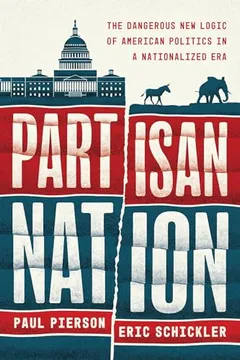

Key Takeaways
1. Contemporary polarization is historically unique, nationalized, and self-reinforcing.
The nationalization of political conflict is at the heart of today’s dynamics.
Existential partisan stakes. Today's political climate is defined by an intensifying run of presidential contests where both Democrats and Republicans view the other side's victory as an existential threat to the nation. Unlike past eras of temporary division, modern polarization has deepened over four decades, resisting even massive national crises like the Great Recession and the COVID-19 pandemic.
A self-reinforcing cycle. The current crisis is driven by a fundamental shift from a decentralized polity to a highly nationalized one. This nationalization has transformed mediating institutions—such as state parties, interest groups, and the media—into engines that accelerate and lock in partisan divisions rather than diffusing them.
Asymmetric party dynamics. While both parties have sorted into more internally homogeneous coalitions, they are not mirror images of each other. The self-reinforcing dynamics of polarization are particularly intense on the political right, where structural advantages and media ecosystems have weakened traditional incentives for compromise.
- Partisan hostility has become a durable, defining feature of American life.
- Nationalization has dismantled the traditional, localized safety valves of the political system.
- The two parties are asymmetric in their coalitions, media environments, and incentives.
2. The original Madisonian system relied on decentralized, crosscutting cleavages to limit partisan rancor.
Social pluralism, when combined with America’s fragmented constitutional structure, forces bargaining and compromise among diverse groups to achieve policy success.
The Madisonian design. The Framers designed a constitutional framework of federalism, separation of powers, and geographically based representation to prevent any single faction from consolidating power. Madison famously argued in Federalist No. 10 that a large, expanding republic would naturally foster a wide diversity of local interests, making a stable, oppressive majority highly unlikely.
Fostering social pluralism. This institutional fragmentation forced politicians to build broad, diverse coalitions and seek compromise to achieve policy goals. Because representation was tied to specific geographic territories, local economic and social concerns consistently disrupted national party lines, preventing a single, overarching cleavage from dominating the country.
The role of geography. Federalism allowed states to operate as autonomous centers of political power, ensuring that local parties remained highly responsive to their immediate constituencies. This geographic diversity lowered the stakes of national elections, as losing a presidential contest did not mean losing representation or control over local affairs.
- Separation of powers and federalism divided authority to prevent majoritarian tyranny.
- Geographic representation ensured that diverse local interests were funneled into national politics.
- Crosscutting cleavages prevented the formation of permanent, hostile national majorities.
3. Historical periods of intense polarization were short-lived due to flexible, localized party structures.
What stands out in each of these periods, especially compared with our own era, is that despite deep antagonisms partisan polarization did not prove durable.
Historical precedents of division. While American history has experienced periods of intense partisan rancor—such as the 1790s, the Civil War era, and the turn of the twentieth century—these divisions did not remain permanently frozen. In each case, the decentralized structure of state parties, interest groups, and the press eventually disrupted the polarized battle lines.
Flexible party coalitions. In the early republic and the Gilded Age, national parties operated as loose, catchall organizations that accommodated highly diverse regional ideologies. For example, the Jeffersonian Republicans absorbed pro-manufacturing northern artisans alongside southern slaveholders, creating internal factions that ultimately eroded the sharp Federalist-Republican divide.
Unstacking the cleavages. Even after the cataclysm of the Civil War, the intense sectional polarization quickly gave way to crosscutting economic debates over railroad regulation and currency. Because local politicians' careers depended on satisfying geographically concentrated interests rather than national party leaders, they frequently crossed party lines to form shifting, issue-specific alliances.
- The 1790s and Gilded Age featured intense rancor but quickly dissolved into factionalism.
- Localized party structures allowed politicians to adapt to regional voter demands.
- Emerging economic issues like silver and railroad regulation repeatedly disrupted national party lines.
4. The civil rights movement and the "Long 1960s" triggered the modern era of ideological sorting.
Racial realignment was the essential first trigger in the development of contemporary polarization.
The racial realignment. The modern era of polarization began with the partisan sorting of the electorate over civil rights. As Black Americans migrated north and joined the New Deal coalition, they, alongside industrial labor unions, pressured the Democratic Party to embrace civil rights, eventually leading to the landmark legislation of 1964 and 1965.
The Southern Strategy. In response to the Democrats' embrace of civil rights, the Republican Party adopted a "Southern Strategy" to appeal to white conservatives in the South. This historic shift sorted racially conservative southern whites into the GOP and racially liberal northerners into the Democratic Party, establishing a deep, durable divide.
The Great Broadening. This racial realignment coincided with the "Long 1960s," a period of dramatic federal policy expansion in social spending, environmental regulation, and civil rights. As the federal government's reach expanded, the stakes of national politics grew exponentially, forcing diverse social movements and interest groups to align permanently with one of the two sorting parties.
- The civil rights movement forced national parties to take clear, opposing stances on race.
- Southern white conservatives migrated to the GOP, while liberals consolidated in the Democratic Party.
- The expansion of federal authority in the 1960s raised the stakes of national political control.
5. State parties have transformed from local power centers into nationalized engines of polarization.
Rather than playing the braking role that had been common in earlier eras, state political parties became engines of polarization.
Loss of local autonomy. Historically, state parties operated as independent power centers that controlled nominations and shaped the career paths of ambitious politicians. However, Progressive-Era reforms, the introduction of direct primaries, and the nationalization of campaign finance have stripped state parties of their traditional gatekeeping power and local patronage resources.
The rise of nationalized funding. Today, state legislative and congressional candidates rely heavily on national networks of donors, activist groups, and national party committees. This financial nationalization incentivizes candidates to focus on national cultural and ideological battles rather than local, place-based economic concerns that might cut across party lines.
Ideological sorting of activists. As a result, state party organizations are now dominated by highly ideological, nationally focused activists and primary voters. Rather than moderating to appeal to the local median voter, state parties across the country now adopt highly standardized, polarized platforms that mirror the national culture wars.
- Primaries and campaign finance reforms weakened the independent power of state party bosses.
- Candidates increasingly rely on out-of-state, ideologically driven donors and national PACs.
- State party platforms have shifted from local economic issues to national cultural flashpoints.
6. Interest groups have shifted from bipartisan access-seeking to deeply integrated partisan alliances.
The nationalization of the interest group system has had a profound impact on the constitutional order.
From access to alliance. In the mid-twentieth century, interest groups typically pursued an "access-oriented" strategy, donating to incumbents in both parties to secure influence regardless of who was in power. As the parties sorted ideologically, however, groups found that their policy goals were increasingly dependent on which party controlled the government.
Pitched partisan battles. This shift led powerful groups—such as the NRA, environmental organizations, and Christian conservatives—to forge tight, exclusive alliances with a single party. Instead of lobbying for bipartisan compromises, these groups now focus their immense resources on helping their favored party win closely contested national and state elections.
Policing the politicians. These tight group-party alliances have created a self-reinforcing cycle of polarization. Politicians who attempt to compromise across party lines are quickly disciplined or primaryed by allied interest groups, drying up the supply of moderate lawmakers and locking in rigid, zero-sum partisan battle lines.
- Interest groups shifted from lobbying both parties to investing heavily in one party's electoral success.
- The NRA, Christian conservatives, and environmental groups became core pillars of partisan coalitions.
- Group-party alliances punish moderate politicians, preventing cross-party legislative deals.
7. The media landscape has nationalized and polarized, creating isolated information ecosystems.
The developing markets for talk radio, cable, and social media encouraged niche strategies based on the mobilization of outrage.
The decline of local news. For most of the twentieth century, local newspapers and nonpartisan broadcast networks dominated the media landscape, providing a diverse array of local political information. The rapid decline of local journalism, driven by technological change and the loss of advertising revenue, has deprived citizens of a crucial source of de-polarizing local news.
The outrage industry. In the absence of local news, nationalized media platforms have flourished by utilizing niche strategies that mobilize outrage and partisan identity. The rise of talk radio, cable news, and social media algorithms has made it highly profitable to appeal to narrow, intensely partisan audiences rather than seeking a broad, moderate consensus.
Asymmetric media ecosystems. This transformation is highly asymmetric, with a particularly isolated and powerful right-wing media ecosystem anchoring the Republican Party. Outlets like Fox News and conservative talk radio have successfully insulated their audiences from mainstream news, reinforcing sectarian "us versus them" narratives and making compromise seem like treason.
- The collapse of local newspapers has forced voters to rely almost exclusively on national partisan cues.
- Cable news and social media algorithms profit by amplifying political conflict and outrage.
- The right-wing media ecosystem has insulated conservative voters, reinforcing extreme partisan narratives.
8. Congressional gridlock has shifted policymaking power to the executive branch and the courts.
Congress, mired in gridlock, has weakened.
The legislative stalemate. The combination of highly disciplined, polarized parties and the Senate filibuster has made it extraordinarily difficult for Congress to pass major legislation. This persistent gridlock has eroded Congress's traditional role as the primary venue for resolving national problems, leading to a decline in its institutional authority.
Unilateral executive action. To bypass congressional stalemate, presidents increasingly rely on unilateral executive orders and administrative rulemaking to advance their policy agendas. While this allows for rapid policy shifts, these executive actions are highly unstable, as they can be easily reversed when the opposing party wins the White House.
The rise of judicial policymaking. Most significantly, congressional gridlock has shifted immense policymaking power to the federal judiciary, particularly the Supreme Court. Operating with a solid, vetted conservative majority, the court has aggressively remade national policy on abortion, environmental regulation, and voting rights, with little fear of congressional override.
- The Senate filibuster and partisan teamsmanship have paralyzed Congress's legislative capacity.
- Presidents increasingly use executive orders to bypass a gridlocked legislature.
- The Supreme Court has become the most active and powerful policymaking body in the country.
9. The Republican Party's asymmetric structural advantages reduce its incentives to moderate.
The Constitution was simply not designed to meet the challenges we now face.
The density dividend. The geographic sorting of the electorate—with Democrats concentrated in dense urban areas and Republicans dominating rural regions—has created a powerful structural bias in American political institutions. Because the Senate, the Electoral College, and state legislative maps disproportionately empower low-density, rural areas, they systematically favor the Republican Party.
Insulation from majorities. This structural skew allows the Republican Party to win and maintain power without securing popular majorities. For example, the GOP has repeatedly controlled the Senate and the presidency despite representing a minority of the national population, reducing the electoral pressure on the party to moderate its positions.
Motive and opportunity. This institutional insulation creates a dangerous dynamic where Republican elites face strong incentives to engage in minoritarian "deck-stacking" strategies. Rather than adapting to a diversifying electorate by moderating, the party can cling to power by utilizing gerrymandering, voting restrictions, and a sympathetic Supreme Court to entrench its minority rule.
- The urban-rural divide gives the GOP a significant structural advantage in the Senate and Electoral College.
- Republicans can win national power and shape the judiciary without winning the popular vote.
- Minoritarian advantages reduce the electoral pressure on the GOP to appeal to the median voter.
10. Safeguarding American democracy requires targeted legislative reforms to alter political incentives.
Addressing this threat will require reforms that encourage moderation, but achieving this within the contours of the contemporary constitutional order will be extraordinarily challenging.
The limits of self-correction. The contemporary political system lacks the natural self-correcting mechanisms that resolved past periods of polarization. Because the high hurdles to constitutional amendment make formal structural changes highly unlikely, reformers must focus on targeted legislative changes that can alter the incentives of political elites.
Empowering centrist factions. Electoral reforms such as nonpartisan primaries, ranked-choice voting, and fusion voting offer the most promising path to disrupting the current polarized duopoly. By changing how candidates are nominated and elected, these reforms can create a viable electoral base for moderate, cross-party coalitions that can check extreme partisan behavior.
National rules of the game. Ultimately, safeguarding democracy will require a national legislative drive to establish uniform standards for voting rights and restrict partisan gerrymandering. While achieving these reforms will require overcoming the Senate filibuster, altering the rules of the game is essential to force both parties to compete for broad popular majorities rather than relying on minoritarian entrenchment.
- Constitutional amendments are politically unfeasible, making legislative reform the only viable path.
- Ranked-choice voting and nonpartisan primaries can insulate moderate politicians from extreme primary challenges.
- National voting rights standards and anti-gerrymandering laws are essential to restore majoritarian democracy.
Review Summary
Download PDF
Download EPUB
.epub digital book format is ideal for reading ebooks on phones, tablets, and e-readers.








































