Key Takeaways
1. California's rapid capitalist development was built on the violent expropriation of indigenous lands and racialized labor.
California is very important for me because nowhere else has the upheaval most shamelessly caused by capitalist centralization taken place with such speed.
Violent land seizure. The foundation of California's wealth was laid through the systematic, state-sponsored elimination of its indigenous populations. Settlers and federal forces collaborated to displace native tribes, replacing mutualistic ecological relationships with a rigid market economy.
Racialized labor hierarchy. To exploit the newly acquired territory, Anglo-American capitalists established a strict racial hierarchy. Non-white workers, including Native Americans, Mexicans, and Chinese immigrants, were forced into low-wage, highly exploitative labor roles.
- Native populations were subjected to forced labor and displacement.
- Mexican landowners were systematically stripped of their property rights.
- Chinese immigrants were heavily taxed and legally barred from testifying in court.
Centralization of capital. The gold rush accelerated this transition, transforming California from a remote frontier into a global financial hub. The rapid accumulation of wealth in San Francisco and the Santa Clara Valley laid the groundwork for modern industrial agriculture and banking.
2. The transcontinental railroad established a corporate monopoly that reshaped American finance and real estate.
The white man, to whom time is money, and who labors hard all day to create the comforts of life, cannot sit up all night to watch his property; and after being robbed a few times, he becomes desperate, and resolves upon a war of extermination.
Monopoly power. The Big Four—Leland Stanford, Collis Huntington, Mark Hopkins, and Charles Crocker—used federal subsidies and land grants to build the Central Pacific Railroad. This monopoly, known as the Combine, choked off competition and dominated California's economic and political life.
Financial alchemy. The Associates pioneered sophisticated financial scams, using subsidiary construction companies to overcharge the railroad and pocket the profits. They turned the vast landscape of the West into a speculative real estate commodity, selling land grants to global investors.
- Federal land grants divided the West into a speculative checkerboard.
- Joint-stock corporations allowed the Associates to control millions with minimal personal investment.
- The Supreme Court's Santa Clara County ruling established corporate personhood.
Settler conflict. The railroad's aggressive land speculation led to violent clashes with homesteaders, most notably the Mussel Slough tragedy. The Combine's relentless pursuit of profit proved that under capitalism, corporate interests always override individual human lives.
3. The "Palo Alto System" applied industrial efficiency and genetic determinism to biological and human capital.
We aim to first develop the speed, and after that to condition the horse to carry it.
Equine engineering. At his Palo Alto Stock Farm, Leland Stanford applied capitalist rationality to the breeding and training of trotting horses. He treated the animals as biological machines, developing a highly structured training regimen designed to maximize speed and efficiency.
The kindergarten track. The Palo Alto System focused on developing speed in colts at an extremely young age, prioritizing visible potential over long-term health. This method shortened the production cycle and increased the speculative value of the horses' genetics.
- Five-month-old colts were trained on a miniature "kindergarten" track.
- Selection processes favored early speed, even at the risk of physical injury.
- The farm sold horses for their genetic potential, pioneering biological intellectual property.
Human application. The principles of the Palo Alto System were later applied to human education and social organization. Stanford's early leaders believed that human intelligence and potential were genetically predetermined and could be systematically measured and tracked.
4. Stanford University was founded as a monument to private wealth and a laboratory for technocratic progress.
The children of California shall be our children.
Memorial university. Following the tragic death of their only child, Leland and Jane Stanford founded Stanford University as a grand monument to his memory. They envisioned a school that would teach useful, practical arts to the children of California, free of tuition.
Technocratic turn. Under its first president, David Starr Jordan, the university shifted away from the founders' liberal arts vision toward advanced scientific research. Jordan built a eugenic university, focusing on the biological and intellectual development of a white technocratic elite.
- David Starr Jordan promoted the science of "bionomics" and eugenics.
- The university became a national center for intelligence testing and tracking.
- Jane Stanford's sudden death by poisoning cleared the way for Jordan's full control.
Corporate alignment. Stanford's early trustees and faculty were deeply connected to the region's leading capitalist enterprises. The university functioned as a human-capital factory, producing the engineers, managers, and scientists required to run the expanding American empire.
5. Postwar military spending transformed Palo Alto into a high-tech hub of the military-industrial complex.
You are dealing with forces, young man, when you speak of Wheat and the Railroads, not with men.
Military-academic complex. During and after World War II, Stanford University became a major contractor for the United States military. Under the leadership of engineering dean Fred Terman, the school built "steeples of excellence" in microwave and electronics research to attract federal defense dollars.
The industrial park. Terman pioneered the Stanford Industrial Park, leasing university land to high-tech defense contractors like Varian Associates, Hewlett-Packard, and Lockheed. This created a highly efficient, self-reinforcing ecosystem of academic research, corporate development, and military funding.
- The Varian brothers' klystron tube powered advanced military radar systems.
- Lockheed Missiles and Space became the county's defining employer during the Cold War.
- The Stanford Research Institute (SRI) conducted sensitive counterinsurgency research for the state.
Weapons of empire. The technologies developed in Palo Alto—from radar jammers to intercontinental ballistic missiles—were crucial to American global hegemony. The town's prosperity was directly funded by the state's bottomless appetite for advanced weapons of mass destruction.
6. The rise of the "associative state" under Herbert Hoover aligned corporate interests with federal power.
The university is deeply involved in production for private profit.
Associative governance. As secretary of commerce and then president, Stanford alumnus Herbert Hoover championed the "associative state." This model sought to coordinate the national economy through the voluntary association of private business leaders, with the federal government acting as a facilitator.
Infrastructure and cartels. Hoover used federal resources to build massive infrastructure projects, like the Hoover Dam, and to support the cartelization of key industries. He believed that private-public cooperation was the key to national efficiency and progress.
- The Hoover Dam was built by a coalition of private West Coast contractors.
- The Air Commerce Act of 1926 established the federal framework for the commercial aviation industry.
- Federal housing policies backed private home loans, fueling the suburban boom.
Anti-democratic bias. The associative state prioritized corporate profits and property rights over democratic control. When faced with working-class demands during the Great Depression, Hoover deployed military force against the Bonus Army, cementing his reputation as a defender of the wealthy.
7. Silicon Valley's growth relied on a bifurcated labor market that exploited immigrant and minority workers.
Should the worst come to the worst, it would be better for us if we were to turn our guns upon every vessel bringing Japanese to our shores rather than permit them to land.
Labor exploitation. Silicon Valley's high-tech industries were built on a deeply divided labor market. While white-collar engineers and managers enjoyed high salaries and stock options, low-wage manufacturing and assembly work was outsourced to immigrant and minority workers.
Racialized assembly lines. Electronics firms recruited immigrant women, particularly from Southeast Asia and Mexico, to perform tedious, hazardous assembly work at piece rates. These workers faced toxic chemical exposure and low wages, with little opportunity for advancement or unionization.
- The Bracero program supplied cheap Mexican labor to California's farms.
- Asian-American workers were excluded from high-wage engineering roles and segregated into assembly.
- Tech companies aggressively fought unionization efforts to keep labor costs down.
Ghettoization and exclusion. While white space settlers bought ranch-style homes in exclusive suburbs, minority workers were redlined into segregated, under-resourced neighborhoods like East Palo Alto. The region's extreme wealth was directly sustained by this local and global exploitation.
8. The personal computer and internet revolutions privatized public technologies for corporate monopolization.
The use we have made of exceptional ability reminds one of the primitive methods of surface mining.
Enclosing the commons. The technologies that powered the personal computer and internet revolutions—from microprocessors to the World Wide Web—were originally developed with public funds. However, Silicon Valley venture capitalists and entrepreneurs successfully privatized these public technologies for corporate profit.
Monopoly platforms. Companies like Microsoft, Apple, Google, and Amazon established monopoly positions by controlling key bottlenecks in the digital ecosystem. They used aggressive, anti-competitive tactics to crush rivals and lock users into their proprietary platforms.
- The Bayh-Dole Act of 1980 allowed universities to patent publicly funded research.
- Netscape's IPO triggered a speculative land rush on the virtual commons.
- Google and Facebook built massive advertising monopolies by scraping and selling user data.
The gig economy. Modern tech platforms like Uber and Airbnb furthered this privatization, using software to bypass labor regulations and turn workers into precarious independent contractors. This "lean" business model shifted all the risk to workers while concentrating the profits in the hands of a few billionaires.
9. Modern Palo Alto remains a haunted bubble where extreme wealth is sustained by global exploitation and local exclusion.
This is a horrible death to die.
The haunted bubble. Today, Palo Alto is one of the wealthiest cities in the world, a postmodern El Dorado of tech billionaires and venture capitalists. But this idyllic surface conceals a dark history of violence, exploitation, and exclusion that continues to haunt the community.
The cost of success. The extreme pressure to perform and succeed in Palo Alto's hothouse environment has had tragic consequences for its youth. The city's unusually high rate of teenage suicide on the Caltrain tracks is a stark symptom of a system that values achievement above human life.
- The Muwékma Ohlone Tribe remains unrecognized and dispossessed of its ancestral lands.
- Restrictive zoning and high housing prices keep the working class excluded from the suburb.
- Tech-funded surveillance systems are deployed to police the borders and the poor.
A call for divestment. To break this cycle of violence and exploitation, the Palo Alto System must be dismantled. Decolonization means more than symbolic recognition; it requires returning the land and resources to the people from whom they were stolen, starting with Stanford University itself.
Review Summary
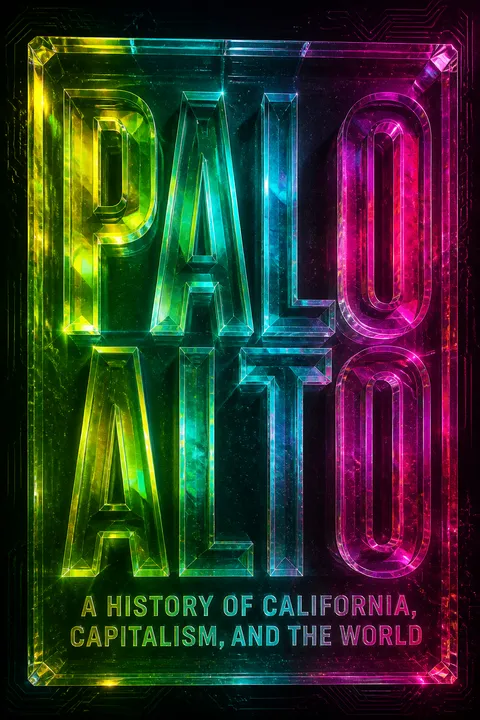
Palo Alto by Malcolm Harris receives mixed reviews. Many praise its comprehensive history of Silicon Valley, connecting capitalism, technology, and social issues. Readers appreciate Harris's writing style and deep research. However, some criticize its length, digressions, and perceived bias. The book's Marxist perspective and critique of capitalism are contentious points. While some find it enlightening and thought-provoking, others see it as overly negative and poorly organized. The conclusion suggesting returning Stanford to indigenous people is particularly divisive. Overall, it's seen as an ambitious, flawed work that sparks debate.
People Also Read









About the Author
Other books by Malcolm Harris

Download PDF
Download EPUB
.epub digital book format is ideal for reading ebooks on phones, tablets, and e-readers.








































