

Key Takeaways
Your shadow is the disowned self, and it holds gold, not just garbage
The shadow is what you refuse to see. Johnson, a Jungian analyst, defines three parts of the psyche: the persona (how you want to appear), the ego (what you consciously know yourself to be), and the shadow (everything you split off and refuse). Growing up in any culture means sorting your traits into acceptable and forbidden piles. The forbidden ones do not vanish. They collect in the dark and eventually take on a life of their own.
The shocking part: your best qualities hide there too. People bury not only cruelty and rage but also nobility, talent, and vision. Johnson claims we resist owning our gold more fiercely than our darkness. It is easier to admit you are a bum than to discover you carry profound worth you have refused to live.
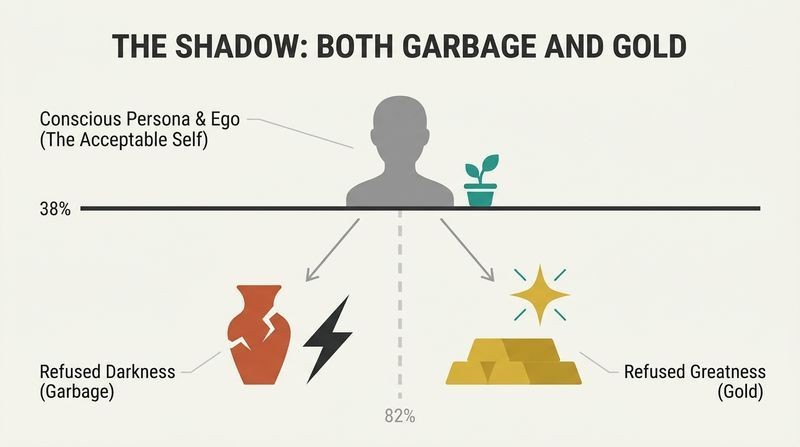
What's striking is how this inverts the usual self-help script. Most personal-growth writing chases the light and treats the dark as an obstacle. Johnson insists the disowned material is where vitality lives. This echoes modern findings in emotion research: suppressed feelings do not disappear but resurface as rumination, displacement, or somatic symptoms. The claim about hidden gold connects to what psychologists call the impostor phenomenon, where capable people cannot integrate evidence of their own competence. Johnson's move to treat unclaimed excellence as a form of self-avoidance is genuinely fresh and reframes hero-worship as outsourced potential.
Every civilization requires a shadow, but wholeness demands you take it back
Culture is the machine that manufactures shadows. Johnson argues that becoming civilized means culling the traits that threaten social order. This is necessary and admirable, the brightest achievement of humankind. Without it we stay primitive. The catch is that the sorting is arbitrary and local: individuality is a virtue in the West and nearly a sin in the Middle East, where students may sign work with their master's name.
Life splits into two tasks. The first half of life builds the ego through discipline, skill, family, and career, which inevitably creates a large shadow. The second half is meant for restoring wholeness. Johnson roots the word religion in the Latin re-ligare, to bind back together. The point of the round trip is that the wholeness you reach consciously in maturity was only unconscious and childlike at the start.
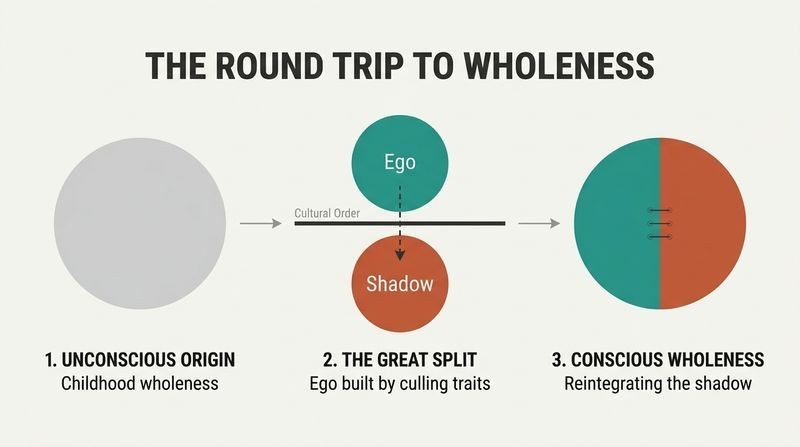
This maps neatly onto Jung's broader theory of individuation and onto developmental models like Erik Erikson's, where midlife pivots from productivity toward integration. Johnson's cross-cultural examples (shoes on in Western churches, off in Eastern temples) make a sharp anthropological point: the content of any shadow is contingent, so one society's virtue is another's taboo. A useful caution: not everything culture represses deserves reclaiming. Some prohibitions encode hard-won ethical wisdom. Johnson's framework works best when paired with discernment about which disowned impulses to integrate consciously and which to keep firmly contained.
Whatever you create casts an equal shadow you must pay consciously
Picture the psyche as a seesaw. Every trait must sit somewhere, and nothing can be deleted, only relocated. Johnson's iron law: the seesaw must stay balanced. Indulge one side heavily and an equal weight builds on the other. This explains sudden flips: the reformed alcoholic who turns fanatically temperate, the conservative who abruptly abandons all caution. They only swapped sides without gaining anything.
To create is to destroy at the same moment. A medieval manuscript showed one tree handing out salvation on one side and damnation on the other. Johnson confesses that after enduring difficult houseguests with heroic patience, he promptly picked a fight with an innocent nurseryman. His fix: pay the shadow deliberately and symbolically. Two analysts he knew took out the garbage whenever they had good fortune. Jung greeted friends by asking if they had suffered any terrible successes lately.
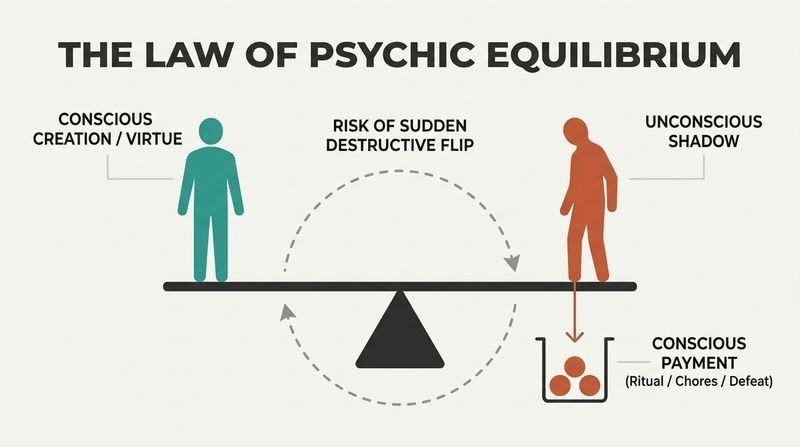
The seesaw is a vivid metaphor, though it risks sounding like a crude conservation law of morality. The deeper insight holds up: high achievers often carry destructive private lives, and the energy of intense focus demands release. This resonates with research on ego depletion and with the observation that willpower operates like a finite resource. The prescription (small, deliberate symbolic acts to discharge shadow pressure) anticipates therapeutic techniques like expressive writing and ritual, where James Pennebaker's studies show that structured processing of dark material measurably improves health. The key qualifier is symbolic. Johnson insists the release must harm no one.
The unconscious cannot tell a real act from a symbolic one
This is the book's most practical lever. Because the psyche registers a ceremonial gesture as fully as a literal one, you can honor your dark side without inflicting it on anyone. Johnson recommends deliberate rituals: write a lurid short story, burn something, do active imagination, throw a wet towel at the floor and shout. He suggests doing this before sunset, borrowing the biblical instinct to clear accounts daily.
Healthy societies ritualize the shadow; sick ones act it out. Johnson reads the Catholic Mass as a masterpiece of balance, full of betrayal, torture, and death, all contained safely within the altar rail. When such containers weaken, we reach for cruder substitutes: horror films, gangster epics, lurid headlines. The alternatives to ceremony are the ugly ones, war, violence, psychosomatic illness, and accidents, which he calls low-grade ways of living out the dark.
The claim that the unconscious does not distinguish real from symbolic action is a strong one, and it finds partial support in neuroscience: mental rehearsal activates motor and emotional circuits overlapping with real performance, which is why visualization aids athletes and exposure therapy uses imagined scenarios. Ritual studies in anthropology, from Victor Turner onward, document how symbolic enactment discharges collective tension. A skeptic might counter that catharsis theory has a mixed empirical record, since venting anger can sometimes reinforce it. Johnson's version is subtler than venting: it is contained, conscious, and compensatory, closer to structured ritual than to raw emotional discharge.
The evil you see in enemies is your own shadow projected outward
Projection is the lazy alternative to integration. When you refuse to own your darkness, you unconsciously lay it on someone else, a person, a race, a rival nation. Johnson calls this medieval consciousness, the fortress mentality still running the modern world. Whole industries exist to hold our shadow for us: film, fashion, tabloids, the daily parade of disasters.
The stakes are civilizational. Johnson argues that it is not monsters who create catastrophe but the collective shadow every ordinary person feeds. Germany projecting its shadow onto the Jewish people produced the Holocaust. He notes that when Cold War tension eased around 1990, humanity simply relocated the projection, promptly finding new demons in the Persian Gulf. His cure is disarmingly personal: any repair of the fractured world must begin with individuals brave enough to own their own darkness. Nothing out there helps while the projecting mechanism runs.
Projection is one of the most durable concepts in depth psychology, and social science has since given it empirical teeth. Research on scapegoating, out-group dehumanization, and moral disengagement (Albert Bandura) confirms that groups under stress attribute their own disowned aggression to enemies. Johnson's political reading, that mature people can no longer afford projection in a nuclear age, is urgent rather than naive. The provocative move is placing responsibility on the individual psyche rather than on institutions. Critics might call this politically insufficient, since structural injustice is not merely projected feeling. Yet the psychological point stands: collective darkness is assembled from countless private refusals.
Stop handing your children the shadow you refuse to carry
The heaviest projections land on the closest people. Johnson observes that men dump shadow on women, whites on Black people, and, most damagingly, parents on children. A child who absorbs a parent's shadow grows up carrying a double burden and tends to pass it on, which is why the Bible speaks of sins visited to the third and fourth generation.
A haunting clinical vignette makes it concrete. Jung treated a man who claimed he never dreamed while his five-year-old son had extraordinarily vivid dreams. Jung read the boy's dreams as the father's unlived shadow. Within a month of the father taking up his own inner work, he began dreaming and the son's vivid dreams stopped. Johnson invokes Truman's desk sign, the buck stops here, as the greatest gift a parent can give: refuse to pass the buck.
This intergenerational transmission theme finds robust support in attachment research and studies of adverse childhood experiences, which document how unprocessed parental trauma propagates across generations. The idea that a parent's unlived life becomes a child's burden echoes Jung's famous remark that nothing influences children more than the unlived life of the parent. The dream anecdote is striking but scientifically unverifiable, and readers should treat it as illustrative rather than evidential. The actionable core is sound and testable in one's own life: do your own inner work so your children inherit a cleaner psychological ledger rather than your unfinished business.
Refuse another's shadow like a matador letting the bull pass
You can decline a projection without retaliating. Johnson says this only works if your own shadow is reasonably in hand. When your shadow is like a gas can waiting for a match, anyone can provoke you. He describes a woman whose retired husband made a daily sport of dumping shadow on her, reducing her to tears. He coached her not to fight and not to freeze in icy withdrawal but simply to stay grounded in herself. The house shook with shadow energy for days until the husband finally saw what he was doing, and genuine conversation became possible.
Sometimes silence is the highest service. A Japanese village wrongly blamed a priest for fathering a girl's child. His only reply was Ah, so. When the truth emerged, he said the same. By absorbing the projection without protest, he gave the villagers room to face their own rush to judgment.
This is applied Stoicism meeting nonviolent resistance. The matador image captures a stance that modern therapy calls non-reactivity or, in dialectical behavior therapy, opposite action: refusing to feed an escalation cycle. Johnson wisely notes the precondition, that your own shadow must be contained, otherwise you cannot help retaliating. This aligns with research on emotional regulation showing that self-awareness is prerequisite to de-escalation. The priest story romanticizes silent endurance, and a critic might warn that absorbing false blame can enable abuse rather than heal it. Johnson's own distinction, deflect most projections but consciously carry a few, keeps this from becoming a doctrine of passivity.
Falling in love is projecting your image of God onto a mortal
Romance is the most powerful projection you will ever make. To fall in love, Johnson says, is to cast the divine, golden part of your shadow onto another person, who instantly becomes the carrier of everything holy. But this is a 10,000-volt experience running through a 110-volt human being. No ordinary person can survive the overload. This is why most Western marriages begin in projection, pass through disillusionment, and, if lucky, settle into something humanly real.
Loving is quieter than being in love. Johnson draws on the twelfth-century myth of Tristan and Iseult, who accidentally drank a love potion meant for royalty and were destroyed by a force too large to hold. The task is to behold the sacred charge briefly, then step back to ordinary voltage. He recounts a couple who exchanged mock shadow vows the night before their wedding, laughing at the manipulations they knew marriage would eventually surface.
The voltage metaphor is memorable and clinically useful. It reframes the pain of fading infatuation not as failure but as the necessary descent from projection to reality. This dovetails with attachment theory's distinction between limerence (the obsessive early phase studied by Dorothy Tennov) and secure companionate love, and with research showing that the neurochemical high of new romance predictably fades within one to three years. Johnson's historical claim, that romantic love is a recent twelfth-century invention rather than a human universal, is contested by anthropologists who find passionate love across cultures and eras. Still, the therapeutic insight, that idealization obliterates the real partner, is durable and humane.
Turn painful contradiction into holy paradox and grace becomes possible
Contradiction is barren; paradox is creative. Johnson distinguishes the two. Contradiction traps you between two warring values and grinds you into meaninglessness. Paradox holds both opposites in equal dignity until a third thing emerges. He lists the clash between Sunday religious values (losing, giving, fasting, obedience) and Monday practical values (winning, earning, action, freedom), and argues that giving people two contradicting value systems is the fastest way to break them.
The error hides in the word religious. Johnson insists no single act is religious. Religion means to bind back together, so it can never attach to one side of a pair. Calling giving holy and receiving profane is like a false math proof where something was secretly divided by zero. The cure is conscious waiting. When von Franz's patient sobbed that she could bear no more, her analyst replied, good, now something will happen. Johnson redefines heroism as the capacity to stand paradox.
This is the philosophical heart of the book and its most demanding idea. It resonates with dialectical thinking in Hegel, with the both-and logic of dialectical behavior therapy, and with research on integrative complexity, where the capacity to hold competing truths predicts wiser judgment and better conflict resolution. The distinction between contradiction and paradox is genuinely clarifying: one is a dead end, the other a doorway. The claim that no act is inherently religious will unsettle the doctrinally minded, yet it recovers an old mystical intuition. The practical difficulty is real, since sitting in unresolved tension runs against every instinct to fix, decide, and escape discomfort.
Overlap your opposites like two circles to form a healing mandorla
The mandorla is the almond-shaped overlap of two circles. Borrowed from medieval Christian art, where Christ or the Virgin is framed in this shape, it symbolizes the meeting of heaven and earth, or any pair of opposites. Johnson offers it as a practical technology for healing the split the shadow creates. The overlap starts as a thin sliver, like a new moon, and grows as the reconciliation deepens.
You make mandorlas constantly without noticing. Every well-formed sentence unites subject and object through a verb, which is why good talk restores a fragmented world. Every real story shows opposites merging rather than good simply beating evil. Persecuted early Christians recognized each other by each scratching a circle in the dust, overlapping them to complete the fish symbol. Johnson urges: when you make a statement, invite the opposing one, usually from the shadow, and let a larger view form.
The mandorla is an elegant recovery of a nearly forgotten symbol, and its power lies in being generative rather than merely tolerant. It does not ask you to split the difference; it asks you to hold both fully until a richer synthesis appears. This parallels creativity research on conceptual blending (Fauconnier and Turner), where innovation arises from fusing distant domains, and Arthur Koestler's bisociation, the collision of two frames that sparks insight. Johnson's linguistic claim, that verbs are holy ground uniting subject and object, is poetically overstated but points to something true about how coherent narrative integrates experience, echoing modern narrative therapy's use of storytelling to heal fragmented selves.
Guilt is a cheap, arrogant substitute for real inner work
Guilt masquerades as virtue while accomplishing nothing. Johnson, tweaking his devout Baptist grandmother, called guilt a sin because it burns the energy that could build a mandorla. Guilt is arrogant, he argues, because it means you have already taken a side and declared yourself right, which forecloses the confrontation between competing truths that could actually heal you. It is one-sidedness dressed up as piety.
Being beats doing at the deepest level. Citing the I Ching, that a wise person's thoughts in a quiet room are heard for a thousand miles, Johnson insists inner reconciliation radiates outward. When people asked Jung whether humanity would survive its crises, he answered only if enough people do their inner work. Johnson invokes the alchemical stages ending in the pavanis, the peacock's tail, where all life's colors combine into a rich pattern rather than neutralizing into gray.
The critique of guilt as self-indulgent rather than redemptive is bracing and psychologically astute. Research distinguishes guilt, which can motivate repair, from shame, which corrodes the self; Johnson's target is closer to the ruminative, paralytic variety that June Tangney's work links to worse outcomes and avoidance. His reframe converts moral hand-wringing into a call for constructive integration. The insistence that being precedes doing runs counter to a hyper-productive culture, and it echoes contemplative traditions from Zen to centering prayer. A fair challenge: inner work without outer action can become a comfortable evasion. Johnson's whole argument, though, is that genuine inner reconciliation changes how one acts.
Analysis
Owning Your Own Shadow is a compact distillation of Jungian depth psychology aimed at general readers, structured in three movements: the shadow, romantic love as shadow projection, and the mandorla as the instrument of reconciliation. Johnson writes as a clinician-storyteller, mixing analysis-room vignettes, myth, Christian symbolism, and cross-cultural anecdote rather than argument or data. This is its charm and its vulnerability. The book persuades by resonance, not evidence, and readers trained in empirical psychology should treat its dream-cure anecdotes and seesaw conservation laws as poetic frameworks rather than testable claims. What gives the book enduring value is its counterintuitive core: that the material we most despise, and the excellence we most fear, both live in the same disowned basement, and that psychological and even civilizational health depends on retrieving them consciously. Johnson's most original contribution is practical: because the psyche cannot distinguish symbolic from literal action, ritual becomes a real technology for discharging destructive energy without harm. This reframes ceremony, long dismissed by secular modernity as superstition, as functional psychic hygiene, an idea that anticipates current interest in ritual's measurable effects on anxiety and grief.
The book's weakness is its tendency toward tidy dualism and grand claims (romantic love invented in the twelfth century, wars erupting on twenty-year shadow cycles) presented without qualification. The seesaw metaphor can flatten moral complexity into mechanical balance. Yet the paradox and mandorla concepts partly correct this, refusing simple either-or resolution in favor of held tension and emergent synthesis.
Read today, amid polarization and reflexive scapegoating, Johnson's central prescription lands with force: the darkness we assign to enemies is our own refused material, and the only reliable repair begins privately, in the willingness to stand contradiction long enough for something larger to appear. It is old wisdom, freshly and humanely delivered.
Review Summary
Owning Your Own Shadow explores the Jungian concept of the shadow self, emphasizing the importance of integrating one's dark side for psychological wholeness. Readers appreciate Johnson's accessible writing style and insightful ideas about paradox and spiritual growth. Many find the book thought-provoking and applicable to personal development. Some criticize its lack of practical advice and overreliance on religious references. While some readers consider it a valuable reference, others find it oversimplified or confusing. Overall, the book receives mixed reviews but is generally seen as a brief introduction to shadow work.
People Also Read






Glossary
Shadow
The disowned part of yourselfIn Jung's general sense used here, everything in the personality that a person fails to see, refuses, or represses because culture deemed it unacceptable. It includes both dark traits (rage, cruelty) and positive ones (nobility, talent). Denied entry to consciousness, it accumulates energy and, if ignored, erupts as moods, projection, illness, or accidents.
Persona
The social mask you wearThe image a person presents to the world, the psychological clothing that mediates between the true self and the environment. It is what we would like to be and how we wish to be seen, as distinct from the ego (what we consciously know ourselves to be) and the shadow (what we refuse to see).
The seesaw
Psyche's balance of oppositesJohnson's metaphor for the personality as a teeter-totter with acceptable traits on the right and forbidden ones on the left. No trait can be deleted, only relocated, and the balance must be maintained. Overloading one side forces an equal weight on the other, explaining sudden reversals of behavior and the need to pay out creativity's shadow consciously.
Gold in the shadow
Disowned nobility and talentThe positive, superior qualities a person represses because they threaten the existing ego structure. Johnson claims people resist owning their gold more fiercely than their darkness, which fuels hero-worship: we project our finest potential onto admired figures instead of living it ourselves, then must gradually internalize it as development proceeds.
Projection
Casting your shadow onto othersThe unconscious act of laying one's own disowned traits onto another person, group, or nation, so one need not take responsibility for them. Johnson identifies it as the most dangerous feature of the modern psyche, driving scapegoating, racism, and war, and argues integration is the only mature alternative.
Mandorla
Healing overlap of oppositesThe almond-shaped region where two overlapping circles intersect, borrowed from medieval Christian art. Johnson uses it as a symbol and technique for reconciling opposites such as heaven and earth or good and evil. The overlap begins tiny and grows; every well-formed sentence, true story, and act of synthesis creates one, healing the split the shadow produces.
Paradox versus contradiction
Creative tension versus barren conflictJohnson's key distinction. Contradiction pits two values against each other, draining energy and producing meaninglessness. Paradox holds both opposites in equal dignity until a superior synthesis emerges. Moving from contradiction to paradox is a leap of consciousness that makes room for grace, and Johnson redefines heroism as the capacity to stand paradox.
Religion (re-ligare)
To bind back togetherJohnson returns the word to its Latin roots re (again) and ligare (to bind), meaning to reunite what was split. He argues religion can never attach to one side of a pair of opposites, so no single act is inherently religious. Only the insight that bridges and reconciles opposites deserves the word.
10,000-volt experience
Divine charge of falling in loveJohnson's metaphor for romantic love as the projection of one's image of God onto another person. This divine charge overwhelms an ordinary human being, wired only for 110 volts, which is why infatuation gives way to disillusionment. Lasting love requires stepping down to ordinary human voltage.
Pavanis (peacock's tail)
Alchemy's final integrated wholenessThe culminating stage in Johnson's alchemical sequence (nigredo, albedo, rubedo, citrino), where all the colors of life combine into a rich, full pattern rather than neutralizing into gray. It symbolizes achieved wholeness, the fully formed mandorla that contains every preceding hue.
FAQ
What's "Owning Your Own Shadow" about?
- Exploration of the Shadow: The book delves into the concept of the shadow, a part of the psyche that contains the aspects of ourselves we reject or deny.
- Integration of the Shadow: It emphasizes the importance of acknowledging and integrating the shadow to achieve personal wholeness and spiritual growth.
- Cultural and Personal Impact: Johnson discusses how the shadow affects both individual lives and broader cultural dynamics.
- Spiritual Discipline: The book presents the integration of the shadow as a profound spiritual discipline necessary for personal development.
Why should I read "Owning Your Own Shadow"?
- Self-Understanding: It offers insights into understanding the hidden parts of your personality and how they influence your behavior.
- Personal Growth: The book provides guidance on how to integrate these aspects for personal and spiritual growth.
- Cultural Relevance: Johnson's exploration of the shadow is relevant to understanding societal issues and conflicts.
- Practical Advice: It includes practical advice on how to work with your shadow in everyday life.
What are the key takeaways of "Owning Your Own Shadow"?
- Shadow's Origin: The shadow is formed by the traits and desires we reject due to societal and cultural conditioning.
- Integration is Essential: Integrating the shadow is crucial for achieving personal wholeness and avoiding psychological imbalance.
- Cultural Shadows: Different cultures have varying shadows, which can lead to misunderstandings and conflicts.
- Spiritual Wholeness: Embracing the shadow is a path to spiritual wholeness and enlightenment.
What is the shadow according to Robert A. Johnson?
- Definition: The shadow is the part of the psyche that contains the traits and desires we reject or deny.
- Formation: It forms early in life as we learn to conform to societal norms and expectations.
- Energy Potential: The shadow holds significant energy, which can manifest as rage, depression, or creativity if not integrated.
- Cultural Influence: Different cultures have different shadows, affecting how individuals within those cultures behave.
How does "Owning Your Own Shadow" explain the concept of romantic love as shadow?
- Projection of Divinity: Falling in love involves projecting our idealized image of divinity onto another person.
- Temporary Experience: This projection is temporary and often leads to disillusionment when reality sets in.
- Path to Growth: Recognizing and integrating this projection can lead to more mature and stable relationships.
- Cultural Shift: The book discusses how romantic love became a powerful force in Western culture, starting in the twelfth century.
What is the mandorla, and how is it used in "Owning Your Own Shadow"?
- Definition: The mandorla is an almond-shaped overlap of two circles, symbolizing the reconciliation of opposites.
- Healing Symbol: It represents the healing of the split between opposing forces, such as heaven and earth.
- Cultural Significance: The mandorla is used in Christian art to depict the overlap of divine and human realms.
- Practical Application: Johnson suggests using the mandorla as a tool for personal healing and integration of the shadow.
How does Robert A. Johnson suggest balancing culture and shadow?
- Cultural Process: Culture demands we live out only part of our nature, creating a shadow with the rest.
- Balance is Key: Maintaining a balance between the ego and shadow is crucial for psychological health.
- Symbolic Acts: Engaging in symbolic acts or rituals can help balance the shadow without causing harm.
- Personal Responsibility: Individuals must take responsibility for their shadow to prevent projecting it onto others.
What role does paradox play in "Owning Your Own Shadow"?
- Embracing Paradox: Paradox is seen as a source of spiritual insight and growth, allowing for the coexistence of opposites.
- Beyond Contradiction: Moving from contradiction to paradox involves accepting and integrating opposing forces.
- Religious Experience: Paradox is central to religious experience, offering a path to unity and enlightenment.
- Practical Exercise: Johnson encourages readers to list their personal contradictions and work towards embracing them as paradoxes.
What are the best quotes from "Owning Your Own Shadow" and what do they mean?
- "To own one's own shadow is to reach a holy place—an inner center—not attainable in any other way." This quote emphasizes the spiritual significance of integrating the shadow.
- "The balance of light and dark is ultimately possible—and bearable." It highlights the necessity of balancing opposing forces within oneself.
- "The mandorla binds together that which was torn apart and made unwhole—unholy." This illustrates the healing power of the mandorla in reconciling opposites.
- "To suffer one's confusion is the first step in healing." This suggests that embracing confusion and paradox is essential for personal growth.
How does "Owning Your Own Shadow" address the projection of the shadow?
- Projection Mechanism: The shadow is often projected onto others, leading to misunderstandings and conflicts.
- Cultural Projections: Societies project their collective shadows onto other groups, causing large-scale conflicts.
- Personal Responsibility: Individuals must recognize and reclaim their projections to achieve personal wholeness.
- Healing Relationships: Understanding and integrating projections can lead to healthier and more authentic relationships.
What is the significance of the shadow in middle age according to Robert A. Johnson?
- Midlife Crisis: Middle age often brings a crisis as the shadow demands recognition and integration.
- New Vitality: Integrating the shadow can lead to renewed energy and creativity in the second half of life.
- Dangerous Moments: Failure to integrate the shadow can result in destructive behavior or depression.
- Opportunity for Growth: Middle age is an opportunity to embrace the shadow and achieve personal wholeness.
How does "Owning Your Own Shadow" relate to modern societal issues?
- Collective Shadow: The book discusses how societal issues like war and racism are manifestations of the collective shadow.
- Cultural Differences: Different cultures have different shadows, leading to misunderstandings and conflicts.
- Personal Responsibility: Individuals can contribute to societal healing by integrating their personal shadows.
- Path to Peace: Johnson suggests that personal shadow work is essential for achieving peace and harmony in society.
About the Author
Other books by Robert A. Johnson

Download PDF
Download EPUB
.epub digital book format is ideal for reading ebooks on phones, tablets, and e-readers.








































