
Key Takeaways
1. Myths as Timeless Blueprints for the Human Psyche
Myths, therefore, portray a collective image; they tell us about things that are true for all people.
Universal truths. Myths are not mere fictions but profound distillations of collective human experience, reflecting universal psychological patterns that transcend time and culture. Just as human biology remains consistent, so too do the unconscious psychological dynamics of personality, making ancient stories deeply relevant today. They offer direct, simple portrayals of basic human behavior, allowing us to understand fundamental needs and observe how their expression changes over time.
Inner reality. While details may be fantastic, myths depict levels of reality that include both the outer rational world and the less understood inner world. Like a child's nightmare, which is undeniably real in its emotional impact, myths hold an awesome inner reality, influencing our emotional and physical reactions. C.G. Jung, in his studies of personality structure, emphasized myths as expressions of basic psychological patterns, urging us to "think mythologically" to access their profound insights.
Femininity's scope. When exploring the feminine aspects of the Eros and Psyche myth, it's crucial to understand that this applies not only to women but also to the anima, the feminine side present in every man. Just as men have recessive female chromosomes, they also possess a minority element of feminine psychological characteristics. This broadens the myth's applicability, offering parallels to the interior feminine aspect of a man's psychology, making its lessons universal.
2. The Clash of Archetypal and Evolving Femininity
For her to see the rise of a new goddess of femininity was more than she could bear!
Ancient power. Aphrodite, born of the sea, represents the primeval, oceanic, and archetypal feminine power, reigning in the unconscious. She is vast, impersonal, and difficult to relate to on ordinary conscious terms, embodying an overwhelming majesty. Her nature is to mirror every experience back into consciousness, often revealing our divine-like qualities or our projections, and she is fiercely jealous of any competition to her established reign.
New consciousness. Psyche, born of dewdrops on land, symbolizes a new, more human-like expression of the feminine principle, moving from oceanic proportions to a comprehensible scale. Her emergence challenges Aphrodite's ancient authority, stirring apocalyptic rage and jealousy in the older goddess. This collision between the old, instinctive Aphrodite nature and the new, evolving Psyche nature is a central drama, often manifesting as inner turmoil for modern women.
Evolutionary force. Aphrodite, despite her tyrannical and regressive tendencies, paradoxically serves as an evolutionary force, pushing Psyche towards growth. Her jealousy and competitive nature, though painful, create the necessary hurdles for Psyche's development. This dynamic illustrates that growth often arises from conflict, where old ways resist the new, forcing a deeper consciousness to be born, much like an elephant calf being tossed to make it breathe.
3. Marriage as a Profound Death and Rebirth for Women
In truth the maiden does die on her wedding day; an era of her life is over and she dies to many of the feminine elements she has lived thus far in her life.
Lonely perfection. Psyche's unworldly beauty and virginal innocence lead to worship but not courtship, creating an intensely lonely experience. This "Psyche nature" within every woman can make her feel too deep or perfect for the ordinary world, leading to a sense of being untouched and unrelated. This painful isolation is a precursor to the transformative journey she must undertake.
Oracle's prophecy. Desperate, Psyche's father consults an oracle, which, influenced by a jealous Aphrodite, decrees that Psyche must marry Death—the ugliest, most horrible creature. She is taken to a mountaintop, chained to a rock, and left for this dreadful union. This prophecy, though terrifying, foreshadows the archetypal "death" of maidenhood that marriage represents for a woman.
Sacrificial element. The wedding, a funeral cortege in disguise, symbolizes the end of an era and the dying to old feminine elements. Many ancient wedding customs, like the groom's abduction of the bride or the bride's tears, reflect this sacrificial aspect. For a woman, marriage is not merely an addition to her stature, as it often is for a man, but a profound death and resurrection, forcing an evolution towards mature womanhood. Honoring this dying to an old part of life is crucial to prevent later resentment.
4. "In Love" as a Shattering, Archetypal Encounter
It has been said that Psyche is the first mortal who ever looked at a god in his true splendor and lived to tell the tale.
Eros's accident. Aphrodite sends her son, Eros, the god of love, to make Psyche fall in love with a loathsome beast. However, Eros accidentally pricks himself with his own arrow upon seeing Psyche and falls deeply in love with her. He whisks her away to a paradise garden, where he visits her nightly under the condition that she never look at him or question his ways, promising a god-child if she complies.
Paradise lost. This "paradise" is an immature Eros's creation, a desire for peace without conscious relationship. It is shattered when Psyche, influenced by her jealous sisters, lights a lamp to see her husband, discovering him to be the magnificent god of love. A drop of oil from the lamp burns Eros, who then flies away, punishing her by his absence and declaring their child will be mortal. This moment of revelation, though painful, is a dramatic rise in consciousness.
Superhuman energy. The experience of "in love" is distinct from "loving." While loving is a human bond appreciating ordinary magnificence, "in love" is a superhuman, 100,000-volt experience, a whirlwind from heaven that obliterates ordinary values. It's seeing the god or goddess behind the person, a profound archetypal encounter. Psyche's survival of this divine touch, and her subsequent journey, is the heart of the myth, demonstrating that mortals can endure and be radically changed by such experiences.
5. The Lamp of Consciousness: A Woman's Transformative Power
A woman gently shedding light on a situation produces miracles; a woman with a knife in her hands would kill.
Unmasking Eros. Psyche's confrontation with Eros in the paradise garden is driven by her "shadow" sisters, who represent the repressed, unlived parts of her personality demanding growth. They provide her with two tools: a lamp, symbolizing her capacity for consciousness, and a sharp knife. The lamp, with its warm, gentle, "Luminea Natura" light, is the tool she uses, revealing Eros in his true, magnificent form.
Man's need for light. This act of lighting the lamp is crucial, as it calls Eros to live up to the god within him, a masculine consciousness that trembles yet requires feminine acknowledgment. Men often derive their deepest sense of self-worth from a woman's gaze, her "light" reminding them of their best selves. A woman's ability to shed light on a situation, to bestow meaning on a man's struggles, is a precious gift that can transform a relationship.
Fiery awareness. The touch of consciousness, like the hot oil from Psyche's lamp, is a fiery experience that can sting a man into awareness, explaining his fear of the feminine. While a woman with a knife might destroy, a woman with a lamp can bring about a miracle of transformation, revealing the god in her partner. This power to illuminate and give meaning is a woman's unique contribution to relationship and personal growth.
6. The Animus: A Woman's Inner Masculine Guide
If a woman is to evolve past feminine adolescence she must break the unconscious domination of her subordinate, largely unconscious, masculine component which often dictates her relationship to the outer world.
Animus possession. Before lighting the lamp, Psyche lived under the unconscious domination of Eros, her inner masculine side (animus), in a state of "animus possession." She believed her choices were her own, but her ego was taken over by this unconscious masculine component. This is a common stage in a woman's development, where her relationship to the outer world is dictated by an unexamined inner masculine principle.
Mediator's role. When Psyche lights the lamp, she consciously recognizes Eros as separate from her ego, a potent, godlike figure. This is a dangerous moment, as she risks being overwhelmed by his grandeur or her own inadequacy. However, if she can negotiate this, the animus, now consciously recognized, can return to the inner world and function effectively as a mediator between her conscious ego and the unconscious, opening up a true spiritual life.
Eros's return. After being unmasked, Eros flies back to his mother, Aphrodite, and largely disappears from the outer narrative, signifying his return to the inner world. From this position, he can mediate for Psyche with the other gods, sending help through natural elements like ants, eagles, and reeds during her tasks. This illustrates how a woman's conscious relationship with her animus can provide essential inner guidance and support for her evolution.
7. Psyche's First Task: Cultivating Inner Order and Differentiation
What a beautiful bit of symbolism; a pile of seeds to sort!
Chaos to order. Aphrodite's first impossible task for Psyche is to sort a huge pile of mixed seeds before nightfall, under penalty of death. This symbolizes the challenge of bringing form and order to the chaotic "too-muchness" of life, whether in household management, professional tasks, or the vast influx of material from the unconscious. It's about differentiation and establishing structure.
Ant-nature's wisdom. Overwhelmed, Psyche collapses, but an army of ants comes to her rescue, diligently sorting the seeds. This "ant-nature" represents a primitive, chthonic, instinctive, and quiet quality available to women—a non-intellectual proficiency in sorting and ordering. It allows a woman to break the impasse of overwhelming tasks by approaching them in a simple, earthy, and methodical way, choosing one seed to bring to fruition.
Inner sorting. Beyond external tasks, this sorting process applies profoundly to the inner world. A woman's special province is to sort feelings, values, timing, and boundaries within her inner dimension, protecting herself and her family from inner floods of moods, inflations, and vulnerabilities. This feminine genius in managing the inner landscape is crucial, especially in modern times where both partners often focus solely on the outer world, leaving the inner realm unprotected.
8. Psyche's Second Task: Wisely Engaging Masculine Energy
She is to approach these dangerous bull-headed, aggressive beasts only indirectly.
Fleece from fierce rams. Psyche's second task is to gather golden fleece from fierce, aggressive rams pastured across a river, again by nightfall. This symbolizes a woman's need to assimilate masculine energy into her interior life without being overwhelmed or "bludgeoned to death" by the patriarchal, competitive, and impersonal aspects of the modern world. The rams represent a great, instinctive, elemental masculine quality.
Indirect approach. The reeds by the river advise Psyche not to confront the rams directly in the heat of the day, but to gather the wool caught on brambles and low branches at dusk. This teaches a crucial lesson: power is not always to be seized by force. A woman can obtain necessary masculine energy indirectly, quietly, and in proportion, without resorting to destructive power plays like Delilah.
Proportional power. The myth cautions against taking too much power or approaching it unwisely, which can lead to obliteration or abuse. It emphasizes taking only as much as one needs, sacrificing what is not required, and maintaining a balance between power and relatedness. A woman can use as much masculine energy as she can, so long as she remains centered in her feminine identity and uses it as a conscious, subsidiary tool.
9. Psyche's Third Task: Containing Life's Vastness with Eagle Vision
The feminine way is to do one thing and do it well and in proportion.
River of life and death. Aphrodite's third task demands Psyche fill a crystal goblet with water from the treacherous, circular river Styx, which flows from high mountains to the depths of hell and back. This river symbolizes the vastness of life and death, its swift currents and slippery banks making direct access impossible without being swept away. Psyche, overwhelmed, collapses once more.
Eagle's perspective. An eagle of Zeus, sent to assist, takes the crystal goblet, flies to the center of the stream, and fills it, bringing it safely back. This "eagle vision" represents a broader, panoramic perspective needed to navigate life's overwhelming complexity. When faced with the "too-muchness" of modern life, the feminine way is to focus on one thing, one "goblet of water," and do it well and in proportion, rather than attempting to grasp everything at once.
Fragile container. The crystal goblet symbolizes the human ego, a fragile and precious container for a small portion of life's vastness. It warns against plunging into the depths to bring all of life into focus, as this can shatter the ego. Instead, the lesson is to take one goblet at a time, experiencing a quality in high consciousness, finding contentment in a single grain of sand, and moving forward in good order.
10. Psyche's Fourth Task: The Perilous Journey to Profound Mystery
The deepest interior mystery for a woman may not be named or given any label.
Underworld journey. Psyche's fourth and most profound task is to journey to the underworld to ask Persephone, queen of mysteries, for a cask of her beauty ointment for Aphrodite. This represents a deep step in personal growth, a perilous descent into the hidden recesses of the inner world, guided by the wisdom of a "tower" (cultural legacy). It requires immense fortitude and careful preparation.
Strict adherence. The tower's instructions are precise: carry two barley cakes and two coins, refuse distractions like helping a lame man or the three Fates, and pay Charon the ferryman and Cerberus the three-headed dog. Psyche must conserve her energy and resources, prioritizing the journey over her natural generosity, to ensure her return to the human world of light. This emphasizes the discipline required for such a profound inner quest.
Persephone's mystery. In Hades, Psyche must refuse Persephone's lavish hospitality, accepting only the simplest food and sitting on the ground, lest she be bound to the underworld queen forever. Persephone embodies the eternal maiden, the most hidden goddess, representing a profound, unnamed feminine mystery. Psyche receives a cask containing "a mystical secret," a beauty ointment that is "nothing" to her eyes, symbolizing the ineffable essence of healing and feminine mystery that cannot be labeled or identified with.
11. The Danger of Identifying with the Divine Feminine
To identify with the mystery is to lapse into unconsciousness, which is the end of any further development.
The forbidden opening. On her return journey, Psyche disobeys the tower's final instruction not to open the cask. Thinking she might adorn herself for Eros, she opens it, finding "nothing" inside. This "nothing" issues forth as an infernal, deadly sleep, rendering her a corpse. This act, a "felix culpa" or necessary fall, highlights the extreme danger of identifying with the divine feminine mystery itself.
Unconsciousness trap. Many who reach this stage of profound inner development fall into the trap of identifying with Persephone's mysterious charm or the power of the "secret mystery." This identification leads to a lapse into unconsciousness, halting further personal growth and leaving them as "spiritual fossils" without human dimension. The mystery must be honored and respected, but never fully grasped or claimed for personal ego.
Love's redemption. Psyche's failure, however, activates Eros, her interior masculine side, who, having recovered from his wounds, escapes his mother's imprisonment. He rescues her, wiping the deadly sleep from her face and returning it to the cask. He awakens her with the prick of an arrow of love, admonishing her curiosity. This signifies that only love, and the conscious integration of the animus, can save one from the hardness and remoteness of a partial spirituality, bringing redemption and true immortality.
12. Modern Psyche: Bridging the Spiritual and Practical Worlds
A truly modern person can not go off to a convent or the Himalayas exclusively to search for spirituality; nor can she pour herself exclusively into her family, profession, and practicality.
Timeless struggle. The myth of Eros and Psyche, though ancient, continues to play out in modern life, as seen in contemporary dreams. The core struggle remains the interplay between different "levels"—earth and heaven, mortality and immortality, human and divine. A modern Psyche constantly mediates between the numinous, visionary world and the avalanche of practical, everyday tasks, facing the same urgency to bridge these two realms.
"Either-and-or" mentality. Unlike medieval man who lived by "either-or," modern individuals must embrace an "either-and-or" approach, integrating both the spiritual and the practical. The challenge is to endure both the demands of a professional life, family, and urban existence, alongside the sudden intrusions of the visionary world, without sacrificing one for the other. This integration is the prime task of a truly modern mind.
Conscious evolution. The modern dream illustrates this ongoing evolutionary process, where the dreamer is pulled between cleaning a house (practical tasks) and exploring a luminous "white world" (spiritual vision). The increasing crowd in the house symbolizes the encroaching demands of the mundane, threatening to obscure the portals to the spiritual. The dream emphasizes the urgency of consciously choosing to engage with both worlds, translating the pain and suffering of archetypal encounters into mundane steps of personal development, leading to a conscious goddesshood.
Review Summary
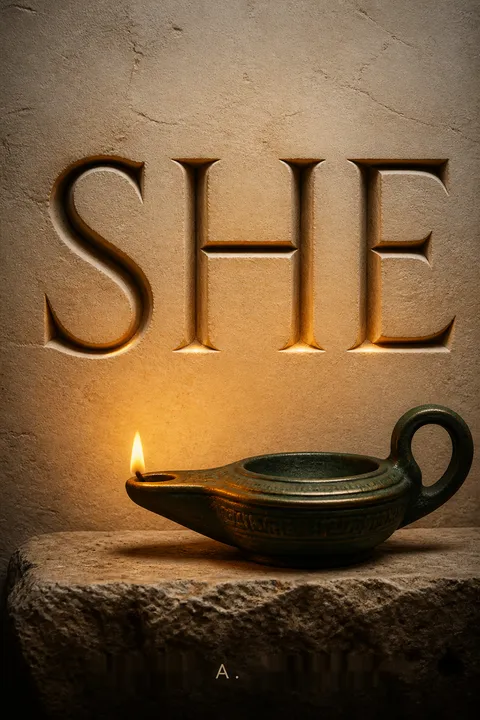
She: Understanding Feminine Psychology receives mixed reviews. Some praise its insightful analysis of feminine psychology through Greek mythology, finding it enlightening and applicable to modern life. Others criticize it as outdated, sexist, and overly focused on women's relationships with men. Many readers appreciate Johnson's interpretation of the Psyche and Eros myth, though some find it limited. The book's brevity is both praised and criticized. While some readers find valuable insights, others feel it oversimplifies complex topics. Overall, opinions are divided on its relevance and accuracy in understanding feminine psychology.
People Also Read






About the Author
Other books by Robert A. Johnson


Download PDF
Download EPUB
.epub digital book format is ideal for reading ebooks on phones, tablets, and e-readers.








































