

Key Takeaways
The problem isn't your disturbing thoughts; it's how you fight them
Good people have horrifying thoughts. Around 90 percent of people, when asked, admit to sudden intrusions like imagining jumping off a train platform or shoving a stranger onto the tracks. Winston and Seif estimate over 6 million Americans suffer when such thoughts get stuck. The content is usually violent, sexual, blasphemous, or self-harming, precisely because it violates the person's deepest values.
Nothing is wrong with you. The authors' opening reassurance is that the sufferer is not perverted, dangerous, or crazy, just using the wrong method. A gentle person fights a violent thought, and the fight cements it. The intrusive thought is the opposite of who you are. Recognizing this, naming the phenomenon, and dropping the shame is itself the first step toward relief.
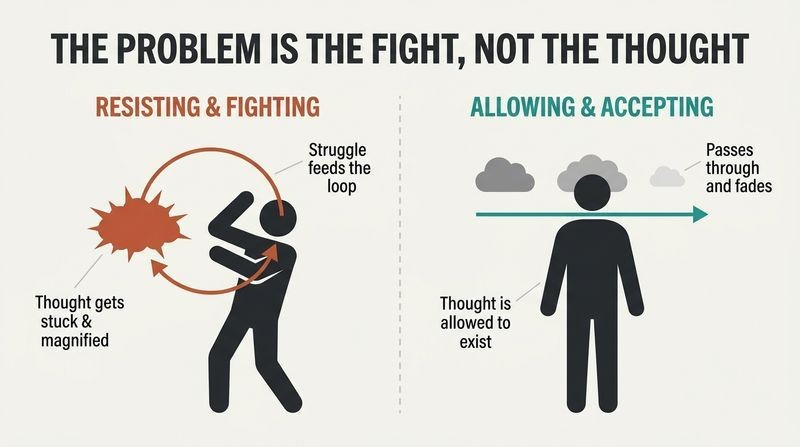
What's striking is how the authors reframe a shame-soaked private torment as a near-universal glitch of a healthy, creative mind. This echoes acceptance and commitment therapy's insight that psychological suffering often comes from experiential avoidance rather than the experience itself. The 90 percent figure traces to research by Rachman and de Silva showing clinical obsessions and ordinary intrusions differ in frequency, not kind. One caveat worth holding: the book aims at anxiety-driven, ego-dystonic thoughts, not genuine intent, a distinction the authors carefully preserve. The liberating move here is diagnostic reattribution: relocating the pathology from the person's character to their coping strategy.
What you resist persists: fighting a thought is how it sticks
Try not to think of carrots. The authors borrow Daniel Wegner's ironic process research: set a timer, forbid yourself one neutral topic, and it floods your mind. Reset the clock every time carrots appear and five minutes becomes impossible. You have manufactured a stuck thought out of something you never cared about. The suppression itself is a form of thinking about it.
Effort works backward. Lee Baer called this the imp of the mind, after Poe's imp of the perverse. Thoughts about chairs and fruit salad never stick because nobody fights them. The thoughts that lodge are the ones you most desperately want gone. Every push generates a pushback, so the harder you struggle, the louder and more frequent the intrusion becomes.
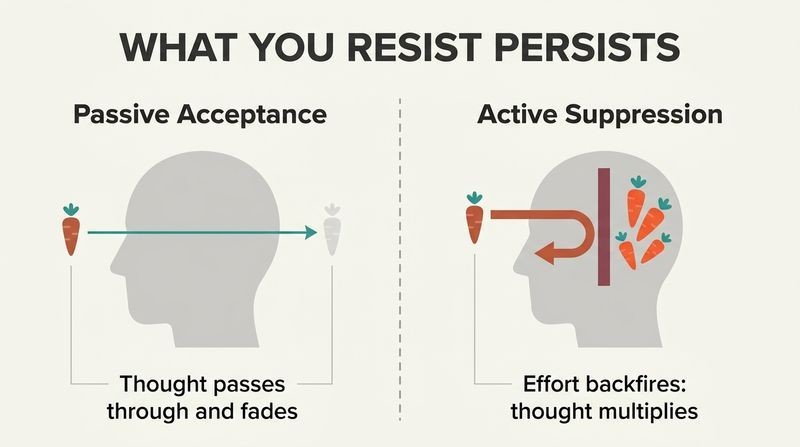
The carrot exercise is a small experimental masterpiece because it lets readers feel the mechanism rather than merely read about it. Wegner's ironic process theory holds that suppression recruits a monitoring process that scans for the forbidden content, ironically keeping it activated. Modern replications have been mixed under high cognitive load, but the clinical phenomenon is robust in OCD and anxiety populations. The deeper principle connects to paradoxical intention, coined by Viktor Frankl decades earlier: deliberately courting the feared outcome dissolves the anticipatory tension driving it. The counterintuitive lesson is that control, the very faculty we prize, becomes the trap.
Meet the three voices arguing inside your anxious mind
Worried Voice, False Comfort, Wise Mind. The authors personify the internal commentary that inflates a thought into torment. Worried Voice is the panicked what-if machine, seizing every alarm as real danger. False Comfort rushes in to reassure, argue, distract, and neutralize, but never succeeds, because each reassurance simply invites Worried Voice's next what-if. Their endless back-and-forth is the actual source of suffering.
Wise Mind watches unbothered. The third voice is calm, curious, sometimes amused, and accepting of uncertainty. It knows most alarms are false and that engaging the argument feeds it. Crucially, False Comfort's soothing is not the solution but a disguised part of the problem. The path out is silencing False Comfort so Worried Voice loses its sparring partner and quiets on its own.
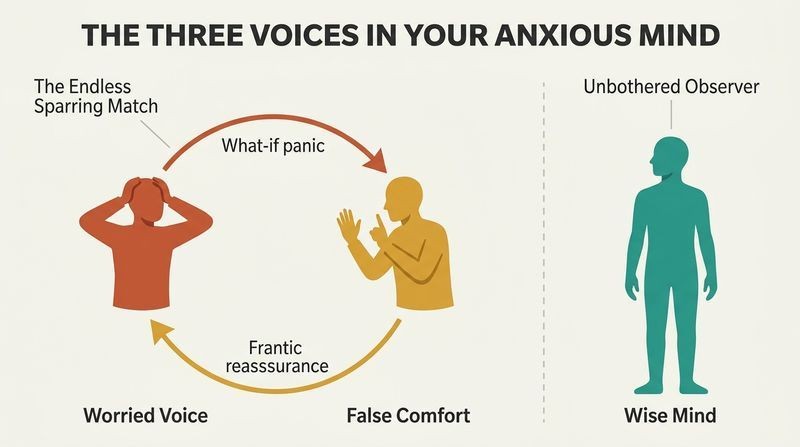
Personifying inner states resembles Internal Family Systems therapy and cognitive defusion techniques, where naming a mental process creates observer distance. The genuinely original move is exposing False Comfort as a wolf in sheep's clothing. Most well-meaning advice, and most reassurance-seeking, operates at this level, which is why loving friends and even therapists inadvertently worsen the condition. In OCD terms, reassurance is a covert compulsion. There is a subtle risk that readers over-identify with the labels and turn voice-spotting into another checking ritual, but as a heuristic for catching the futile argument in real time, the trio is clarifying and memorable.
Your amygdala fires a false alarm before thinking can intervene
First fear is unstoppable. Drawing on Joseph LeDoux's research, the authors explain that a trigger reaches the amygdala by two routes. A fast, crude path fires the alarm in about a fifth of a second, producing an instant whoosh of fear. A slower path through the thinking cortex arrives roughly half a second later to assess whether danger is real. So you feel frightened before you can reason.
Second fear is optional. When someone yells boo, the cortex signals all clear and you calm down. But with intrusive thoughts, Worried Voice tells the amygdala there really is danger, so the alarm keeps clanging. The amygdala prefers a thousand false positives to one missed threat. Willpower cannot stop first fear, but it need not manufacture second fear.
Grounding the experience in neuroanatomy performs real therapeutic work: it externalizes the whoosh as hardware, not moral failure. LeDoux's dual-pathway model has been refined since the 1990s, and he himself now cautions against equating amygdala activation with the conscious feeling of fear, distinguishing threat detection from subjective experience. The book's simplification is pedagogically useful even if neuroscientifically loose. The practical payoff is the first fear versus second fear distinction, which maps neatly onto Claire Weekes's mid-century work with anxious patients and gives sufferers permission to stop blaming themselves for the initial jolt they never chose.
Thoughts reveal nothing about your character, only your choices do
Nine myths keep thoughts stuck. The authors debunk beliefs that fuel the trap: that we control our thoughts, that thoughts reveal hidden character, that the unconscious can hijack our actions, and that thinking something makes it more (or less) likely to happen. This last error, calling it thought-action fusion, is the anxious conviction that a mental event is morally equivalent to or predictive of a real act.
Character is action, not mental noise. A thought is not a fact, a wish, a premonition, or a message from a buried self. If every dark thought revealed true nature, 90 percent of people would be monsters, and horror films would be written by murderers rather than ordinary creative professionals. What defines you is what you choose to do, never what pops uninvited into your mind.
The demolition of thought-action fusion, a concept from Rachman and Salkovskis, is the intellectual spine of the book. It also quietly overturns a century of pop-Freudianism, the notion that intrusive fears betray repressed wishes, which the authors call actively harmful. Contemporary cognitive science largely agrees: mental content is noisy, associative, and stochastic, not a coded confession. The point that we readily excuse a friend's bizarre thought while condemning our own reveals a self-directed attribution bias. One nuance: beliefs can shift mood and motivation, and thus indirectly influence behavior, which the authors acknowledge, so the claim is about probability in the world, not psychology entirely.
Repeating thoughts are stuck, not important or prophetic
Frequency signals resistance, not significance. A common myth holds that a thought must matter because it keeps returning. The authors invert this: thoughts recur precisely because you push them away. Neural pathways strengthen with attention, so investing energy in a thought, even hostile energy, wires it deeper. A truly unimportant thought fades the moment you stop resisting it.
Junk channels of the mind. They compare the mind to a radio playing many stations at once. Most is junk: idle observations, random associations, replayed jingles. You normally let this pass without comment. But treat one intrusion as a meaningful signal, grant it attention it doesn't deserve, and it hijacks the broadcast. The insomniac's experience of thoughts amplifying the harder they try to stop thinking is the same mechanism at work.
This reframing dismantles a seductive cognitive distortion, the availability heuristic applied inward: what comes to mind easily feels important. The authors correctly note that recurrence tracks salience and rehearsal, not truth value. The Hebbian principle they invoke, neurons that fire together wire together, is real, though the causal story is simplified. What is practically powerful is decoupling repetition from meaning, because sufferers routinely reason that a persistent thought is trying to tell them something. Mindfulness traditions arrived at the same place centuries ago: thoughts are events in awareness, not commands or oracles. The junk-channel metaphor gives that ancient insight a usably modern handle.
Three culprits keep you trapped: sticky mind, paradoxical effort, entanglement
Why nothing you tried worked. The authors name three forces. Sticky mind is a biologically based, partly inherited tendency for thoughts to linger and recur, worsened by fatigue, stress, hangover, or hormonal shifts. Paradoxical effort is the Chinese finger trap principle: the harder you pull, the tighter the grip, so struggling to relax or to not-think backfires. Entanglement is getting drawn into dialogue with the thought, arguing, analyzing, or reassuring, which treats junk as worthy of response.
Words are just words. To feel entanglement, they suggest rating the emotional charge of skill and grape, then dropping the first letter to reveal kill and rape. Suddenly the harmless originals feel loaded. Meaning and dread are something we add. Healthy living reduces stickiness but does nothing for the other two culprits.
Separating these three mechanisms is analytically elegant because it explains why partial remedies fail. Exercise and sleep dampen stickiness yet leave entanglement untouched, so sufferers conclude they are beyond help when they simply treated one factor. The finger-trap image for paradoxical effort has deep resonance with Taoist wu wei and with performance psychology, where trying too hard degrades a golf swing or a night's sleep. The skill-grape demonstration is a clever in-body proof of constructivist emotion theory: affect is assigned, not intrinsic to stimuli. The framework's value is diagnostic, letting a reader locate exactly where their coping went wrong.
Run the six-step RJAFTP drill when a thought ambushes you
Acceptance is the operative attitude. The authors offer a sequence: Recognize the intrusion and label it, remind yourself these are Just thoughts best left alone, Accept and allow them without pushing, Float and feel by shifting from what-if imagining to present-moment senses, let Time pass without checking whether it's working, and Proceed with whatever you were doing.
Accept means welcome, not endure. Acceptance does not mean resigning yourself to lifelong misery or believing the thought's content. It means actively allowing the thought to exist because it genuinely doesn't matter. Checking to see if acceptance is working means you haven't accepted. The metaphors sharpen it: ignore the party crasher stealing shrimp, refuse to dignify the heckler's question, watch debris float past behind a waterfall rather than lunging to grab it.
RJAFTP operationalizes acceptance and commitment therapy and mindfulness-based approaches into a field-usable protocol, which is its chief virtue over vaguer exhortations to let go. The trickiest and most sophisticated point is that acceptance-as-technique defeats itself, because covert monitoring (is it working yet?) is itself resistance. This paradox has frustrated meditators for millennia and maps onto the observer effect in attention. The party and waterfall metaphors work because they transfer a felt sense of nonchalant allowing. The risk is that anxious readers weaponize the six steps into a compulsion, performing them anxiously to make thoughts leave, which the authors explicitly warn against but which remains a real failure mode.
Deliberately summon your worst thought to rewire the fear out of it
Exposure is the active ingredient. Recovery requires provoking the thoughts on purpose while practicing acceptance. The authors cite two mechanisms: emotional processing (staying with the fear until false danger memories update) and inhibitory learning (building new non-fearful pathways, like a highway beside an old road, that eventually carry the traffic). You cannot reason the amygdala calm; you must activate the fear to teach it.
Make it absurd, add humor. Practice with a twist: a mother tormented by images of her son's fatal crash sang the catastrophe to a nursery tune during chores until it turned boring, then ridiculous. A man fearing impulsive suicide carried a rope everywhere to rehearse the thought. Write it, sing it, exaggerate it to absurdity. The wanted intrusion becomes a passing thought of no consequence.
This is the therapeutic engine, and it aligns with exposure and response prevention, the gold-standard OCD treatment with strong meta-analytic support. The book wisely favors Craske's inhibitory-learning model, which now supersedes strict habituation theory: the goal is tolerating anxiety and building competing associations, not necessarily reducing fear within a session. The road-and-highway metaphor captures why relapse under stress happens, the old path never erases. Humor deserves emphasis as an underrated clinical tool; laughter is incompatible with the rigid threat state and signals cognitive defusion. The caveat the authors themselves stress: exposure without genuine acceptance is just self-inflicted misery, so attitude is not optional garnish but the mechanism.
Recovery means not caring whether the thoughts come back
Aim past symptom relief. The authors deliberately avoid the word cure. Recovery is an attitude and set of beliefs: thoughts are just thoughts, not warnings or moral acts, and your particular ones are outcroppings of a sticky mind opposite to your values. When intrusions genuinely stop mattering, they lose their fuel and fade on their own, a self-reinforcing recovery cycle that lowers anticipatory anxiety.
Expect setbacks, welcome them. They prefer setback to relapse because intrusions always return during stress, illness, fatigue, or even relaxed vacation moments. Treating a return as catastrophe (not this again) restarts the struggle. Treating it as a practice opportunity keeps skills sharp. The telltale sign is never the content, which morphs freely, but the familiar whoosh and the urge to push it away or argue.
Defining recovery as indifference rather than absence is psychologically shrewd and mirrors relapse-prevention models in addiction, where expecting lapses inoculates against the abstinence-violation effect (the spiral of shame after a slip). The insistence that content is irrelevant, that a pedophilia fear can morph into a disease fear while the underlying process stays identical, is clinically important and distinguishes the disorder from its disguises. There is a genuine tension the authors navigate honestly: how do you stop caring without caring about stopping caring? The resolution is behavioral, not logical, you act as if it doesn't matter, and belief follows action, an insight William James would have endorsed.
Know the four red flags that mean self-help isn't enough
Not all repetitive thoughts are harmless. The authors carefully distinguish unwanted intrusive thoughts from conditions needing professional care. Watch for four:
1. Invited thoughts that become actual plans, like self-harm that feels soothing or revenge fantasies turning into schemes.
2. Genuine suicidal preoccupation, where the feeling is a sincere wish to die alongside hopelessness, appetite and sleep loss, and worthlessness, not the anxious what-if I might harm myself against my will.
3. Real pedophilic arousal seeking stimulation, versus anxious sufferers desperately checking to prove they are not attracted to children.
4. Lost perspective, agitation, or racing thoughts signaling depression or bipolar illness.
The feeling is the tell. Harmless intrusions feel alien and horrifying; dangerous ones feel wanted, comforting, or appropriate. That emotional signature separates anxiety from genuine risk.
This chapter is a responsible act of clinical humility, drawing the boundary of a self-help book's competence. The ego-dystonic versus ego-syntonic distinction (thoughts felt as alien and abhorrent versus thoughts felt as consistent with one's desires) is the cornerstone of differential diagnosis in this domain and prevents two opposite errors: a genuinely suicidal reader being told to just accept it, and an anxious reader misreading their horror as intent. Notably, the book's own logic makes reassurance-seeking futile, yet here it directs readers toward professional evaluation, which is not reassurance but appropriate risk assessment. That nuance, knowing when the whole framework does not apply, is a mark of intellectual integrity.
Analysis
This is a niche clinical self-help book, framework-based rather than story-driven, addressing a specific and stigmatized affliction that broader anxiety and OCD literature tends to bury. Its target reader suffers privately from violent, sexual, blasphemous, or bizarre thoughts they dare not confess. The book's central achievement is a reattribution: the pathology is not the thought's content but the sufferer's war against it. Everything flows from that inversion.
Winston and Seif synthesize three research traditions into an unusually coherent whole. From Wegner they take ironic process theory (suppression backfires). From LeDoux and Weekes they take the dual-pathway fear model (first fear is automatic, second fear is manufactured). From Rachman, Salkovskis, Foa, and Craske they take thought-action fusion and modern exposure theory. The originality lies less in new science than in translation: the Worried Voice, False Comfort, and Wise Mind trio, the sticky mind, paradoxical effort, and entanglement triad, and the RJAFTP protocol convert abstract mechanisms into usable tools.
The book's boldest and most defensible claim is that reassurance, the intuitive kindness we offer suffering people, is a covert compulsion that feeds the disorder. This aligns with contemporary exposure and response prevention consensus and explains why sympathetic families and even therapists worsen outcomes.
Limitations deserve mention. The neuroscience is simplified to the point that LeDoux himself would object to equating amygdala firing with felt fear. The 6 million and 90 percent figures are estimates presented with more confidence than their sourcing supports. And the acceptance paradox, stop caring without caring about stopping, is genuinely hard to operationalize; some readers will convert the six steps into fresh rituals. Yet the book's clinical humility, its explicit red-flag chapter distinguishing ego-dystonic anxiety from genuine risk, marks it as responsible rather than glib. For its intended sufferer, it delivers precisely the reframe that decades of generic anxiety advice failed to provide.
Review Summary
Overcoming Unwanted Intrusive Thoughts receives mostly positive reviews, with readers praising its accessibility and effectiveness in managing intrusive thoughts. Many find it life-changing, offering practical techniques and a compassionate approach. The book helps normalize intrusive thoughts and provides tools for handling anxiety. Some readers appreciate its scientific basis and clear explanations. However, a few criticize its repetitiveness and limited scope. Overall, most reviewers highly recommend it for those struggling with intrusive thoughts and anxiety.
People Also Read






Glossary
Unwanted intrusive thoughts
Stuck, distressing, uninvited mental intrusionsUninvited thoughts, images, or urges (typically violent, sexual, blasphemous, or self-harming) that enter the mind, trigger intense fear or disgust, and become stuck because the person fights them. They are ego-dystonic, meaning they feel alien and contrary to the person's values, character, and wishes, and they signal overcontrol and anxiety rather than genuine intent or danger.
Worried Voice, False Comfort, and Wise Mind
Three inner voices in intrusionThe authors' personification of internal commentary. Worried Voice raises panicked what-if alarms. False Comfort tries to reassure, argue, and neutralize but always triggers another what-if, secretly sustaining the cycle. Wise Mind observes calmly, accepts uncertainty, and knows the thoughts are harmless junk requiring no response. Recovery involves silencing False Comfort and adopting Wise Mind's stance.
First fear and second fear
Automatic alarm versus added fearA distinction from Claire Weekes. First fear is the instantaneous, unstoppable whoosh of alarm the amygdala fires before the thinking brain can assess a trigger. Second fear is the additional, optional fear generated when the person interprets the thought as truly dangerous and struggles with it. First fear cannot be controlled; second fear can be dropped, which lets natural calming occur.
Sticky mind, paradoxical effort, and entanglement
Three forces trapping intrusive thoughtsThe three factors that keep intrusions alive. Sticky mind is a biologically based, partly inherited tendency for thoughts to linger, worsened by stress and fatigue. Paradoxical effort is the finger-trap principle that struggling harder backfires. Entanglement is getting drawn into arguing with, analyzing, or reassuring the thought, treating meaningless mental noise as worthy of response.
Thought-action fusion
Confusing thinking with doingA cognitive distortion, drawn from Rachman and Salkovskis, in which a person treats a thought as morally equivalent to an action or as evidence that the feared act is likely to happen. During anxious thinking the line between imagining and doing blurs, so a mental image feels predictive or self-incriminating when it is neither.
RJAFTP
Six-step acceptance response drillAn acronym for the six steps to reduce distress over an intrusive thought: Recognize and label it, remind yourself they are Just thoughts, Accept and allow without pushing away, Float and feel by shifting to present senses, let Time pass without checking, and Proceed with your activity. The steps embody acceptance rather than control.
Exposure with acceptance
Deliberately provoking thoughts to rewire fearThe core treatment: intentionally summoning the feared thought while practicing an accepting, non-struggling attitude. It works via emotional processing (staying with fear until false danger memories update) and inhibitory learning (building new non-fearful neural pathways that outcompete old ones). Often paired with humor and absurdity, such as singing the thought to a nursery tune.
FAQ
What's "Overcoming Unwanted Intrusive Thoughts" about?
- Focus on Intrusive Thoughts: The book is a guide to understanding and overcoming unwanted intrusive thoughts, which are distressing thoughts that enter the mind unbidden and can cause significant anxiety.
- CBT-Based Approach: It uses cognitive behavioral therapy (CBT) principles to help readers change their relationship with these thoughts, reducing their power and impact.
- Practical Guidance: The authors provide practical, research-based strategies to help individuals manage and eventually overcome these thoughts.
- Target Audience: It is aimed at both sufferers of intrusive thoughts and the clinicians who support them.
Why should I read "Overcoming Unwanted Intrusive Thoughts"?
- Expert Insights: The book is authored by Sally M. Winston and Martin N. Seif, who are experts in anxiety disorders and have decades of experience in the field.
- Comprehensive Approach: It offers a thorough understanding of the nature of intrusive thoughts, their origins, and their impact on emotional distress.
- Actionable Strategies: Readers are provided with actionable steps and strategies to manage and reduce the distress caused by these thoughts.
- Support for Clinicians: It also serves as a resource for clinicians seeking to better support their clients dealing with intrusive thoughts.
What are the key takeaways of "Overcoming Unwanted Intrusive Thoughts"?
- Thoughts Are Not Actions: Intrusive thoughts do not reflect one's character or intentions and are not indicative of future actions.
- Acceptance Over Control: The book emphasizes accepting thoughts rather than trying to control or suppress them, which can paradoxically increase their frequency.
- Mindfulness and Awareness: Developing a mindful attitude towards thoughts can help reduce their distressing impact.
- Exposure Therapy: Deliberately exposing oneself to these thoughts in a controlled manner can help reduce their power over time.
How does "Overcoming Unwanted Intrusive Thoughts" define intrusive thoughts?
- Unbidden and Distressing: Intrusive thoughts are unwanted, distressing thoughts that enter the mind without invitation.
- Common Experience: They are experienced by a large percentage of the population, though they can become problematic for some.
- Not Indicative of Character: These thoughts do not reflect the individual's true desires or character.
- Variety of Forms: They can be aggressive, sexual, nonsensical, or related to personal fears and anxieties.
What is the two-step process for change in "Overcoming Unwanted Intrusive Thoughts"?
- Step 1 - Recognize and Label: The first step involves recognizing and labeling the thought as an intrusive thought, which helps in distancing oneself from it.
- Step 2 - Acceptance and Allowance: The second step is to accept and allow the thought to be present without engaging with it or trying to push it away.
- Reduce Entanglement: This process helps reduce entanglement with the thought, decreasing its power and frequency.
- Mindful Observation: Observing the thought without judgment is key to this process.
How does "Overcoming Unwanted Intrusive Thoughts" suggest handling thoughts when they happen?
- Recognize and Label: Acknowledge the thought as an intrusive thought and label it as such.
- Accept and Allow: Allow the thought to be present without trying to suppress or fight it.
- Float and Feel: Float above the fray and allow the feelings to just stay there, focusing on the present moment.
- Let Time Pass: Allow time to pass without urgency, letting the natural calming process take over.
What are the myths about thoughts discussed in "Overcoming Unwanted Intrusive Thoughts"?
- Myth of Control: The belief that we can control all our thoughts is a myth; many thoughts are automatic and not under conscious control.
- Character Reflection: Thoughts do not reflect one's character or hidden desires.
- Thought-Action Fusion: The idea that thinking something makes it more likely to happen is false.
- Repetition Equals Importance: Repeated thoughts are not necessarily important; they often persist because of the effort to suppress them.
What is the role of the amygdala in intrusive thoughts according to "Overcoming Unwanted Intrusive Thoughts"?
- Alarm System: The amygdala acts as an alarm system, triggering a fight-or-flight response even to non-dangerous thoughts.
- False Alarms: It often sends out false alarms, causing a whoosh of fear in response to intrusive thoughts.
- Conditioned Responses: Over time, the amygdala can become conditioned to react to certain thoughts as if they were dangerous.
- Rewiring Possible: Through exposure and acceptance, the brain can be rewired to reduce these automatic fear responses.
How does "Overcoming Unwanted Intrusive Thoughts" recommend using exposure therapy?
- Deliberate Exposure: Intentionally think about the intrusive thoughts in a controlled manner to reduce their power.
- Acceptance is Key: Exposure should be done with an attitude of acceptance, not as a means to fight the thoughts.
- Rewire the Brain: This process helps create new, non-fearful pathways in the brain, reducing the impact of the thoughts.
- Variety and Frequency: Practice should be frequent and varied to maximize the benefits.
What are the common obstacles to acceptance in "Overcoming Unwanted Intrusive Thoughts"?
- Guilt: Feeling guilty about having the thoughts can lead to seeking reassurance, which reinforces the cycle.
- Doubt: The need for certainty can prevent acceptance, as individuals may constantly question the safety of their thoughts.
- Urgency: A sense of urgency to resolve the thoughts can lead to increased anxiety and entanglement.
- Reassurance Seeking: Seeking reassurance from oneself or others can temporarily relieve anxiety but ultimately strengthens the intrusive thoughts.
What are the best quotes from "Overcoming Unwanted Intrusive Thoughts" and what do they mean?
- "Good people have awful thoughts." This quote emphasizes that intrusive thoughts do not reflect one's character or morality.
- "What you resist tends to persist." It highlights the paradoxical effect of trying to suppress thoughts, which often makes them more persistent.
- "Thoughts are just thoughts." This reinforces the idea that thoughts are not facts or actions and should not be given undue importance.
- "Acceptance is more of an attitude than a technique." It underscores the importance of adopting a mindset of acceptance rather than using it as a tool to eliminate thoughts.
Download PDF
Download EPUB
.epub digital book format is ideal for reading ebooks on phones, tablets, and e-readers.








































