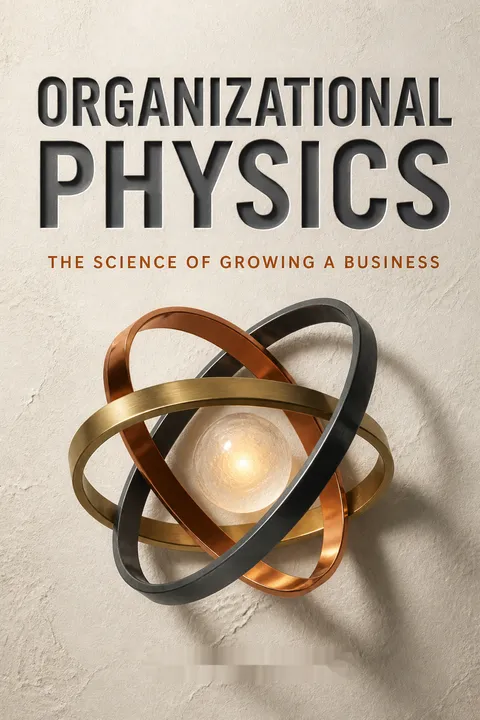

Key Takeaways
1. Success is a function of managing energy: Integration over Entropy.
The universal success formula shows that success is just a function of two things: integration over entropy.
System Energy Management. Every system, from an individual to a business, operates with finite energy and is subject to the laws of thermodynamics. The First Law states that a system has finite energy and must acquire new energy from its environment. The Second Law introduces entropy, the natural tendency for all systems to fall apart over time, requiring energy to maintain themselves.
The Success Formula. Success is achieved when a system effectively manages its energy, specifically by maximizing "integration" and minimizing "entropy."
- Integration: The amount of new energy (money, resources, market clout) a system gets from its environment by aligning capabilities with opportunities. High integration is good.
- Entropy: The energy required to maintain the system, make decisions, and get work done, often manifesting as disorder, friction, or internal conflict. Low entropy is good.
Prioritize Entropy Reduction. Energy available to a system always flows first to manage its entropy needs. Only leftover energy can be used for integration. Therefore, high internal friction (e.g., politicking, infighting, poor health) directly steals from top-line performance and growth. Identifying and eliminating these "energy drains" is paramount for sustainable success, as it frees up more energy for growth and adaptation.
2. Organizations are driven by four universal forces: Producing, Stabilizing, Innovating, Unifying (PSIU).
The Producing force demonstrates a drive to shape the environment and is focused on individual components or aspects of the system.
Adaptive Systems Model. All complex adaptive systems (people, teams, companies) must constantly shape and respond to their environment, focusing on both individual parts and the whole system. This fundamental dynamic gives rise to four universal forces, or behavioral styles, that are present at every level of an organization. These forces are in constant "co-op-etition," meaning they cooperate for overall survival but compete for available energy.
The Four Forces (PSIU):
- Producing (P): Drives results, focuses on "what to do now," fast-paced, short-term, results-oriented, structured. (e.g., sales, coding, getting work done).
- Stabilizing (S): Makes things controllable, focuses on "how to do things," methodical, short-term, process-oriented, structured. (e.g., accounting, quality control, systematizing work).
- Innovating (I): Makes things adapt, focuses on "why not?" and the whole system, fast-paced, long-term, results-oriented, unstructured. (e.g., R&D, strategy, entrepreneurship).
- Unifying (U): Makes things respond as a whole, focuses on "who is involved," measured pace, long-term, process-oriented, unstructured. (e.g., team building, culture, interpersonal dynamics).
Scale-Independent Application. These forces manifest in tasks, individual styles, team dynamics, and entire organizational functions. For instance, R&D needs high 'I', sales needs high 'P', accounting needs high 'S', and HR needs high 'U'. Understanding these underlying forces allows managers to diagnose behavior and apply the appropriate "force" for desired change.
3. High-performing teams require complementary PSIU styles, not individual perfection.
What all successful and harmonious unions have in common is that both partners naturally complement each other (or find alternative ways of bringing all four forces into the relationship).
The Myth of the Perfect Leader. No single individual can embody all four PSIU forces perfectly and simultaneously. A CEO cannot be equally adept at driving results (P), ensuring efficiency (S), innovating (I), and unifying the team (U) all the time. Attempting to do so leads to burnout and inefficiency. The media often celebrates individual leaders, overlooking the complementary teams behind their success.
Complementary Teams are Key. Just as a successful marriage often involves partners with complementary strengths (e.g., one focused on external career, the other on internal domestic harmony), high-performing organizations thrive when their leadership and teams collectively cover all four PSIU forces. For example:
- Steve Jobs (PsIu - visionary, product-focused, impatient) was complemented by Tim Cook (PSiU - relentless operator, detail-oriented, relationship builder).
- A strong Producer (P) needs a Stabilizer (S) to ensure quality, an Innovator (I) for new ideas, and a Unifier (U) for team cohesion.
Judge the Force, Not the Person. Effective management involves recognizing the dominant PSIU forces in individuals and situations without personal judgment. Instead of criticizing a "slow" Stabilizer, understand their need for data and process. By giving each force what it needs (e.g., autonomy for Producers, data for Stabilizers, excitement for Innovators, connection for Unifiers), you unlock their potential and reduce entropy, fostering healthier, more productive relationships.
4. Strategic success demands aligning Product, Market, and Execution Lifecycles.
In order to successfully execute on a strategy, the stages of all three lifecycles must be in close alignment with each other.
Adaptation is Supreme. The ultimate goal of any business strategy is to acquire new energy (money, resources, clout) from the environment, now and in the future. This requires constant adaptation, as environments and opportunities are always changing. Darwin's principle of adaptation, not just "survival of the fittest," is the bedrock of strategic success.
Three Interconnected Lifecycles: All systems, including businesses, products, and markets, follow a lifecycle of birth, growth, maturity, and decline. Strategic success hinges on aligning these three lifecycles:
- Product Lifecycle: Pilot It (test assumptions), Nail It (prove value to early adopters), Scale It (standardize for early majority), Milk It (maintain for late majority), Kill It.
- Market Lifecycle: Innovators (tech enthusiasts), Early Adopters (visionaries seeking breakthroughs), Early Majority (pragmatists seeking proven solutions), Late Majority/Laggards (resistant to change, buy commodities).
- Execution Lifecycle: Birth (psIu - innovative), Early Growth (Psiu - results-focused), Growth (PSiu - standardized), Maturity (PSIu - balanced), Decline, Aging, Death.
The Power of Alignment. Aligning these lifecycles means matching your organizational capabilities and focus to the specific stage of your product and the type of customer you're targeting. For example, a product in the "Pilot It" stage for "Innovators" requires a "Birth" mode organization (psIu). This alignment maximizes energy acquisition, optimizes investments, maintains pricing, and avoids common strategic pitfalls.
5. Avoid strategic follies by "going the long way around" the lifecycle.
The path to strategic success goes “the long way around.”
The Path to Prosperity. Strategic success is not about shortcuts; it's about following a deliberate sequence:
- Pilot It for Innovators: Establish thought leadership, disrupt the status quo.
- Nail It for Early Adopters: Prove the product solves a core problem, get repeat purchases.
- Scale It for Early Majority: Standardize the product, add high-value extensions, capture market share.
This "long way around" builds market awareness, ensures timely investments, maintains margins, and delays commoditization.
Three Strategic Follies to Avoid: Companies often fail by attempting to bypass these stages, leading to predictable disasters:
- The Face Plant: Innovating a product directly into a commodity market (Quadrant 4) without establishing thought leadership or proving value. The company spends resources solving an already-solved problem, gets crushed by established competitors, and never achieves profitability.
- The Flame Out: Prematurely scaling (Quadrant 3) without having truly "nailed" the product for early adopters (Quadrant 2). This leads to aggressive marketing and market noise, but dissatisfied customers, bugs, and unsustainable revenue, as demand was presupposed, not validated.
- The Lost Opportunity: Piloting and nailing the product (Quadrants 1 & 2) but failing to execute quickly or efficiently enough to scale (Quadrant 3). Another company captures the market, and the original innovator is left with a product that dies on the vine, unable to compete or achieve significant success.
Strategic Timing. Understanding market growth rate, competition, pricing pressure, and net cash flow at each stage is crucial. For instance, negative cash flow is expected in Pilot/Nail stages, but positive cash flow and market leadership should emerge in the Scale stage. Smart investment capital (friends/family, angels, VCs, IPO) aligns with these stages, funding the right activities at the right time.
6. A pre-startup checklist ensures foundational commitment and alignment.
Commitment means that the entrepreneur and founding team have taken a real risk to make the business happen.
Commitment is the Foundation. The core difference between a "pre-startup" idea and a true "startup" is unwavering commitment. This means the entrepreneur and founding team have taken significant personal risks (e.g., quitting jobs, investing personal funds) and are unequivocally "in." Without this deep commitment, a venture remains an idea, lacking the necessary drive to overcome inevitable challenges.
The Pre-Startup Checklist: Before launching, ensure these critical elements are in place:
- Align Vision and Values: The venture's purpose and acceptable behaviors must align with the founding team's personal vision and values. Misalignment leads to stress, internal conflict, and ultimately, failure, regardless of financial success.
- Know Your Customers' Pain: A clear understanding of the target market's core problem or need is paramount. "No customer pain, no business gain." This requires focused research into customer spending priorities, acquisition costs, pricing, and how customers prefer to buy.
- Get the Right People on the Bus: All resources (capital, technology, customers) flow from people. A strong, complementary team with aligned skills, vision, and dedication is more critical than initial capital. Jim Collins' "who's on the bus" principle applies here.
- Don't Wear Cement Shoes (Low Entropy): Conduct an "internal entropy scan" of the founding team. Address any significant internal friction, discord, or personal issues (e.g., toxic relationships, health problems) before launch. High entropy at the start will magnify challenges and drain vital energy.
Customer-Driven Development. Methodologies like "customer-driven development" and "agile" are valuable tools within this framework. They help limit risk and cost by validating product-market fit early (Pilot It to Nail It stages) through continuous customer feedback and iterative development, ensuring that development efforts are aligned with real market needs.
7. Accelerate execution by understanding and managing organizational "mass" and "force."
Mass is resistance to change.
Newton's Laws for Organizations. Just as physical objects, organizations are governed by Newton's three laws of motion, which explain momentum and change:
- First Law (Inertia): An organization will continue its current behavior (stuck or moving) unless acted upon by an outside force. Greater inertia requires greater effort to change.
- Second Law (F=MA): Force equals Mass times Acceleration. In organizations, "Mass" is resistance to change, not size. A large organization can have low mass (e.g., during a crisis), and a small one can have high mass. Lowering resistance allows for greater acceleration with less force.
- Third Law (Action/Reaction): Every organizational action creates an equal and opposite reaction. Rapid growth, for example, will create administrative and operational challenges that must be managed to avoid becoming a drag on momentum.
Gathering the Mass. The secret to sustainable acceleration is to "gather the mass"—making the organization's resistance to change cohesive and unified. When mass is scattered (like shattered glass), any applied force is ineffective. By aligning the organization's subsystems, you consolidate this mass, allowing a focused force to create rapid, sustained acceleration in a chosen direction.
The Execution Diamond. This "gathering" is achieved by aligning four core organizational subsystems: Vision & Values, Structure, Process, and People. These act as a "corral" to keep the organization unified and coherent. Prioritizing this alignment before taking action saves immense time, energy, and resources, preventing costly "wipes outs" like a misaligned car on an icy road.
8. Organizational alignment is built on Vision & Values, Structure, Process, and People.
Alignment is what keeps your organization’s mass (M) on track, cohesive, and manageable.
The Execution Diamond. To achieve rapid, sustainable execution, an organization must align its four core subsystems, forming a cohesive "Execution Diamond":
- Vision and Values: The shared destination and acceptable norms of behavior.
- Organizational Structure: How functions are designed, located, and granted authority.
- Decision-Making and Implementation Process: How decisions are made and executed.
- People: How individuals are matched to roles and responsibilities.
Vision and Values First. Conflict in vision and values is a deal-breaker. Leaders must embody and constantly communicate the "why" and "how" of the organization. Use a "Starters, Bench, Free Agents, Waivers" matrix to align people with the culture:
- Starters: High proficiency, shared vision/values (develop long-term).
- Bench: Low proficiency, shared vision/values (coach and train).
- Free Agents: High proficiency, unaligned vision/values (use sparingly for non-critical tasks).
- Waivers: Low proficiency, unaligned vision/values (help them find new roles elsewhere).
Form Follows Function in Structure. Organizational structure dictates performance. When strategy changes, the structure must change too, making a clean break from old hierarchies. Key rules:
- Don't let efficiency functions (e.g., operations) control effectiveness functions (e.g., sales).
- Don't let short-range functions (e.g., daily sales) control long-range development (e.g., marketing strategy).
- Balance decentralized autonomy (for customer-facing roles) with centralized control (for systemic risk).
- Match people's PSIU styles to job requirements.
9. Effective decision-making follows a "slow-quick" rhythm, gathering Authority, Power, and Influence.
The right rhythm is slow-quick. It’s not quick-slow or quick-quick—and it’s clearly not slow-slow.
The Slow-Quick Rhythm. Fast execution doesn't mean fast decision-making. It means taking adequate time to make a good decision ("slow") and then implementing it swiftly and decisively ("quick"). Rushed, "quick-quick" decisions often lead to flawed solutions that get bogged down in implementation ("quick-slow"). Suspend time pressure during decision-making, then leverage it for implementation.
Gathering CAPI (Coalesced Authority, Power, Influence). To ensure effective decisions and rapid implementation, involve all key stakeholders upstream in the decision-making process. This "critical mass" ensures diverse perspectives and fosters buy-in, reducing resistance to change.
- Authority: The legal right to say "yes" or "no" to the decision.
- Power: The ability to help or hinder the implementation (e.g., team members, unions, customers).
- Influence: The ability to sway opinions without direct authority or power (e.g., experts, thought leaders).
If CAPI cannot be present, postpone the meeting; proceeding without them increases resistance.
Six Steps to Effective Decision-Making:
- Set the Stage: Unfreeze the group, get initial buy-in on desired outcomes, set time expectations.
- Gather Data: Collect all relevant quantitative and qualitative facts from the group.
- Generate Insights: Leverage collective wisdom to identify underlying causes and symptoms.
- Decide What to Do: The authority makes the final decision after participative input.
- Assign Action Steps: Clearly define "what, who, and by when" for implementation, with accountability.
- Reinforce: Reflect on the process, verbally commit to implementation, and integrate lessons.
10. High performance comes from aligning people with their intrinsic "genius zones," not external motivation.
The truth, however, is that your employees will either thrive or fail due to the setting in which they work and how well they’re matched to their respective roles and interests.
The Myth of Motivation. People are inherently motivated; the challenge is aligning that motivation with organizational goals. External incentives (bonuses, threats) can actually decrease intrinsic motivation, job satisfaction, and productivity. Instead of trying to "motivate" employees, focus on creating a "setting" that taps into their natural drive.
The Genius Zone. Each individual has a "genius zone"—a range of activities and interests where they naturally excel, feel energized, and are highly productive. This zone is often reflected in their dominant PSIU styles.
- Aligning Roles: Match an individual's PSIU style and genius zone to their job functions. A person strong in Stabilizing (S) will thrive in process-oriented roles, while a Unifier (U) will excel in roles requiring interpersonal connection.
- Transformative Impact: When people are aligned with their genius zones, they become self-motivated, engaged, and high-performing. This can transform "B players" into "A players" simply by changing their environment and responsibilities.
Setting Trumps Tactics. The right organizational "setting" is created by aligning the Vision & Values, Structure, and Decision-Making Process. When these three subsystems are aligned, they create an environment where people can naturally thrive. Compensation and HR tactics are secondary; they support, but do not create, fundamental alignment and intrinsic motivation. If a role fundamentally mismatches an individual's genius zone, the best solution is to find a better fit, either within or outside the organization, rather than attempting to force motivation.
People Also Read







Download PDF
Download EPUB
.epub digital book format is ideal for reading ebooks on phones, tablets, and e-readers.








































