

Key Takeaways
Service is black and white; hospitality is color
The distinction that built a empire. In a job interview, a candidate gave Guidara the best answer he ever heard: service is doing your job with competence (getting the right plate to the right table), while hospitality is how you make people feel while doing it. Service is technical; hospitality is emotional. Eleven Madison Park climbed onto the World's 50 Best list through excellence (the black and white), but reached number one by adding color: connection so generous it could only be called unreasonable.
A quote he lives by (often misattributed to Maya Angelou): people forget what you did and said, but never how you made them feel. Thirty years after a Four Seasons dinner as a boy, Guidara still remembers the feeling, not the food.
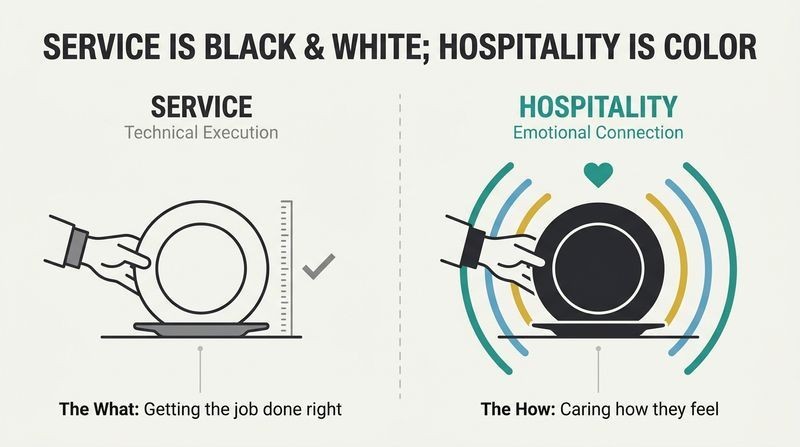
The service/hospitality split maps neatly onto research in emotional labor by sociologist Arlie Hochschild, who showed that the felt quality of an interaction, not its mechanics, drives customer loyalty. What is fresh here is the insistence that feeling is not a soft add-on but the actual product. Marketing scholars call this the peak-end rule: people judge experiences by emotional highs and endings, not averages. One caveat worth noting: color without black and white collapses into sloppiness. Guidara concedes the two must coexist, which is harder than championing either alone.
Being unreasonable is how you see a world that doesn't exist yet
The word meant to shut them down became their rallying cry. Every time Guidara and chef Daniel Humm proposed a radical reinvention, someone said, "You're being unreasonable." Rather than retreat, they adopted it. Their thesis: no one who ever changed their field did it by being reasonable. Great chefs had long been unreasonable about food (a turbot dish took weeks of R&D for three minutes of eating). Guidara asked what would happen if he brought that same obsession to hospitality.
Unreasonable Hospitality means giving people more than they expect, as a deliberate practice rather than an accident. Its opposite is not cruelty but merely reasonable hospitality: perfectly fine, forgettable, and never number one in the world.
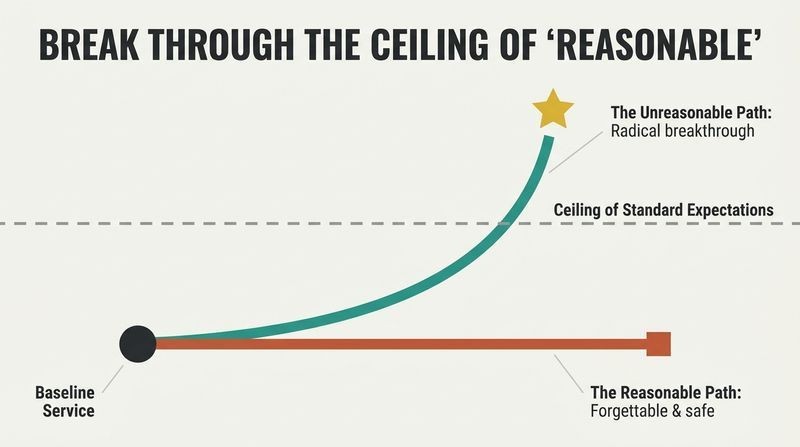
Behavioral economist Rory Sutherland's line, quoted in the book, sharpens the point: the opposite of a good idea can also be a good idea. Reasonable service is defensible; it just does not create legends. This echoes Peter Thiel's argument that competition on conventional metrics produces sameness, while genuine differentiation requires doing something others find irrational. The risk, unstated, is survivorship bias: for every unreasonable EMP there are unreasonable ventures that simply went bankrupt. The discipline that saved Guidara was pairing unreasonable generosity with penny-level financial rigor, which most imitators forget.
Put your team first and they will take care of everyone else
Enlightened Hospitality, borrowed from mentor Danny Meyer, inverts the usual hierarchy: employees come first, ahead of guests and investors. The logic is a chain reaction. Treat your people extraordinarily well, invest in their growth, and they will pour that same care into customers. Guidara's version: if he wanted his team obsessed with how guests felt, he had to be obsessed with how his team felt.
Language builds this culture. Meyer coined phrases that became shared shorthand: "make the charitable assumption" (assume the best of a late employee, ask "is everything okay?" before lecturing), "be the swan" (glide gracefully while paddling furiously underneath), and "constant, gentle pressure" (everyone improving a little always). Naming concepts makes them teachable and repeatable across a hundred and fifty people.
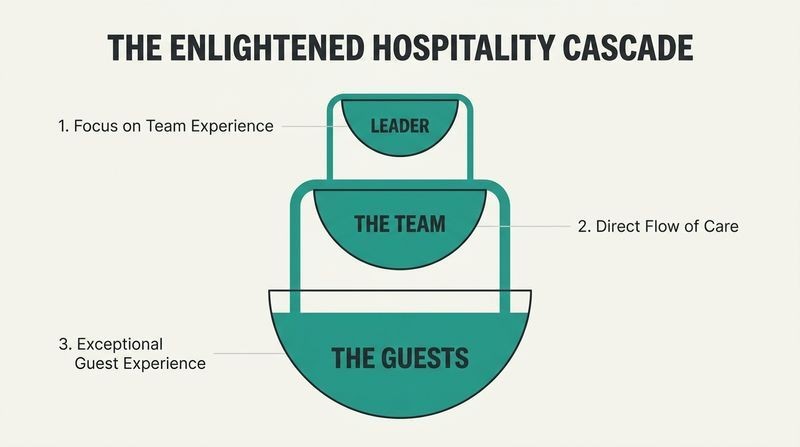
This is the operational heart of the book and aligns with Vineet Nayar's "Employees First, Customers Second" and Southwest Airlines' long-standing philosophy. The mechanism is emotional contagion, well documented in psychology: moods and attitudes transfer between people, so a cared-for staff radiates warmth outward. The linguistic point deserves emphasis. Coining sticky phrases is how culture scales beyond the founder's presence, a lesson from organizational anthropology. One tension: "team first" can be weaponized to excuse toxic star performers. Guidara addresses this directly, insisting it means all employees, including protecting good workers from abusive ones.
Manage 95% to the penny so you can spend 5% foolishly
The Rule of 95/5. Guidara learned finance in the basement of Restaurant Associates, counting oysters by hand in the morning and running accounting reports by afternoon. That dual education taught him ruthless cost discipline. But discipline had a purpose: managing 95 percent of the budget aggressively earned the right to blow the last 5 percent on details with outsize emotional impact.
Examples of the foolish 5 percent:
1. Heartbreakingly expensive tiny blue gelato spoons at MoMA that made curators smile
2. One rare Grand Cru wine at the end of an otherwise economical pairing
3. Four sleds and a chauffeured SUV so a Spanish family's kids could play in their first-ever snow in Central Park
Because the rest was so tightly controlled, these splurges never broke the budget.
This is a genuinely portable financial framework, and its power lies in reframing indulgence as a disciplined line item rather than a lapse. It resonates with the Pareto principle and with the peak-end rule again: a single vivid, generous moment shapes the entire memory of an experience disproportionately. Retailers exploit the inverse (loss-leader pricing) for decades. The nuance often missed: the 5 percent only works because the 95 percent is genuinely airtight. Undisciplined businesses that skip straight to the fun spending mistake extravagance for hospitality, which Guidara explicitly warns against. Thoughtfulness, not luxury, is the actual variable.
Give people more responsibility than they're ready for
The ownership program turned food runners into world-class experts. Guidara noticed the coffee at rival Per Se was merely fine, while his own barista-obsessed staff pulled better shots on their days off. So he handed entire beverage programs to junior employees: a twenty-two-year-old food runner ran the beer program (soon rated among America's best), another took tea, another cocktails. He gave them a budget, guardrails, and the keys, then said, "Go make it awesome."
The counterintuitive result: the more responsibility people were trusted with, the more responsible they became, exactly as Chipotle founder Steve Ells found when he let store teams prep fresh food. The perfect moment to promote someone is often before they feel ready; hungry people work harder to prove you right.
This directly contradicts conventional hiring wisdom that demands prior experience for every role, a practice that makes internal promotion mathematically impossible. The insight connects to the Pygmalion effect in social psychology: expectations become self-fulfilling. When leaders signal belief through delegated authority, performance rises to meet it. It also anticipates modern engagement research showing autonomy is a stronger motivator than pay above a threshold (Daniel Pink's work on intrinsic motivation). The honest cost Guidara names: mentoring novices is slower than doing it yourself, and some experiments fail. His answer, that "it might not work" is a terrible reason not to try, is a bet on compounding returns over short-term efficiency.
When someone perceives a mistake, their perception is your reality
Being right is irrelevant. A guest insisted his medium-rare steak was undercooked. The server, technically correct by culinary standards, corrected him, and in doing so shamed him and killed the connection. Guidara's mantra: their perception is our reality. If a guest thinks the steak is wrong, the only response is "Let me fix it," plus a discreet note so it never recurs.
Saying sorry does not mean you were wrong. The goal is human connection, and connection dies the moment a guest feels rebuked. Guidara draws a bright line, though: this applies to honest disagreements, never to abuse. The customer is not always right, and clear boundaries against disrespectful behavior protect the team. Graciousness is not servility.
This is a sophisticated take on the tired "customer is always right" cliche. Guidara separates factual accuracy from emotional truth, a distinction conflict-resolution researchers call the difference between positions and interests. Neuroscience supports him: perceived social rejection activates the same brain regions as physical pain, so a public correction genuinely hurts and blocks receptivity. The crucial refinement, easy to overlook, is the abuse exception. Many service cultures use "the customer is always right" to justify employee mistreatment. By carving out a firm boundary, Guidara protects the team-first principle from being hollowed out, keeping graciousness distinct from doormat compliance.
Interrogate every rule with a stubborn, childlike 'why?'
Guidara's lack of fine-dining experience became his superpower. A service director scolded him for leaning on a guest's table, a classic fine-dining no-no. When Guidara asked why, the only answer was "that's how it's always been done." That answer, he decided, means the rule deserves scrutiny. Impeccable training builds muscle memory, but muscle memory can also be blinders, keeping people from asking whether a rule still serves its purpose.
So EMP broke the rules that hurt connection: servers leaned in and chatted, soufflES were served the "wrong" way to preserve eye contact, cooks knelt tableside in their whites, and the fancy farewell pastries (canelES that went stale in cabs) were swapped for humble granola that made guests feel welcomed into a home.
This is essentially first-principles reasoning applied to tradition, the same method Elon Musk popularized for engineering and Aristotle used millennia earlier. The organizational-behavior term is "active inertia": firms fail by rigidly repeating formulas that once worked. Guidara's edge is that inexperience let him see the water he was swimming in. There is a subtle counterpoint worth holding: not every inherited rule is arbitrary; Chesterton's fence warns against removing a barrier before understanding why it was built. Guidara honors this by loving restaurant history and keeping rituals that still serve guests, discarding only those that block connection. The test is purpose, not novelty.
Deliberately pursue two goals that seem to contradict each other
Hospitality and excellence are not friends. A staff living in fear of mistakes delivers flawless technique but stiff, guarded service; a warm, relaxed team tends toward sloppiness. Easy cultures pick one. EMP put both words on its list of values and refused to choose, forcing the team to solve the hardest version of the problem.
This is integrative thinking, a concept from management scholar Roger Martin: choosing conflicting goals forces innovation rather than compromise. Southwest Airlines aimed to be simultaneously the lowest-cost airline and the leader in customer and employee satisfaction, goals that appear mutually exclusive, and became the most profitable US airline for decades. The friction between opposing aims is not a bug to resolve but an engine to harness.
Integrative thinking is one of the more intellectually robust ideas in the book, echoing F. Scott Fitzgerald's definition of a first-rate intelligence: holding two opposed ideas and still functioning. It also parallels the "genius of the AND" from Collins and Porras's Built to Last, which found visionary companies reject the "tyranny of the OR." The practical warning is that embracing tension is exhausting and requires constant recalibration; it is not a set-and-forget policy. Teams need leaders willing to referee the friction daily. When one pole quietly wins, as excellence briefly did at EMP, the whole proposition degrades and needs deliberate rebalancing.
Turn recurring moments into legends with a hospitality toolkit
The street hot dog that started it all. Overhearing four departing Europeans lament they never tried a New York street dog, Guidara bought one for two dollars, had Humm plate it elegantly, and served it as a surprise course. They called it the highlight of their entire trip. He named these bespoke gestures Legends, because they give guests a story worth retelling forever, and hired Dreamweavers, staff whose entire job was executing them.
But magic can be systemized. By spotting patterns (guests heading to the airport, anticipating hangovers, celebrating engagements), EMP pre-built toolkits: airplane snack boxes, morning rescue kits, Tiffany champagne flutes to take home. The value of a gift is not the effort behind it but how the receiver feels; the thirtieth snack box delights as much as the first.
The distinction between one-off improvisation and systemized generosity is the book's most transferable operational insight, applicable to realtors, car dealers, and banks alike. It resembles jazz, which Guidara invokes: structured enough to be repeatable, loose enough to surprise. The hot dog illustrates a research finding from experiential economics: people increasingly value experiences and stories over possessions, and memory-worthy peaks drive word-of-mouth more than consistent quality. One might push back that systematization risks feeling scripted, the very trap that earned EMP a scathing review when servers memorized speeches. Guidara's resolution is that gifts differ from performances; the toolkit frees attention for genuine, unscripted connection rather than replacing it.
Remove every transactional friction between you and the person you serve
Guidara audited EMP for anything that felt like a business rather than a home. Order-entry computers were banished from the dining room. The maItre d's podium (a literal barrier lit by an ugly screen) was hidden around a corner; guests were instead greeted by name, having been Googled in advance and confirmed by that same maItre d' days earlier by phone. A ticketless coat check meant coats appeared as if by magic right as guests reached the door.
The end-of-meal problem, solved with generosity. Instead of awkwardly dropping the check, EMP left it alongside a full bottle of cognac: "Help yourself, and your check is here whenever you're ready." No one feels rushed when handed free booze, yet the check waits in plain sight. A hospitality solution gives more, not less.
The reframe from a transaction to a home visit is deceptively powerful and grounded in behavioral science: friction points at the start and end of experiences carry disproportionate emotional weight (the peak-end rule, again). Removing the podium is a spatial-psychology move, eliminating a status barrier that anthropologists would recognize as a boundary marker. The cognac trick is elegant because it solves a genuine operational dilemma (never rush a guest, never make them wait) through addition rather than subtraction. The broader principle, asking "what is the hospitality solution?" instead of defaulting to cut-back-and-push-harder, is a creative constraint that reliably produces better answers than efficiency logic alone.
When you lose focus in the last inch, you ruin everything before it
The One-Inch Rule. A dish represents weeks of recipe development, years of a cook's training, and a server's painstaking memorization, all of which is wasted if a garnish slides off in the careless final inch of setting the plate down. Literally, it means place the plate gently. Metaphorically, it means follow through to the very end: check the lighting before opening, walk guests to the door for a personal goodbye.
Excellence is the aggregation of marginal gains, a phrase from cycling coach Sir David Brailsford, who revitalized British cycling by improving every tiny variable by one percent. EMP placed plates so the maker's stamp faced up if flipped, aligned every wineglass logo to the table edge, and set silverware exactly one thumb-joint from the edge. As Walt Disney said of a barely visible animatronic bird: people can feel perfection.
The One-Inch Rule is a memorable packaging of the well-documented finishing problem: humans systematically lose attention as tasks near completion, a cousin of the planning fallacy and the reason software ships with last-mile bugs. Brailsford's marginal-gains philosophy has since been scrutinized (British Cycling's dominance also involved larger structural advantages), so the one-percent story is somewhat mythologized, but the underlying discipline is sound. The Disney anecdote makes a subtler claim: that unnoticed details register subconsciously and accumulate into an overall feeling. This is plausible and supported by research on ambient cues, though hard to measure, which is precisely why most businesses underinvest in it.
Name why your work matters, or you will never excel at it
Nobility exists in service once you acknowledge its impact. Guidara believes any job can be a hospitality job, and that serving others feels demeaning only until you recognize the difference you make. At MoMA, his team reframed customers not as people buying lunch but as museumgoers on an adventure, and their whole demeanor shifted. The great real estate agents, he observed, know they sell homes, not houses; the great insurance sellers offer families security, not policies.
The proof came at his lowest moment. A week after his mother died, chef Daniel Boulud hosted Guidara and his grieving father for a meal so full of care it gave them four of the best hours of their lives. That night taught Guidara that hospitality offers people respite in their darkest hours and joy in their brightest, a responsibility worth building a life around.
This is the book's meaning-of-work argument, and it aligns with Amy Wrzesniewski's influential research on job crafting, which found that employees who frame their roles as a calling (famously, hospital janitors who saw themselves as part of patient healing) report higher satisfaction and perform better. The reframe is not spin; it is cognitive restructuring that changes behavior measurably. The vulnerability of the Boulud story grounds an otherwise abstract claim in genuine stakes. A skeptic might note that meaning-framing can also mask exploitative conditions (calling work a calling to justify low pay). Guidara's team-first ethos is what keeps this from tipping into that trap, pairing purpose with genuine investment in people.
Analysis
Unreasonable Hospitality is a memoir-driven business book that doubles as a manifesto for the service economy, which Guidara notes accounts for over three-quarters of US GDP. Its structure follows the eleven-year arc of transforming Eleven Madison Park from a middling two-star brasserie into the world's number one restaurant, with each chapter mining an operational lesson from a narrative beat. The difficulty in summarizing it is that its power lives in specificity: the street hot dog, the tiny blue spoons, the bottle of cognac. Strip the stories and you get platitudes; keep only stories and you lose the frameworks. The best adaptation preserves both.
What elevates the book above genre convention is Guidara's synthesis of two normally opposed worlds. From Danny Meyer he inherited restaurant-smarts (warmth, autonomy, connection); from his father and Restaurant Associates he learned corporate-smarts (systems, controls, unit economics). His central intellectual move is refusing to choose between them, an application of Roger Martin's integrative thinking that recurs as a structural motif: hospitality versus excellence, control versus trust, discipline versus splurge. The 95/5 Rule is the clearest crystallization: fanatical thrift funding strategic extravagance.
The book's honesty about failure gives it credibility. Guidara documents a scathing New York Times review that resulted directly from his own control freakery (scripting servers' speeches), and he ties it to the same flaw that made him refuse to promote a general manager. His willingness to name perfectionism as both superpower and potential "villain origin story" is unusually self-aware for the genre.
The limitation is scalability and generalizability. EMP operated with margins, media attention, and a small elite clientele that most businesses lack; Guidara gestures at realtors and car dealers but never proves the model survives at scale or in low-margin contexts. Still, the core reframe, that how you make people feel is the actual product and can be engineered with the same rigor as a product itself, is genuinely transferable and increasingly urgent in an automated, lonely economy.
Review Summary
Unreasonable Hospitality receives mostly positive reviews, with readers praising its insights on leadership, hospitality, and customer service. Many find the book inspiring and applicable beyond the restaurant industry. Reviewers appreciate Guidara's storytelling and practical advice. Some criticize the book for being self-congratulatory or too focused on high-end dining. Overall, readers value the emphasis on going above and beyond in service and creating memorable experiences for customers and employees alike.
People Also Read





Glossary
Unreasonable Hospitality
Deliberately giving more than expectedThe book's central thesis: bringing the same obsessive passion, detail, and rigor to how you make people feel as elite chefs bring to food. It means systematically giving guests (and employees) more than they expect. Its opposite is not bad service but merely reasonable hospitality, which is competent, forgettable, and never exceptional.
Enlightened Hospitality
Prioritize employees above everyoneDanny Meyer's philosophy that inverts traditional hierarchy by putting the team first, ahead of guests and investors. The logic: hire great people, treat them exceptionally well, invest in their growth, and they will take extraordinary care of customers. Guidara clarifies it means taking care of all employees, including protecting good workers from toxic star performers.
The Rule of 95/5
Discipline funds strategic splurgingManage 95 percent of your budget down to the penny so you earn the right to spend the final 5 percent 'foolishly' on details with outsize emotional impact. Because the majority is tightly controlled, indulgent gestures (rare wine, custom spoons, surprise gifts) never break the budget and deliver disproportionate return on guest experience.
Legend
Bespoke unforgettable guest gestureA spontaneous, personalized act of hospitality so memorable it becomes a story the guest retells forever. Named after a banker who called his night 'legendary.' Examples include an elegantly plated two-dollar street hot dog or a beach scene built in a private dining room. The true gift is the retellable story, not the object.
Dreamweaver
Staff dedicated to magical gesturesA full-time EMP position created to design and execute Legends and personalized guest gifts. Named after the Gary Wright song. Dreamweavers worked from a fully equipped studio with art and craft tools, freeing servers to focus on service while ensuring magical, bespoke moments happened consistently rather than only by accident.
One-Inch Rule
Follow through to the endBoth literal (place the plate gently in the final inch so nothing shifts) and metaphorical (stay present and follow through to the very end of any task). Losing focus in the last inch wastes all the work that preceded it, from recipe development to a server's memorization to the guest's trust.
Restaurant-smart vs. Corporate-smart
Autonomy versus systems tradeoffGuidara's father's framework. Restaurant-smart companies give frontline staff autonomy and creative latitude, enabling nimble hospitality but weak business controls. Corporate-smart companies have strong back-end systems (accounting, purchasing, HR) and higher profitability but stifle creativity. The gold standard, achieved at EMP, is being both simultaneously.
Make the charitable assumption
Assume the best of peopleA Danny Meyer phrase urging you to assume the best of others, especially when they behave badly. Instead of lecturing a late employee, ask 'is everything okay?' Extended to difficult guests, it suggests they may need more hospitality, not less, and it softens how you treat yourself too.
Earning informality
Formality first, ease laterEMP's approach to serving guests who found its young staff alarming: begin the meal with heightened formality to earn trust, then gradually shift toward warmth and ease over the evening. Informality is something you earn, not impose. Service should happen for the guest, inviting them along, not to them.
Their perception is our reality
Feeling matters more than factsAn EMP mantra meaning that if a guest perceives a mistake (say, an undercooked steak that is technically correct), the only response is to fix it graciously, never to prove them wrong. Being right is irrelevant because correcting a guest shames them and destroys connection. Excludes cases of genuine abuse.
FAQ
What's Unreasonable Hospitality about?
- Focus on Hospitality: Unreasonable Hospitality by Will Guidara explores the power of exceptional hospitality in transforming the service industry. It highlights how exceeding guest expectations can create memorable experiences and foster loyalty.
- Personal Journey: The book recounts Guidara's journey from managing a struggling restaurant to leading Eleven Madison Park to global acclaim. It shares lessons on leadership, teamwork, and valuing people.
- Cultural Shift: Guidara advocates for prioritizing hospitality over mere service, emphasizing the importance of creating a sense of belonging for both employees and guests.
Why should I read Unreasonable Hospitality?
- Invaluable Insights: The book offers practical strategies for enhancing customer experiences through genuine hospitality, valuable for anyone in the service industry.
- Inspiration for Change: Guidara's experiences can inspire organizational change, encouraging readers to rethink their definitions of service and hospitality.
- Personal Growth: It also touches on personal growth, highlighting the fulfillment that comes from making others feel welcome and valued.
What are the key takeaways of Unreasonable Hospitality?
- Unreasonable Approach: The book emphasizes going beyond expectations to create extraordinary experiences, which can differentiate a business in a competitive market.
- Culture of Care: Creating a culture where employees feel valued and empowered is crucial, as happy staff are more likely to provide exceptional service.
- Attention to Detail: Excellence is achieved through meticulous attention to detail, with small gestures significantly impacting the guest experience.
What specific methods does Will Guidara suggest in Unreasonable Hospitality?
- Daily Meetings: Guidara recommends daily pre-meal meetings to align the team and set the tone for service, focusing on both operational and emotional aspects.
- Ownership Programs: Empowering team members by giving them ownership over specific areas encourages pride and responsibility in their work.
- Feedback Culture: Establishing open communication and feedback is crucial for addressing issues promptly and maintaining a positive work environment.
What are the best quotes from Unreasonable Hospitality and what do they mean?
- Emotional Connections Matter: “People will forget what you do; they’ll forget what you said. But they’ll never forget how you made them feel.” This highlights the essence of hospitality.
- Consistency in Service: “The way you do one thing is the way you do everything.” It underscores the importance of consistency and attention to detail.
- Guest Perception: “Their perception is our reality.” This emphasizes prioritizing guests' perceptions over technical correctness, focusing on their experience.
How does Unreasonable Hospitality define the difference between service and hospitality?
- Service is Functional: Service is described as fulfilling a task or duty, often transactional and lacking emotional engagement.
- Hospitality is Emotional: Hospitality involves creating a warm, welcoming environment with genuine interactions that enhance the experience.
- Color vs. Black and White: Guidara uses this metaphor to illustrate that while service is necessary, hospitality adds depth and richness.
What challenges did Will Guidara face while transforming Eleven Madison Park?
- Cultural Resistance: Guidara faced resistance from staff accustomed to a different service style, requiring careful management and communication.
- Operational Inefficiencies: The restaurant dealt with inconsistent service and communication breakdowns, necessitating systems and training for alignment.
- High Expectations: Aiming for three stars from The New York Times brought immense pressure, balancing excellence with a positive work culture.
How does Unreasonable Hospitality suggest building a strong team culture?
- Empowerment and Ownership: Guidara emphasizes empowering team members by giving them ownership over specific areas, fostering responsibility and pride.
- Open Communication: Creating an environment for sharing ideas and feedback is crucial, with regular meetings maintaining transparency and collaboration.
- Celebrating Successes: Recognizing achievements builds morale and reinforces a positive culture, with awards and public recognition motivating staff.
What role does intention play in Unreasonable Hospitality?
- Purposeful Actions: Every action should be intentional, aligned with creating exceptional experiences, and thoughtful about guest treatment.
- Setting Expectations: Clear communication of expectations helps the team work effectively towards common goals and values.
- Creating Connections: Intentional interactions forge deeper connections with guests, enhancing experiences and fostering loyalty.
How can the principles in Unreasonable Hospitality be applied outside the restaurant industry?
- Customer-Centric Approach: Prioritizing customer experience and emotional connections can benefit any service-oriented business, like retail or healthcare.
- Team Empowerment: Strategies for building a strong team culture, such as ownership programs, are relevant in any workplace for fostering engagement.
- Attention to Detail: Focusing on excellence through detail can enhance operations in any business, leading to significant impacts on success.
What is the concept of "Unreasonable Hospitality" in the book?
- Definition: Unreasonable Hospitality involves providing experiences that far exceed guest expectations through thoughtful gestures and personalized service.
- Examples in Practice: Guidara shares examples from Eleven Madison Park, like surprising guests with personalized gifts, to illustrate the concept.
- Impact on Business: Adopting this approach can lead to increased customer loyalty, positive word-of-mouth, and business success.
How does Will Guidara suggest handling criticism in Unreasonable Hospitality?
- Private and Constructive: Criticism should be delivered privately and constructively, maintaining the dignity of the individual and fostering positivity.
- Emotional Control: Focus on behavior rather than the person, ensuring feedback is received in the intended spirit without emotional outbursts.
- Encouraging Growth: Constructive criticism is seen as an investment in team members' growth, showing care for their development and improvement.
Download PDF
Download EPUB
.epub digital book format is ideal for reading ebooks on phones, tablets, and e-readers.








































