

Key Takeaways
Unanswered prayer is a legal problem, not an effort problem
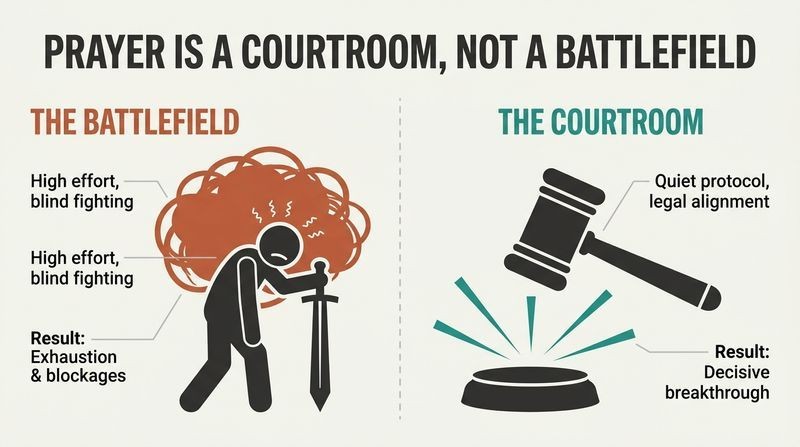
Stop shadowboxing an unseen enemy. Henderson's core claim is that most Christians treat prayer as a battlefield, charging in to yell at the devil, make decrees, and pray harder and longer. When nothing changes, they assume they need more intensity. He argues the opposite: prayer is first a courtroom, and a stalled prayer means a legal issue remains unresolved in the spirit realm.
More effort rarely fixes it. He recounts praying for his depressed son Adam for two years with 'brute force' and zero results. What finally worked was fifteen minutes of addressing legal accusations in what he calls the courts of Heaven. Like an attorney who must know protocol before a verdict comes, believers must secure a ruling before marching to battle. Custer's massacre becomes his metaphor for prayer without legal footing.
The reframe has real psychological pull: it converts frustration into diagnosis. Instead of self-blame ('my faith is weak'), the believer asks 'what legal ground remains?' This resembles the shift from willpower-based to systems-based thinking in behavioral science, where repeated failure signals a broken process rather than a broken person. The obvious critique is falsifiability. If answered prayer proves the courtroom worked and unanswered prayer proves a hidden legal issue, the theory can never be wrong. Still, the pastoral value of replacing striving with structured repentance is hard to dismiss, and it echoes older Christian traditions of examining conscience before petition.
Reframe prayer as a courtroom before you treat it as a war
The title concept. Henderson builds his thesis on Revelation 19:11, where Jesus 'judges' before He 'makes war,' and on Luke 18's parable of the persistent widow who never once addressed her adversary but appealed only to the judge. She understood that a verdict from the bench neutralized her opponent automatically. Daniel 7:10 anchors the image: the court is seated, the books are opened.
Protocol matters. A juror who pulled out a sword mid-trial would be arrested. Heaven's court has spiritual protocol too. Verdicts are won through petition, evidence, and answering accusations, not volume. Once a legal precedent is secured, the battlefield victory follows. He claims his daughter won an out-of-state custody case the same morning he 'silenced the accuser' and petitioned Heaven, with her stunned attorney saying such rulings never happen.
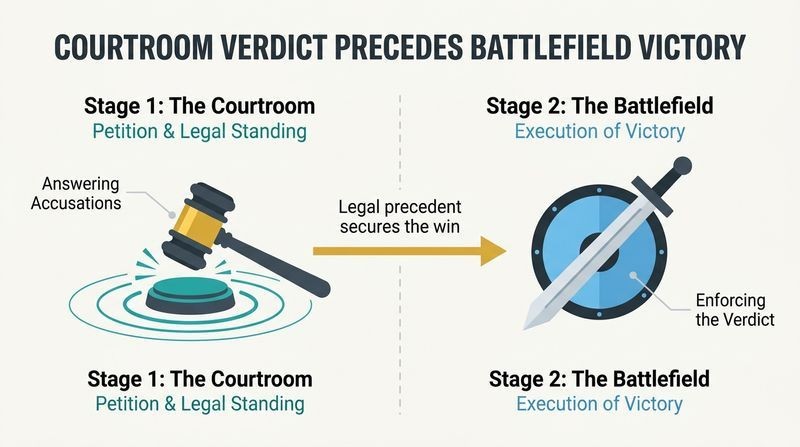
The courtroom metaphor is theologically fertile because Scripture is saturated with juridical language: advocate, accuser, witness, verdict, justification. Henderson's contribution is systematizing scattered legal imagery into a single operating model. Critics within Christianity, particularly cessationists and Reformed theologians, warn this can drift toward a transactional, almost mechanical view of God, where the right procedure compels a result. The anecdotal courtroom victories also invite survivorship bias: dramatic answered-prayer stories get told, silent failures do not. Yet the metaphor's insistence on righteousness and justice as the foundation of God's throne (Psalm 89:14) keeps it tethered to a serious moral vision rather than mere technique.
You have a book in Heaven; read it in your own passions
Every life is prewritten. Drawing on Psalm 139:16, Henderson teaches that God wrote a book for each person before birth, containing their days and Kingdom purpose. Jesus had one (Hebrews 10:7, 'in the volume of the book it is written of Me'), and Ephesians 2:10 calls us God's 'workmanship,' which he notes is the Greek word for poem. Nations, cities, and businesses have books too.
Find yours in your heart. Psalm 40 links the scroll to the heart: 'Your law is within my heart.' So your desires, aspirations, and the activities where you feel grace and effectiveness are clues to what is written. His illustration is his son Micah, born unexpectedly, whom a dream revealed was meant for another couple derailed by death. God, needing Micah in the earth, chose the Hendersons as a second option.

The 'book' motif overlaps intriguingly with secular ideas of vocation and 'ikigai,' the Japanese concept of purpose found where passion, skill, and contribution meet. Henderson's practical test, look for where you experience grace and fruitfulness, echoes the Quaker notion of 'the way opening' and even flow psychology, where absorption signals alignment. The Micah anecdote pushes into contested territory: it implies fixed divine slots that must be filled, raising old debates about predestination versus free will. Henderson tries to hold both, insisting the book is predestined yet unfulfillable without your cooperation. That tension, purpose given but not guaranteed, is arguably the book's most humane and motivating idea.
Accusation is Satan's only weapon; answer it and he loses
The accuser has no other move. Henderson argues that the devil cannot simply attack; he must find a legal right, gathered by 'walking about' seeking evidence (1 Peter 5:8, Job 1:7). Revelation 12:10 calls him the accuser who indicts believers day and night. His examples are courtroom scenes hiding in plain sight: Satan 'demanded' Peter for trial (Luke 22:31, which Henderson renders as 'demanded for trial'), accused Job's motives, and resisted Joshua the High Priest over filthy garments in Zechariah 3.
Curses need a cause. Proverbs 26:2 says a curse without cause cannot land. He tells of a woman who died of breast cancer at 43, mirroring her mother, because she and her husband had stolen resources, giving a family curse legal permission to 'alight.' Remove the cause through repentance, and the accusation collapses.
This is a coherent internal logic: if God is perfectly just, He cannot act arbitrarily even in mercy, so the adversary's leverage is always legal rather than raw power. It gives spiritual conflict a rule-governed shape rather than chaotic dread. The danger, well documented in pastoral care, is that attributing illness or misfortune to hidden 'legal rights' can breed anxiety, spiritual scrupulosity, and victim-blaming, the very error Job's friends committed. Jesus explicitly rejected the assumption that the man born blind or those killed by a falling tower sinned to deserve it. Henderson's framework needs that corrective to avoid turning every tragedy into evidence of a concealed sin.
Repent for your bloodline, not just your personal sins
Ancestral sin as legal fodder. If the devil finds no accusation in your own life, Henderson says he searches your family tree, which he quips 'looks more like a jungle.' Sins centuries back, covenant-breaking, idolatry, bloodshed, can grant present-day legal rights to resist your destiny. His biblical models are Nehemiah and Daniel, who repented for their fathers' sins to break national captivity.
A personal case study. After moving into a larger ministry, millions of dollars were allegedly stolen from him. During a 'bloodline cleansing' session, a seer prophet named a demonic entity, Parax, whose trait was to 'suck dry,' tied to an ancestral covenant. Another session surfaced an ancestor burned at the stake who cursed Native Americans after stealing their land, which Henderson connected to his lifelong struggle with anger. He repented, renounced the covenants, and reports blessing breaking through.
Generational or ancestral sin is genuinely biblical (Exodus 20:5) but sits in unresolved tension with Ezekiel 18 and Deuteronomy 24:16, which insist each person dies for their own sin, not the father's. Henderson threads this by distinguishing eternal guilt (unchanged) from legal rights the enemy exploits (removable). Secular parallels are striking: epigenetics shows trauma can imprint across generations, and family-systems therapy treats inherited dysfunction as a real force. The vulnerability of his method is its reliance on 'seer prophets' naming specific demons and ancestral events with no verifiability, which shifts enormous authority to charismatic intermediaries and invites suggestion and confirmation bias.
Your words become sworn testimony in Heaven's court
Even careless words count. Henderson cites Matthew 12:36-37, that we give account for every 'idle' word, which he notes means an 'unemployed' word we do not really mean but say anyway. These words become testimony that justifies or condemns. The insight crystallized with his son Adam: after silencing accusations through repentance, God told him to also repent for the negative things he had spoken in frustration, phrases like 'why won't he stand up and fight?'
Authority amplifies testimony. He realized his own complaints, spoken as Adam's father and authority figure, had empowered the accuser, who could argue 'even his own father says these things.' Once he repented for his words and prophesied Adam's destiny instead, the depression lifted within days after two futile years.
This lands on solid ground even outside its theology. The self-fulfilling prophecy, the Pygmalion effect, and decades of research on parental expectation show that spoken belief measurably shapes outcomes, especially from authority figures to children. Narrative therapy similarly treats the stories we speak over people as constructive or destructive forces. Henderson's spiritualized version, that words are literal courtroom evidence, gives extra weight to a well-established human dynamic. The practical takeaway is disciplined speech about the people in your care. The overreach risk is magical thinking, treating words as incantations with automatic mechanical power rather than expressions of and influences on relationship and belief.
Justification is the hinge between your calling and your glory
The five stages of manifesting destiny. Henderson maps Romans 8:29-30 as a pipeline from Heaven to earth:
1. Foreknew, God's counsel before time
2. Predestined, the decision written in your book
3. Called, glimpsing your purpose through your heart's desires
4. Justified, silencing every accusation in court
5. Glorified, living the dream, the convergence point
Why the fourth stage decides everything. He calls justification the most critical stage for individuals and nations alike. Justified means 'rendered just or innocent,' with no accusation that can stick. Joseph illustrates glorification: betrayal, slavery, and prison all converged to position him as Egypt's preserver of life. But without passing through justification, the accuser blocks the destiny in the book from ever manifesting on earth.
Reading Romans 8 as a sequential process is a creative homiletic move, though Paul likely intended these terms as one unbreakable chain of divine action rather than stages the believer navigates. Henderson's innovation is inserting human agency into justification, treating it as something we actively appropriate in court rather than a settled forensic declaration, which is closer to the Reformed view. This is where his system diverges most from classical Protestant soteriology, which sees justification as a completed, once-for-all verdict grounded in Christ alone. Framing it as ongoing legal maintenance may empower engagement, but it risks reintroducing the works-anxiety the doctrine of grace was meant to dissolve.
Know your jurisdiction before you confront any principality
Not every court is open to you. Just as earthly courts range from small claims to the Supreme Court, Heaven has jurisdictions, or what Paul calls a metron, a measured sphere of authority (2 Corinthians 10:13). Every believer may freely enter the Throne of Grace (Hebrews 4:16) for personal and family matters. But engaging territorial principalities over cities and nations requires recognized authority tied to an apostle.
The spirit realm cannot be bluffed. He cites the sons of Sceva (Acts 19), beaten and stripped for invoking Jesus without authority. In his own story, a South African intercessor named Natasha was challenged in the court by a principality asking 'who said you could be here?' naming the actual mayor and governor of Colorado. Henderson had to verbally establish his apostolic jurisdiction before proceeding.
The jurisdiction concept doubles as a safety mechanism and a hierarchy-legitimizing device. As caution, it sensibly warns against reckless spiritual overreach, and it parallels the real principle that authority without competence invites harm. As structure, it conveniently centralizes power in apostles and their networks, a hallmark of the New Apostolic Reformation Henderson operates within. The Natasha anecdote, where a foreign seer 'heard' the names of local officials, is presented as verification but is exactly the kind of unfalsifiable claim skeptics flag. The underlying wisdom, that spiritual authority is relational and earned rather than self-declared, is sound; the institutional apparatus built atop it deserves scrutiny.
Grant God the legal right to act on His fatherly passion
God is Judge and Father at once. Henderson's most quietly radical claim is that God will not violate His own justice to satisfy His love. Hebrews 12:23 calls Him 'the Judge of all,' and He cannot compromise that role even to bless the family He longs to bless. So the believer's job is to remove legal obstacles so the Judge can lawfully do what the Father desires.
Abraham modeled this. In Genesis 18, God brings Abraham into the Sodom decision because He was 'seeking a legal reason to show mercy.' Abraham negotiates down to ten righteous men, which Henderson notes is the minimum number that constitutes a government in Jewish thought. The lesson: you do not need a whole population to repent, only a governmental representation, the Ecclesia, to petition the court for mercy over judgment.
This resolves a version of the problem of evil elegantly: God is neither impotent nor indifferent, He is constrained by His own righteousness and by the authority He delegated to humans (Psalm 115:16). The move dignifies human agency and reframes intercession as genuinely consequential. The theological cost is a God who seems bound by procedure, closer to a constitutional monarch than the sovereign of classical theism who can forgive freely. The Abraham reading is compelling, and the 'ten equals a government' insight is a genuinely useful hermeneutical nugget. It also carries civic implications: a small righteous remnant can shift a nation's spiritual verdict, an idea with obvious motivational force for minority movements.
Your giving speaks aloud in the courtroom of Heaven
Money carries testimony. Henderson teaches that finances are the ninth voice in the courts. Hebrews 7:8 says tithes are received by the living Christ, and Cornelius's alms 'came up for a memorial before God' (Acts 10:4), triggering an angelic visit and the gospel reaching the Gentiles. A memorial, he explains, is something that causes God to remember and respond.
Sow with a clean heart. He tells of a woman who gave money 'for her husband's restoration' while the alcoholic man lay comatose and declared a permanent vegetable; days later Henderson prayed and the man revived and danced. But Matthew 5:23-24 warns that an offering given with bitterness testifies wrongly and can even bring a verdict of imprisonment. Prophesy over your giving so it carries the right sound into court.
The idea that generosity has spiritual weight is ancient and cross-cultural, from Jewish tzedakah to karmic notions of merit. Reframing giving as 'testimony' rather than transaction is a subtle safeguard against crude prosperity theology, since Henderson stresses the heart-condition behind the gift. Still, this chapter sits closest to the prosperity gospel's danger zone, where sowing money becomes a lever to pull for outcomes, and dramatic healing stories tied to donations can pressure vulnerable givers. The Matthew 5 caveat is important and often ignored: he insists reconciliation must precede the offering. Read charitably, the teaching sacralizes generosity; read carelessly, it monetizes faith.
First intercede as a priest, then decree as a king
The full courtroom protocol. Henderson closes with a sequence: get off the battlefield, read your book (personally through your heart, corporately through prophets), present your case, agree with the accuser by repenting quickly (Matthew 5:25), confess sin to release the blood's testimony, resist the now-legally-disarmed devil (James 4:7), and only then make decrees.
Priest and king, in that order. Believers are 'kings and priests' (Revelation 1:6). The priest intercedes to secure legal standing; the king decrees to enforce the verdict. His model is Lazarus's tomb: Jesus first says 'Father, I thank You that You have heard Me,' having already done the priestly legal work, then shifts to kingly authority with 'Lazarus, come forth.' Decrees only carry power after legality is settled; otherwise you are shadowboxing again.
The priest-then-king ordering is the book's most practically portable framework, and it corrects a common charismatic error of declaring outcomes before doing the humbling groundwork. The Lazarus reading is homiletically sharp: authority flows from settled relationship and secured legal ground, not from volume or confidence. There is genuine leadership wisdom here that transfers beyond theology, decision rights must be established before commands land. The recurring risk across the whole system remains: an unbroken loop where success validates the method and failure indicts the practitioner's hidden legal issues. But as a disciplined liturgy of repentance-before-declaration, the protocol channels charismatic zeal into something more humble and examined.
Analysis
Robert Henderson's book is a flagship text of the New Apostolic Reformation, the charismatic movement associated with the late C. Peter Wagner, who endorses it as a 'game changer.' Its genre is instructional charismatic theology, structured around a single controlling metaphor, prayer as legal proceeding, then elaborated through nine 'voices,' assorted biblical proof-texts, and personal anecdotes involving dreams, seer prophets, and courtroom victories that manifest in earthly courts. What makes it hard to summarize is that its power lies less in propositional argument than in accumulated narrative testimony and a reinterpretive lens laid over familiar scripture.
The framework's intellectual appeal is real. It offers a coherent theodicy of unanswered prayer, dignifies human agency through delegated authority, and grounds spiritual conflict in rules rather than raw force. It replaces striving with diagnosis and centers repentance, which is pastorally healthier than 'pray harder.' The priest-then-king ordering and the 'ten equals a government' insight are genuinely useful.
The weaknesses are equally clear. The system is functionally unfalsifiable: answered prayer proves the method, unanswered prayer proves an undiscovered legal issue. This structure, combined with heavy reliance on unverifiable seer-prophet revelations naming specific demons and ancestral events, invites confirmation bias, suggestion, and spiritual anxiety. The generational-curse teaching sits in unresolved tension with Ezekiel 18. The reframing of justification as ongoing legal maintenance strains against Reformation soteriology's completed verdict, potentially reintroducing works-anxiety. The finances chapter flirts with prosperity mechanics despite its heart-condition caveats. And the jurisdiction doctrine conveniently centralizes authority in apostolic networks.
Read critically, the book is best mined for its psychological insights, words shape outcomes, expectation influences children, generosity carries moral weight, and humility precedes authority, while its metaphysical machinery and anecdotal proofs warrant sober discernment. It is a compelling, internally consistent, and controversial system that rewards engagement more than uncritical adoption.
Review Summary
Operating in the Courts of Heaven receives mixed reviews. Many readers find it transformative, praising its insights on prayer and spiritual warfare. They appreciate the scriptural basis and practical applications. However, some criticize it for being confusing, overly complex, or potentially misleading for new believers. Critics argue it presents a formulaic approach to prayer that contradicts the idea of God as an approachable father. Despite the polarized opinions, many readers report experiencing breakthroughs in their prayer lives after applying the book's teachings.
People Also Read





Glossary
Courts of Heaven
Prayer as legal proceedingHenderson's central concept that prayer is primarily a judicial process before God as Judge, not a battlefield fight against demons. Believers present petitions, answer accusations, and secure verdicts that grant God the legal right to act. Once a verdict is won, earthly 'battlefield' victory follows automatically. Drawn from Daniel 7:10 and Luke 18's parable of the persistent widow.
Books of Heaven
Prewritten scrolls of destinyScrolls in Heaven (Psalm 139:16, Daniel 7:10) that record the God-ordained Kingdom purpose of every person, church, business, city, and nation before time began. One's book is discoverable through the passions and desires of the heart. The believer's job is to get what is written in the book manifested on earth.
The Accuser
Satan's legal roleHenderson's reading of Satan (Revelation 12:10) as a courtroom prosecutor whose only weapon is accusation. He gathers evidence by 'walking about' (1 Peter 5:8) and presents legal grounds, personal sin or ancestral sin, to disqualify people from their destiny. Silencing him through repentance and the blood of Jesus removes his legal footing.
Bloodline cleansing
Repenting for ancestral sinThe practice of repenting for and renouncing the sins of one's ancestors, covenant-breaking, idolatry, bloodshed, so the accuser loses legal rights inherited across generations. Modeled on Nehemiah and Daniel repenting for their fathers' sins. Henderson distinguishes ancestors' unchanged eternal standing from removable present-day legal rights the enemy exploits.
Nine Voices
Testimonies in Heaven's courtThe nine sources of testimony believers agree with to secure verdicts: the blood of Jesus, the Mediator (Jesus), the spirits of just men made perfect, God the Judge, the general assembly, the Ecclesia, angels, the Bride, and finances. Eight are drawn from Hebrews 12:22-24; the ninth, finances, from elsewhere in Scripture.
Ecclesia
Governmental, judicial people of GodHenderson's redefinition of the Greek word for church as a legislative, governmental, and judicial body (like the Greco-Roman assembly), authorized to bind and loose in Heaven's courts. A true Ecclesia is 'registered in Heaven,' connected to an apostle, and carries jurisdiction to secure verdicts over regions and nations.
Metron
Measured sphere of authorityThe Greek word for a measured portion or limited jurisdiction (2 Corinthians 10:13). Each believer and apostle has a metron defining where they can legitimately operate in the courts. Acting outside one's metron invites satanic backlash, illustrated by the sons of Sceva in Acts 19.
House with a Mountain (Zion)
Governmental church on ZionHenderson's image, drawn from Isaiah 2 and Hebrews 12:22, for a church that looks ordinary outside but contains governmental authority (a 'mountain' meaning government) within. Coming 'to Mount Zion' means being positioned in Heaven's judicial system to disciple nations, not merely worship.
Just men made perfect
Great cloud of witnessesDeceased believers (Hebrews 12:23) who, having won a 'good testimony' through faithfulness, still function as witnesses in Heaven's courts and cannot 'be made perfect' without living believers completing their mission. Henderson recounts encounters with Noah, Smith Wigglesworth, and others as active intercessors in the courtroom.
Throne of Grace
Court accessible to all believersThe one court in Heaven (Hebrews 4:16) open to every believer for personal and family matters, where one obtains mercy and grace. Distinguished from higher-jurisdiction courts dealing with cities and nations, which require recognized apostolic authority to engage territorial principalities.
FAQ
What is "Operating in the Courts of Heaven" by Robert Henderson about?
- Heavenly Courtroom Concept: The book introduces the idea that prayer and spiritual conflict primarily take place in a heavenly courtroom, not just on a battlefield.
- Legal Protocols of Prayer: Henderson explains that there are legal protocols and procedures in the spiritual realm that must be followed to see prayers answered and destinies fulfilled.
- Unlocking Destinies: The book focuses on how to access and fulfill the destinies written in the "books of Heaven" for individuals, families, and nations.
- Practical Application: Through personal stories and biblical examples, Henderson provides practical steps for presenting cases in the courts of Heaven to overcome spiritual resistance.
Why should I read "Operating in the Courts of Heaven" by Robert Henderson?
- New Paradigm for Prayer: The book offers a fresh perspective on why prayers may go unanswered and how to address spiritual obstacles legally.
- Empowerment for Breakthrough: Readers are equipped with tools to break generational curses, silence the accuser, and see tangible results in their lives and ministries.
- Biblical Foundation: Henderson grounds his teaching in Scripture, using examples from Daniel, Jesus, and others to support the courtroom model.
- Personal and Corporate Impact: The principles can be applied to personal issues, family matters, and even national or global intercession.
What are the key takeaways from "Operating in the Courts of Heaven" by Robert Henderson?
- Prayer as Legal Activity: Prayer is not just warfare but a legal process where cases are presented before God the Judge.
- Importance of Books in Heaven: Every person, church, and nation has a book in Heaven detailing their destiny, which must be accessed and contended for.
- Role of Repentance and Testimony: Repentance, cleansing of bloodlines, and agreement with the testimony of Jesus’ blood are crucial for victory in the courts.
- Jurisdiction and Authority: Understanding your spiritual jurisdiction and operating within it is essential to avoid backlash and see effective results.
How does Robert Henderson define and explain the "Courts of Heaven" in his book?
- Heavenly Judicial System: The Courts of Heaven are a spiritual reality where God acts as Judge, and legal cases are heard regarding destinies and spiritual matters.
- Scriptural Basis: Henderson uses passages like Daniel 7:10 and Luke 18:1-8 to show that the Bible frames prayer and spiritual conflict in judicial terms.
- Multiple Courts and Jurisdictions: There are different levels and types of courts in Heaven, and not everyone has access to all of them.
- Legal Precedents and Protocols: Just as in earthly courts, there are protocols, evidence, and testimonies that must be presented for verdicts to be rendered.
What are the "books of Heaven" and why are they important in "Operating in the Courts of Heaven"?
- Destiny Blueprints: The books of Heaven contain the destinies, purposes, and assignments for individuals, families, churches, and nations.
- Accessing the Books: To fulfill your destiny, you must access what is written in your book and contend for it in the courts of Heaven.
- Scriptural References: Henderson cites Psalm 139:16 and Daniel 7:10 to show that these books are a biblical concept.
- Contending for Fulfillment: The enemy seeks to resist what is written in the books, so believers must present cases to secure and manifest their destinies.
How does Robert Henderson describe the process of presenting a case in the Courts of Heaven?
- Step-by-Step Approach: First, discern what is written in the books of Heaven about your situation through prayer and prophetic insight.
- Repentance and Cleansing: Address any accusations or legal rights the enemy may have by repenting for personal and generational sins.
- Agreement with Testimonies: Come into agreement with the voices in the courts (e.g., the blood of Jesus, the Mediator, the cloud of witnesses).
- Decreeing and Executing Verdicts: Once legal obstacles are removed, make decrees based on the court’s verdict to see breakthrough manifest on earth.
What are the main voices or testimonies in the Courts of Heaven according to "Operating in the Courts of Heaven"?
- Nine Key Voices: The book identifies nine voices: the blood of Jesus, the Mediator (Jesus), spirits of just men made perfect (cloud of witnesses), God the Judge, the Church/Ecclesia, the general assembly, angels, the Bride, and finances.
- Role of Each Voice: Each voice provides testimony or evidence that can influence the court’s verdict in favor of God’s purposes.
- Agreement is Essential: Believers are encouraged to agree with these voices through repentance, worship, giving, and prophetic declaration.
- Legal Weight: The combined testimonies create the legal basis for God to render favorable judgments.
How does "Operating in the Courts of Heaven" by Robert Henderson address unanswered prayers and spiritual resistance?
- Legal Hindrances: Unanswered prayers are often due to unresolved legal issues in the spiritual realm, such as unrepented sin or generational curses.
- Role of the Accuser: Satan acts as the accuser, presenting evidence against believers to block their destinies.
- Repentance as a Key: Repenting for personal and ancestral sins removes the enemy’s legal rights and silences accusations.
- Shifting from Battlefield to Courtroom: The book teaches that many spiritual battles are won not by warfare but by legal proceedings in Heaven.
What practical steps does Robert Henderson recommend for operating in the Courts of Heaven?
- Discern the Issue: Identify whether your situation requires a courtroom approach rather than battlefield warfare.
- Present Your Case: Bring your petition before God the Judge, referencing what is written in the books of Heaven.
- Repent and Cleanse: Address any legal rights the enemy may have through repentance and cleansing of bloodlines.
- Agree and Decree: Come into agreement with the voices in the courts and make decrees to enforce the court’s verdict on earth.
How does "Operating in the Courts of Heaven" by Robert Henderson explain the role of repentance and cleansing bloodlines?
- Legal Rights of the Enemy: Sins—personal or ancestral—can give the enemy legal rights to resist God’s purposes in your life.
- Repentance Removes Accusations: Repenting for these sins, even those of forefathers, removes the legal grounds for the enemy’s accusations.
- Biblical Examples: The book references Nehemiah, Daniel, and others who repented for their nation’s and ancestors’ sins to secure breakthrough.
- Ongoing Process: Cleansing bloodlines is not a one-time event but a continual process as new issues are revealed.
What are some of the best quotes from "Operating in the Courts of Heaven" by Robert Henderson and what do they mean?
- “The protocol of a battlefield will not work in a courtroom and neither will the protocol of a courtroom work on a battlefield.” – Emphasizes the need to discern the right spiritual approach for each situation.
- “If we are to get unanswered prayers answered, we must first rightly discern where the conflict is in which we find ourselves.” – Highlights the importance of understanding the spiritual context of your struggle.
- “Our judgment will be based on how closely we lived our lives to what is written in the books of Heaven.” – Stresses the significance of fulfilling your God-given destiny.
- “The only weapon the devil has against us and our destiny in the books of Heaven is accusation.” – Points to the central role of legal accusations in spiritual warfare.
What impact has "Operating in the Courts of Heaven" by Robert Henderson had on readers and the wider Christian community?
- Testimonies of Breakthrough: Many readers report experiencing answered prayers, family restoration, and personal freedom after applying the book’s principles.
- Adoption by Prayer Networks: The book is recommended and used by leaders of major prayer networks and intercessory ministries worldwide.
- Shift in Prayer Paradigm: It has contributed to a shift from traditional spiritual warfare to a more judicial, legal approach in prayer.
- Ongoing Influence: The concepts have inspired further books, teachings, and practical manuals for individuals and churches seeking deeper breakthrough.
Download PDF
Download EPUB
.epub digital book format is ideal for reading ebooks on phones, tablets, and e-readers.








































