
Key Takeaways
1. Traditional health and weight-loss goals are the "Wrong Whys" that doom fitness plans
The vast majority of the participants whose goals were weight loss and better health spent the least amount of time exercising overall—up to 32 percent less than those with other goals.
The logic trap. We are culturally conditioned to believe that logical, future-oriented goals like "preventing disease" or "losing weight" are the best motivators for exercise. However, behavioral science reveals that human beings are hardwired to prioritize immediate gratification over distant, abstract rewards. When we couple a negative association with a payoff we must wait months or years to see, our daily motivation quickly evaporates.
The Vicious Cycle. Starting a fitness regimen with these "Wrong Whys" inevitably leads to the Vicious Cycle of Failure. We force ourselves to comply with a strict, unpleasant routine because we feel we "should," only to abandon it the moment life gets hectic. This cycle of starting and quitting reinforces a sense of personal failure and deepens our resentment toward physical activity.
Why logic fails.
- Logical goals exist in a vague, distant future and fail to make us happy right now.
- Weight loss as a primary motivator often stems from self-rejection, which triggers short-term compliance but long-term rebellion.
- Future health benefits are too abstract to overcome daily inertia and busy schedules.
2. Shift your core meaning of exercise from a punishing "chore" to a life-enhancing "gift"
The idea of exercise has become too much of a synonym for punishment.
Deconstructing our meaning. Everything in our lives holds a symbolic meaning constructed from societal messages and past personal experiences. For most people, "exercise" is synonymous with sweat, pain, and gym-class humiliation, making it feel like an obligatory chore. To build a sustainable relationship with movement, we must consciously "exorcise" these old, punishing definitions and replace them with positive associations.
The framing effect. How we frame an activity completely dictates how our brain processes it and how much energy we derive from it. A study on framing showed that when a physical task is framed as "work," it depletes our willpower and makes subsequent self-control harder. Conversely, when the exact same physical movement is framed as "fun" or a "gift," it becomes vitalizing and leaves us feeling refreshed.
Chore versus gift.
- A chore is driven by external pressure, guilt, and "shoulds," leading to avoidance.
- A gift is an autonomous choice that we look forward to opening because it makes us feel good immediately.
- Transforming exercise into a gift shifts us from the Vicious Cycle of Failure to the Successful Cycle of Motivation.
3. Autonomy and immediate positive feelings are the true drivers of sustainable behavior
When we experience autonomy, we feel ownership over our movement and choose activities that are meaningful and feel good to us.
The power of autonomy. Self-determination theory (SDT) highlights the profound difference between "controlled" motivation and "autonomous" motivation. When we feel controlled—exercising because a doctor, spouse, or societal standard pressures us—we experience the behavior as an obligation. When we act with autonomy, we take complete ownership of our choices, selecting movements that align with our personal preferences and daily needs.
Feelings trump function. In the heat of daily decision-making, our emotional, experiential brain system effortlessly overrides our slow, logical system. We naturally approach what feels good in the moment and avoid what feels bad, regardless of the long-term logical value of the activity. Therefore, the immediate emotional reward of feeling energized or destressed during movement is a far more potent predictor of consistency than the functional goal of burning calories.
The science of liking.
- High-intensity exercise past the ventilatory threshold often decreases pleasure and increases feelings of displeasure.
- When people autonomously choose their exercise intensity, they tolerate higher efforts much better than when it is imposed on them.
- The neuroscience of reward shows that "liking" an activity triggers a subconscious "wanting" to repeat it.
4. "Everything counts" because any movement is better than sedentary inertia
The belief that everything counts builds a new bridge from 'I don't have time' to 'I can fit this in!'
Dismantling the threshold. Many people abandon physical activity because they believe that if they cannot complete a continuous, high-intensity 30- or 45-minute workout, it is not worth doing. This all-or-nothing mindset is a psychological trap that sets us up for failure. Embracing the liberating truth that "everything counts" removes the high barrier to entry, allowing us to view any amount of movement as a victory.
The ten-minute myth. The common belief that physical activity must be performed in bouts of at least ten minutes to be beneficial is a historical misunderstanding. This rule was based on the limitations of older scientific measurement tools, not on evidence showing that shorter bouts are useless. Modern research using wearable trackers suggests that even micro-bouts of movement contribute to positive health markers, boosted energy, and improved mood.
The danger of sitting.
- Inactivity physiology shows that prolonged sitting is an independent health hazard, similar to smoking.
- Reducing sedentary time has been linked to longer telomeres, a key physiological marker of cellular longevity.
- Accumulating small movements throughout the day keeps our metabolic and cardiovascular systems active.
5. Ditch the rigid medical model of exercise and hunt for "Opportunities to Move" (OTMs)
We've been encouraging people to forgo tasty physical activity 'snacks' they can consume any time and instead buy large, expensive, multi-course meals—and they have to get specially dressed to partake of many of those meals.
The medical model failure. The traditional "exercise is medicine" paradigm prescribes physical activity in rigid, clinical doses of duration and intensity. While well-intentioned, this medical model fails because it ignores the chaotic realities of modern life and the emotional nature of human decision-making. When we treat movement like a bitter pill we must swallow, compliance rates plummet, just as they do with actual prescription medications.
The OTM treasure hunt. Shifting to a life-centered fitness model transforms our daily routine into a treasure hunt for "Opportunities to Move" (OTMs). Instead of restricting movement to the gym, we can actively seek out physical "snacks" that are hidden in plain sight throughout our day. This playful, opportunistic mindset makes staying active feel effortless, creative, and highly adaptable to our schedules.
Examples of OTMs:
- The Long Cut: Parking further away or taking a longer walking route to build in movement.
- Active Waiting: Walking around the perimeter of a park or field while your children practice sports.
- The Boogie Break: Putting on a favorite song and dancing in the privacy of your office or living room.
- The Phone Moment: Pacing, stretching, or doing light chores while talking on a cordless or mobile phone.
6. Give yourself permission to prioritize self-care as your life's essential fuel
If you don't mindfully give yourself Permission to prioritize time for your own self-care, no one else will.
The caretakeritis epidemic. Many of us suffer from "caretakeritis"—a state of chronic exhaustion and overwhelm caused by constantly putting the needs of our families, employers, and daily to-do lists ahead of our own. We are socialized to believe that taking time for ourselves is selfish or indulgent. Consequently, self-care is relegated to the very bottom of our priority list, where it is easily crowded out by more urgent demands.
The power of permission. To break free from this exhausting cycle, we must actively grant ourselves "Permission" to prioritize our own well-being. Permission is the psychological gateway that transforms self-care from an optional luxury into a nonnegotiable daily necessity. When we accept personal responsibility for our own energy levels, we stop letting the endless "shoulds" of life dictate our health.
Mindset and neuroplasticity.
- Our self-care mindset is shaped by childhood socialization and cultural expectations of productivity.
- Neuroplasticity proves that the adult brain can change its structure and function through intentional shifts in thought and behavior.
- Pretending to prioritize self-care is a highly effective low-stakes experiment to begin rewiring your brain.
7. The "What Sustains Us, We Sustain" paradox: Self-care enables you to give more to others
The amazing paradox of self-care: Giving to yourself means giving more to others.
The energy paradox. We often treat our personal energy as a finite pool that is depleted when we spend time on ourselves. However, the true paradox of self-care is that investing in our own well-being actually generates a renewable, compounding source of energy. When we take the time to revitalize our minds and bodies through enjoyable movement, we return to our daily roles with greater patience, focus, and enthusiasm.
Sustain-ergy in action. Physical activity acts as an alchemical agent, transforming simple bodily movement into "sustain-ergy"—the essential fuel required to power our most cherished life projects. When we are physically active, we are not taking time away from our loved ones or our work; we are actively investing in our capacity to show up fully for them. What sustains us, we sustain.
The Broaden-and-Build theory.
- Positive emotions generated by self-care broaden our cognitive awareness, making us more creative, flexible, and resilient.
- Over time, these fleeting positive states build enduring physical, intellectual, and social resources.
- Prioritizing self-care shifts us into the Sustainable Cycle of Self-Care, where motivation is rooted in who we are.
8. Adopt learning goals instead of performance goals to build lifelong resilience
When a task is complex and environments are dynamic, having a learning perspective is key for an optimal outcome.
Learning versus performance. Most fitness programs focus heavily on performance goals, such as losing twenty pounds, running a 5K, or exercising five days a week. While these goals can spark initial motivation, they often lead to "tunnel vision" and a fragile mindset. When we inevitably hit a setback or miss a target, we view ourselves as failures and abandon the behavior entirely.
The growth mindset. Shifting to a "learning goal" changes our entire relationship with physical activity. Instead of focusing on a rigid, perfect outcome, our goal becomes mastering the complex skill of integrating movement into a busy, unpredictable life. In this mindset, obstacles are no longer failures; they are valuable data points that teach us how to adapt and improve our strategies for the future.
Benefits of learning goals:
- They foster intrinsic motivation, curiosity, and a genuine interest in the process of movement.
- They build psychological resilience, helping us bounce back quickly when our plans are disrupted.
- They encourage us to experiment with different activities to find what truly brings us joy.
9. Strengthen the core of sustainability by prioritizing consistency over quantity
Strengthen the core—build consistency before quantity.
The consistency foundation. The single biggest mistake people make when starting a new fitness routine is attempting too much too soon. Driven by a burst of temporary motivation, they commit to long, intense workouts that their schedules and bodies cannot sustain. When the initial enthusiasm fades, the routine collapses because they never established the core habit of simply showing up.
The balance bike analogy. Just as a child learns to ride a bicycle by first mastering balance on a pedal-less bike, we must master the "balance" of fitting movement into our lives before worrying about the volume. Starting with tiny, highly achievable goals—like five minutes of walking a day—allows us to build the neural pathways of consistency. Once the habit of daily movement is firmly established, increasing the quantity is relatively easy.
Building self-efficacy.
- Achieving small, consistent wins builds our self-efficacy, or our belief in our ability to succeed.
- A continuum of success (setting a low-end and high-end goal) ensures we can always experience a win.
- Focusing on one behavioral change at a time prevents cognitive depletion and willpower exhaustion.
10. Master the art of flexible negotiation to "dance with life's challenges"
Unless your approach to physical movement isn't flexible, your physical activity plans will lose out every time the unexpected happens.
The necessity of negotiation. Life is a dynamic, unpredictable system that constantly throws curveballs at our best-laid plans. To maintain a physically active lifestyle, we must become skilled "self-care negotiators," learning to manage our behavior and time in real-time. Instead of viewing schedule disruptions as roadblocks that stop us completely, we must treat them as challenges to be met with flexibility and improvisation.
Proactive self-regulation. Proactive self-regulation involves planning for the unexpected before it happens. By using "if-then" planning (implementation intentions), we link potential obstacles with concrete, alternative actions ahead of time. This reduces the amount of active willpower required to make a healthy choice in the moment, turning our backup plans into automatic, stress-free responses.
Negotiation strategies in action:
- If-Then Planning: Deciding that "if" it rains during a planned outdoor walk, "then" you will walk the stairs inside.
- Hesitation: Taking a moment to evaluate a request before automatically saying yes and sacrificing your self-care time.
- Compassionate Evaluation: Reviewing your weekly successes and setbacks with kindness and curiosity rather than self-criticism.
Review Summary
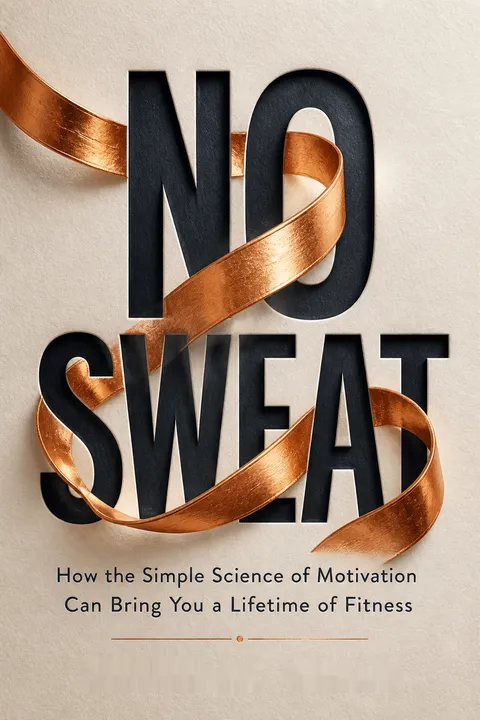
Reviews of No Sweat are mixed, averaging 3.62/5. Many praise its science-backed approach to reframing exercise as enjoyable movement rather than obligation, appreciating its accessible style and practical exercises. The core message—find movement you enjoy, view it as a gift not a chore, and recognize all activity counts—resonates with struggling exercisers. However, frequent criticisms cite excessive repetition and length, with many suggesting the content could be condensed significantly. The book is best suited for those lacking exercise motivation, as already-active readers often find it unnecessary.
Download PDF
Download EPUB
.epub digital book format is ideal for reading ebooks on phones, tablets, and e-readers.








































