


Key Takeaways
Stop job hunting solo; recruit a council of fellow seekers
The book's central thesis is simple and countercultural: the single most important thing you can do in a job search is refuse to do it alone. Phyl Terry recommends forming a Job Search Council (JSC), a mutual-support group of four to eight peers who are also looking for work, who meet regularly and help each other through every stage.
The reason is emotional, not tactical. Every job seeker, from freshly graduated to seasoned CEO, rides a roller coaster of insecurity and fear. Consider DD, a Chief Data Officer who spent 12 lonely months updating her resume, networking, and interviewing with zero offers. Once she formed a JSC and followed the process, she landed two strong offers in two months. The council converts fear, envy, and dejection into hope, confidence, and accountability.
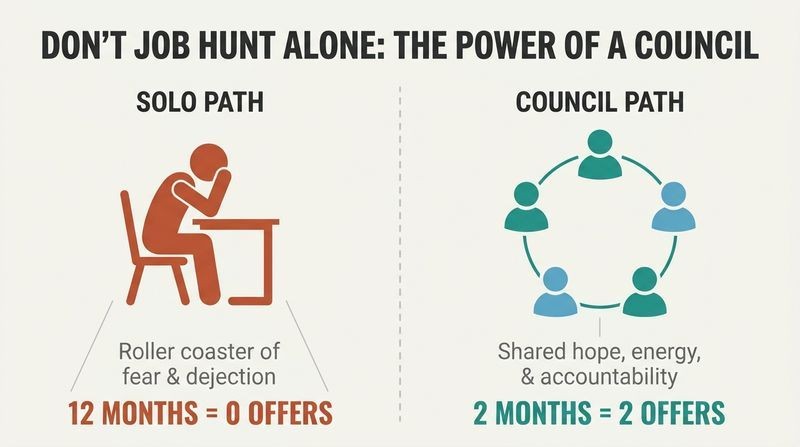
The claim aligns with decades of group psychology. Irvin Yalom's work on group therapy shows that the mere discovery that others share your struggle (universality) reduces shame and restores agency. What's notable is Terry's reframing of job searching as fundamentally an emotional-regulation problem, not an information problem. Behavioral economics supports this: cognitive load and anxiety degrade decision quality, so a stressed solo searcher makes worse choices. One caveat worth naming: JSCs require coordination and trust that can be hard to sustain, and a poorly moderated group can amplify collective anxiety rather than dissolve it. The design (peer seekers, not cheerleaders) matters enormously.
Treat yourself as a product and find your Candidate-Market Fit
Borrowing from the startup world's product-market fit, Terry coins Candidate-Market Fit: the intersection of what you want, what your skills are, and what the market actually needs right now. Most seekers skip this and pay for it with wasted months.
DD believed she was a fit for traditional CTO roles, but the market disagreed. Research revealed she was perfect for a new trend: midsize banks hiring CTOs with heavy data backgrounds. That precise positioning unlocked offers. The lesson: you are the product, and just as companies must understand customers before shipping, you must understand how the market perceives you before networking. A vague self-presentation (I can do many things) repels offers; a focused one attracts them, and paradoxically even earns off-strategy opportunities.
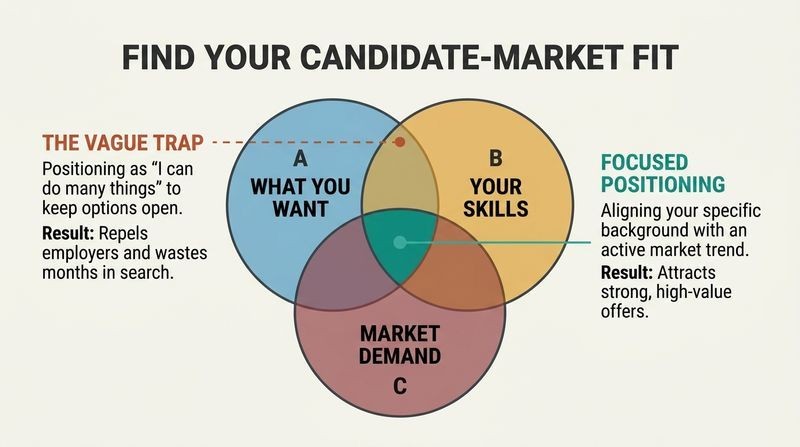
The product metaphor is clarifying but has limits. Humans are not static SKUs; identity and desire shift through the very conversations the book prescribes, which Terry acknowledges by making the fit iterative. The deeper insight echoes marketing's positioning theory (Ries and Trout): confused messaging gets ignored, while a sharp category claim gets remembered. There is also a self-knowledge problem here that psychology calls the introspection illusion: people are poor at predicting what will satisfy them. Outsourcing part of that discovery to the market is a shrewd workaround, though it risks over-indexing on external validation at the expense of genuine intrinsic preference.
Resist the urge to network first; do a Listening Tour instead
The conventional search starts with the resume, then networking and interviewing. Terry inverts the order. Before any of that, conduct a Listening Tour: market research on yourself, not networking for a job. It is the hardest step emotionally because anxiety screams at you to just get out there.
The danger of interviewing as research is real. Krista interviewed at a company she did not even want, seeking a revenge offer, got emotionally invested, was rejected, and concluded no one would want her. Rejection for jobs you do not want still drains your confidence. The Listening Tour avoids this by keeping conversations exploratory and curious. It is a liminal, creative phase where opportunities you never imagined surface, like when a poet discovered long-form copywriting existed.
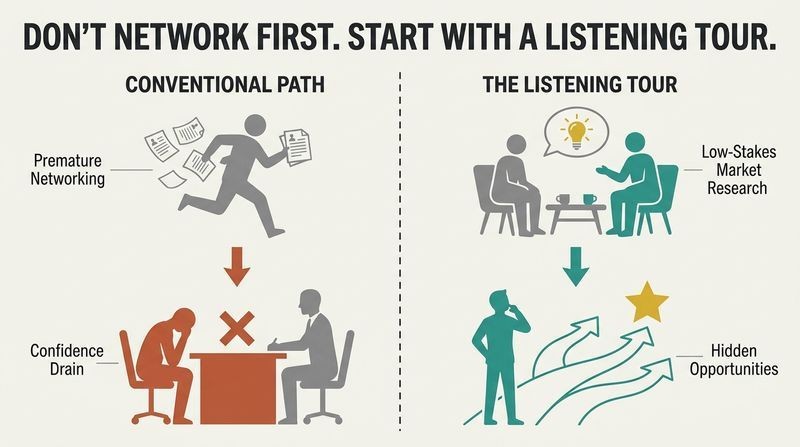
This maps neatly onto the explore-exploit tradeoff from reinforcement learning and behavioral science: exploit too early and you lock into a local optimum, missing better options a little more searching would reveal. The counterintuitive cost of premature interviewing (confidence damage from rejections that do not even matter) is psychologically astute; loss aversion means those stings outweigh neutral data-gathering. The friction is that unemployed people often cannot afford exploration financially. Terry's answer, that the tour is faster overall, is plausible but rests largely on selected success stories rather than controlled comparison, so readers under acute financial pressure should calibrate the timeline honestly.
Asking for help signals confidence, not weakness
Terry argues the schooling system miseducates us: in school, asking for help is cheating, but in careers, we get promoted for collaboration and the ability to ask well. His interviews found that 85% of executives who reach senior management credit asking for help, while 85% who stall report rarely asking.
The key distinction is independent versus dependent asking. Independent asking means you do your homework, form your own view, and seek advice to sharpen a decision you still own. Dependent asking means complaining without acting, outsourcing your thinking. Olivia repeatedly asked Terry for help but never acted, bouncing through four jobs in a few years while blaming bad luck. Brad Smith, the Intuit CEO who once wasted $40 million ignoring his team, learned to ask and grew the stock sevenfold.
The research psychologist Brad Klontz's observation that the ultrawealthy simply are not afraid to ask for help resonates with sociological findings on social capital: Ronald Burt's work on structural holes shows advantage flows to those who broker across networks, which requires asking. The independent-dependent framing preempts the fear that asking creates dependency, a genuinely useful distinction. Worth adding: research on advice-seeking by Brooks, Gino, and Schweitzer found that asking for advice actually makes the asker appear more competent, not less, directly validating Terry's counterintuitive claim. The barrier is almost entirely internal narrative rather than real reputational risk.
Strangers who share your situation build trust faster than friends
Your JSC should be mostly strangers and acquaintances, not close friends. This feels backward until you understand cognitive empathy, a concept from sociologist Mario Luis Small: connecting with someone who has walked in your exact shoes creates immediate trust, distinct from ordinary empathy or sympathy.
Small's research found we discuss our serious worries with weak ties (strangers, acquaintances) nearly half the time. Preschool mothers who barely know each other will spontaneously entrust their children in a pinch. Strangers also bring bigger, non-overlapping networks, a benefit Mark Granovetter identified in 1973 as the strength of weak ties. Five laid-off strangers formed a JSC, pooled contacts, sent one member to interview a private-equity insider, and two of them landed PE-backed jobs directly through that shared research.
Granovetter's weak-ties paper is one of the most cited in social science, and its job-search relevance is well established: novel information travels through distant connections, not the echo chamber of close friends. Terry adds a genuine refinement, noting Granovetter missed that weak ties can convert into strong ties over time. The cognitive-empathy claim is intriguing but leans on Small's specific findings; trust formed through shared predicament may be situational and could dissolve once members land jobs. The practical genius is combining trust (shared plight) with reach (diverse networks), two properties usually in tension, into one group design.
Others see your blind spots that you literally cannot
Drawing on Kahneman and Tversky's behavioral economics, Terry names Kahneman's Conundrum: even the Nobel laureate who cataloged cognitive biases admitted he still cannot detect when he is committing them. No warning bell rings. We spot others' errors easily while staying blind to our own.
This is why the JSC is indispensable. When Andre described negotiating a company up through three revised offers, fellow member Juana had an epiphany: she had never once asked for more in her entire career, always accepting the first offer, getting disappointed, and leaving. She had read books on impostor syndrome and negotiation but could not see her own pattern until she heard Andre's story. Peers function as objective mirrors whose feedback you will actually act on, unlike a book you nod along to and forget.
This is the strongest argument in the book, because it is philosophically airtight. If self-observation is structurally limited (a claim supported by research on bias blind spot by Emily Pronin), then no amount of solo introspection fixes it; you need external observers. It connects to the Johari Window model from the 1950s, where the blind quadrant (known to others, unknown to self) shrinks only through feedback. The subtlety Terry captures is that generic advice fails not because it is wrong but because knowing does not equal doing. Seeing your flaw reflected in a peer's story bypasses the defensiveness that direct criticism triggers.
Bridge the knowing-doing gap through mutually reinforcing action
You have read the self-help books. You know about vulnerability and growth mindsets. Yet knowledge rarely changes behavior. Terry calls this the central problem of psychology, citing former NIMH director Thomas Insel, who concluded that decades of insights did little to help and that the real lever is connection, not knowledge.
Terry's answer is mutually reinforcing activity, or job seeker see, job seeker do. When you watch a peer ask for help, negotiate, or handle rejection, you gain permission and courage to do the same. Mandy Ginsberg, later CEO of Match Group, was terrified early on that asking questions would expose her as not smart enough, until she watched other accomplished women ask for help in peer groups and adopted the behavior herself. Seeing normalizes doing.
This is the book's most underrated idea and its intellectual keystone. Social learning theory (Albert Bandura) established decades ago that we acquire behaviors by observing credible models, especially peers who resemble us. Terry essentially applies Bandura to career development. It also dovetails with Insel's pivot toward social determinants of mental health. The claim that knowledge alone fails is slightly overstated (knowledge is necessary if insufficient), but the emphasis on modeling over information is well grounded. It reframes why so much career advice evaporates: the missing ingredient was never a better framework but a live example among trusted equals.
Mine your former colleagues for truth with Reverse Exit Interviews
Companies interview departing employees; Terry flips it. In a Reverse Exit Interview, you ask former colleagues and bosses two questions: what did I do well, and what could I have done better? The window right after you announce departure or after you have left is uniquely honest, because office politics evaporate and people feel honored to be asked.
David Krauter, leaving a Boston startup, learned he needed to pick his battles and stop fighting for everything, advice that helped him run a 300-person division. Beth Comstock at GE discovered through such feedback that she went it alone too much; accepting it and telling her team I need your help became a career-defining moment that led to Chief Marketing Officer. The catch: some feedback stings or is simply wrong, which is why you process it with your JSC.
The timing insight is sharp and underexploited. Organizational research confirms that 360-degree feedback is routinely diluted by self-protective vagueness; departure removes the incentive to soften. There is a parallel in the exit-interview literature showing leavers disclose far more candidly than current staff. One tension: recency and social-desirability bias still operate, and a bruised former boss (like Armen's, who called him too laid-back) may project their own grievances. Terry's safeguard, filtering feedback through the council to separate the kernel of truth from noise, is essential, because raw feedback taken literally can misdirect a search as easily as illuminate it.
Ask people to walk in your shoes with the Golden Question
The Golden Question is deceptively simple: If you were in my shoes, how would you approach this job search? It outperforms the flat what job should I look for because it invites people onto your side of the table and sparks richer, more generous thinking.
Heather Fisher-O'Neill, a poet facing divorce who needed more income to stay in New York, asked this of everyone. Three separate people mentioned long-form copywriting, a field she had never heard of. A private student then connected her to an ad agency, and she built a new career writing corporate annual reports while still publishing poetry. She would never have imagined this option alone. Terry pairs the Golden Question with recruiter conversations, where you ask what jobs you could get tomorrow, what would be a stretch, and what is out of your league.
The perspective-shift mechanism has empirical backing: research on advice-giving shows people generate more creative, less risk-averse suggestions when reasoning about someone else's situation than their own, a manifestation of construal-level theory (psychological distance improves big-picture thinking). Asking recruiters for candid tiering rather than a placement is clever social judo; it flatters their expertise and sidesteps their transactional incentive to place you fast. The limitation is sampling: a handful of well-meaning contacts can steer you toward conventional paths that merely reflect their own imaginations. The volume Terry recommends (three to five per exercise) partly corrects for individual idiosyncrasy and bias.
Write a Job Mission with OKRs before you ever negotiate
Once you are seriously interviewing, draft a Job Mission with OKRs (objectives and key results): the concrete deliverables you promise to hit in the role. Terry adapts this from the hiring book Who, but flips it so the candidate writes it, not the manager. Almost no seeker does this, and of 200 early readers, it was the most powerful yet least-followed tool.
It delivers five payoffs: it sharpens your interview questions, impresses the hiring manager, confirms role alignment, gives you leverage in negotiation, and helps you start strong. Crucially, it sets up the four-legged negotiation stool. Wallace learned one objective required retiring $20 million in technical debt, so his JSC insisted he get the CEO's written commitment before accepting. He eliminated the debt fast, got promoted, and was considered for CEO within 18 months.
Turning a hiring instrument into a candidate instrument is genuinely original and shifts power. It resembles the concept of a joint pre-commitment in negotiation theory: by co-defining success criteria before the offer, both parties surface hidden misalignments while leverage is highest. The counter-case Terry cites (a peer who skipped negotiating $10 million in tech debt and was job-hunting again within a year) is a vivid demonstration of what economists call unfunded mandates. One risk: over-specifying deliverables during courtship could scare a risk-averse employer or lock a candidate into premature promises before they understand internal realities. Framed as alignment rather than contract, it mostly avoids this.
Negotiate the budget and support you need, not just salary
The negotiation stool has four legs: salary, budget, resources, and support. Most people negotiate only money; almost no one negotiates the rest. Terry has tracked roughly $100 million in extra compensation and hundreds of millions in non-financial support won through JSCs.
The research is blunt: ask and you receive 83% of the time, yet women and people of color often do not ask, forfeiting an estimated $560,000-plus in lifetime earnings (per Babcock and Laschever). One reframe changed everything for Rebecca: her JSC told her to negotiate not for herself but for her family, and the raise ended up funding her daughter's tuition, and it reset her base for every future raise. Lauren, who would be the only Black woman on the leadership team of a company whose customers were majority Black women, leveraged that strategic value into roughly $200,000 more plus mentorship and board coaching.
The budget-and-support insight is the book's most tactically valuable and least intuitive point. It reflects a systems view of success: compensation rewards you, but resources determine whether you can actually deliver, which drives future comp far more. This echoes research on person-job fit and job resources in the Job Demands-Resources model, where adequate resources predict performance and prevent burnout. The 83% statistic is encouraging though it likely reflects reasonable asks, not aggressive ones. The equity dimension is important and honest: the same reticence that suppresses individual pay compounds structural wage gaps, so the council's role in supplying courage has distributional stakes beyond any one career.
Read a boss's true character through backchannel scuttlebutt
The best behavior you will ever see from a company is during interviews, when everyone is performing. To learn the truth, conduct backchannel research: talk to people who have worked for your potential boss, and keep probing, because every answer is an invitation to ask more.
Allyson, interviewing to be president under a celebrity co-founder, heard a former colleague call the CEO intense and hard to work with. She almost stopped there. Terry pushed her to dig. The vague word intense unpacked into a boss who screamed at and belittled employees, especially women. She wisely walked away. Terry's favorite cutting question, from HBS professor Paul Marshall: if I left you a voicemail saying call me back only if you feel strongly I must take this job, would you call? That framing pierces people's reluctance to speak ill of others.
This is applied signal detection: interviews are a low-information, high-noise channel because both sides are impression-managing, so external data points carry disproportionate weight. The Marshall voicemail question is a small masterpiece of behavioral design; by inverting the default (silence means no), it exploits the fact that people will withhold criticism but will act on strong endorsement. It resembles reference-checking best practices used by top investors. The narcissism cue Terry cites (giant CEO photos, from Chatterjee and Hambrick's research linking executive self-images to volatile strategy) is a fun heuristic, though a single signal should never be decisive. The discipline of relentless follow-up questioning is the real skill.
Analysis
Never Search Alone is a practitioner's manual disguised as a manifesto, and its genuine contribution is not any single tactic but a reframe: the job search is primarily an emotional and social problem, only secondarily a logistical one. Phyl Terry, who spent two decades running peer councils for product leaders at companies like Amazon and Google, essentially productizes group therapy for the unemployed. That lineage is the book's greatest strength and its subtle limitation. The strength is credibility earned through iteration; Terry claims 400-plus drafts and 200-plus test readers, and the concepts (Job Search Council, Candidate-Market Fit, the Listening Tour, the Job Mission) fit together as a coherent five-step system rather than a grab bag of tips. The limitation is that the evidence base is overwhelmingly anecdotal and self-selected. The success stories are vivid and instructive, but there is no control group, no counterfactual, no accounting for survivorship bias among the people who completed the demanding process. The recurring 83% and 85% statistics come largely from Terry's own interviews, and readers should treat them as directional rather than rigorous. What elevates the book above typical career advice is its intellectual scaffolding. Terry repeatedly grounds intuition in real research: Granovetter on weak ties, Small on cognitive empathy, Kahneman on the invisibility of our own biases, Grant and Gino on gratitude, Insel on connection over knowledge. The synthesis is genuinely original, particularly the insistence that the knowing-doing gap closes only through modeled peer behavior, not information. The book is also refreshingly honest about power asymmetry: companies field lawyers and compensation specialists while candidates stand alone, and the JSC is framed as the seeker's counterweight. The deepest, most portable idea transcends job hunting entirely: that asking for help, done with homework and ownership, is a form of self-reliance rather than its opposite, and that most human growth happens in curated small groups rather than in solitary willpower. That claim deserves attention well beyond anyone's next role.
Review Summary
Never Search Alone emphasizes a collaborative approach to job searching, advocating for peer support networks and strategic self-analysis. Readers appreciate its fresh perspective on career transitions, praising the focus on understanding one's market fit and the value of support groups. Many found the book's advice practical and transformative, especially for mid-career professionals. While some critics noted repetitive content and a heavy focus on Silicon Valley, most reviewers found the book's central concepts valuable. The accompanying online resources and community were highly regarded by many readers.
People Also Read








FAQ
What's "Never Search Alone: The Job Seeker's Playbook" about?
- Comprehensive job search guide: "Never Search Alone" by Phyl Terry is a detailed guide for job seekers, offering a structured approach to finding a job that fits both personal and market needs.
- Social Search methodology: The book introduces a five-step process called Social Search, emphasizing the importance of community and support in the job search.
- Focus on self-discovery: It encourages job seekers to understand their own strengths and market fit before diving into networking and interviews.
- Practical tools and exercises: The book provides actionable exercises and tools, such as the Job Search Council and Candidate-Market Fit, to aid in the job search process.
Why should I read "Never Search Alone: The Job Seeker's Playbook"?
- Unique approach: The book offers a unique approach to job searching that focuses on community support and self-discovery, which can lead to more fulfilling career choices.
- Actionable advice: It provides practical, step-by-step guidance and tools that can be immediately applied to improve your job search strategy.
- Emotional support: The emphasis on building a Job Search Council helps manage the emotional roller coaster of job searching, providing hope and motivation.
- Long-term career benefits: By following the book's methodology, readers can not only find a job but also set themselves up for long-term career success and satisfaction.
What are the key takeaways of "Never Search Alone: The Job Seeker's Playbook"?
- Never search alone: Form a Job Search Council to provide emotional support and accountability throughout the job search process.
- Conduct a Listening Tour: Before networking, understand how the market perceives you and what opportunities exist.
- Define Candidate-Market Fit: Clearly articulate the intersection of your skills, desires, and market needs to focus your job search.
- Negotiate comprehensively: Beyond salary, negotiate for the budget, resources, and support needed to succeed in your new role.
How does the Social Search methodology work in "Never Search Alone"?
- Five-step process: The methodology includes forming a Job Search Council, conducting a Listening Tour, defining Candidate-Market Fit, networking and interviewing, and negotiating.
- Community support: Emphasizes the importance of mutual support and accountability through a Job Search Council.
- Market research: Encourages understanding market needs and personal strengths before engaging in job applications.
- Iterative learning: Promotes continuous learning and adaptation throughout the job search process.
What is a Job Search Council according to "Never Search Alone"?
- Mutual support group: A Job Search Council (JSC) is a group of peer job seekers who support each other throughout the job search.
- Emotional balance: Provides emotional support, helping members convert fear and insecurity into hope and confidence.
- Practical advice: Members offer practical advice and feedback on resumes, interviews, and job offers.
- Accountability: Helps keep members accountable and motivated during the job search process.
What is the Candidate-Market Fit in "Never Search Alone"?
- Intersection of skills and market: Candidate-Market Fit is the alignment between a job seeker's skills, desires, and what the market needs.
- Focus and clarity: It requires job seekers to clearly define what roles they are best suited for and focus their search accordingly.
- Guides job search strategy: Acts as a guiding principle for networking, interviewing, and negotiating.
- Avoids wasted effort: Helps prevent job seekers from pursuing roles that are not a good fit, saving time and energy.
How does "Never Search Alone" suggest handling job interviews?
- Research thoroughly: Conduct in-depth research on the company, its culture, and its products before the interview.
- Prepare questions: Develop questions to ask the employer, focusing on role expectations, company culture, and strategic goals.
- Create a Job Mission: Draft a Job Mission with OKRs to align expectations and impress potential employers.
- Post-interview debrief: Conduct a debrief with a JSC member to reflect on the interview and identify any red flags.
What negotiation strategies are recommended in "Never Search Alone"?
- Negotiate beyond salary: Focus on negotiating for the budget, resources, and support needed to succeed in the role.
- Use Job Mission: Leverage the Job Mission with OKRs to justify requests for additional support and resources.
- Ask for help: Utilize the JSC to gain confidence and advice on negotiation tactics.
- Comprehensive preparation: Prepare thoroughly by understanding industry standards and personal needs before entering negotiations.
What are some of the best quotes from "Never Search Alone" and what do they mean?
- "Never search alone": Emphasizes the importance of community and support in the job search process, highlighting that collaboration leads to better outcomes.
- "Convert fear into hope": Suggests that emotional support from a JSC can transform negative emotions into positive motivation.
- "Candidate-Market Fit": Encourages job seekers to find the sweet spot between their skills and market needs, ensuring a focused and effective job search.
- "Negotiate for success": Advises job seekers to negotiate not just for salary but for the resources and support needed to thrive in a new role.
How does "Never Search Alone" address emotional challenges in job searching?
- Emotional roller coaster: Acknowledges the emotional ups and downs of job searching and provides strategies to manage them.
- Support system: Recommends forming a JSC to provide emotional support and accountability.
- Gratitude exercises: Encourages exercises like Gratitude House to boost confidence and maintain a positive outlook.
- Focus on hope: Emphasizes converting fear and insecurity into hope and motivation through community support.
What role does self-discovery play in "Never Search Alone"?
- Listening Tour: Encourages job seekers to conduct a Listening Tour to understand their strengths and market fit.
- Mnookin Two-Pager: Suggests creating a document outlining what you love, hate, and your career goals to guide the job search.
- Continuous learning: Promotes ongoing self-discovery and adaptation throughout the job search process.
- Aligning goals: Helps job seekers align their personal goals with market opportunities for a more fulfilling career.
How can "Never Search Alone" help with long-term career success?
- Building a network: Encourages forming lasting relationships through a JSC and broader network, which can support future career moves.
- Negotiating for growth: Advises negotiating for resources and support that can lead to promotions and career advancement.
- Learning to ask for help: Teaches the importance of asking for help, a skill that can benefit career growth and development.
- Career councils: Suggests converting a JSC into a Career Council for ongoing support and guidance in career progression.
Download PDF
Download EPUB
.epub digital book format is ideal for reading ebooks on phones, tablets, and e-readers.








































