

Key Takeaways
You are a risen ape, not a fallen angel
The zoologist's provocation. Of 193 living species of monkeys and apes, 192 wear fur. One walks around naked, self-named Homo sapiens, spending enormous energy admiring its lofty motives while hiding its animal ones. Morris insists on studying humans exactly as he studied fish courtship or bird pairing: as a specimen laid on the dissecting table.
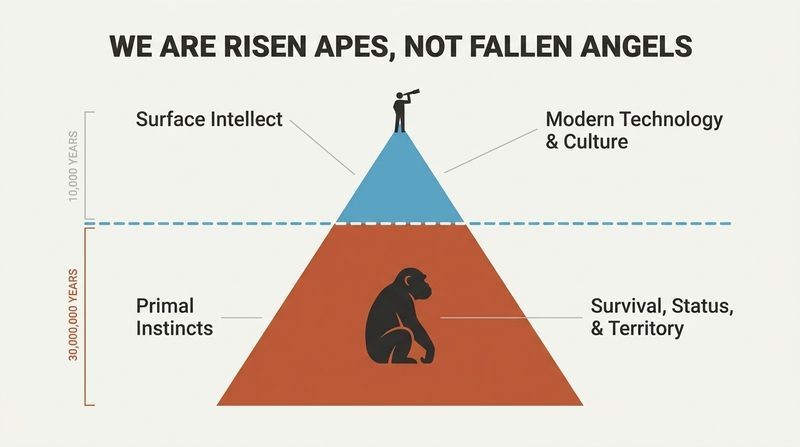
Lofty new urges, ancient old ones. He argues that acquiring space-age intelligence did not erase the drives built over millions of years. Our newest motives are a few thousand years old; the earthy ones are millions. The label naked ape is not an insult but a corrective, a way to keep proportion. Understand your animal nature, he says, and you become a less worried, more fulfilled creature.
Written in 1967, the book scandalized readers; churches burned it, a Chicago newspaper pulped an issue for printing the word penis. What reads as obvious now was radioactive then. Morris's stance anticipates evolutionary psychology and Wilson's sociobiology, but critics rightly note his method leans on speculative just-so stories rather than testable hypotheses. The framing remains valuable precisely because it resists both blank-slate environmentalism and genetic fatalism, insisting instead that culture must be designed to accommodate biology rather than override it.
A fruit-picking primate turned killer, creating a split personality
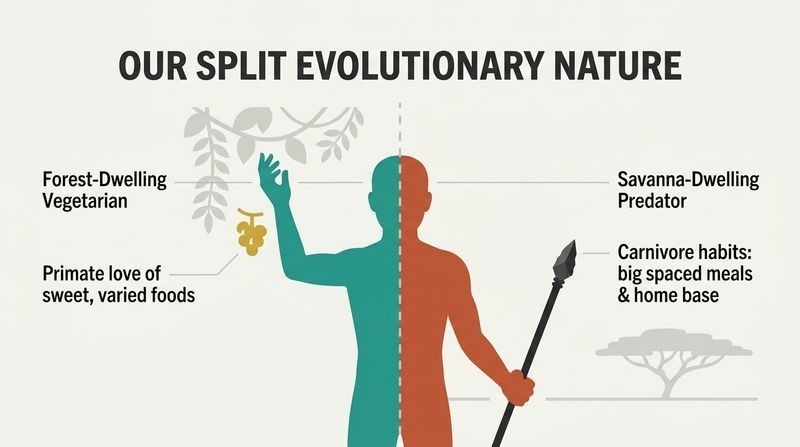
Expelled from the forest. Around fifteen million years ago, shrinking forests forced our ancestors onto open plains. Unable to outrun the specialized cats and wolves, they became a new kind of predator, winning by brain rather than brawn: upright posture, freed weapon-holding hands, group cooperation, and artificial tools instead of fangs.
The panda in reverse. Morris compares us to the giant panda, a carnivore that became vegetarian. We are the mirror image, vegetarians who became carnivores. Such a major dietary switch produces an animal with a dual personality, dragging old traits into a new role. We kept the primate love of varied, sweet-flavored food while adopting the carnivore pattern of big spaced meals, food storage, a fixed home base, and even acquiring our own species of flea, a parasite only nomad-free settlers can host.
The hunting hypothesis dominated mid-century anthropology, and Morris rides it hard. Later scholarship complicates the picture: our ancestors likely scavenged heavily, and gathering by females may have supplied most calories, prompting the feminist counter-model of woman the gatherer. The flea detail is a genuinely clever piece of behavioral forensics, inferring a settled home base from parasite life cycles. What holds up best is the structural insight that rapid ecological role-switching leaves an organism internally contradictory, a tension modern humans still feel between craving both novelty and security, both fat-rich meat and sugar.
We conquered Earth by staying permanent babies
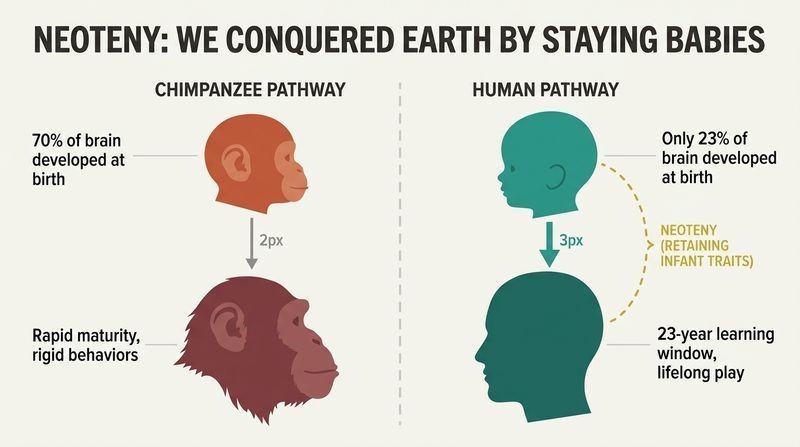
Neoteny, the great trick. Neoteny means retaining juvenile traits into adulthood. A monkey is born with 70% of its adult brain; a human newborn has only 23%, and the brain keeps growing for about a decade after birth, finishing near age twenty-three. This prolonged infancy buys years of learning and imitation that no other primate gets.
One stroke, many gifts. Morris argues the same retarding of development gave us our flat face, small late-erupting teeth, slender neck, forward-facing head on a vertical body, and even our hairlessness. Infant chimps are born nearly naked with a good head of hair; freeze that condition into adulthood and you get something close to us. Crucially, the curiosity and playfulness that fade fast in young apes stay switched on in humans for life.
Neoteny, or paedomorphosis, is a legitimate and powerful concept in developmental biology, championed later by Stephen Jay Gould in Ontogeny and Phylogeny. Domesticated animals show the same syndrome, floppy ears, retained playfulness, reduced aggression, which is why some researchers describe humans as a self-domesticated species. Morris's claim that a single neotenous shift explains so many disparate traits is elegant but probably overstated; these features have distinct genetic and selective histories. Still, the core idea that prolonged childhood is our defining adaptation reframes education, play, and lifelong learning not as luxuries but as the engine of the species.
We shed our fur to keep from overheating on the hunt
The naked mystery. Almost no surface-dwelling mammal abandons its insulating coat; those that do are burrowers or swimmers. So why did a plains-dwelling ape strip? Morris surveys theories: parasite control, messy feeding, fire, sexual signaling, and the ingenious aquatic ape idea (that we passed through a shore-dwelling diving phase, explaining our streamlined bodies, subcutaneous fat, and backward-pointing back hair).
His preferred answer. A physically inferior hunter had to make punishing chases and long pursuits, generating dangerous overheating. Losing the heavy coat and multiplying sweat glands produced a cooling film of evaporating liquid during the supreme moments of the chase. A layer of subcutaneous fat compensated at rest, retaining warmth without blocking sweat. The combination gave hard-working ancestors exactly what they needed.
This remains genuinely unsettled science. The thermoregulation hypothesis has strong support today, bolstered by evidence that humans are extraordinary endurance runners, capable of persistence hunting that runs prey to heatstroke. The aquatic ape theory Morris treats respectfully has since been largely rejected by mainstream anthropology as unnecessary, though it retains popular defenders. What Morris models well is intellectual honesty under uncertainty: he lays out rival explanations, weighs them, and commits without pretending the case is closed. The deeper lesson is that a trait as conspicuous as nakedness demands a functional account, not a shrug.
Falling in love evolved to make cooperative hunting possible
A social engineering problem. Hunting required males to leave females and young at a home base for long stretches, something unheard of among promiscuous primates. It also required weaker males to cooperate rather than be driven to the fringes, and demanded that heavily armed rivals not slaughter each other over mates. Pair-bonding solved all three at once.
Love as adaptation. Males and females had to fall in love and stay faithful. This kept females loyal during hunts, reduced lethal sexual rivalry so cooperation could flourish, and produced a stable family unit to rear the slow-developing young. Morris even reframes the incest taboo as a much older biological out-breeding drive, not merely a cultural rule, since without it the whole breeding system could never have escaped its primate origins.
Pair-bonding as the keystone of human social evolution has aged reasonably well; provisioning models and the grandmother hypothesis both hinge on stable cooperative units. But Morris presents monogamy as almost inevitable, glossing over the vast anthropological diversity of human mating systems, from polygyny to serial monogamy to communal arrangements. His dismissal of societies that deviate as biological failures reflects a mid-century confidence that modern industrial cultures represent evolutionary success. Genetics tells a messier story: modern humans show signatures of mild polygyny in our past. The enduring insight is that emotions like romantic attachment are not cultural inventions but evolved commitment devices.
Most human sex isn't for babies, it's for bonding
The sexiest primate alive. Other monkeys copulate in seconds with no courtship and females receptive only around ovulation. Humans court for weeks, engage in prolonged foreplay, and remain sexually active across the entire monthly cycle and even during pregnancy. Since a female ovulates only once per cycle, the overwhelming majority of human copulation cannot possibly serve procreation.
Sex as glue. Morris argues this hyper-sexuality exists to cement the pair-bond through repeated mutual reward. The uniquely violent female orgasm, physiologically near-identical to the male's, does double duty: it rewards cooperation and, because a bipedal female stands nearly vertical, the resulting exhaustion keeps her horizontal so seminal fluid is not lost to gravity. Erogenous zones multiplied on the front of the body, and even fleshy earlobes, he claims, evolved purely as new zones for erotic stimulation.
The bonding function of non-reproductive sex is now mainstream, echoed in bonobo research where sex mediates nearly all social tension. Morris's specific mechanisms are shakier. The gravity theory of orgasm is speculative and largely unsupported, and the evolutionary purpose of female orgasm remains one of biology's live debates, with Elisabeth Lloyd arguing it may be a developmental byproduct of the shared embryonic template with the penis, exactly as Morris half-suggests when he calls it a pseudo-male response. His willingness to discuss physiology frankly was radical for 1967 and is precisely why the book was banned in places.
Female breasts and red lips are mimics of buttocks and genitals
Self-mimicry. Some monkeys copy their own genital signals on their faces: the male mandrill's red-and-blue muzzle echoes its red-and-blue rear; the gelada baboon female wears a chest patch mimicking her genital patch, useful because she sits upright. Morris borrows this to explain a human puzzle.
The frontal shift. As our ancestors became vertical and face-to-face in both social life and copulation, sexual signals migrated to the front of the body. He proposes that the permanently protruding hemispherical breasts (found in no other primate and, he argues, poorly designed for actual nursing) mimic the rounded buttocks, while the sharply outlined red lips mimic the genital labia. Both swell and redden during arousal exactly as their originals do. Brassieres, lipstick, and rouge, he notes wryly, artificially amplify these ancient signals.
This is the book's most famous and most contested speculation. The breast-as-buttock-mimic idea is delightful but rests on assumptions modern research questions: human breasts do function in nursing, and their permanent enlargement may relate to fat storage, honest signaling of fertility, or sexual selection without any need for mimicry. Morris's evidence that round breasts hinder suckling is thin. Yet the underlying principle, that evolution redeploys existing signals to new anatomical locations when posture changes, is sound and testable. The passage best illustrates his method's double edge: generative, memorable, and often unfalsifiable. Treat it as provocation, not proof.
The baby's smile is a clinging-substitute that hooks the parent
No fur to grip. A newborn monkey clings to its mother's coat within moments of birth. A human infant is helpless, with nothing to cling to. Morris argues the smile evolved to fill this gap: a signal that attracts and pacifies the mother, rewarding her for staying close. It appears around five weeks, first to any pair of eyes, then narrowing onto the specific face of the mother as parental imprinting completes by about seven months.
Emotions with deep roots. He traces a genealogy of expressions: we cried before we laughed, and laughed before we smiled. Laughter, he claims, emerged from crying as a signal meaning the shock is not real, safe because it comes from the trusted protector. He also cites experiments where recorded heartbeats at 72 beats per minute calmed newborns and sped their sleep, explaining why 80% of mothers cradle babies on the left, over the heart.
The heartbeat studies and the left-cradling bias are real and have been replicated; left-cradling is now linked to right-hemisphere processing of emotion rather than simply heart sound, adding nuance Morris lacked. His developmental sequence of crying to laughing to smiling is more literary than established, but attachment theory, developed by Bowlby whom Morris thanks, independently confirms the smile's function as a proximity-maintaining bond signal. The broader claim that human emotional expression is evolved and cross-culturally universal was later vindicated by Ekman's global studies of facial expression. This chapter is where the book's speculation most closely tracks durable science.
Curiosity is our survival superpower, held in check by fear of the new
Neophilia versus neophobia. Every advanced animal balances two drives: neophilia, love of the new, and neophobia, fear of it. Specialists like the koala need little curiosity; opportunists must constantly investigate. Morris calls humans the supreme opportunists, a species that specialized in non-specialization, keeping infantile inquisitiveness switched on for life.
Play with rules. Studying children and chimps drawing, he finds both start with scribbles, but only the child crosses into representation, the marked circle becoming a face. He distills the play principles behind all art and science: investigate the unfamiliar until familiar, impose rhythmic repetition, vary it, select the best variations, recombine them, and do it all for its own sake. Blocked curiosity is dangerous: isolated monkeys and caged zoo animals collapse into rocking, self-clasping stereotypes, patterns visible in withdrawn or bored humans too.
The neophilia-neophobia tension is a clean framework that maps onto modern personality science, notably the trait of openness to experience, and onto the exploration-exploitation tradeoff studied in reinforcement learning and behavioral economics. Morris's observation that art continued as pure exploration once photography freed it from documentation prefigures how each technological offloading of a function liberates the older form for play. The stereotypy research he cites, drawn from Harlow's isolation studies, remains ethically infamous but scientifically foundational for understanding deprivation. His point that stimulation-starved humans and caged animals develop identical repetitive tics is a quietly damning comment on modern institutional and urban environments.
Long-range weapons plus loyalty turned self-defense into mass slaughter
Animals rarely kill their own kind. Fighting among animals aims at dominance or territory, not death. Threat displays, submissive postures, and appeasement signals settle most disputes bloodlessly, and the more lethal a species' natural weapons, the stronger its instinctive inhibitions against using them on rivals. The loser's surrender switches off the winner's aggression.
Why humans break the rule. Morris identifies a lethal combination. First, weapons that kill at a distance mean the victim's appeasement signals can no longer be seen, so the aggression never gets switched off. Second, our hunting cooperativeness curdles into group loyalty: soldiers attack to support comrades, not to dominate an enemy who might submit. He is skeptical of easy fixes like disarmament, de-patriotizing, or sport as a war-substitute, and argues the deepest driver is overpopulation, which laboratory crowding experiments show reliably explodes into violence.
Morris echoes Konrad Lorenz's On Aggression, and both were later challenged for portraying aggression as a hydraulic drive that builds until released, a model behavioral science has largely abandoned. Yet the distance-kills-empathy insight is robust and disturbingly confirmed: Dave Grossman's research on killing shows soldiers fire far more readily at range than face to face, and drone warfare stress-tests exactly the appeasement-blindness Morris describes. His identification of in-group loyalty rather than hatred as war's engine anticipates modern findings that combat cohesion, not ideology, drives soldiers. The framework explains why atrocity scales with technological and psychological distance from the victim.
Small talk and minor illnesses are our substitutes for social grooming
Grooming without fur. Monkeys cement friendships by picking through each other's coats for hours, an activity now more social than hygienic. Hairless humans needed a replacement. Morris argues that grooming talk, the meaningless polite chatter of cocktail parties and greetings (nice weather, read anything good lately), does the same bonding work: it lets us expose ourselves to one another harmlessly and build trust. It peaks right after greeting and just before parting.
When the body asks for care. He extends this to what he calls grooming-invitation ailments: minor coughs, colds, headaches, and rashes that strike the socially stressed far more than the well-adjusted, and that function as signals summoning comfort from doctors, nurses, and friends. The pills matter less than the attention. He notes such illnesses even tailor themselves to the sufferer's needs, an actress under strain loses her voice, a wrestler breaks out in a rash.
Grooming talk brilliantly reframes phatic communication, the linguistic category Malinowski identified for speech that maintains social ties rather than transmits content. Robin Dunbar later built an entire theory on exactly this idea, proposing that language evolved as vocal grooming to bond groups too large for physical grooming, and that gossip is its primary use. The grooming-invitation ailment concept is riskier, flirting with blaming the sick for their illness, though Morris carefully distinguishes genuine behavioral causation from malingering. Modern psychoneuroimmunology partly vindicates him: chronic social stress measurably suppresses immunity, so the socially isolated really do catch more colds.
Analysis
The Naked Ape endures less as settled science than as a method and a mood. Morris, a curator of mammals turned popularizer, applied the cold eye of ethology to a species that had exempted itself from zoology, and the shock of that reversal accounts for both the book's ten-million-copy success and its outrage. Its structure is deceptively simple: take the universal behaviors any zoologist would catalogue, feeding, fighting, mating, grooming, rearing, and ask how the human version compares to other primates and what evolutionary story explains the difference. This comparative frame is the book's lasting gift, and it seeded the field that became evolutionary psychology, sociobiology, and Dunbar's social brain research. Morris's central claim, that culture must be engineered to fit an inherited biological template rather than pretending to overwrite it, threads a needle between the blank-slate environmentalism fashionable in 1967 and crude genetic determinism, and it reads as prescient. The weaknesses are equally clear from a modern vantage. Much of the argument is adaptationist storytelling, elegant, memorable, and untestable, the very just-so reasoning Gould and Lewontin would later criticize. The hunting-male model marginalizes female contribution, the confident dismissal of non-Western societies as stultified biological failures betrays a colonial-era hierarchy of cultures, and specific mechanisms (breasts as buttock-mimics, orgasm as sperm-retention device, aggression as accumulating drive) range from contested to discredited. Yet the book's instincts often outran its evidence in the right direction: thermoregulatory nakedness, sex as pair-bond glue, language as vocal grooming, and distance-enabled killing have all found later support. Read today, it works best as a provocation that trains a habit of mind, the willingness to see the primate beneath the executive, the mating display beneath the fashion, the troop beneath the corporation. Its final warning, that overpopulation would shatter our behavioral limits before it starved us, remains its most sober note, and its plea is not to return to nature but to design civilization around the creature we actually are.
Review Summary
The Naked Ape received mixed reviews. Some praised its innovative approach to studying humans from a zoological perspective, finding it fascinating and thought-provoking. Others criticized its outdated views on gender roles, sexuality, and isolated societies, calling it sexist and homophobic. Many readers found Morris's theories on human evolution and behavior intriguing, but noted the lack of scientific evidence. The book's impact on popular science was significant, though some of its claims have since been debunked. Overall, it remains a controversial yet influential work in human sociobiology.
People Also Read







Glossary
Naked Ape
Humans viewed zoologicallyMorris's deliberately deflating name for Homo sapiens, chosen because the single most conspicuous feature distinguishing humans from the other 192 primate species is hairless skin. The label is a device to maintain scientific objectivity and force readers to view themselves as one animal species among many, examining the biological drives beneath cultural sophistication.
Neoteny
Keeping infant traits into adulthoodThe evolutionary process of retaining juvenile or fetal characteristics into sexually mature adult life. Morris argues it is the key to human evolution: a human newborn's brain is only 23% of adult size and keeps growing for years, buying a long learning period, while traits like our flat face, small teeth, upright head posture, and hairlessness are frozen infant-ape features.
Neophilia and neophobia
Love versus fear of noveltyTwo opposing drives Morris says govern exploratory behavior. Neophilia is attraction to the new and unfamiliar; neophobia is fear of it. All animals balance the two, but humans, the supreme opportunists, keep infantile neophilia active for life. The shifting balance between them drives everything from fashion fads to scientific and artistic progress.
Self-mimicry
Copying one's own sexual signalsA phenomenon in which an animal reproduces its own sexual signals on another part of the body, seen in the mandrill's face echoing its genitals. Morris uses it to argue that human female breasts mimic buttocks and red lips mimic genital labia, sexual signals relocated to the front of the body as humans became vertical and face-to-face.
Grooming talk
Small talk as social bondingMorris's term (credited to Jan van Hooff) for meaningless polite conversation that substitutes for the mutual fur-cleaning primates use to build bonds. Since hairless humans cannot groom coats, chatter about weather or trivia performs the same function, allowing harmless prolonged social exposure that strengthens friendships. It peaks just after greeting and just before parting.
Grooming-invitation ailments
Minor illnesses that summon careTrivial complaints such as colds, coughs, headaches, and rashes that Morris argues are behaviorally caused, striking the socially stressed more than the well-adjusted. They function as signals eliciting comfort and attention from others, the modern equivalent of soliciting grooming. He distinguishes this real symptom production from deliberate malingering.
Displacement activity
Irrelevant action releasing inner tensionA seemingly pointless behavior performed during intense inner conflict, when an animal cannot decide between attacking and fleeing. Examples include a threatening bird suddenly pecking at food or a tense human lighting a cigarette, adjusting ornaments, or scratching. The action drains pent-up energy and, in evolution, many such activities became ritualized threat signals.
Aquatic ape theory
Proposed shore-dwelling human phaseA hypothesis Morris presents (without fully endorsing) that human ancestors passed through a semi-aquatic shore-dwelling stage before becoming hunters. It attempts to explain our hairlessness, streamlined bodies, subcutaneous fat, sensitive hands, and the backward flow of body hair. Morris finds it appealing but lacking direct fossil evidence; mainstream anthropology has largely rejected it.
FAQ
What's The Naked Ape about?
- Zoological Study of Humans: The Naked Ape by Desmond Morris examines human behavior from a zoological perspective, comparing us to other primates and animals.
- Focus on Evolution: The book emphasizes our evolutionary origins, suggesting that many behaviors are rooted in our animal ancestry.
- Primal Behaviors and Instincts: It explores aspects like sex, rearing, and exploration, highlighting primal instincts influencing modern behavior.
- Cultural and Biological Insights: Morris bridges zoology and anthropology, providing insights into the human condition by challenging readers to confront their biological roots.
Why should I read The Naked Ape?
- Provocative Insights: The book offers a fresh perspective on human behavior, encouraging readers to reconsider views on sexuality, parenting, and social interactions.
- Timeless Relevance: Despite being published in 1967, its themes remain relevant, addressing fundamental questions about human behavior and societal norms.
- Engaging Writing Style: Morris's accessible writing makes complex scientific concepts easy to understand, blending humor with serious analysis.
What are the key takeaways of The Naked Ape?
- Understanding Our Origins: Recognizing our evolutionary history informs our current behaviors, leading to a more authentic self-understanding.
- Sexual Behavior Insights: Human sexuality is influenced by biological and cultural factors, with societal norms impacting our instincts.
- Parental Roles and Responsibilities: Human parenting involves unique challenges, requiring cooperation and bonding for successful child-rearing.
What are the best quotes from The Naked Ape and what do they mean?
- "The naked ape is an animal.": This challenges the notion of human superiority, encouraging a humble view of our place in nature.
- "Understand your animal nature and accept it.": A call to embrace primal instincts for a more fulfilling life.
- "We are indeed an amazingly peaceful species, given our population levels.": Highlights the paradox of human violence amidst our overall peaceful nature.
How does The Naked Ape compare humans to other primates?
- Physical Differences: Humans are unique among primates due to our naked skin, affecting social signaling and sexual attraction.
- Behavioral Parallels: Many social behaviors, like grooming and bonding, have deep evolutionary roots shared with other primates.
- Evolutionary Adaptations: Humans have adapted uniquely in tool use and social organization, shaping cultural practices and societal structures.
What insights does The Naked Ape provide about human sexuality?
- Complex Sexual Dynamics: Sexual behavior is a complex interplay of biological instincts and cultural influences, not solely driven by reproduction.
- Pair-Bonding Importance: Pair-bonding evolved as a strategy for successful parenting and cooperation, essential for raising offspring.
- Sexual Signals and Communication: Humans use various signals to communicate attraction, enhancing pair-bonding and social cohesion.
How does The Naked Ape address parenting and child-rearing?
- Heavy Parental Burden: Human parental care requires extensive cooperation due to a long dependency period.
- Role of the Mother: Emphasizes the importance of breastfeeding and emotional bonding for child development.
- Father's Involvement: Paternal involvement is crucial for family success, promoting healthier dynamics.
What are the implications of The Naked Ape for understanding modern human behavior?
- Cultural vs. Biological Influences: Balancing cultural norms and biological instincts is key to understanding human behavior.
- Challenges of Urban Living: Transitioning from tribal to urban living creates conflicts between instincts and societal structures.
- Potential for Future Evolution: As society evolves, so will our behaviors, emphasizing the need to align cultural practices with biological nature.
How does The Naked Ape explain the concept of neoteny in humans?
- Definition of Neoteny: Retention of juvenile traits into adulthood, a key feature of human evolution.
- Impact on Development: Neoteny allows for greater brain development and learning opportunities during childhood.
- Social and Emotional Bonds: Contributes to strong emotional bonds between parents and children, essential for successful parenting.
What role does sexual selection play in The Naked Ape?
- Sexual Selection Dynamics: Influences behavior and relationships, with traits evolving to enhance reproductive success.
- Mate Preferences: Individuals seek partners with desirable traits, influenced by biological instincts and cultural factors.
- Impact on Social Structures: Sexual selection shapes social dynamics, aiding in navigating modern relationships.
How does The Naked Ape explain aggression in humans?
- Aggression as Instinct: Rooted in evolutionary history, serving purposes like dominance and territory defense.
- Physiological Changes: Aggressive encounters trigger changes like increased heart rate, preparing for fight or flight.
- Ritualized Combat: Many species, including humans, use ritualized displays to resolve conflicts without harm.
How does The Naked Ape address the concept of exploration?
- Curiosity as a Drive: Essential for survival and adaptation, driving us to investigate and seek new experiences.
- Neophilia vs. Neophobia: Balancing love of the new with fear of the unknown is crucial for development.
- Exploratory Behavior in Children: Vital for development, with curiosity leading to learning and growth.
About the Author
Download PDF
Download EPUB
.epub digital book format is ideal for reading ebooks on phones, tablets, and e-readers.








































