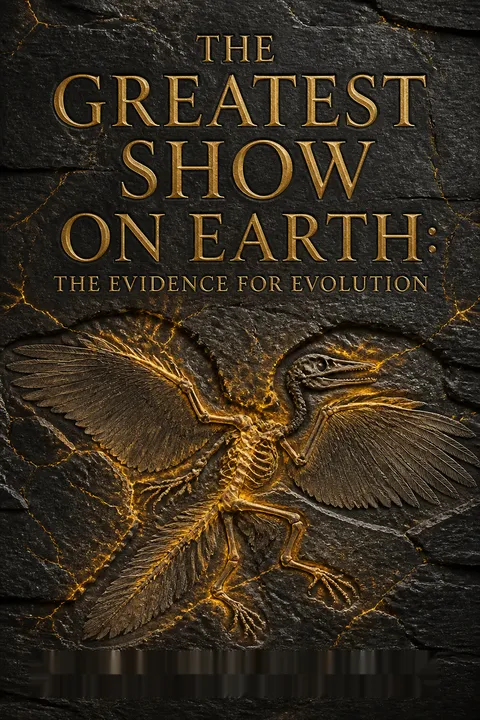

Key Takeaways
1. Evolution is an undeniable fact, supported by overwhelming evidence.
Beyond reasonable doubt, beyond serious doubt, beyond sane, informed, intelligent doubt, beyond doubt evolution is a fact.
Scientific consensus. In science, a "theory" like evolution is a robust system of ideas confirmed by extensive observation and experiment, far from a mere hypothesis or speculation. It stands as an established truth, akin to the heliocentric theory of the solar system.
Reliable inference. While direct observation of past evolution is impossible, scientific "facts" are often established through powerful inference from observable consequences. The fallibility of eyewitness accounts (like the gorilla experiment) highlights that careful inference can be more reliable than direct observation.
Unfalsified truth. Evolution is a falsifiable scientific theory, meaning evidence could disprove it, yet no such evidence has ever emerged. The sheer volume and consistency of supporting evidence elevate evolution to the status of an incontrovertible fact, accepted by all informed observers.
2. Artificial selection demonstrates evolution's power to transform species.
If human breeders can transform a wolf into a Pekinese, or a wild cabbage into a cauliflower, in just a few centuries or millennia, why shouldn’t the non-random survival of wild animals and plants do the same thing over millions of years?
Population thinking. Evolution challenges "essentialism," the idea that species have fixed, ideal forms; instead, it embraces "population thinking," where species are fluid distributions of varying individuals. Artificial selection, like breeding diverse dog breeds from wolves or cabbages from a wild plant, vividly illustrates this malleability.
Sculpting gene pools. Breeders "sculpt" the gene pool by selectively choosing individuals with desired traits, inadvertently altering gene frequencies over generations. The Belyaev fox experiment showed that selecting for tameness rapidly produced dog-like traits like floppy ears and piebald coats, demonstrating pleiotropy and the speed of evolutionary change.
Experimental proof. Artificial selection serves as a powerful experimental test of evolutionary principles, showing that non-random selection of genetic variation leads to dramatic changes. If humans can achieve such transformations in centuries, nature can achieve far greater changes over millions of years.
3. Natural selection, without conscious intent, drives adaptation and diversity.
Darwin’s special genius realized that nature could play the role of selecting agent. Everybody knew about artificial selection, or at least everybody with any experience of farms or gardens, dog shows or dovecotes. But it was Darwin who first spotted that you don’t have to have a choosing agent.
Nature as selector. Darwin's profound insight was that a conscious "chooser" is not required for selection; differential survival itself acts as the selecting agent. Examples like insects "breeding" flowers for attractiveness or anglerfish lures "selecting" prey illustrate this non-deliberate process.
Survival of the fittest. Individuals with traits that enhance survival and reproduction are more likely to pass on their genes, leading to the accumulation of advantageous traits in the gene pool. This continuous, non-random process, operating on random variations, drives adaptive evolution.
Compromises and trade-offs. Organisms are not perfectly designed but represent a "patchwork of compromises" due to economic trade-offs in resource allocation. For instance, strengthening rat teeth might weaken bones, or faster legs might be more prone to breakage, with natural selection optimizing these balances.
4. Earth's ancient age is precisely measured by multiple independent clocks.
The currently agreed age of 4.6 billion years is the estimate upon which several different clocks converge.
Time's traces. Evolutionary science relies on natural "clocks" that exploit processes occurring at steady, known rates to date geological events. These clocks offer a vast range of sensitivity, from archaeological timescales to billions of years.
Radiometric dating. Radioactive isotopes decay at predictable, exponential rates, with each having a characteristic "half-life." By measuring the ratio of parent to daughter isotopes in igneous rocks, geologists can determine the time since the rock solidified, effectively "zeroing" the clock.
Consistent evidence. Multiple independent dating methods, including tree rings (dendrochronology) for recent times and various radiometric clocks (e.g., potassium-argon, carbon-14) for older periods, consistently converge on an Earth age of approximately 4.6 billion years. This robust agreement refutes "young Earth" creationist claims, which would require implausible, coordinated fiddling with physical laws.
5. Rapid evolution is observable within a human lifetime, even in complex organisms.
Although the vast majority of evolutionary change took place before any human being was born, some examples are so fast that we can see evolution happening with our own eyes during one human lifetime.
Elephants and lizards. Human hunting has driven rapid evolution in African elephants, with a statistically significant trend towards smaller tusks observed over decades. Similarly, lizards transplanted to an Adriatic island evolved larger heads, stronger bites, and even rudimentary gut structures for herbivory in just 37 years (18-19 generations).
Bacterial evolution. Richard Lenski's long-term E. coli experiment, spanning over 45,000 generations, provides a spectacular demonstration of evolution in action. Twelve independent bacterial lines evolved increased fitness and body size, with one line dramatically acquiring the ability to metabolize citrate through a sequence of "priming" and "enabling" mutations.
Guppies and antibiotics. Guppy populations, when transplanted to predator-free streams, rapidly evolved brighter coloration and altered life-history traits (later maturity, fewer, larger offspring) within two years. The rapid evolution of antibiotic resistance in bacteria like MRSA further highlights evolution's speed and adaptability.
6. The fossil record is rich with transitional forms, not "missing links."
Evolution could so easily be disproved if just a single fossil turned up in the wrong date order. Evolution has passed this test with flying colours.
Fallacy of "gaps." The "missing link" argument is a misunderstanding; the fossil record is a bonus, not a prerequisite for proving evolution, and gaps are expected due to the rarity of fossilization. Crucially, no fossil has ever been found in the wrong geological stratum, a powerful validation of evolutionary theory.
Cambrian and flatworms. The "Cambrian Explosion" saw the "sudden" appearance of many animal phyla, but this period still spanned millions of years. The absence of flatworm fossils throughout history, despite their presumed ancient existence, demonstrates that soft-bodied creatures simply don't fossilize well, undermining arguments based on fossil gaps.
Abundant intermediates. Numerous transitional fossils document major evolutionary shifts:
- Fish to land vertebrates: Eusthenopteron, Panderichthys, Acanthostega, Ichthyostega, and the iconic Tiktaalik bridge the gap between fish and amphibians.
- Land to sea mammals: Fossils like Pakicetus, Ambulocetus, Rodhocetus, Basilosaurus, Pezosiren (walking manatee), and Puijila darwini (walking seal ancestor) illustrate the return to water.
- Turtle shell: Odontochelys semitestacea, a 220-million-year-old aquatic turtle with a half-shell, sheds light on carapace evolution.
7. Embryonic development is a process of self-assembly, not a blueprint.
The development of the embryo, and ultimately of the adult, is achieved by local rules implemented by cells, interacting with other cells on a local basis.
Recipe, not blueprint. DNA is not a blueprint for building a body, which implies a one-to-one mapping and reversibility; instead, it functions more like a recipe or a computer program, guiding a process of "epigenesis" or progressive differentiation. This "self-assembly" is fundamentally different from human top-down design.
Local rules, emergent complexity. Complex structures, from starling flocks to virus capsomeres, emerge from simple local rules obeyed by individual units, without a central plan or choreographer. In embryology, cells interact locally through processes like differential growth, invagination, and programmed cell death (apoptosis).
Cellular interactions. Mechanisms like Roger Sperry's chemo-affinity hypothesis for nerve wiring and the precise binding of cell adhesion molecules (e.g., cadherins) demonstrate how cells find their partners and differentiate. This intricate network of local interactions, ultimately controlled by genes, shapes the embryo.
8. Biogeography and plate tectonics reveal life's grand dispersal history.
The fact is that, if we survey every continent and every island, every lake and every river, every mountaintop and every Alpine valley, every forest and every desert, the only way to make sense of the distribution of animals and plants is, yet again, to follow Darwin’s insight about the Galapagos finches: ‘One might really fancy that from an original paucity . . . one species had been taken and modified for different ends.’
Geographical isolation. Speciation often begins with geographical isolation, where populations diverge genetically until they can no longer interbreed. The Galapagos archipelago, with its unique finches, iguanas, and tortoises, perfectly illustrates how islands foster endemic species from mainland ancestors.
Continental drift. The theory of plate tectonics, where continents are thickened parts of moving plates, explains large-scale biogeographical patterns. The breakup of supercontinents like Gondwana carried "arks" of animals and plants to new locations, leading to unique faunas like Australia's marsupials or Madagascar's lemurs.
Evidence for plate tectonics. Evidence for plate tectonics includes:
- Matching coastlines and geological formations across continents.
- The age of oceanic crust, which is youngest at mid-ocean ridges and progressively older further away.
- Magnetic stripes in oceanic rocks, mirroring reversals of Earth's magnetic field, confirming sea-floor spreading.
This evidence, combined with biogeography, makes sense only through evolution and deep time, refuting "Noah's Ark" dispersal.
9. All life forms are interconnected on a single, universal family tree.
The sum total of genetic sequence data now available puts the matter beyond all conceivable doubt. Far more convincingly even than the (also highly convincing) fossil evidence, the evidence from comparisons among genes is converging, rapidly and decisively, on a single great tree of life.
Homologous structures. The underlying skeletal plan is remarkably conserved across diverse vertebrates and arthropods, despite vast differences in individual bone shapes and functions. This "homology" – where structures are recognizably derived from a common ancestral pattern – is powerful evidence for shared ancestry.
Molecular comparisons. Genetic comparisons, using methods like DNA hybridization or direct sequencing, reveal hierarchical patterns of relatedness among species. Humans and chimpanzees share about 98% of their DNA letters, with progressively lower percentages for more distant cousins.
The tree of life. Crucially, different genes and proteins consistently yield approximately the same "family tree" of life, confirming a single evolutionary history for all organisms. This molecular evidence, combined with anatomical and fossil data, paints a coherent and undeniable picture of universal cousinship.
10. Imperfections in nature are hallmarks of evolutionary tinkering, not design.
This pattern of major design flaws, compensated for by subsequent tinkering, is exactly what we should not expect if there really were a designer at work.
Vestigial relics. Living bodies are replete with non-functional or reduced "vestigial" structures, like human goosebumps (from ancestral hair erection), whale pelvis bones (from walking ancestors), or kiwi bird wing stubs (from flying ancestors). These are historical relics, not optimal designs.
"Unintelligent design." Apparent design flaws, such as the inverted retina of the vertebrate eye (with light passing through nerves before photoreceptors) or the absurdly long detour of the recurrent laryngeal nerve (15 feet in a giraffe), are inexplicable by intelligent design. They make perfect sense as historical accidents compensated by subsequent evolutionary "tinkering."
Compromises, not perfection. The vas deferens' detour around the ureter is another example of evolution making ad hoc modifications to existing structures rather than starting from scratch. Life is a "patchwork of makeshifts," where improvements are achieved by adjusting what's already there, reflecting a history of descent with modification.
11. Evolutionary arms races explain nature's relentless competition and suffering.
The total amount of suffering per year in the natural world is beyond all decent contemplation.
Red Queen effect. Evolutionary "arms races" drive species to constantly improve their adaptations just to maintain their relative position against rivals. Predators evolve better hunting skills, while prey evolve better escape mechanisms, leading to a "running to stay in the same place" dynamic.
Futility and waste. These arms races, like trees competing for sunlight by growing excessively tall, often result in a "futility" from a holistic perspective, as resources are diverted to competitive advantage rather than overall efficiency. A central planner would optimize for the group, but natural selection favors individual gain.
Indifference to suffering. Natural selection is indifferent to suffering and "cruelty," as these are merely byproducts of gene survival. The horrific adaptations of parasites like ichneumon wasps, which keep prey alive to be eaten from within, are explicable by gene propagation, not by a beneficent designer's intent.
12. Life's astonishing complexity arose from a simple beginning through natural selection.
Natural selection is an improbability pump: a process that generates the statistically improbable.
Grandeur in life. Darwin's "grandeur in this view of life" encompasses the understanding that all complex life, including human intellect and culture, directly follows from the "war of nature, from famine and death." These higher faculties emerged as byproducts of utilitarian selection pressures.
Simple origins. The origin of life must have been "simple" because statistically improbable things do not spontaneously arise. The key step was the emergence of a self-replicating entity, which allowed natural selection to begin its work of accumulating complexity.
The RNA World. The "RNA World" hypothesis suggests that RNA, capable of both storing genetic information and acting as an enzyme, bridged the gap between non-life and the DNA-protein system. Powered by the sun, natural selection acts as an "improbability pump," driving life from simple beginnings to "endless forms most beautiful and most wonderful."
People Also Read








Download PDF
Download EPUB
.epub digital book format is ideal for reading ebooks on phones, tablets, and e-readers.








































