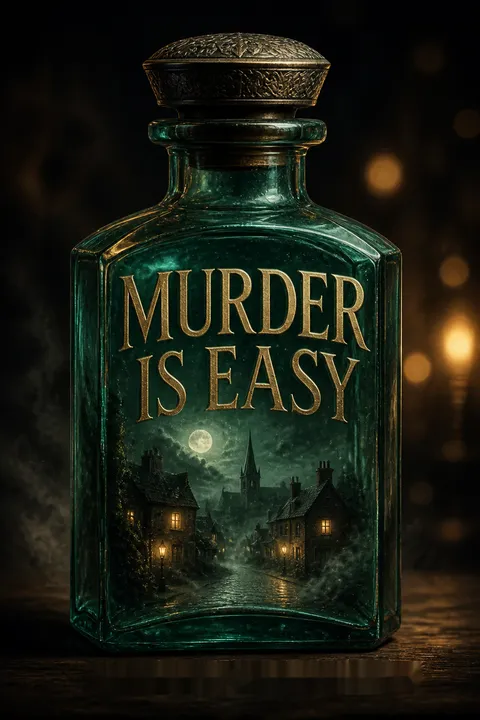

Plot Summary
Homecoming Interrupted
Luke Fitzwilliam arrives in England after years away, full of uncertainty about how to fill his days as a retired police officer. His homecoming is immediately derailed when, on a train to London, he meets Miss Lavinia Fullerton, an elderly spinster whose chatter unexpectedly turns to warnings about a murderer loose in her village, Wychwood under Ashe. She insists multiple deaths in her sleepy community are no accident, spurring Luke's curiosity. Luke is not convinced, dismissing her warnings as fanciful, but is nonetheless struck by her vivid certainty. This random encounter will become the crux that changes the course of his otherwise uneventful retirement.
The Old Lady's Warnings
Miss Fullerton describes to Luke a series of seemingly unrelated deaths—drownings, accidental poisonings, suspicious illnesses—in her village. She insists she's seen a "look" in the killer's eyes before someone dies and is on her way to Scotland Yard to report her suspicions. Luke humors her, believing her to be a harmless, over-imaginative woman, yet her calm conviction unsettles him. When he later learns that Miss Fullerton is killed in a hit-and-run before reaching the police, the premonition of her warning becomes haunting. This incident plants the seed for Luke to look deeper, drawing him toward the web of dark happenings in Wychwood under Ashe.
Death in the Village
Learning from the newspaper that Dr. Humbleby, named by Miss Fullerton as the next intended victim, has indeed died suddenly, Luke's skepticism turns to intrigue. The accumulation of suspicious deaths—each neatly explained away—seems too orderly for mere chance. Encouraged by his friend Jimmy, who arranges for Luke to stay with local aristocrat Lord Easterfield (engaged to Bridget Conway, Jimmy's cousin), Luke travels to Wychwood under Ashe, assuming the guise of a folklore researcher. Thus begins his subtle investigation, one inspired by unease that fatefully links him to a growing list of the dead.
Suspicions Multiply
Luke, welcomed into Ashe Manor by Bridget Conway and Lord Easterfield, begins to explore the village. Through conversations with locals—Bridget, Dr. Thomas, Major Horton, the solicitor Abbot, antiquarian Ellsworthy, and Honoria Waynflete—Luke gathers impressions and details of the deceased: disgraced servant Amy Gibbs, the cruel Tommy Pierce, drunkard Harry Carter, the respectable Dr. Humbleby. Yet, answers are elusive. Deaths seem regrettable but explainable, and village loyalty and gossip obscure the facts. However, Luke's experience as a detective pushes him to seek out the undercurrents for what lies beneath the surface.
Secrets Among the Neighbors
As Luke penetrates the village social fabric, every prominent figure emerges as a potential suspect. Dr. Thomas appears gentle, but the surge in his confidence after Humbleby's death is notable. Abbot is affable yet quarrelsome and hides something behind his geniality. Major Horton, constant with bulldogs, distracts with tales of his late wife's "martyrdom." Ellsworthy, the strange antique dealer, has potential for malice—if only by atmosphere and local whispers. Miss Waynflete, quietly efficient and intelligent, lingers as a background presence, cautious and alert. The dead are painted as flawed but never quite deserving of their fate, complicating Luke's search for motive.
Unlikely Partnerships
Bridget's intelligence and skepticism set her apart, and she soon sees through Luke's cover story—recognizing his real purpose. She becomes his confidante and investigative partner. Together, they dissect the villagers' behavior, Amy's unlikely "suicide," the odd spate of "accidents," and the path Miss Fullerton was determined to pursue, including the connection with the vicar, the old gossips, and the eccentric Ellsworthy. Their collaboration is charged with suppressed emotion, as mutual attraction develops amidst the tension, commitment to truth, and risk. They resolve not just to expose a murderer, but to protect each other.
Who Benefits from Death?
Luke, methodical, constructs and deconstructs lists of suspects and victims. Each death—Amy's poisoning, Tommy's fall, Carter's drowning, Humbleby's infection—provided someone with relief or advantage. The deaths do not clearly benefit one person, suggesting cunning or madness. The pattern hints at a killer who blends into the fabric of village life, unsuspected by all. The focus shifts from those outwardly suspicious (like Ellsworthy or the gruff Major) to those who are "the last person anyone would suspect," a phrase that echoes increasingly in Luke's mind, shaping his evolving theories.
Investigating the Victims
Interviews with relatives and employers reveal more about the victims: Amy Gibbs was dismissed for moral conduct, but upright; Tommy Pierce, universally disliked for cruelty; Carter, a public nuisance. Dr. Humbleby maintained enemies for his old-fashioned ideas, especially with Abbot and Lord Easterfield. Each death, while regrettable, could be attributed to character or fate—unless, as Luke suspects, they were all orchestrated to look that way. The killer's cleverness lies in selecting victims that society is almost relieved to see gone, making the pattern of murder invisible under layers of coincidence and prejudice.
Drifting Closer to Danger
As Luke's probing intensifies, the villagers begin to treat him differently, and rumors swirl. His theories are met with skepticism, particularly when he names Ellsworthy as prime suspect after witnessing his manic behavior, stained hands, and disturbing rituals—a hypothesis the villagers scoff at, used to Ellsworthy's eccentricities. Yet Luke persists, devising an elaborate plan to test each person's alibi. Amidst this, the emotional stakes heighten between him and Bridget, culminating in a stormy confession of love—just as evidence seems thinnest and the true murderer more elusive than ever.
Revelations on the Hill
On Midsummer Eve, the village is alive with superstitious excitement and rumor of rituals in Witches' Meadow. Luke breaks into Ellsworthy's home, uncovering ominous tokens, but nothing that would absolutely confirm guilt. Returning, he and Bridget have a final, honest reckoning—about their feelings and the investigation's danger. Bridget accepts his marriage proposal, symbolizing their commitment to face the peril together. The euphoria is shattered when they stumble across a fresh death, the chauffeur Rivers, left to appear as an accident. With blood on Luke's hands and after seeing Ellsworthy with bloodstained hands, Luke is closer to conviction—but uncertain still if he's been cleverly misled.
The Circle Narrows
Luke methodically revisits his lists, eliminating suspects by testing alibis and motives. Horton and Abbot had opportunity, Ellsworthy's behavior raises alarm, but nothing is conclusive. The deaths' connections, particularly to Amy Gibbs and Mrs. Horton, point ambiguously to several villagers, with each seemingly plausible, yet evidence lacking. Discussions with Miss Waynflete and Bridget further cloud the case; Miss Waynflete's refusal to voice her suspicions proves frustrating. Just as he resolves a new murder would break the case wide open, Rivers' staged accident (engineered to incriminate Ellsworthy) seemingly offers the proof Luke needs.
Entrapment and Confessions
Now convinced that Ellsworthy is the murderer, Luke prepares to alert Scotland Yard. Yet discussions with Bridget and Miss Waynflete lead him to question if the case has been too easily "solved." As Luke's investigation draws official interest—with Scotland Yard's Battle arriving—the trauma and uncertainty of relentless suspicion begins to take its toll. Mrs. Humbleby's sudden warning about a "wicked woman" in the village rekindles doubt. Luke reconsiders Miss Fullerton's words—had he, all along, assumed the murderer was a man? Subtle cues suggest otherwise: the real killer may be a woman, and perhaps the one person above suspicion.
The Witch's Meadow
Bridget accepts an invitation to stay with Miss Waynflete—now a leading, if unproven, suspect in Luke's mind. Bridget, determined to draw the killer out or confirm her theory, plays the unassuming guest. Miss Waynflete, composed and attentive, serves Bridget tea, which Bridget discreetly does not drink. A stroll together into the fields turns sinister as Miss Waynflete's demeanor shifts—her gloves, her careful parcel, her words all betray her intent. As Bridget feigns stupor, Miss Waynflete's explanations gush forth: every murder, meticulously executed, was designed to implicate Gordon Easterfield (Lord Easterfield), her long-ago fiancé.
The Real Killer Revealed
Betrayed by love, thwarted in life, and cultivated in resentment, Honoria Waynflete details how she orchestrated each death: Amy's poisoning, Tommy's fall, Carter's drowning, Humbleby's infection, Fullerton's accident, and Rivers' staged murder—all carefully designed to incriminate her former fiancé under a veil of "divine justice." She boasts of her intelligence and cunning, feeding Lord Easterfield's delusions of omnipotence. Bridget listens in horror, realizing too late the full scope of the danger. Miss Waynflete, in a mad crescendo, readies a knife with Lord Easterfield's fingerprints to frame him—intending to make Bridget the final sacrifice.
Dangerous Hospitality
As Miss Waynflete attacks, describing her crimes in chilling detail, the drugs she administered fail to incapacitate Bridget, thanks to Bridget's quick thinking. A violent struggle ensues in the secluded field, Mad with rage and superhuman strength, Miss Waynflete almost strangles Bridget—until Luke, guided by intuition and frantic for her safety, bursts onto the scene at the last moment, tearing the murderess's hands from Bridget's throat. The murderer is finally subdued. Superintendent Battle arrives, confirming that the net of suspicion, skill, and luck have finally outed the real killer.
The Power of Suggestion
With the truth revealed, the final pieces fall into place: how suggestion, gossip, and calculated framing turned the village's eyes away from true danger. Lord Easterfield, bewildered, cannot comprehend the lengths Miss Waynflete went to for revenge. Battle, and the others, enumerate Miss Waynflete's long-unnoticed insanity, noting a proud, thwarted intellect gone to rot by bitterness, jealousy, and careful plotting. The most dangerous villain was the unremarkable fixture, the "spinster" no one suspected—easy to overlook, deadly in her invisibility and the power of suggestion.
Motives Behind Masks
In the aftermath, Luke and Bridget piece together how Honoria's intelligence and pride, denied a meaningful life or love, festered into hatred. She manipulates village drama, framing a man who wronged her decades before. The deaths themselves are not sadistic, just a means to a greater, more enduring hurt—discredit, humiliation, destruction of Lord Easterfield. The story's moral ambiguity emerges: the consequences of repression, the unconscious cruelty of social roles, and how easily evil dresses itself in the familiar garb of village life, offering security while destroying from within.
Unmasking the Goat
As the dust settles, the villagers reflect on their roles and blindness. Bridget's careful reasoning—questioning received narratives, refusing to accept easy truths—proves vindicated. Her realization that Miss Waynflete lied about her relationship with Lord Easterfield was the final clue: the kindest, least remarkable woman was the most dangerous of all. As the legal authorities take away the criminal, the village's heart of darkness is exposed—secured not by the men of stature, but by the overlooked, underestimated figures at the edge of society.
Confrontation and Rescue
In the wake, Bridget and Luke publicly declare their feelings, solidified by their struggle and survival. Lord Easterfield, bewildered but emotionally unharmed, focuses on his projects, while the rest of the village absorbs the shock. Some marriages appear, others fade. The darkness that hovered over the village is dispelled, for a time, through love, mutual trust, and hard-won realism. Against the backdrop of so much death, true companionship stands out as the rarest and most enduring victory.
Aftermath and Understanding
As the duo prepares to leave, cogitating the strange mixture of evil and banality exposed, they find hope in reality and acceptance. "Liking is more important than loving. It lasts." The evil is not exorcised with violence but with clear-eyed regard for the non-sensational truths of living together—humility, honesty, and acceptance of imperfection. Evil had flourished by being unnoticed, love promises endurance by seeking to truly know and appreciate the everyday face of those one lives with.
Analysis
Agatha Christie's Murder Is Easy is a masterclass in the subversion of expectations and the perils of assumption. Through its labyrinth of village secrets and meticulously constructed accidents, the novel interrogates how communities ignore evil when it surfaces in familiar, unthreatening forms. The lessons are manifold: social roles and gendered prejudices often protect the truly dangerous, while "eccentric" outcasts serve as convenient scapegoats. The psychological depth of Honoria Waynflete—a portrait of repression, thwarted intellect, and revenge—contrasts with the blindness of the complacent villagers and even the protagonist's own biases. The narrative also functions as a cautionary tale about ignoring the marginalized (embodied in Miss Fullerton), whose "wild stories" hold the seeds of truth. Christie's signature plotting is on display, using red herrings, shifting suspicion, and the unreliable recollections of characters to challenge both detective and reader until the real, everyday face of evil is finally unmasked. In the end, it is not logic alone, but clear-eyed empathy, scrupulous attention, and courage in the face of the unexpected that allow justice—and real intimacy—to prevail.
Review Summary
Murder Is Easy receives mixed reviews, averaging 3.77/5. Readers praise Christie's clever plotting, atmospheric village setting, and a surprising murderer reveal, with many noting the intriguing premise of a serial killer identified by an elderly woman on a train. Common criticisms include the underdeveloped protagonist Luke Fitzwilliam, described as less compelling than Poirot or Miss Marple, an unnecessary romance subplot, and some readers finding the murderer predictable. Superintendent Battle's near-absence despite the book bearing his series name also disappointed fans.
Characters
Luke Fitzwilliam
Luke is an ex-policeman who finds himself thrust into a murder investigation not by professional duty, but personal conscience. His intelligence is methodical, but not infallible—his biases, especially in favoring male suspects, nearly blind him to the real murderer. Over the course of the story, Luke is forced to adapt: questioning his instincts, his emotional self-control, and his ability to trust and collaborate, especially with Bridget. His journey is one from polite detachment to passionate involvement—discovering not only the facts of the case but the truth of his own heart. His psychological arc is one of humility, learning to "see" what's plain—often through the eyes of others, especially women.
Bridget Conway
Bridget begins as Lord Easterfield's secretary and fiancée, having abandoned idealistic ideas of love after a harsh disappointment. Intelligent and cool-headed, she quickly discerns Luke's true intentions and becomes his valued collaborator. Her psychoanalytical strength is her refusal to be fooled by easy narratives; she is self-protective yet capable of deep feeling, especially as her partnership with Luke shifts from rivalry to intimacy. Bridget's key development is reclaiming her vulnerability, trusting Luke and herself, and matching her rational skepticism with commitment—becoming a rare Christiesque heroine who is as much detective as emotional center.
Honoria Waynflete
Honoria is introduced as a typical "country spinster": precise, prim, quietly helpful. Beneath this exterior, however, is a mind warped by pride, love betrayed, loneliness, and the thwarted intellect of a gifted woman given no real outlet. Her plotting is motivated not by passion but by the cold determination to destroy Lord Easterfield—using village death as artistic revenge. She is a study in the banality of evil: madness sealed beneath perfect decorum and demonstrated control. Her eventual unmasking is both sensational and profoundly sad, exposing how easily the "ordinary" can camouflage the extraordinary.
Lord Easterfield (Gordon Ragg)
Lord Easterfield is a powerful, childlike self-made man, admired and resented as a local benefactor, and for his social climbing. His need for affirmation and religiosity—believing in his own providential luck—make him the perfect prey for Honoria's framing. Gordon is not evil; he is, rather, childishly vain and emotionally immature, interpreting events as confirmation of his specialness. His psychological arc is one of gradual bewilderment—a man crushed but not destroyed by the machinery of someone else's obsessive hate.
Dr. Geoffrey Thomas
Dr. Thomas, young, competent, and overshadowed by the late Dr. Humbleby, is a suspect for much of the narrative. His emotional subtlety is clouded by his insecurities and ambition, not criminality. His genuine feelings for Rose Humbleby (his beloved) render him more credibly human than menacing. He is a lesson to the reader in not leaping to conclusions based on manner or opportunity.
Miss Lavinia Fullerton
Miss Fullerton, with her cat and endless gossip, is the catalyst for the novel's events. Her apparently fanciful warnings prove almost eerily prescient. She embodies the theme of how the voices of women, especially older, single women, are dismissed by society—at everyone's peril. Her murder is the silent scream echoing through the entire book.
Major Horton
Major Horton provides comic relief and apparent suspicion with his bulldogs and stories of hardship at home. His boisterous masculinity hides a fundamentally harmless, even vulnerable, core. All suspicion toward him proves misplaced, turning him into a useful misdirection in the village's drama.
Mr. Abbot
Affable yet quick-tempered, Abbot is a lawyer viewed with suspicion, as his job requires discretion and involves him in everyone's affairs. His bluster and secretive nature provide plot tension, yet ultimately, he is just another villager caught up in the swirl of death and gossip.
Mr. Ellsworthy
Ellsworthy is every outsider's nightmare: melodramatic, odd, and possibly "wicked"—with tastes for late-night rituals and artistic excess. He is prime suspect for much of the narrative, yet ultimately his strangeness is superficial. His dark interests mask loneliness and a longing to belong, not a taste for murder.
Mrs. Humbleby
Rose Humbleby's mother is emotionally fragile and tuned to the village's dark undercurrents, providing second-order warnings that help tip Luke toward the truth. She embodies the psychological cost of violence upon a community's psyche and the heavy burden of intuition that cannot quite translate to action.
Plot Devices
Disguised Motive and Unseen Hand
The most crucial device is the ability of the killer to frame murders as accidents perfectly suited to the known flaws of the deceased. Amy's mistake, Carter's drunken drowning, Humbleby's minor cut—all cleverly chosen so that suspicion never alights. This device underscores the main thematic element: that evil is not always bold, but thrives on invisibility and neglect.
Social Hypocrisy and Gender Bias
The story leverages the invisibility of women—especially spinsters—and the tendency of both villagers and the investigator himself to suspect men, specifically outsiders, while dismissing "harmless" figures. The expectations of gender and order blind everyone to the truth hiding behind the "least likely" face.
Unreliable Narration/Assumed Perspective
Even Luke's reasoning is clouded by assumptions and misremembrances. Only by replaying Miss Fullerton's actual words do the protagonists realize their own ingrained bias, opening the door to the final reveal. Imagery and rumors are powerful tools in shaping the "truth."
Wrong Suspects/Red Herrings
Ellsworthy's oddness, Abbot's secrecy, Horton's bluster, and Thomas's ambition all help Christie maintain tension, keeping both readers and protagonist in a web of plausible guilt. The village is a hall of mirrors: who is merely strange, and who is truly dangerous?
Emotional Stakes as Engine
The final sense of danger—and the urgency in unmasking the killer—arise not just from intellect, but from the emotional stakes between Luke and Bridget. Their feelings sharpen their wits, keeping them alert to subtle clues, and their commitment heightens the threat posed by the murderer.
Superintendent Battle Series Series
About the Author
Other books by Agatha Christie



Download PDF
Download EPUB
.epub digital book format is ideal for reading ebooks on phones, tablets, and e-readers.








































