

Key Takeaways
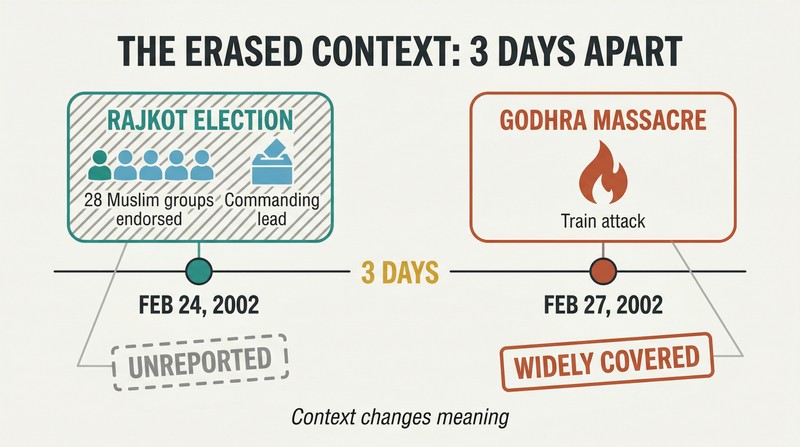
Modi swept Muslim votes in Rajkot three days before Godhra
The untold pre-riot story. On February 24, 2002 — three days before the Godhra train massacre — Modi won his first-ever election from Rajkot with overwhelming Muslim support. Twenty-eight Muslim organizations publicly endorsed him. Muslim women campaigned openly for BJP. Election booths with over 70% Muslim voters gave Modi a commanding lead. Local newspapers documented Congress panic at losing their captive Muslim vote bank.
This context is almost never reported. Modi's election speeches contained zero communal rhetoric — only promises about Narmada water, earthquake rehabilitation, and education reform. Kishwar argues this evidence is critical: a man who just won Muslim trust has no motive to engineer anti-Muslim riots.
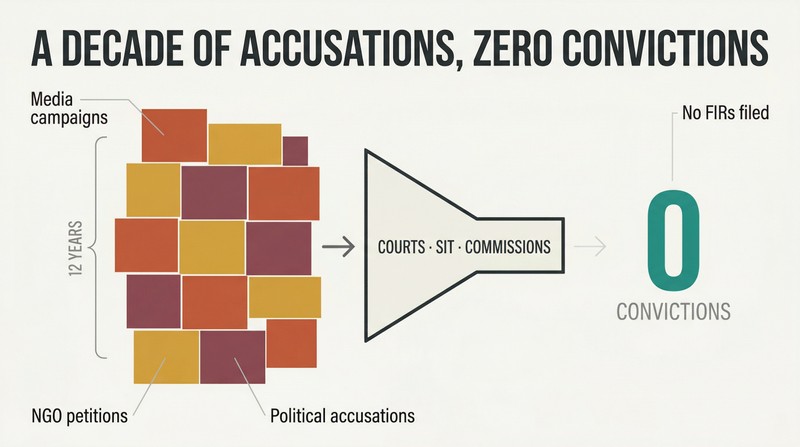
A decade of demonization produced zero court convictions against Modi
The book's central thesis. Kishwar documents how the Supreme Court-appointed Special Investigation Team, the Nanavati Commission, and multiple court rulings found no evidence implicating Modi in engineering or facilitating the 2002 Gujarat riots. Despite twelve years of relentless campaigns by Congress-allied NGOs, prominent journalists, and international media, not a single FIR was filed against him.
Manufactured by political coalition. The author argues this demonization was built by a constellation of Congress Party operatives, Left intellectuals, and funded NGOs whose political survival depended on keeping Muslims as a captive vote bank through permanent victimhood. The book presents hundreds of video-recorded interviews from Gujarat as a "necessary antidote" to what Kishwar calls systematic misinformation.
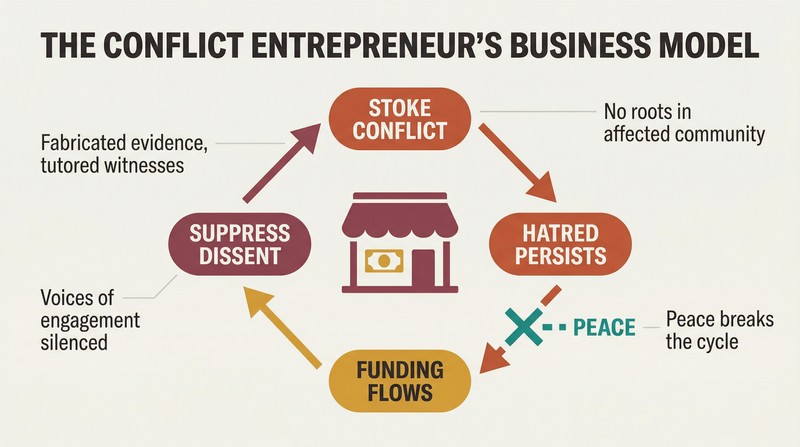
Conflict Entrepreneurs keep hatred alive because peace closes their shops
Borrowed from filmmaker Mahesh Bhatt, the term "conflict entrepreneurs" describes activists and NGOs who financially sustain themselves by perpetuating communal hostility. Key anti-Modi campaigners — Teesta Setalvad from Mumbai, Shabnam Hashmi from Delhi — had no roots in Gujarat's Muslim community. Their former ground operative, Rais Khan, testified that Teesta fabricated affidavits, suppressed photographs implicating Congress workers in riots, and distributed funds to maintain tutored witnesses.
Those who tried engagement were punished. Maulana Vastanvi was forced to resign as Deoband's vice chancellor for merely acknowledging Muslim prosperity under Modi. Journalist Shahid Siddiqui was expelled from his party for interviewing Modi. The message was clear: breaking the demonization consensus carried severe consequences.
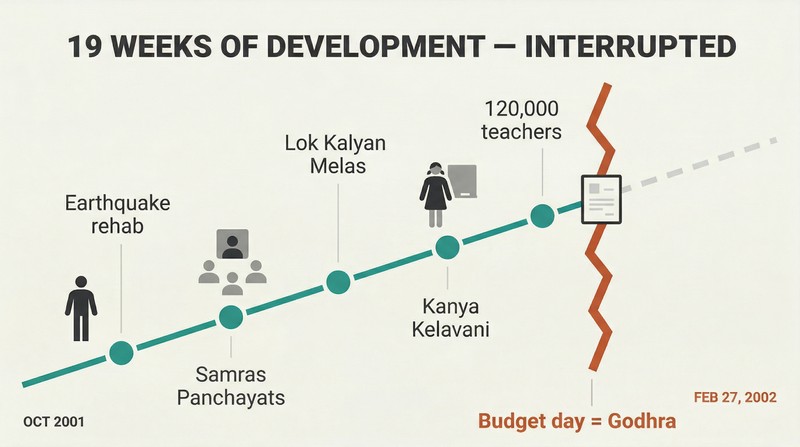
Modi's pre-Godhra 19 weeks prove development was his sole agenda
Nineteen weeks of inclusive governance. Between October 2001 and February 2002, Modi launched earthquake rehabilitation on a war footing, Samras Panchayats for consensus-based village governance, Lok Kalyan Melas delivering welfare at people's doorsteps, Kanya Kelavani for girls' education, and recruited 120,000 teachers after a decade-long freeze. His first budget was scheduled for February 27 — the very day of Godhra.
Congress panic began before any riot. Kishwar documents that the smear campaign started immediately upon Modi's appointment because his inclusive agenda threatened the Congress vote bank. His first election from Rajkot saw brazen slander and police complicity with Congress — all before Godhra. The riots destroyed his development momentum; they didn't serve it.
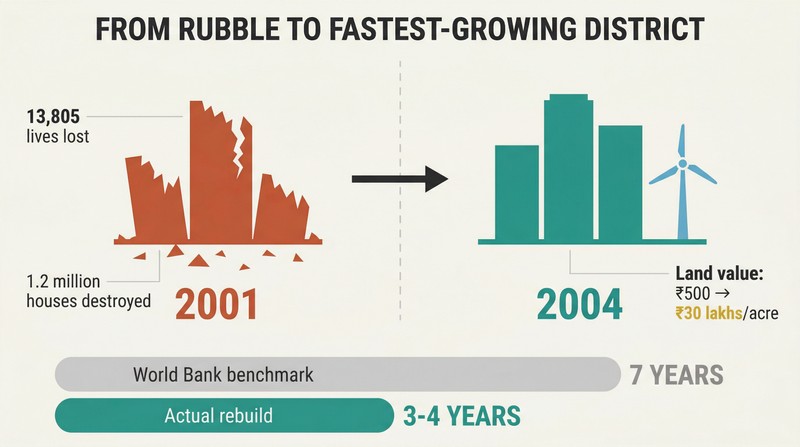
Kutch went from earthquake rubble to India's fastest-growing district
A world record in reconstruction. The 2001 earthquake killed 13,805 people and destroyed 1.2 million houses. Under the previous government, politicians openly looted donated supplies. Modi made reconstruction his top priority within days, sending senior officers to spend every weekend in devastated villages. Instead of government contractors, village committees built schools with free materials from government depots — producing better quality at lower cost, with many returning surplus funds.
The World Bank's standard seven-year timeline was beaten in three to four years. Modi simultaneously attracted industrial investment, wind and solar energy, and revived agriculture through water harvesting. Land bought for Rs. 500 thirty years ago commanded Rs. 30 lakhs per acre. Kutch became Modi's laboratory for citizen-centric governance.
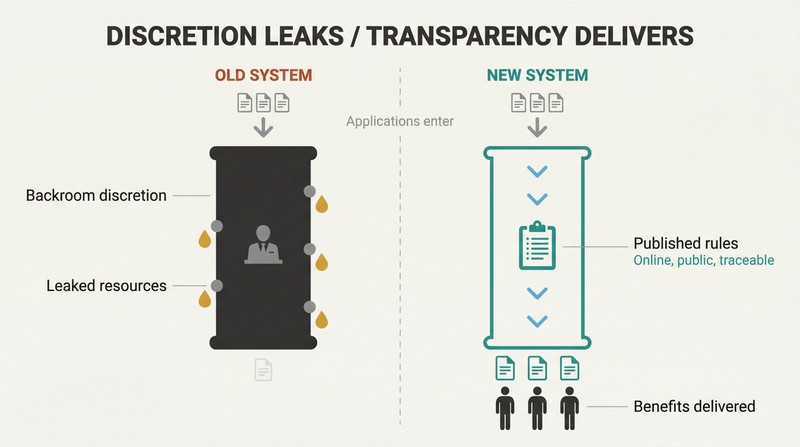
Replace bureaucratic discretion with transparent rules and corruption starves
Systems over spectacles. Rather than suspensions or sting operations, Modi redesigned governance to eliminate corruption structurally. School permissions went online — officers saw applications only on meeting day and couldn't deny without published reasons. Policy drafts were posted publicly for feedback, killing backroom deals. Tenders moved online. The SWAGAT grievance redressal portal let citizens escalate complaints to the CM via video conference.
Lok Kalyan Melas delivered welfare benefits publicly to named individuals at mass gatherings, making phantom beneficiaries nearly impossible. This approach won UN Public Service Awards in 2009 and 2010. But it made bitter enemies of every politician and bureaucrat whose corruption pipeline it disrupted — which, Kishwar argues, explains the ferocity of anti-Modi politics.
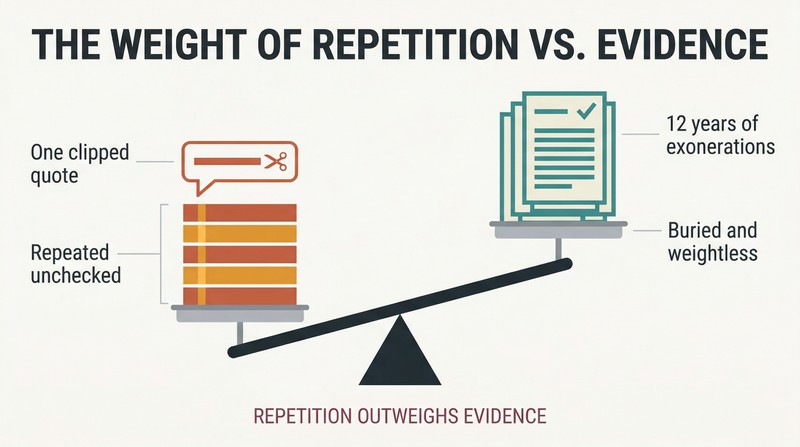
One clipped TV quote can bury twelve years of court exonerations
The anatomy of a distortion. Zee TV broadcast Modi saying, "A chain of action-reaction is going on" — but cut the second sentence: "We want that there should be neither action nor reaction." The Times of India published fabricated interview statements on its front page; Modi's correction appeared twenty days later in an inside corner. The SIT found Modi was "quoted out of context."
False atrocity stories went viral unchecked. The pregnant-woman-disemboweled narrative was repeated by BBC and Arundhati Roy but never verified. Roy's claimed source was a fact-finding team organized by Teesta Setalvad. When challenged, Roy dismissed "genuine errors" as irrelevant. Despite corrections, these distortions became unchallengeable orthodoxy — because repetition, not evidence, drove the narrative.
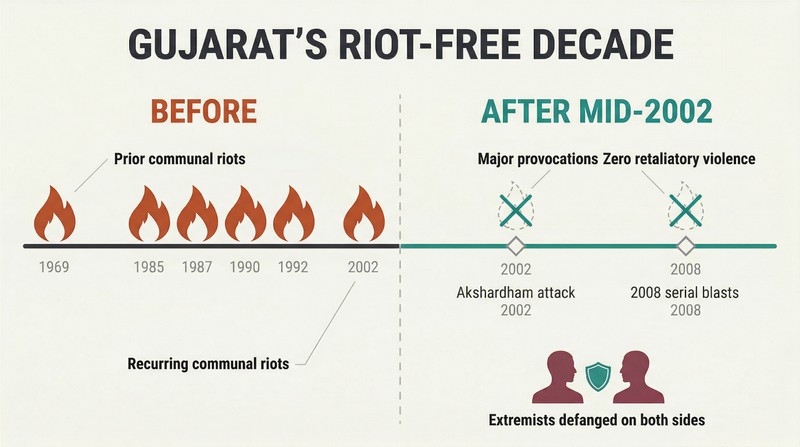
Gujarat's first-ever riot-free decade came under its 'most divisive' CM
Centuries of communal violence stopped. Gujarat had experienced hundreds of riots — 1969, 1985, 1987, 1990, 1992, 2002. Curfews once lasted 200 consecutive days. Yet after mid-2002, not a single communal riot occurred. Even the Akshardham terrorist attack killing 33 and the 2008 serial bomb blasts killing 56 provoked zero retaliatory violence.
Modi defanged extremists on both sides. The VHP's Praveen Togadia could spew hate speeches freely in Congress-ruled states but dared not in Gujarat, where enforcement was swift. When infrastructure projects required demolishing 280 illegally-built temples on public land, VHP leaders called Modi "the new Mehmood Gaznavi" — but he proceeded. Muslim dons were similarly marginalized, reducing both communal triggers and the cycle of retaliation.
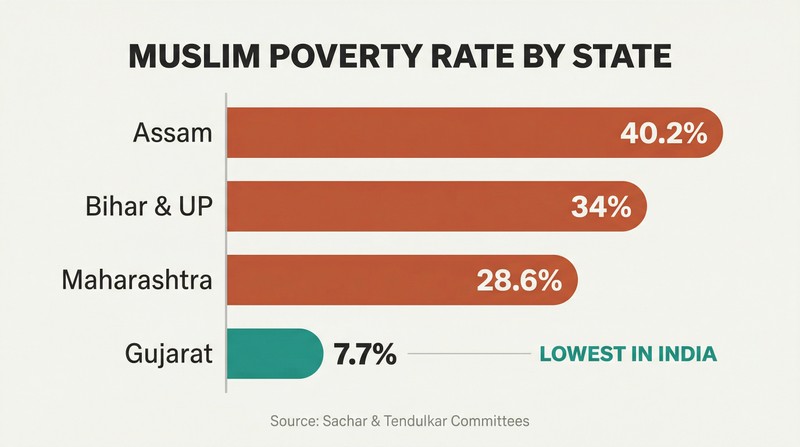
Gujarat's Muslim poverty rate fell to 7.7% — lowest among Indian states
Data from the government's own Sachar Committee showed Gujarat Muslims far ahead of most states. Muslim literacy stood at 73.5% versus India's 59.1% average. The Tendulkar Committee ranked Gujarat's Muslim poverty rate lowest nationally at 7.7% — compared to 34% in Bihar and UP, 28.6% in Maharashtra, and 40.2% in Assam. Universities grew from 11 to 44 in a decade; engineering seats expanded from 3,000 to 55,000.
No scheme was labeled "for Muslims." Everything targeted "all Gujaratis." When 24x7 power reached every village, Muslim homes weren't excluded. When Kanya Kelavani enrolled every girl child, Muslim daughters participated equally. Modi's argument: creating abundance eliminates scarcity-driven competition between communities, making quota politics redundant.
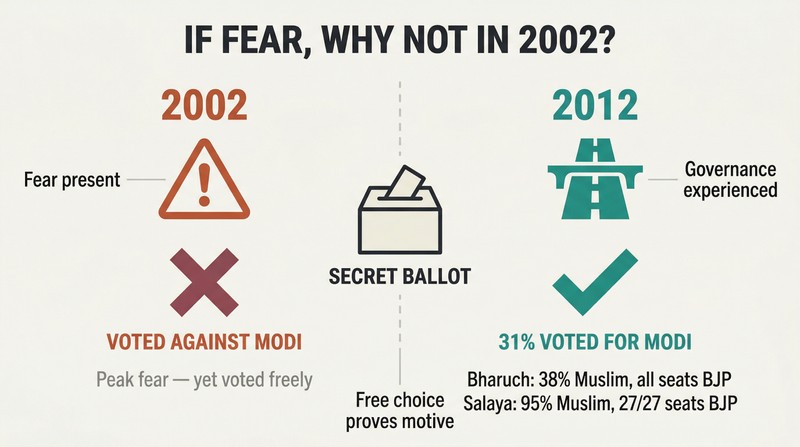
31% of Gujarat Muslims voted BJP in 2012 — from experience, not fear
The voting shift was bottom-up. In Bharuch district, with 38% Muslim voters, every seat went to BJP — even against Congress Muslim candidates. In Salaya municipality (95% Muslim), all 27 seats were won by BJP. Hundreds of Muslims won panchayat, municipal, and district elections on BJP tickets. When political scientists dismissed this as fear-based voting, Kishwar counters: in 2002, when Muslims were genuinely terrorized, they voted against Modi because elections are by secret ballot.
Former Congress spokesperson Asifa Khan switched to BJP after four years of internal frustration, citing Congress dysfunction versus Modi's accessible, responsive governance. A Muslim taxi owner explained the shift simply: "Modi brought such peace that we are actually breathing freely. Our daughters go out freely at night. This was unthinkable fifteen years ago."
Analysis
Kishwar's book functions as a prosecutorial brief for the defense — assembling evidence systematically excluded from the dominant narrative about Modi and Gujarat. Its primary strength is methodological: hundreds of video-recorded interviews with named, identifiable sources willing to stand behind their statements, cross-checked against contemporary newspaper reports and government documents. The Zafar Sareshwala narrative alone — from filing suit at the International Court of Justice to becoming Modi's most articulate Muslim defender — constitutes remarkable political journalism.
However, the book's advocacy posture creates structural limitations that demand honest acknowledgment. By interviewing primarily those with positive Modi experiences, Kishwar creates a selection bias that mirrors the one she criticizes. The analysis of riot dynamics, while sourced from inquiry commissions, underplays documented instances where BJP and VHP allies clearly participated in horrific violence — acknowledging them but treating them as aberrations rather than systemic failures. The either/or framing — either Modi is a monster or a saint — prevents examination of uncomfortable middle ground where a leader's sincere developmental intentions coexist with inadequate riot response by subordinates he should have controlled.
The book's most enduring contribution is demonstrating how narrative monopolies form when counter-evidence goes ungathered. For twelve years, almost no journalist or academic conducted sustained fieldwork in Gujarat to test the dominant frame. This methodological laziness — where ideology substitutes for investigation — remains instructive for understanding information warfare in democratic societies globally. The book anticipated the 'post-truth' era before the term existed, showing how ideologically-aligned institutions can construct and maintain a reality that withstands legal adjudication. Its most transferable insight: when examining any demonized figure, demand the evidentiary standard you would accept in court. Crucially, the book also illustrates how conflict entrepreneurs can sustain a narrative long after courts have rendered their verdicts.
Review Summary
Modi, Muslims and Media presents an alternate perspective on Narendra Modi's tenure as Gujarat's chief minister, challenging media narratives. Readers found it eye-opening, well-researched, and revealing of media bias. Many praised its detailed analysis of the 2002 riots and Modi's governance. Some felt it was repetitive and overly positive towards Modi in parts. Overall, reviewers appreciated the book for providing a counter-narrative to mainstream portrayals, though some noted potential bias. Most found it informative and thought-provoking, recommending it for a balanced understanding of Modi's leadership.
People Also Read

Glossary
Samras Panchayat
Consensus-elected village councilA village governance model promoted by Modi where the panchayat (local council) is elected unanimously through community consensus rather than competitive majoritarian elections. Designed to prevent the social divisions, hostilities, and broken relationships that party-based village elections typically produce. Villages achieving samras status received special government development incentives—Rs. 65.30 crores were paid to 7,793 samras villages between 2001 and 2008.
Sabka Saath, Sabka Vikas
Inclusive development for allModi's governance motto meaning 'Participation of all, for the development of all.' The principle that every government program should target 100% of citizens regardless of religion, caste, or community, rather than creating separate schemes for specific identity groups. Modi argued this approach—building surplus capacity rather than distributing scarce quotas—eliminates structural discrimination more effectively than targeted minority programs.
Conflict Entrepreneurs
Those profiting from communal hatredTerm used by filmmaker Mahesh Bhatt and adopted by Kishwar to describe activists, NGOs, and political operatives who financially and politically sustain themselves by perpetuating intercommunal hatred. Like war industries that would collapse if peace prevailed, conflict entrepreneurs resist resolution because peace threatens their relevance, funding streams, and political leverage. The book applies this framework specifically to anti-Modi campaigners operating from outside Gujarat.
Lok Kalyan Mela
Government welfare fairs for citizensPeople's Welfare Fairs institutionalized by Modi where the government delivers welfare benefits directly to identified beneficiaries at their doorstep in public ceremonies. Prior to each mela, surveys identify eligible recipients. The CM, ministers, and officials personally hand over cheques and benefits at mass gatherings, creating instant public transparency that makes it harder for corrupt officials to divert funds or create phantom beneficiaries.
Kanya Kelavani
Girls' education enrollment campaignAnnual girls' education initiative launched in Modi's first months as CM. All gifts received by Modi are auctioned and proceeds deposited into the Kanya Kelavani Fund for scholarships to girls in Gujarat's poorest districts. The campaign involves three-day events where new students receive free uniforms, school kits, and Narmada Bonds. School dropout rates fell from 17.83% to 2% and female literacy rose from 57.80% to 70.73% between 2001-2011.
SWAGAT
CM's grievance redressal portalAcronym literally meaning 'Welcome'—an IT-enabled grievance redressal system where citizens can escalate unresolved complaints through taluka and district levels to the Chief Minister. The CM personally hears complainants and concerned officers through video conferencing on dedicated days, taking on-the-spot decisions or setting timelines. Won the UN Public Service Award in 2010 for transparent, accountable governance.
Panchamrut Yojana
Five pillars of developmentModi's five-pillar development framework: Jal Shakti (water resources), Jan Shakti (human resource mobilization), Gyan Shakti (education empowerment), Urja Shakti (energy harnessing), and Raksha Shakti (security from illness, disasters, and anti-social activity). Each pillar spawned multiple specific programs and institutions, forming the architectural blueprint for Gujarat's governance transformation across sectors.
Jyoti Gram Yojana
24x7 village electrification schemeProgram providing round-the-clock three-phase power supply to every village and home in Gujarat—urban and rural—including remote tribal areas. Farmers receive assured power through separate agricultural lines for set hours daily. The scheme transformed Gujarat from a power-deficit to power-surplus state and enabled small-scale manufacturing in villages, fundamentally changing rural economic possibilities.
Download PDF
Download EPUB
.epub digital book format is ideal for reading ebooks on phones, tablets, and e-readers.








































