
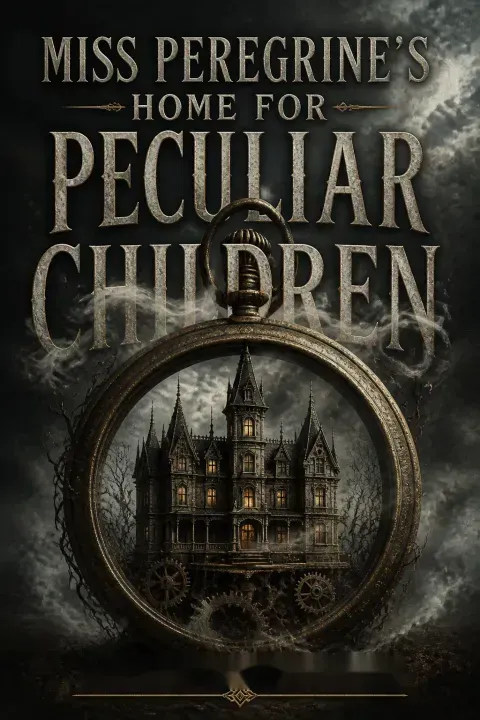


Plot Summary
Prologue
As a child, Jacob Portman1 worshipped his grandfather Abraham,2 who filled his imagination with tales of fighting invisible tentacle-mouthed monsters and living in a magical Welsh children's home protected by a pipe-smoking bird.4
Abraham2 showed him strange vintage photographs: a levitating girl,13 an invisible boy,6 a boy lifting a boulder,18 a man with a face on the back of his head. But as Jacob1 grew older, he dismissed these stories as fairy tales, interpreting the "monsters" as Nazis and the peculiar children as Jewish war orphans.
At fifteen, Jacob1's world splits into Before and After when his grandfather2 dies violently, babbling cryptic last words: "Find the bird.4 In the loop. On the other side of the old man's grave. September third, 1940." Jacob1 glimpses a nightmare creature in the woods that night, but no one believes him.
The prologue establishes the book's foundational tension between childish wonder and adult rationalization. Jacob's journey from belief to skepticism mirrors the universal loss of magical thinking. What the prologue does brilliantly is set up a trauma that requires Jacob to revisit those fairy tales as possibly true, creating dramatic irony: the reader suspects Abraham's stories were real, but Jacob has emotionally buried them. The photographs are crucial here, serving as physical artifacts that bridge imagination and reality. Abraham's last words function as a quest map, dense with clues Jacob cannot yet decode. The prologue also seeds the theme of intergenerational trauma: Abraham's war experiences, his paranoia, his obsession with guns, all reframed through Jacob's retrospective understanding. The creature sighting at the end is the inciting incident of the entire narrative, the moment Jacob's ordinary world cracks open.
Grandfather's Last Words
Jacob1's grandfather2 calls him at work in a paranoid frenzy, convinced monsters are coming and demanding the key to his gun locker. Jacob1 and his friend Ricky16 drive to Abraham2's Florida subdivision. Jacob1 finds the house ransacked and follows a trail of flattened palmettos into the woods.
He discovers Abraham2 facedown, bleeding from deep gashes across his torso, clutching a letter opener. As Jacob1 cradles him, Abraham2 whispers final instructions: go to the island, find the bird4 in the loop on the other side of the old man's grave, dated September third, 1940, and mention Emerson's letter.
Jacob1 glimpses a terrifying creature with tentacles writhing from its mouth before blacking out. Police blame feral dogs. A psychiatrist, Dr. Golan,5 diagnoses Jacob1 with acute stress reaction.
This scene establishes the central mystery while introducing the psychological wound Jacob carries. Abraham's death is simultaneously mundane (an old man killed by animals) and extraordinary (Jacob's vision of a monster). The last words are not random ravings but precise, decodable instructions, positioning Abraham as a man who lived with secrets he chose to reveal only at the end. Jacob's helplessness here, kneeling in the dirt while his grandfather bleeds out, becomes the emotional engine of the entire quest. Dr. Golan's diagnosis pathologizes Jacob's experience, making him doubt his own perception, a gaslighting that mirrors what the peculiar children have endured from the world.
The Letter from Miss Peregrine
Months later, at Jacob1's sixteenth birthday party, his Aunt Susie gives him a present from his grandfather:2 a worn copy of The Selected Works of Ralph Waldo Emerson. Inside the book, Jacob1 finds an old letter from 15 years earlier, written by the headmistress4 of the children's home on Cairnholm Island in Wales.
The letter, signed by Alma LeFay Peregrine,4 mentions a photo enclosed: a woman smoking a pipe.4 Jacob1 realizes the "bird4" his grandfather2 spoke of was not literal but a woman, Miss Peregrine4 (a type of falcon), who smoked a pipe.
He deciphers his grandfather2's last words: the "old man" is Cairnholm Man, a 2,700-year-old bog body displayed in the island's museum; his "grave" is the cairn where it was found. The loop and the date remain mysterious. Jacob1 persuades his parents, with Dr. Golan5's surprising endorsement, to let him and his father9 travel to Cairnholm.
This is the pivot from grief to quest. The discovery of the letter transforms Abraham's cryptic last words from dementia into a coherent puzzle. The Emerson book serving as a literal container for secrets mirrors the novel's larger project: finding hidden truths inside familiar objects. Dr. Golan's endorsement of the trip, which seems supportive, will later read as manipulation, a predator steering prey toward a trap. Jacob's ability to decode the clues (Peregrine equals falcon, the bog boy equals the old man) establishes that he possesses his grandfather's intuitive gift, even if he doesn't yet recognize it as peculiar.
The Island and the House
Jacob1 and his father9 arrive on Cairnholm, a remote Welsh island with one phone, diesel generators, and a pub called the Priest Hole. Local boys Dylan and Worm trick Jacob1 into stepping into a sheep-stable shithole before abandoning him.
Jacob1 finds the children's home alone: a gothic ruin with trees growing through broken windows, collapsed roofs, and rooms filled with rotted debris and exploded food jars. In Miss Peregrine4's bedroom, he finds a locked steamer trunk. After dragging it to the landing and pushing it over, it crashes through the floor into the basement.
Jacob1 descends into darkness, discovers shelves of pickled organs in jars, then finds dozens of old photographs scattered from the smashed trunk. Looking at them, he hears footsteps above and sees a girl holding a ball of flame in her bare hand,3 peering down at him.
This chapter is all about the gap between expectation and reality. The house Jacob finds is a corpse of a home, not the sunlit paradise Abraham described. The pickled organs in jars are the first hints that this was no ordinary orphanage. The photographs that spill from the trunk are the novel's thematic heart: images can preserve truth even when buildings crumble. The girl with fire in her hand appearing at the chapter's end is a perfect cliffhanger that upends everything Jacob (and the reader) thought they knew about the reality of his grandfather's stories. The boys' prank with the sheep stable is a mundane cruelty that contrasts with the supernatural wonder about to unfold.
Into the Time Loop
The girl with the flame3 flees, and Jacob1 chases her across the bog into a Neolithic cairn. When he exits, the world has transformed: the sky is sunny, the path is dry, horses pull carts instead of tractors, and townspeople stare at him. In the pub, an unfamiliar bartender accuses him of being a German spy and chases him with a mob.
The flame-wielding girl, Emma Bloom,3 captures Jacob1 at knifepoint, accusing him of being a wight. She drags him to a cottage where an invisible boy, Millard,6 helps them escape. Emma3 demonstrates she can create fire from her hands.
They evade the mob using Millard6's precise knowledge of events that repeat daily and hide in the Priest Hole's secret compartment. A horse-drawn wagon takes them toward the children's home, which now stands pristine and beautiful, not ruined. Miss Peregrine4 greets Jacob1 by name, revealing she's been watching him.
The time-loop reveal is masterfully executed through Jacob's disorientation. The identical yet different world of September 3, 1940, is gradually understood through accumulating anomalies: the weather, the transport, the bartender, the absence of the Waiting Woman statue. Emma's hostility toward Jacob is logical within her world: wights are infiltrators who pose as peculiars. Her knife-to-throat interrogation establishes her as dangerous, competent, and terrified, a combination that makes her immediately compelling. Millard's knowledge of exactly when planes will fly over reveals the loop's repetitive nature without explicit explanation, trusting the reader to catch up.
The Peculiar Children Revealed
Miss Peregrine4 explains that she is an ymbryne, a female peculiar who can transform into a bird and manipulate time. She created a time loop on September 3, 1940, to save her wards from a German bomb that would have killed them all.
The loop repeats the same day endlessly, and the children have lived there for decades without aging, though they can never leave permanently or they would rapidly age and die.
Jacob1 meets the other peculiars: Olive,13 who levitates; Bronwyn,7 a girl of immense strength; Hugh,11 who has bees living in his stomach; Claire,14 who has a mouth on the back of her head; Fiona,12 who can make plants grow; Horace,10 who has prophetic dreams; and Enoch,8 who can animate dead things. Emma,3 Jacob1 learns, was his grandfather Abraham2's sweetheart before he left to fight in the war and never returned.
This section is the lore download that makes the novel's world coherent. Miss Peregrine's classroom-style lecture to Jacob mirrors how fantasy novels must educate their protagonists (and readers) about the rules of their universe. The explanation of loops and ymbrynes creates clear stakes: the children are safe but imprisoned, living in eternal sunshine that is also eternal stasis. Learning that Emma loved Abraham adds a poignant, slightly taboo layer to her growing connection with Jacob: is his attraction to her, and hers to him, a continuation of his grandfather's unfinished romance? The variety of peculiar abilities allows for ensemble storytelling while Jacob's apparent lack of any ability makes him both an outsider and a mystery.
The Hollowgast Threat
Jacob1 spends blissful days with the peculiar children, swimming at a cove, watching their talents, and growing closer to Emma.3 He kisses her on a shipwreck under a sky of bioluminescent fish. But a wight disguised as his psychiatrist, Dr. Golan,5 has been grooming Jacob1 to lead him to the loop.
Miss Avocet,15 an elderly ymbryne and Miss Peregrine4's mentor, arrives in a panic: wights disguised as council members kidnapped her wards and Miss Bunting, another ymbryne. She reveals a coordinated effort to abduct ymbrynes across multiple loops. Miss Peregrine4 locks down the house.
Jacob1 admits he told Golan5 everything about his grandfather2's stories, realizing he unknowingly betrayed the peculiars. That night, a hollowgast kills Martin,17 the museum curator, and Golan5 and his hollowgast servant Malthus confront Jacob1 and his friends in the icehouse where Martin17's body is kept.
The idyllic middle section serves a dual purpose: it deepens emotional investment in the peculiar children before the coming violence, and it allows Jacob to experience the seductive appeal of loop life, making his eventual choice to stay meaningful. The revelation that Golan was a wight all along reframes the entire psychiatric relationship as predator-prey manipulation. Jacob's guilt over inadvertently betraying the children mirrors intergenerational survivor's guilt: he repeated his grandfather's stories to the very monsters Abraham spent his life fighting. Martin's death is the first time violence breaches the loop's protective bubble, proving that nowhere is truly safe.
The Wight Psychiatrist Betrayed
In the fishmonger's icehouse, Enoch8 uses sheep hearts to temporarily resurrect Martin,17 who reveals a hollowgast killed him. Golan5 and his hollowgast, Malthus, trap the group. Golan5 drops his disguise, revealing he has been posing as multiple authority figures in Jacob1's life: his bus driver, his family's yard man, and his psychiatrist.
He offers Jacob1 a deal: help find more peculiars in exchange for protection. Jacob1 refuses. Bronwyn7 collapses the icehouse on the hollowgast, and the group flees toward the loop. Jacob1 and Emma3 are pursued into a sheep-stable shack, where Jacob,1 armed only with shearing scissors, faces the hollowgast.
In the dark bog, he stabs it in the eyes and it sinks. When they return to the house, they learn Golan5 already came with a gun, locked the children in the basement, and forced Miss Peregrine4 and Miss Avocet15 to transform into birds before stuffing them in a cage.
The icehouse confrontation is the novel's moral turning point. Golan's offer to Jacob is genuinely tempting: safety, a return home, a normal life, all for the price of collaboration. Jacob's refusal marks his full commitment to the peculiar world and its values. The revelation that Golan was multiple figures in Jacob's life creates retroactive horror: how long had the surveillance been happening? How much of Jacob's childhood was shaped by this predator? Jacob killing the hollowgast is his rite of passage, proving to himself that he possesses the courage he always doubted. The use of shearing scissors rather than a gun is significant: an ordinary tool turned weapon by desperation.
Lighthouse Confrontation
Millard,6 who tracked Golan,5 reveals the wight5 took Emma3's canoe to a lighthouse offshore. The children mount a rescue using Bronwyn7's shield of a ripped-off cargo door to block gunfire. They fight Golan5 atop the lighthouse. He holds the caged birds hostage, threatening to kill them. Jacob,1 handed a gun, hesitates. Emma3 threatens Golan5 with fire.
Golan5 throws the cage into the sea. Jacob1 shoots Golan5 in the throat, killing him. Jacob1 and Emma3 swim desperately after the cage as a German U-boat surfaces, crewed by wights. The submarine's gunner retrieves the cage and takes Miss Avocet15 aboard. Jacob1 and Emma3 rescue only Miss Peregrine,4 who is injured and cannot transform back into human form.
The lighthouse climax is a moral crucible for Jacob. His hesitation to shoot is entirely in character: he's a traumatized teenager, not a soldier like his grandfather. The act of pulling the trigger represents Jacob choosing violence to protect those he loves, crossing a threshold his grandfather crossed long ago. Emma's fire and Bronwyn's brute force showcase the peculiars' abilities in combat, but it's Jacob's ordinary human action, a trigger pull, that kills the villain. The partial rescue is a bittersweet victory: Miss Peregrine is saved but trapped in bird form, and Miss Avocet is lost. This incomplete success propels the story toward the sequel.
The Loop Collapses
With Miss Peregrine4 stuck in bird form and unable to reset the loop, the day fails to restart. The bomb that normally freezes on Adam's finger completes its trajectory, blasting a crater in the house. The children realize they cannot stay.
Horace10 has a prophetic dream of a snowy prison with razor wire where the ymbrynes are being taken. He draws it in ash on a broken wall. Emma3 retrieves the Map of Days, an atlas listing every time loop ever created. The children decide they must leave Cairnholm to find and rescue Miss Avocet15 and the other kidnapped ymbrynes, and to locate help for Miss Peregrine.4
Jacob1 makes his choice: he writes a letter to his father9 explaining everything, and Emma3 gives him a photo of herself with young Abraham2 as proof for Franklin9 that the peculiar world is real.
The house's destruction mirrors Jacob's internal transformation: the safe, orderly world he knew is gone, replaced by a smoking crater. Horace's vision provides the next quest objective, establishing that his prophetic dreams are not just atmospheric but plot-essential. The Map of Days expands the novel's mythology exponentially, suggesting a vast network of loops throughout history that future books can explore. Jacob's decision to leave his father and follow the children is the story's emotional climax: he chooses the peculiar, dangerous, extraordinary path over the safe, medicated, ordinary one. The letter and photograph are his attempt to give his father closure without the gaslighting Jacob himself endured.
Epilogue
The peculiar children load into three rowboats and push off from Cairnholm at dawn. Jacob1 rows beside Hugh11 while Emma3 watches the island recede. Miss Peregrine,4 still a falcon, rides in Fiona12's hair. Bronwyn7 takes a photograph of the departure, the first picture in what will become a new album.
As they row toward the mainland, black battleships appear on the horizon, silent against the rising sun. The children row faster, into a world at war and an uncertain quest to rescue the kidnapped ymbrynes.
The final image of children in rowboats heading toward battleships encapsulates the novel's central tension: the small, personal world of peculiar children colliding with the vast machinery of historical violence. The rowboats are fragile, human-scaled, while the battleships represent industrialized war. The children rowing faster is both practical (they need to reach the mainland) and metaphorical (they are accelerating into danger). Bronwyn taking a photograph closes the loop on the novel's visual obsession: where Abraham's photos were artifacts of a hidden past, this new photo will document an active quest. The epilogue sets up the sequel while providing emotional closure: Jacob has chosen his new family, and whatever comes next, he faces it with them.
Analysis
Miss Peregrine4's Home for Peculiar Children operates as a story about belief, trauma, and the inheritance of secrets. At its core, the novel is an allegory of mental health and neurodivergence: Jacob1 sees things others cannot, and the world's response is to pathologize, medicate, and dismiss him. His 'acute stress reaction' diagnosis is revealed as a form of gaslighting, both by the psychiatric establishment and by a literal monster who profits from his self-doubt. The peculiar children themselves represent every child who was told their difference was a defect: Emma3 was abandoned by parents who couldn't sell her, Bronwyn7 killed her abuser, Enoch8's family couldn't accept his gift. Miss Peregrine4's loop is a sanctuary built on the recognition that the outside world will destroy what it cannot understand. The novel also engages deeply with Holocaust trauma through Abraham,2 a Jewish boy who survived one genocide only to face another, this one targeting his peculiarity. His lifelong silence about his true nature, his obsession with guns, his emotional distance from his son:9 all are symptoms of a man who could never stop fighting the monsters, even in peacetime. The photographs that structure the novel are themselves a meditation on memory and evidence. They ask: what do we trust? Our eyes? Our memories? The testimony of those we love? And when those conflict, which reality wins? Jacob1's journey answers that question by rejecting false choices: the photographs were real, the stories were true, and a boy who seemed broken was actually gifted with sight.
Review Summary
Miss Peregrine's Home for Peculiar Children receives mixed reviews. Many praise its unique concept, compelling story, and intriguing vintage photographs. Readers enjoy the peculiar characters and their abilities, as well as the creepy atmosphere. However, some criticize the slow pacing, underdeveloped characters, and questionable romantic subplot. The writing style and protagonist's voice are also points of contention. Despite its flaws, many readers find the book entertaining and look forward to continuing the series. The movie adaptation receives mixed reactions compared to the book.
People Also Read
Characters
Jacob Portman
protagonist, peculiar seerA 16-year-old from a wealthy Florida family, Jacob grows up worshipping his grandfather2's stories of monsters and peculiar children. When Abraham2 dies violently, Jacob is diagnosed with acute stress reaction after he claims to have seen a tentacle-mouthed creature. Beneath his privilege and self-doubt lies a peculiar gift he doesn't recognize: he can see hollowgast, the invisible monsters that killed his grandfather2. Jacob's journey is one of reclaiming belief: he must unlearn the rationalist explanations that pathologized both him and Abraham2, and accept that the world is stranger and more dangerous than psychiatry allows. His relationship with Emma3 is complicated by her history with his grandfather2, creating an emotional tangle between legacy, attraction, and identity.
Abraham Portman
grandfather, hidden warriorJacob1's grandfather, a Polish Jew who escaped the Holocaust by train to a Welsh children's home. Abraham possessed the rare peculiar ability to see hollowgast. After the peculiar children's home was bombed in 1940, he left to fight in WWII, refusing to hide in the time loop. He spent decades as a secret warrior, hunting hollowgast while maintaining the facade of an ordinary American life. His relationship with his son Franklin9 was distant because Abraham could never reveal his true life. His final act was to send Jacob1 on a quest to discover the truth he couldn't speak aloud, leaving clues in a letter, a book of Emerson, and his cryptic last words.
Emma Bloom
fire-wielder, Abraham's ex-loveAn 88-year-old peculiar who appears 16, trapped in the 1940 time loop. Emma can generate and control fire with her hands. She was abandoned at a circus when her parents couldn't sell her. During her years in the loop, she fell deeply in love with Abraham Portman2, who promised to return after the war but never did, eventually marrying another woman in America. Emma's unresolved grief makes her initial encounters with Jacob1 volatile: she threatens to kill him with a knife, but she quickly transfers her attachment from Abraham2 to his grandson1. Her fire power is both weapon and metaphor: she burns with passions that the loop's stasis cannot extinguish.
Miss Alma Peregrine
headmistress, ymbryne protectorThe headmistress of the peculiar children and an ymbryne: a woman who can transform into a peregrine falcon and manipulate time. She created the loop on September 3, 1940, to save her wards from a German bombing raid. Fiercely protective, formal, and maternal, she maintains strict rules to keep the children safe from hollowgast and the outside world. She chain-smokes pipes and wears black in mourning for Victor18, a child who was killed by hollows. Her relationship with Jacob1 is ambivalent: she needs his ability to see hollowgast, but fears the disruption his presence brings to the children's sheltered existence.
Dr. Golan (the Wight)
villainous psychiatrist infiltratorJacob1's psychiatrist who diagnoses him with acute stress reaction and prescribes medication to suppress his visions. In reality, Golan is a wight: a hollowgast who has consumed enough peculiars to regain human form and pass as common. He has been surveilling Jacob1's family for years, posing as a school bus driver, a yard man, and other invisible authority figures. His goal is to use Jacob1 to locate Miss Peregrine4's loop and capture ymbrynes for a faction of wights planning to reattempt the catastrophic experiment that originally created the hollowgast. His therapeutic gaslighting of Jacob1 is a deliberate strategy to keep Jacob doubting his own perception.
Millard Nullings
invisible scholarA peculiar boy whose ability is complete invisibility. He is conducting a decades-long project to document every human and animal action on Cairnholm during a single day. Pompous but brilliant, he serves as the group's information source, using his encyclopedic knowledge of the loop's repeated events to predict when planes will fly over or wagons will arrive. He follows Golan5 across the island and is shot during the lighthouse rescue, but survives.
Bronwyn Bruntley
supernaturally strong protectorVictor18's sister, a girl of immense physical strength who accidentally killed her abusive stepfather before coming to the loop. She can lift boulders, tear doors from hinges, and collapse buildings with her bare hands. Despite her terrifying power, she is gentle and emotional, weeping easily and protecting the younger children with fierce devotion. Her strength proves essential in multiple confrontations with hollows and wights.
Enoch O'Connor
dead-riser, cynical lonerA peculiar boy who can temporarily animate dead or inanimate things by implanting hearts from living creatures into them. He creates small clay soldiers powered by mouse hearts and uses them in macabre experiments. Born to a family of undertakers, Enoch is bitter, sarcastic, and jealous of Jacob1's connection with Emma3, for whom he harbors unrequited feelings. His ability to briefly resurrect Martin17's corpse provides crucial intelligence about the hollowgast attack.
Franklin Portman
Jacob's oblivious fatherJacob1's father, an amateur ornithologist and aspiring nature writer who lives off his wife's family wealth. He never understood his own father Abraham2, believing him to be a distant, possibly unfaithful man. On Cairnholm, Franklin drinks heavily and fails to complete his bird book, his pattern of abandoning projects recurring. He serves as a foil to Jacob1: someone who gave up trying to understand the mystery, content with rational explanations that explain nothing.
Horace Somnusson
prophetic dreamer, dandyA peculiar boy whose prophetic dreams manifest as nightmarish visions that sometimes come true. He dresses formally in black suits and is sensitive about his appearance. His dream of a snowy prison with razor wire provides the children with their next destination after the loop collapses.
Hugh Apiston
bee-keeper peculiarA boy with a hive of bees living in his stomach. The bees emerge from his mouth and obey his commands, though he must eat under netting to protect others. He is in a romantic relationship with Fiona12.
Fiona Frauenfeld
plant-controlling peculiarA wild-haired Irish girl who can make plants grow with her hands, from sprouting daisies to shaping massive topiary creatures. She tends the gardens and is romantically involved with Hugh11.
Olive Abroholos Elephanta
levitating girlThe youngest peculiar, a girl who floats uncontrollably unless anchored by weighted shoes. Her light, childish demeanor provides comic relief and emotional warmth to the group.
Claire Densmore
back-mouthed girlA beautiful blond girl who conceals a second, sharp-toothed mouth hidden beneath the curls at the back of her head. She is deeply embarrassed by her peculiarity and eats alone.
Miss Avocet
elder ymbryne, victimA revered elder ymbryne and Miss Peregrine4's former teacher who arrives at the loop after wights kidnapped her wards and Miss Bunting. Her trauma and subsequent kidnapping by the U-boat crew drive the children's rescue mission.
Ricky Pickles
Jacob's only friendJacob1's punk-redneck best friend in Florida who provides protection at school in exchange for academic help. He witnesses Abraham2's death but cannot see the hollowgast, leading him to doubt Jacob1's sanity and end their friendship.
Martin Pagett
museum curator, murder victimThe eccentric curator of Cairnholm's museum who recites his own poetry about the bog boy and provides Jacob1 with historical information about the bombing of the children's home. His murder by the hollowgast Malthus confirms the threat is real and present.
Victor Bruntley
deceased peculiar boyBronwyn7's brother, formerly a peculiar with superhuman strength. He died before the story begins, killed by a hollowgast after leaving the loop. His preserved body lies in a locked bedroom, and Enoch8 occasionally revives him temporarily. His death is why Miss Peregrine4 wears black.
Plot Devices
Time Loops
temporal sanctuaries for peculiarsCreated by ymbrynes (female peculiars who can transform into birds), time loops are repeating 24-hour periods within which peculiars can live indefinitely without aging. The loop on Cairnholm is set to September 3, 1940, the day a German bomb would have killed all the children. Loops must be reset daily by the ymbryne who created them; failure to reset causes the loop to collapse. Peculiars who leave a loop for too long rapidly age to their true chronological age, potentially dying within hours. Loops can be connected across centuries through a process called leapfrogging, allowing travel to historical loops that no longer exist in the present.
Vintage Photographs
evidence and narrative frameworkThe novel incorporates actual vintage found photographs as both narrative devices and physical artifacts within the story. Abraham2's cigar box contains photos of the peculiar children that Jacob1 initially dismisses as fakes. Miss Peregrine4 maintains albums documenting peculiar history, including images of wights, hollows, loops, and the children's sideshow performances. The photos function as physical evidence that bridges skeptical disbelief and belief, serving as the story's central epistemological question: can photographic proof be trusted? At the end, Bronwyn7 takes a new photo of the children rowing away, beginning a new archive.
Hollowgast and Wights
antagonists, fallen peculiarsHollowgast are invisible tentacle-mouthed monsters created when a faction of peculiars attempted an immortality experiment in a Siberian loop in 1908. The experiment backfired catastrophically, destroying their souls and transforming them into flesh-eating abominations invisible to all except peculiars with Abraham2 and Jacob1's gift. If a hollowgast consumes enough peculiars, it evolves into a wight: a human-passing creature with pupil-less white eyes that can infiltrate common society to procure victims for hollows. Wights retain intelligence and can operate in the normal world as spies and scouts. They are currently orchestrating a plan to kidnap ymbrynes and reattempt the failed experiment on a larger scale.
Map of Days
atlas of all time loopsA massive leather-bound book containing hand-drawn maps of every time loop ever known to exist, marked with symbols corresponding to dates and durations. Recovered from the burning house by Emma3, it becomes essential to the children's quest to find the kidnapped ymbrynes. The book reveals that loops exist throughout history, with some dating back to ancient times, and that reaching them requires leapfrogging through connected temporal pockets.
Cairnholm Man (Bog Boy)
clue to the loop entranceA 2,700-year-old preserved body of a teenage boy found in the bog by turf cutters in the 1970s and displayed in Martin17's museum. He was killed by strangulation, drowning, disembowelment, and a blow to the head, apparently a willing human sacrifice who believed the bog was a portal to the gods' world. Abraham2's cryptic last words referenced the 'old man's grave' as the location where Jacob1 would find entrance to the 1940 loop. The cairn (Neolithic tomb) where the bog boy was discovered serves as the physical ingress point to the time loop.
FAQ
Basic Details
What is Miss Peregrine's Home for Peculiar Children about?
- A boy's quest for truth: After his grandfather's death, Jacob Portman seeks to understand his grandfather's fantastical stories, leading him to a mysterious island.
- A hidden world of peculiars: Jacob discovers an abandoned orphanage that houses children with extraordinary abilities, living in a time loop to escape persecution.
- A battle against monsters: Jacob learns that these children are hunted by monstrous creatures, and he must decide whether to join their fight.
Why should I read Miss Peregrine's Home for Peculiar Children?
- Unique blend of genres: The novel combines fantasy, mystery, and historical fiction, creating a captivating and immersive reading experience.
- Intriguing characters and world: The peculiar children and their unique abilities, along with the mysterious time loop, offer a fresh and imaginative story.
- Exploration of deeper themes: The book delves into themes of identity, belonging, and the importance of embracing one's differences, making it thought-provoking.
What is the background of Miss Peregrine's Home for Peculiar Children?
- World War II backdrop: The story is set against the backdrop of World War II, with the children's home serving as a refuge from the horrors of the war.
- Historical allusions: The novel incorporates historical elements, such as the persecution of Jews and the fear of the unknown, adding depth and context to the narrative.
- Mythological parallels: The concept of peculiar children and their abilities draws parallels to mythological figures and folklore, enhancing the fantastical elements.
What are the most memorable quotes in Miss Peregrine's Home for Peculiar Children?
- "I had just come to accept that my life would be ordinary when extraordinary things began to happen.": This opening line sets the stage for Jacob's transformative journey and the extraordinary events to come.
- "We cling to our fairy tales until the price for believing them becomes too high.": This quote reflects Jacob's struggle to reconcile his grandfather's stories with reality and the pain of disillusionment.
- "The peculiarity for which they'd been hunted was simply their Jewishness.": This line reveals the historical context of the children's persecution, highlighting the themes of prejudice and otherness.
What writing style, narrative choices, and literary techniques does Ransom Riggs use?
- First-person perspective: The story is told from Jacob's point of view, allowing readers to experience his confusion, fear, and wonder firsthand.
- Use of found photographs: The integration of vintage photographs adds a unique and haunting visual element to the narrative, blurring the lines between fiction and reality.
- Foreshadowing and suspense: Riggs employs subtle foreshadowing and suspenseful pacing to keep readers engaged and eager to uncover the mysteries of the story.
Hidden Details & Subtle Connections
What are some minor details that add significant meaning?
- The recurring mention of "piss hole": What initially seems like a random insult is later revealed to be the name of the pub, highlighting the island's isolation and the limited communication with the outside world.
- The description of Circle Village: The bizarre lawn ornaments and identical houses foreshadow the artificiality and hidden strangeness of the seemingly normal world.
- The emphasis on the color gray: The pervasive grayness of the island's weather and environment symbolizes the ambiguity and uncertainty that Jacob faces.
What are some subtle foreshadowing and callbacks?
- Grandpa Portman's last words: His cryptic phrases about "the bird," "the loop," and "Emerson" foreshadow Jacob's journey and the discoveries he will make.
- The description of the monsters: The tentacled creatures from Jacob's nightmares are later revealed to be the hollowgast, connecting his fears to the reality of the peculiar world.
- The mention of the "Waiting Woman" statue: The statue's outstretched arms foreshadow the islanders' longing for those lost at sea, and later, the ymbrynes' capture.
What are some unexpected character connections?
- Emma and Abraham's past relationship: The revelation that Emma and Jacob's grandfather were once close adds a layer of complexity to their relationship and Jacob's journey.
- Dr. Golan's true identity: The reveal that Jacob's psychiatrist is a wight is a shocking twist, highlighting the deceptive nature of the enemy.
- Martin Pagett's connection to the bog boy: The museum curator's fascination with the bog boy and his dramatic recitation foreshadow his own tragic fate.
Who are the most significant supporting characters?
- Martin Pagett: The museum curator provides Jacob with crucial information about the island's history and the children's home, acting as a guide and a source of local knowledge.
- Dylan and Worm: These local boys, though initially antagonistic, serve as a bridge between Jacob and the island's culture, and their trickery leads Jacob to the house.
- Kev: The pub owner provides a sense of community and normalcy, and his establishment serves as a hub for Jacob's interactions with the islanders.
Psychological, Emotional, & Relational Analysis
What are some unspoken motivations of the characters?
- Jacob's need for purpose: Jacob's initial skepticism masks a deep desire to find meaning and purpose in his life, which he ultimately discovers through his connection to the peculiar world.
- Miss Peregrine's fear of loss: Her strict rules and protective nature stem from her fear of losing her wards, a fear rooted in her past experiences and the dangers they face.
- Emma's longing for connection: Her initial mistrust of Jacob masks a deep longing for connection and a desire to honor her past relationship with his grandfather.
What psychological complexities do the characters exhibit?
- Jacob's trauma and denial: Jacob's initial disbelief in the monsters and his grandfather's stories is a coping mechanism to deal with the trauma of his grandfather's death.
- Miss Peregrine's burden of responsibility: Her role as an ymbryne and protector of the children weighs heavily on her, leading to a sense of isolation and a fear of failure.
- Emma's internal conflict: She struggles with her feelings for Jacob, her loyalty to the peculiar children, and her desire to protect them from the outside world.
What are the major emotional turning points?
- Jacob's discovery of the photos: The discovery of the hidden photos in his grandfather's cigar box forces Jacob to confront the possibility that his stories were true.
- Jacob's visit to the children's home: The dilapidated state of the house and the sense of loss he feels there solidify his determination to uncover the truth.
- Jacob's encounter with the peculiar children: His first meeting with the children in the basement marks a turning point, as he begins to accept the reality of their world.
How do relationship dynamics evolve?
- Jacob and his father: Their relationship evolves from one of distance and misunderstanding to a more open and honest connection, though still tinged with unspoken grief.
- Jacob and Emma: Their relationship evolves from initial mistrust to a deep bond based on shared experiences, mutual respect, and a growing romantic connection.
- The peculiar children as a family: The children's relationships with each other are complex, marked by both loyalty and conflict, but they ultimately function as a close-knit family unit.
Interpretation & Debate
Which parts of the story remain ambiguous or open-ended?
- The true nature of the hollowgast: The origins and motivations of the hollowgast remain somewhat mysterious, leaving room for further exploration in future installments.
- The extent of the wights' influence: The novel hints at a larger network of wights operating in the human world, but their full reach and power remain unknown.
- The future of the peculiar children: The ending leaves the children's future uncertain, as they embark on a new journey without a clear destination or plan.
What are some debatable, controversial scenes or moments in Miss Peregrine's Home for Peculiar Children?
- The depiction of the peculiar children's abilities: Some readers may find the children's powers and their use in the story to be fantastical or unrealistic.
- The portrayal of the wights and hollows: The monstrous nature of these creatures and their motivations may be disturbing or unsettling for some readers.
- The romantic relationship between Jacob and Emma: The age difference between Jacob and Emma, and the fact that she had a past relationship with his grandfather, may be seen as problematic by some readers.
Miss Peregrine's Home for Peculiar Children Ending Explained: How It Ends & What It Means
- The children leave the loop: The destruction of the house and Miss Peregrine's inability to transform force the children to leave the time loop, embarking on a new journey into the unknown.
- Jacob's acceptance of his peculiarity: Jacob chooses to join the children, embracing his unique ability and his role in their world, signifying his growth and self-acceptance.
- The ongoing battle against evil: The ending suggests that the fight against the wights and hollows is far from over, leaving the door open for future conflicts and adventures.
Miss Peregrine's Peculiar Children Series
About the Author
Other books by Ransom Riggs
Download PDF
Download EPUB
.epub digital book format is ideal for reading ebooks on phones, tablets, and e-readers.








































