

Key Takeaways
Stop asking the universe — your own brain is the manifestation engine
Doty redefines manifestation as neuroscience. It's not cosmic wish-fulfillment but the deliberate process of embedding an intention into your subconscious so that brain networks pursue it around the clock, below conscious awareness. Through visualization paired with strong positive emotion, the brain's salience network classifies your goal as important via value tagging — the brain's system for deciding what deserves resources.
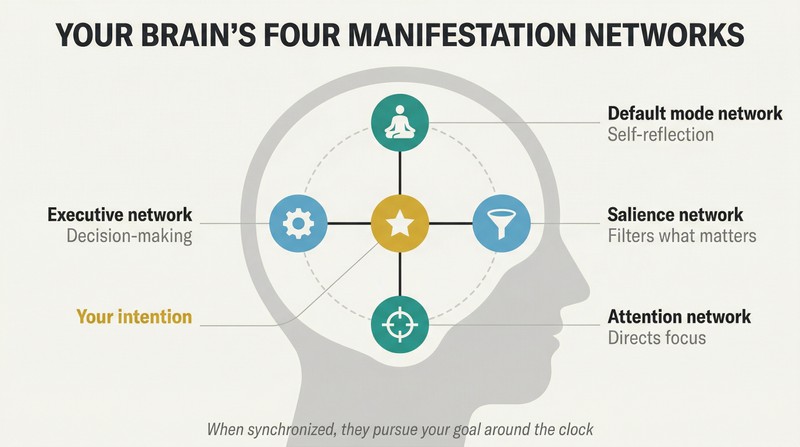
Four networks collaborate: the default mode network (self-reflection), the salience network (filtering what's important), the attention network (directing focus), and the central executive network (decision-making). When they synchronize in a calm state, your subconscious becomes what Doty calls a 'filing clerk and bloodhound' — filing your intention as significant, then relentlessly scanning for ways to realize it.
Getting every item on your wish list can be the loneliest failure
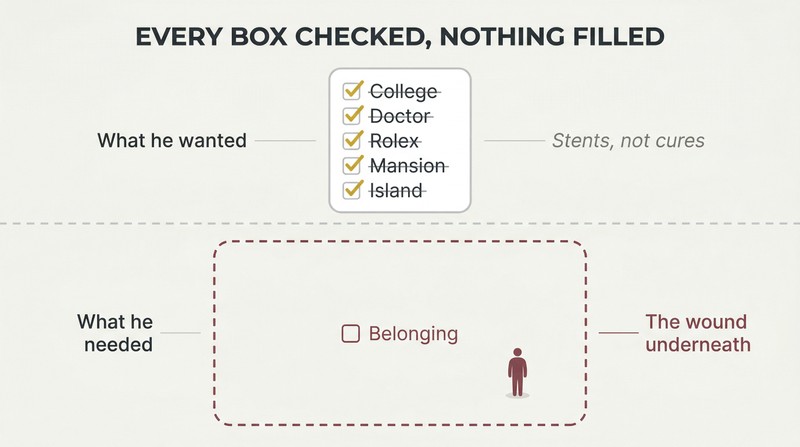
At 44, Doty had it all. A $78 million fortune, a mansion overlooking Newport Bay, a Ferrari, Porsche, BMW, and a deposit on a private island in New Zealand. Within six weeks of the dot-com crash, everything vanished. Wandering his empty house — photos stripped from walls, garden dead — he found a childhood cigar box containing his twelve-year-old wish list: college, doctor, Rolex, mansion, island. Every item checked off.
But he'd lost what mattered. His wife had left. His daughter said she wouldn't miss the place. Doty realized the acquisitions were 'stents' — temporary relief from childhood shame, never treating the wound. He'd manifested a mansion, not a home. The hard lesson: identify the longing underneath the desire before you embed it.
You literally cannot manifest while stressed — calm your body first
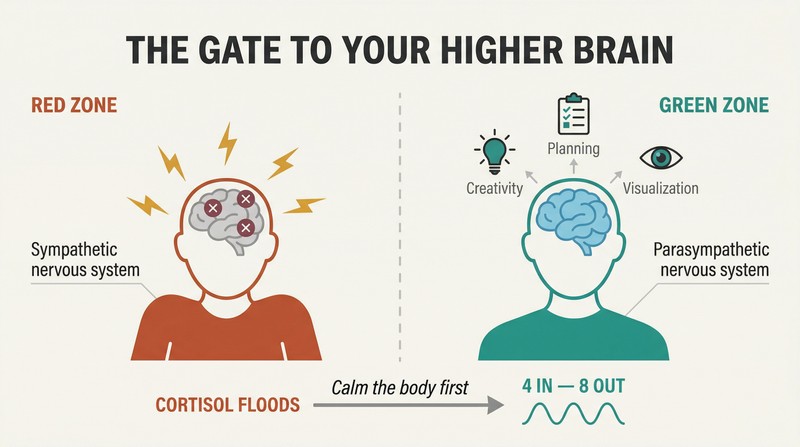
Your parasympathetic nervous system is the gatekeeper. When the sympathetic nervous system floods you with cortisol, higher cognitive functions — planning, creativity, visualization — shut down. Only in rest-and-digest mode (what Doty calls the Green Zone) can you access the executive control areas needed to embed intention. The switch begins with progressive body relaxation: scanning from toes to scalp, breathing slowly in through the nose and out through the mouth.
Anula, a Sri Lankan immigrant paralyzed by test anxiety, couldn't sit for the MCAT despite years of preparation. After learning breath meditation — four-count in, eight-count out — and systematic tension release, her mind finally settled. She scored well, entered medical school, and graduated. The calming came first; the clarity followed.
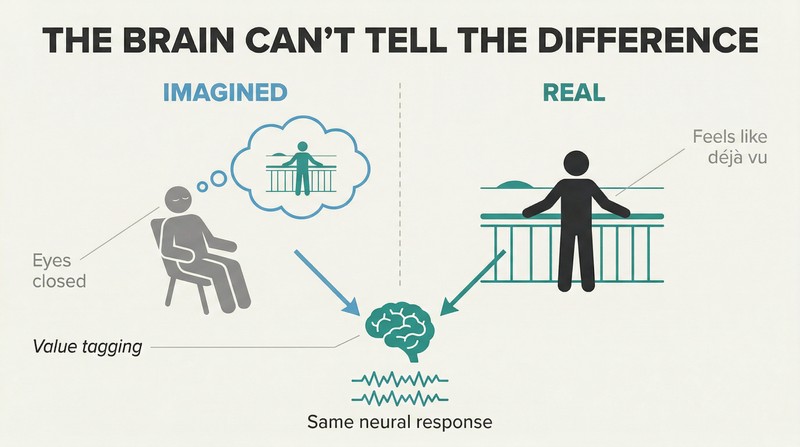
Visualize your goal so vividly that achieving it feels like déjà vu
The mechanism is called value tagging. When you vividly imagine achieving a goal — engaging all five senses, feeling the positive emotions in your body — your salience network flags it as significant, just as it would a real event. Doty visualized his Cape Cod mansion so thoroughly that when he finally stood on its balcony in real life, his brain responded with familiarity, not surprise. It had already 'lived' there.
Research confirms the effect: mentally rehearsing piano practice measurably improves performance without touching a keyboard, and imagining muscle contractions can increase mass. Jim Carrey drove nightly to Mulholland Drive, arms outstretched over LA, telling himself 'Everybody wants to work with me' — then wrote himself a $10 million check years before earning it from three blockbusters.
Your inner critic is a survival relic, not the voice of truth
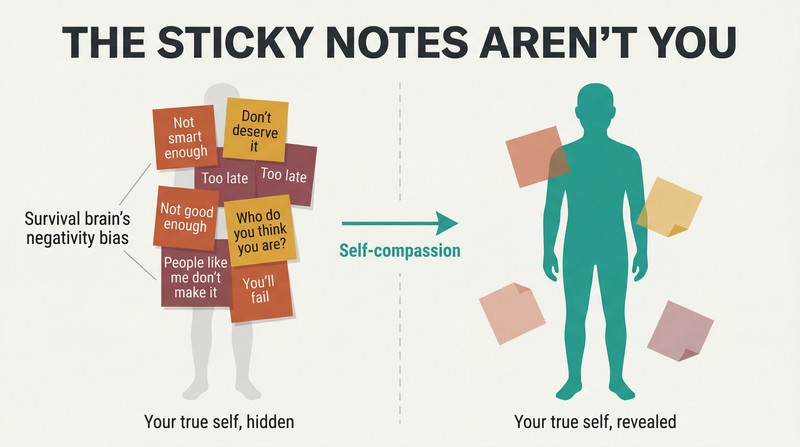
Evolution hardwired a negativity bias that makes threats stickier than rewards — useful on the savanna, toxic today. This bias hijacks the default mode network, producing an inner critic that steals attention from goals. Each negative belief — 'I'm not good enough,' 'People like me don't make it' — becomes what Doty calls a 'sticky note' on the walls of a self-made prison, eventually blocking your view of who you really are.
The antidote is self-compassion, activating the same parasympathetic pathways a parent uses to soothe a child. Through neuroplasticity, you can consciously offer yourself safety and care. A healthcare executive stood up crying at Doty's lecture, admitting her father's words — 'You'll never be anything' — had haunted her through a PhD and executive career. The negative narrative persisted despite every achievement.
Repeat your vision until the brain accepts it like old slippers
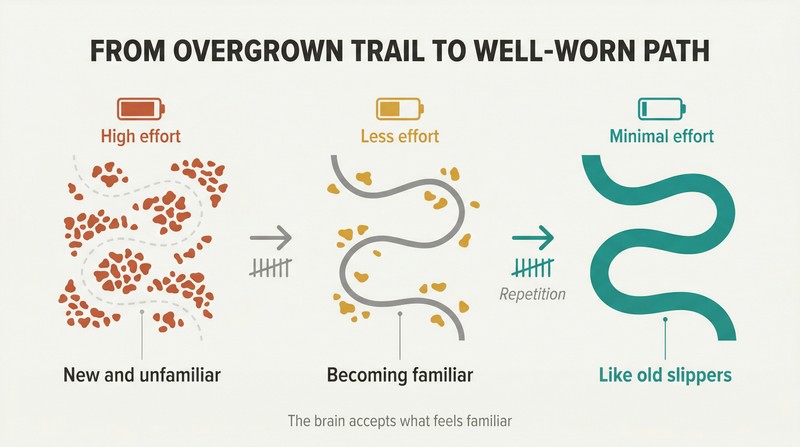
The brain is an energy miser. At just 2% of body weight, it devours 20% of the body's oxygen. To conserve fuel, it resists unfamiliar experiences — if your goal feels foreign, the brain quietly ignores opportunities to achieve it. Doty's solution is cognitive ease: make your desire so familiar it costs the brain minimal energy to accept, 'like well-worn slippers perfectly contoured to the shape of our feet.'
This explains why Anula wrote herself congratulatory letters and reread them daily, and why Carrey kept a worn $10 million check in his wallet for years. Repetition teaches the subconscious filing clerk that your goal matters, unleashing the bloodhound to scan your environment around the clock. The subconscious responds to frequency, not a single dramatic session.
Manifest for others, not just yourself — your brain rewards it
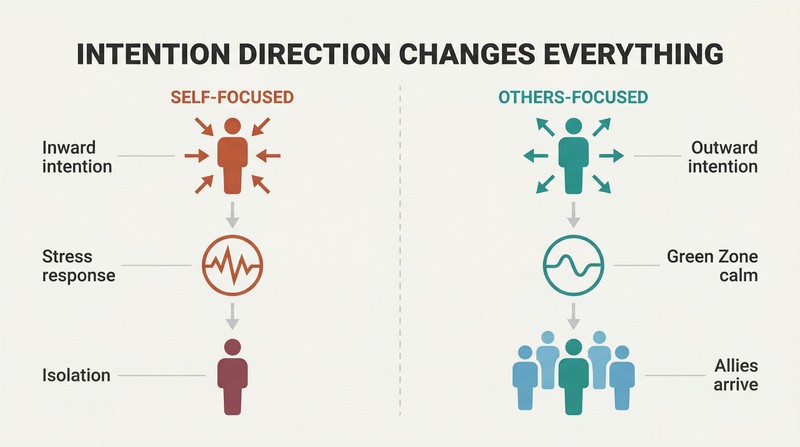
Purpose alignment is a strategic accelerant. Anula's MCAT anxiety dissolved only when she stopped fixating on her own fear and started visualizing patients she could heal — her chest filled with warmth as she pictured correct diagnoses and comforting frightened families. Jim Carrey's breakthrough came when he asked 'What do they want?' instead of 'What do I want?' and realized his audience needed to be free from concern. The persona that launched his stardom was born that night.
When you operate from the parasympathetic Green Zone, your physiology broadcasts safety through neuroception — the subconscious process by which we classify others as safe or dangerous. People instinctively want to help someone whose intention serves the larger good. Compassion is contagious; purpose attracts allies.
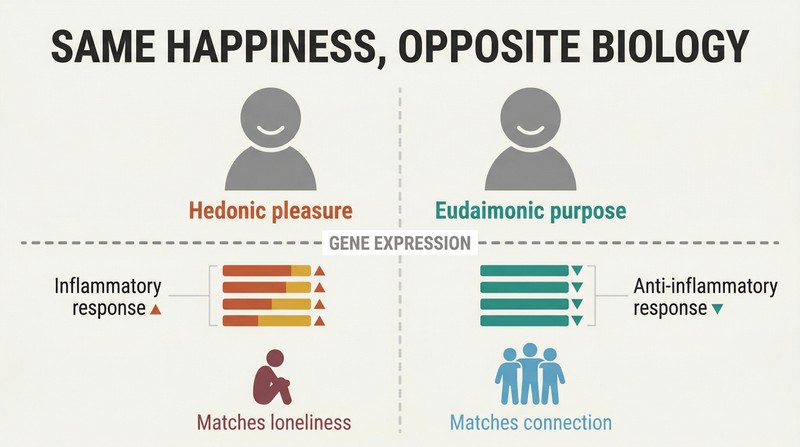
Pleasure without meaning triggers the same genes as loneliness
Your cells track the difference between pleasure and purpose. Researchers Fredrickson and Cole examined 84 people's gene expression alongside self-reported happiness and meaning. Those scoring high on hedonic pleasure but low on purpose showed the same inflammatory gene pattern found in people experiencing grief or loneliness — the body preparing for bacterial infections from isolation. Those with eudaimonic well-being showed anti-inflammatory patterns associated with social connection.
The split was stark: 75% of participants reported high happiness but low meaning. After basic needs are met, what matters genetically is whether your life serves something beyond yourself. This echoes Doty's discovery in his empty mansion — decades of material accumulation never satisfied the deeper longing for belonging, warmth, and contribution his heart required.
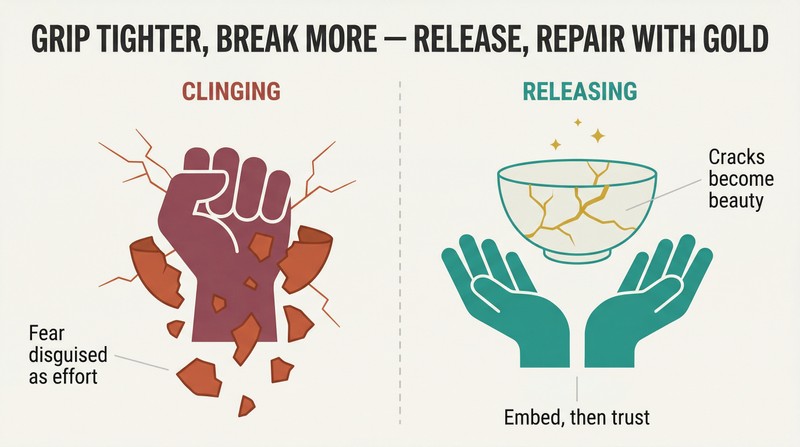
After embedding your intention, practice the art of releasing it
Clinging to outcomes is fear wearing a different mask. Lynne Twist, obsessively running the Hunger Project, felt called to protect the Amazon but couldn't release her obligations — until two strains of malaria flattened her for eight months. In forced stillness, her new vision crystallized. 'I'm so grateful I didn't get diagnosed right away,' she reflects, 'because I would have gotten well too fast.'
Doty draws on kintsugi — the Japanese art of repairing broken pottery with gold — as a model for relating to failure. Instead of hiding cracks, highlight them. Research on experienced meditators supports this: they feel pain more intensely on a sensory level but resist it far less, making it significantly less unpleasant. Manifestation's final paradox: visualize, embed, pursue — then breathe and trust what unfolds.
Analysis
Mind Magic occupies a peculiar position in the manifestation genre: it's written by someone with neurosurgical credentials who also learned visualization from a woman named Ruth in a magic shop. This duality is both the book's greatest strength and its methodological tension. When Doty explains value tagging, brain network collaboration, and the parasympathetic prerequisites for embedding intention, the science is credible and grounded in peer-reviewed research. When he ventures into quantum coherence, vibrational energy, and synchronicity, the empirical footing grows softer.
What distinguishes the book from predecessors like Byrne's The Secret or Napoleon Hill's Think and Grow Rich is Doty's unflinching autobiographical honesty. The bankruptcy narrative — getting everything on his childhood wish list and discovering it was a symptom of unhealed shame — does more persuasive work than any brain scan. It transforms the book from a manifesting manual into a cautionary memoir about the difference between desire and need. This structural choice is shrewd: readers remember stories, not neural pathway diagrams. The Fredrickson-Cole research on hedonic versus eudaimonic gene expression is the book's scientific crown jewel, providing hard biological evidence that meaning outperforms pleasure at the cellular level. Yet it's buried in Chapter 4 rather than serving as the organizing principle — a missed opportunity for a book arguing that what you want matters as much as how you manifest it.
The six-step framework — relax, clarify, remove obstacles, embed, pursue, release — is essentially a neuroplasticity-based cognitive behavioral protocol wrapped in contemplative language. Stripped of manifestation vocabulary, it closely resembles evidence-based interventions: progressive muscle relaxation, cognitive restructuring, mental rehearsal, and acceptance-based strategies. This isn't a criticism — it's perhaps the book's most important contribution: making proven techniques accessible to people who would never pick up a clinical psychology textbook.
Doty's central paradox — that the same brain creating your obstacles is the only tool that can overcome them — is both empowering and humbling. It places full responsibility on the individual without the cruelty of blaming victims for their circumstances. That is a difficult line to walk, and Doty walks it more honestly than most in this space.
Review Summary
Readers find Mind Magic to be a thought-provoking blend of neuroscience and self-help, offering practical techniques for manifestation. While some praise its scientific approach and life-changing potential, others feel it retreads familiar ground. The book's strength lies in explaining the neurological basis for visualization and intention-setting, though some readers desired more in-depth scientific exploration. Overall, it's viewed as an insightful read for those interested in the intersection of brain science and personal development.
People Also Read










Glossary
Value tagging
Brain's importance-flagging systemThe brain's mechanism for determining the importance of incoming information, primarily based on emotional content. In Doty's framework, strong positive emotions experienced during visualization signal to the salience network that a goal is meaningful, causing it to be embedded in the subconscious and pursued automatically by brain resources working below conscious awareness.
Green Zone
Calm, focused optimal stateDoty's term for the physiological state occurring when the parasympathetic nervous system is activated and vagal tone increases. In the Green Zone, a person is calm, focused, in flow, and able to care for others. This is the state that makes manifesting possible by putting the cortex in the driver's seat rather than the fight-or-flight stress response.
Filing clerk and bloodhound
Subconscious storage and scanningDoty's metaphor for two functions of the subconscious mind. The 'filing clerk' manages limited storage, classifying information as important based on repetition and emotional intensity. Once an intention is filed, the 'bloodhound' relentlessly scans the environment around the clock for opportunities to fulfill it, working entirely below conscious awareness.
Alphabet of the heart
Ten heart-opening values mnemonicDoty's mnemonic framework using the letters C through L (CDEFGHIJKL) representing ten values: Compassion, Dignity, Equanimity, Forgiveness, Gratitude, Humility, Integrity, Justice, Kindness, and Love. Originally created for a medical school ceremony, Doty uses it as a daily meditation to set intention each morning and reset when frustrated or overwhelmed.
Vegas Effect
Phone dopamine exploitation patternDoty's term for how smartphone notifications exploit the same psychological mechanism as slot machines—a variable ratio reinforcement schedule. Unpredictable rewards like messages, likes, and content trigger dopamine release that captures attention in an endless loop. The average American spends approximately 1,460 hours per year—about 91 waking days—on their smartphone, largely due to this effect.
Cognitive ease
Familiar equals low energy costApplied by Doty from behavioral economics to manifestation, cognitive ease describes the brain's preference for processing information that is already familiar, requiring less energy. By repeatedly visualizing a goal until the brain is intimately acquainted with every detail, a person reduces the energetic cost of accepting the goal when it appears in reality—like slippers the brain slides into without resistance.
Dispositional optimism
General expectation of good outcomesA generalized tendency to expect positive outcomes across important life domains, cultivated through manifestation practice. Research cited by Doty links dispositional optimism to improvements in cardiovascular health, faster wound healing, and slower disease progression. Doty frames manifestation fundamentally as a practice that builds this optimistic orientation toward life.
FAQ
What's Mind Magic about?
- Exploration of Manifestation: Mind Magic by James R. Doty explores the neuroscience behind manifestation, showing how thoughts and intentions can shape reality. It combines scientific insights with practical exercises.
- Six-Step Program: The book outlines a six-step program to master manifestation, including reclaiming focus, clarifying desires, and embedding intentions in the subconscious.
- Personal Journey: Doty shares his personal experiences, illustrating how he transformed his life through manifestation principles, making the content relatable and inspiring.
Why should I read Mind Magic?
- Scientific Foundation: The book is grounded in neuroscience, providing a credible framework for understanding how our minds work in relation to manifestation.
- Practical Exercises: It offers actionable practices, allowing readers to apply the concepts in their own lives and cultivate a mindset conducive to achieving goals.
- Inspiring Stories: Doty shares compelling stories, including his own, which illustrate the transformative power of manifestation and motivate readers to believe in their potential.
What are the key takeaways of Mind Magic?
- Power of Intention: Clearly defined intentions, when embedded in the subconscious, can significantly influence our lives, highlighting the importance of mindfulness.
- Neuroplasticity: Doty explains how neuroplasticity allows our brains to change based on thoughts and experiences, enabling us to reshape our brains to support our goals.
- Self-Agency: Reclaiming inner power and self-agency is crucial for effective manifestation, encouraging readers to direct their thoughts and actions toward desired outcomes.
What is the six-step program in Mind Magic?
- Reclaim Your Power: Focus on regaining control over thoughts and attention, essential for effective manifestation.
- Clarify What You Truly Want: Define true desires and visualize success, crucial for embedding intentions in the subconscious.
- Remove Obstacles: Identify and address limiting beliefs and negative self-talk, cultivating self-compassion to dismantle mental barriers.
- Embed the Intention: Use visualization and emotional connection to embed intentions into the subconscious.
- Pursue Your Goal Passionately: Actively pursue goals with enthusiasm and commitment, highlighting the importance of taking action.
- Release Expectations: Let go of attachment to specific outcomes, remaining open to possibilities and allowing "magic" to unfold.
How does Mind Magic define manifestation?
- Intentional Process: Manifestation is the process of clearly defining an intention and embedding it into the subconscious mind.
- Neuroscience of Manifestation: Rooted in neuroplasticity, it involves reshaping neural pathways to support goals through focused thought.
- Inner Power: Emphasizes harnessing inner power and self-agency to create desired outcomes, encouraging belief in one's ability to influence reality.
What specific methods does Mind Magic recommend for manifestation?
- Visualization Techniques: Detailed visualization practices help embed intentions in the subconscious, focusing on both outcomes and associated emotions.
- Self-Compassion Practices: Cultivating self-compassion counters negative beliefs and self-doubt, healing parts that feel unsafe and unloved.
- Rituals and Repetition: Engaging in rituals and repeating affirmations reinforce intentions, as the subconscious responds to strong emotions associated with behaviors.
What are the best quotes from Mind Magic and what do they mean?
- “The universe doesn’t give a fuck about you.”: Emphasizes that success or failure is determined by mindset and actions, not external forces.
- “Where attention goes, energy flows.”: Highlights the importance of focusing mental and emotional energy on intentions to achieve them.
- “Manifesting is about cultivating a fierce belief in possibility.”: Stresses maintaining a positive outlook and belief in potential to create change.
How does the brain influence manifestation according to Mind Magic?
- Energy Consumption: The brain consumes significant energy, crucial for forming connections that support manifestation processes.
- Subconscious Filtering: The brain filters stimuli, prioritizing information based on importance, making it essential to familiarize the subconscious with goals.
- Neural Networks: Neural networks can be trained to recognize and pursue intentions, enhancing the brain's ability to seek opportunities aligned with desires.
How does Mind Magic address limiting beliefs?
- Identifying Negative Beliefs: Encourages recognizing and confronting limiting beliefs, often stemming from childhood experiences.
- Transforming Beliefs: Provides strategies for transforming negative beliefs into positive affirmations, reframing mindset.
- Self-Compassion as a Tool: Emphasizes self-compassion in overcoming limiting beliefs, creating a supportive internal environment for growth.
What role does self-compassion play in Mind Magic?
- Healing Negative Beliefs: Self-compassion helps heal negative beliefs that hinder manifestation, fostering a supportive mindset.
- Encouraging Growth: Allows individuals to approach goals with kindness, fostering resilience and persistence.
- Creating a Safe Space: Creates a safe emotional space to explore desires and intentions, alleviating fear and anxiety.
How can I apply the concepts from Mind Magic in my daily life?
- Daily Visualization: Incorporate daily visualization practices to reinforce intentions, imagining goals in vivid detail.
- Journaling: Keep a journal to track thoughts, feelings, and progress, clarifying desires and reinforcing commitment.
- Engage in Rituals: Create personal rituals, such as lighting a candle or repeating affirmations, to serve as reminders of intentions.
What are the obstacles to manifestation discussed in Mind Magic?
- Negative Self-Talk: Negative beliefs and self-doubt can undermine confidence and act as barriers to manifestation.
- Fear of Failure: Fear of not achieving goals creates resistance, requiring acknowledgment and self-compassion to alleviate impact.
- Attachment to Outcomes: Over-attachment to specific outcomes can lead to disappointment, emphasizing the importance of releasing expectations.
About the Author
Other books by James R. Doty

Download PDF
Download EPUB
.epub digital book format is ideal for reading ebooks on phones, tablets, and e-readers.








































