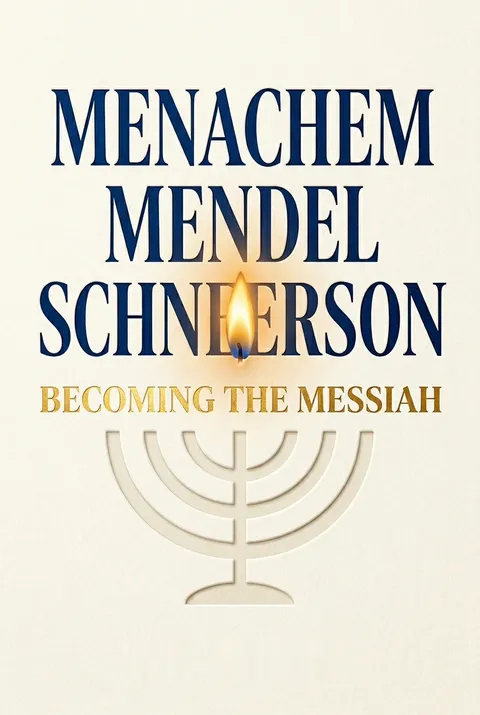

Key Takeaways
1. The Enigmatic Rebbe: A Paradox of Modernity and Fundamentalism
How, then, could I, a nonbeliever, understand someone like Menachem Mendel Schneerson?
A Man of Contradictions. Menachem Mendel Schneerson, the seventh Lubavitcher Rebbe, embodied a profound paradox. He possessed a scientific education from universities in Paris and Berlin, spoke multiple languages, and engaged with contemporary political and social developments. Yet, he was an uncompromising fundamentalist who rejected evolution, believed in geocentrism, and adhered to rigid traditionalism.
Early Life and Intellect. Born in Nikolaev, Ukraine, in 1902, Schneerson displayed early intellectual prowess and a keen interest in science and mathematics. His youth was marked by the turmoil of the Russian Revolution and antisemitic pogroms, experiences that shaped his worldview. Despite his traditional Hasidic upbringing, he pursued secular studies, preparing for an engineering career, a path unusual for a future Hasidic leader.
A Unique Synthesis. Schneerson's intellectual journey was not about reconciling science and faith but demonstrating Judaism's all-encompassing scope. He saw scientific laws as encompassed by Torah teachings, viewing secular learning as a test of his hypothesis that modernity could be integrated within Judaism without compromise. This brazen self-confidence in his faith's universality would define his later leadership.
2. Chabad's Core Theology: Divine Immanence and Human Purpose
For the Hasidic masters, however, these ideas took on new life and breathed a new spirit.
All Is God. Chabad Hasidism, founded by Shneur Zalman of Lyady, teaches a radical doctrine of Divine immanence: the world is not merely created by God but is a continuous manifestation of the Divine, existing only through God's constant presence. This means that any perceived distance from God is perceptual, not real, and Divinity is present throughout creation.
The Paradox of Creation. God, though infinite, requires concealment to be revealed. Creation, therefore, serves to obscure the Divine light, allowing it to shine through a veil. Humanity's task, particularly the Jewish people's, is to reveal God's presence through:
- Performing commandments
- Studying Torah
- Prayer and contemplation (devekut and bittul)
Lowest World, Highest Purpose. Chabad theology posits that the ultimate purpose of creation is not the higher spiritual worlds, but our own lowest, material world. Paradoxically, its very distance from God makes it suitable for the greatest Divine revelation. This concept, rooted in the Midrash, suggests that God desires a "dwelling in the lower worlds," implying that the greatest light can shine from the deepest darkness.
3. From Private Scholar to Public Leader: The Reluctant Ascent to Rebbe
What happens when the Messiah comes?
The Succession Crisis. Following the death of his father-in-law, Yosef Yitshak Schneersohn, in 1950, Schneerson faced a succession crisis. Despite his scholarly reputation and piety, he was an unconventional candidate, having spent years in European universities. His brother-in-law, Shmaryahu Gourary, seemed the more traditional choice, having managed Chabad institutions for decades.
Reluctance and Acclimation. Schneerson initially refused the leadership, insisting that Yosef Yitshak remained the Rebbe even in death, a stance consistent with Chabad tradition. However, pressure from Hasidim, who saw in him a unique blend of traditional piety and worldly intellect, eventually led him to acquiesce. His first discourse, delivered on the anniversary of Yosef Yitshak's passing, was a powerful manifesto, identifying himself as the "seventh" generation leader destined to bring the Messiah.
A New Kind of Rebbe. Schneerson's acceptance marked a shift. He transformed from a private scholar, who once covered his walls with astronomical maps, into a public figure. He adopted the rabbinical frock coat and began to lead farbrengens and private consultations (yehidut). This transition was not without internal conflict, as some older Hasidim and his nephew, Barry Gourary, struggled with his unconventional path and eventual leadership.
4. Messianism as the Driving Force: Activating Redemption in the Present
For the practical engineer he once was, faith, while necessary, wasn’t enough.
The Urgency of Redemption. Schneerson's messianism was not a passive hope but an active, insistent call to action. He believed his generation was not just in the "footsteps of the Messiah" but the "footsteps of the footsteps," making the arrival of the Redeemer an immediate, practical reality. This conviction transformed Chabad's spiritual orientation from inner absorption (bittul) to outward engagement.
Reconciling Paradoxes. Schneerson ingeniously reconciled Maimonides's rationalist messianism (no miracles, gradual change) with Kabbalistic and Hasidic visions of ultimate Divine revelation. He proposed a three-stage redemption:
- Stage 1: Present world, struggle between good and evil.
- Stage 2 (Messianic Age): Struggle won, humanity returns to prelapsarian state, Temple rebuilt, exiles gathered. Maimonides's non-miraculous stage.
- Stage 3 (Final Redemption): Resurrection of the dead, ultimate revelation of God.
Messianic Actions Now. For Schneerson, human actions in the present directly influenced the future messianic era. He taught that studying the laws of the messianic age (e.g., Maimonides's Mishneh Torah) was both preparation and a symbolic enactment of that future. The core message was that every Jew had a role in hastening redemption through "repentance and good deeds," transforming the world into a dwelling for God.
5. The "Breaking Out" Strategy: Global Outreach and Mitzvah Campaigns
The Hebrew word for “and you shall break out”—ufaratsto—became a slogan for Chabad ambitions and, rendered as a song, the march to whose rhythm Schneerson’s followers settled in city after city, country after country.
From Preservation to Proliferation. Building on Chabad's historical network of emissaries, Schneerson dramatically expanded its outreach. He reinterpreted the biblical verse "you shall break out to the West and to the East, to the North and to the South" as a messianic imperative to spread Judaism globally. This transformed Chabad from a parochial Hasidic group into an unprecedented worldwide outreach empire.
Mitzvah Campaigns and Modernity. Schneerson launched military-style "mitzvah campaigns" focused on specific Jewish practices, such as:
- Putting on tefillin (especially during the Six-Day War)
- Lighting Sabbath candles (Neshek - "weapon")
- Studying Torah daily
- Hanging mezuzot
- Giving to charity
These campaigns utilized modern technology (e.g., "mitzvah tanks") and targeted estranged Jews, particularly university students, appealing to their idealism and spiritual seeking.
Love, Not Reproach. Schneerson's outreach philosophy was rooted in the Chabad teaching that all Jewish souls are inherently Divine and good. He emphasized love and compassion over condemnation, believing that every mitzvah, however small, was of infinite value and would lead to further commitment. This inclusive approach, combined with practical social services, allowed Chabad to connect with diverse Jewish populations globally.
6. Navigating the Secular World: Science, Politics, and Cultural Engagement
Everything that happens in 1972 has a place in the Torah, and it must be interpreted, it must be explained, it must be evaluated from the point of view of Torah even if it happened for the first time in March of 1972.
Torah's All-Encompassing Scope. Schneerson believed that Judaism encompassed all knowledge, including science, politics, and culture. He engaged with scientific theories, not to reconcile them with faith, but to assert the Torah's infallibility, often arguing that science's "uncertainty" left room for traditional beliefs, even on issues like geocentrism or the age of the universe.
Politics and Public Morality. While generally nonpartisan, Schneerson advocated for religion in the public sphere, viewing the U.S. as a fundamentally religious nation whose moral well-being depended on Divine law. He supported:
- Government aid for parochial schools
- A "moment of silence" in public schools (after the Regents' Prayer ban)
- The Noahide laws for non-Jews, seeing them as a universal moral code.
His positions often put him at odds with liberal Jewish organizations, who prioritized church-state separation.
Feminism and Women's Roles. Schneerson's approach to women was complex. He empowered Chabad women in education and outreach, seeing them as vital to the movement's mission and even possessing superior spiritual capacity in the messianic age. However, he simultaneously critiqued feminism as an attempt to imitate men, insisting on traditional gender roles rooted in women's "inherent inclinations" as nurturers and homemakers.
7. A Heart in the East: Deep Involvement in Israel's Destiny
For him to assume influence over the policies and politics of the country was insufferable.
A Rebbe Apart. Schneerson never visited Israel, believing his mission was to lead Jews in the diaspora and that his presence was needed near his predecessor's grave. He maintained a principled anti-Zionism, rejecting the notion that the State of Israel held messianic significance or that its establishment was a fulfillment of prophecy. He feared it would divert attention from true redemption.
Pragmatic Engagement. Despite his ideological stance, Schneerson was deeply invested in Israel's welfare. He saw its existence as a result of Divine providence, a refuge for Jews after the Holocaust. He cultivated relationships with Israeli politicians, including prime ministers and presidents, and actively sought to influence the country's policies, particularly on:
- The "Who is a Jew?" question, advocating for Orthodox definitions.
- Territorial compromise, opposing any land concessions for security reasons.
- Praising the Israeli military and its soldiers, attributing their victories to miracles.
Controversial Influence. Schneerson's hardline positions and his remote influence drew sharp criticism from both secular Israelis and other Orthodox leaders, notably Rabbi Elazar Menachem Man Shach, who called him "the madman who sits in New York." His intervention in Israeli electoral politics, such as preventing the formation of a left-leaning coalition in 1990, demonstrated his willingness to exert decisive influence from afar.
8. The Rebbe's Charisma: Building a Movement Larger Than Life
For his Hasidim he was a holy, infallible figure, and many admirers outside the movement held him in high regard.
Routinization and Expansion. After a heart attack in 1977, Schneerson adapted his leadership style, reducing private meetings (yehidut) but increasing the frequency and length of public farbrengens. He also innovated the "general yehidut" for groups and the "Dollars" initiative, where he distributed dollar bills for charity, maintaining personal connection while maximizing his reach.
Media Mastery. Schneerson embraced modern media to spread his message globally. He allowed his talks to be:
- Transcribed and published in multiple languages.
- Broadcast via telephone hookups to communities worldwide.
- Recorded on cassette tapes.
- Documented by photographers, leading to his iconic image appearing on posters and billboards.
- Broadcast on cable and satellite TV, and later, the internet.
This made him one of the most recognizable rabbis globally, fostering a sense of intimacy with followers despite physical distance.
Mythic Proportions. Schneerson's charisma and the stories of his miraculous abilities—from healing to precognition—contributed to his larger-than-life persona. While he often downplayed these powers, he never fully denied them, allowing his followers to see him as a saintly, infallible figure, a "nasi" (prince) of his generation, and even the Messiah himself. This blend of personal magnetism and strategic ambiguity fueled the growing messianic speculation around him.
9. The Final Push: Accelerating Redemption in the Face of Mortality
I don’t know what else I can do. Everything I’ve done until now has been futile and fruitless. It hasn’t helped—we are still in exile . . . The only thing I can do is pass the problem to you.
Personal Loss and Decline. The death of his wife, Chaya Mushka, in 1988 deeply affected Schneerson, marking the end of his closest personal relationship. His own health was declining, and the absence of a successor intensified the urgency of his messianic mission. He began preparing for his eventual death by drafting a will and accelerating the publication of his vast body of work.
Intensified Messianic Campaign. In his final years, Schneerson's focus narrowed almost exclusively to the "Moshiach campaign." He interpreted global events like the Gulf War and the collapse of the Soviet Union as clear harbingers of redemption, citing ancient prophecies. He declared that all preparations were complete, and the Messiah was not just imminent but "already arrived," awaiting only acceptance and revelation.
The "Infamous Sermon" and Ambiguity. In April 1991, a frustrated Schneerson delivered a sermon lamenting the Messiah's delay, blaming his followers for their insufficient efforts and declaring his own work "futile." This shocking address, coupled with his increasingly explicit, yet ambiguous, statements about the Messiah's presence and his own potential role, fueled a messianic frenzy among his Hasidim. While he never unequivocally declared himself the Messiah, his words and actions were widely interpreted as such, leading to widespread public proclamations by his followers.
10. A Legacy of Growth and Division: Chabad After the Rebbe
By his own standard of success—bringing the Messiah—he failed. By any other measure he succeeded enormously.
The Crisis of Succession. Schneerson's stroke in 1992, rendering him unable to speak, and his subsequent death in 1994, plunged Chabad into a profound crisis. His followers, who largely believed him to be the Messiah, struggled to reconcile his passing with their messianic expectations. The absence of a designated successor led to internal power struggles and ideological divisions.
Enduring Divisions. Today, Chabad remains split over the question of Schneerson's messianic status. A significant faction openly proclaims him the Messiah, using slogans and symbols like "King Messiah" and "Yechi" (Long Live). The institutional core, however, while not denying the possibility, maintains a more restrained stance, prioritizing cohesion and outreach over explicit messianic declarations, which they believe alienate outsiders.
A Global Phenomenon. Despite these internal challenges, Chabad has experienced enormous growth since Schneerson's death, far exceeding its size during his lifetime. His legacy is evident in:
- Thousands of emissary families operating institutions in over 100 countries.
- Millions touched by Chabad's social services, education, and holiday programs.
- His teachings and image continuing to inspire and guide the movement.
Schneerson transformed a beleaguered Hasidic group into a worldwide force, leaving an indelible mark on the Jewish world, even as the dream of immediate redemption remains perpetually awaited.
People Also Read






Download PDF
Download EPUB
.epub digital book format is ideal for reading ebooks on phones, tablets, and e-readers.








































