

Key Takeaways
Only weak, needy men fully want the woman you currently are
The book's brutal opening claim. Lambert argues that the confident, high-value men women crush on do not settle for "typical" women. They sleep with them, keep them around for company, then trade up. The men who actually chase and commit to typical women are the damaged, needy, or under-employed ones who need something a woman provides. His evidence comes from advising tens of thousands of women who kept returning heartbroken despite doing everything "right."
The uncomfortable diagnosis: the flaw holding you back is not bad luck or a shortage of good men, it is you being predictable. The excuses ("no good men in my city," "not looking for love") are shields against confronting that you have not learned to stand out. The book positions itself as a mirror, not a hug.
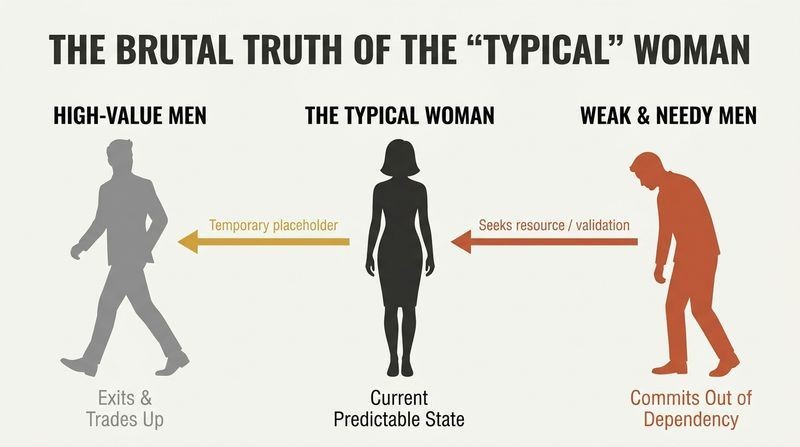
The framing is deliberately provocative, a marketing hook borrowed from tough-love coaching. Its strength is refusing the comforting external-blame narratives ("men ain't shit") that keep people stuck. Its weakness is a survivorship-bias sample: Lambert only hears from women in crisis, so his model of "all men" skews toward players. Research on assortative mating suggests people largely pair with partners of similar attractiveness and social value, complicating the claim that elite men universally discard accomplished women. Still, the underlying cognitive-behavioral move (stop explaining failure through unchangeable externals, examine your own patterns) is sound and echoes locus-of-control research linking internal attribution to better outcomes.
Your degree, cooking, and body are crutches men have seen a thousand times
Credentials are not personality. Lambert insists that a career, financial independence, domestic skills, sexual reputation, and looks are all interchangeable "false confidence crutches." A successful man dates multiple educated, employed, attractive "good women" a month, so none of these read as rare. He mocks the universal pitch, "I'm not like other women," as the single most typical thing a woman can say, since everyone says it.
The reframe: stop leaning on external assets and cultivate the intangibles, charisma, wit, fire, a genuine worldview. His memorable line reframes the whole self-presentation game: instead of listing what you bring to the table, become the table. He also punctures "good pussy" mythology as unmeasurable propaganda men invented, and "Fake Pretty" as self-worth built on others' validation rather than internal beauty.
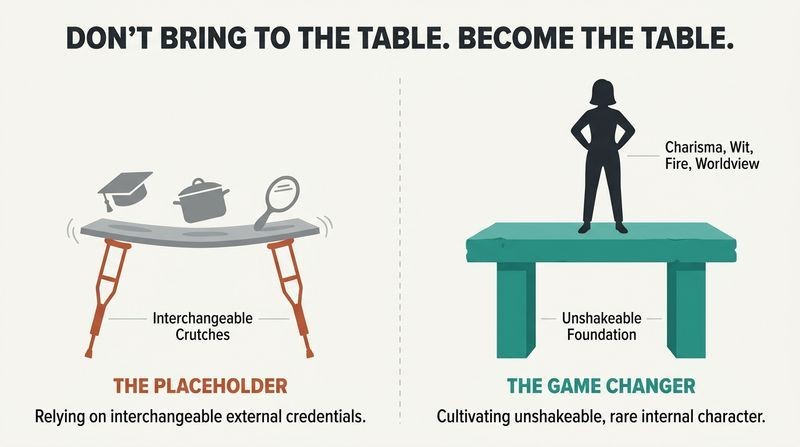
This maps neatly onto signaling theory. Credentials are "common signals" that fail to differentiate in a market saturated with them, while personality functions as a harder-to-fake, harder-to-copy signal. Behavioral economists would call it a commoditization problem: when every competitor offers the same features, differentiation collapses to something else. The claim that all bodies feel identical during sex is biologically overstated and mostly rhetorical, meant to demolish a specific insecurity. The genuinely useful kernel, supported by relationship science, is that novelty and status fade fast while conversational chemistry and shared meaning predict long-term satisfaction far better than looks or income.
You can have a boyfriend, even a husband, and still be a placeholder
The core distinction. Men mentally sort women into Sexual Object versus Romantic Interest, or as the book puts it, Pussy versus Wifey. A Placeholder is a woman a man keeps for the girlfriend experience (dates, sex, company) while he waits for a Game Changer, the rare woman who sparks him to actually settle down and change his life direction. Placeholders do not know they are placeholders; he tells them he cares, does a few nice things, but is never truly "in love."
How to spot it: he seems distracted, spends more time with friends, cannot verbalize deep feelings, and stress spikes when you want something he does not. Lambert's rule: all women are Pussy until proven Wifey, and men treat objects like romantic interests precisely to keep the benefits flowing without commitment.
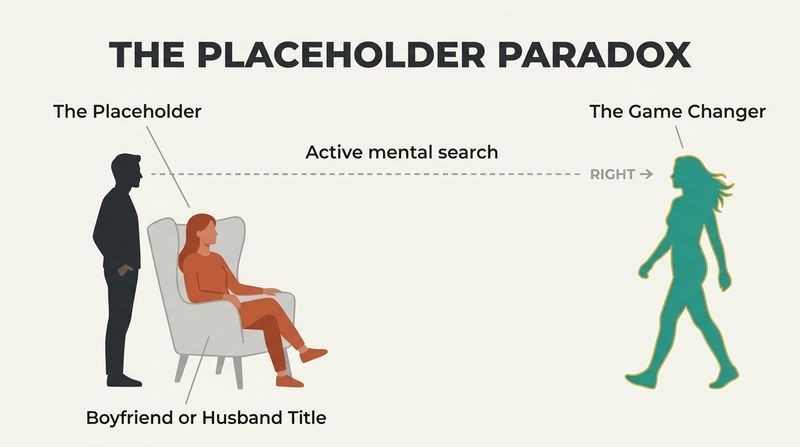
The placeholder concept overlaps with modern dating vocabulary like "breadcrumbing" and "benching," and with the sunk-cost trap: the longer a woman invests, the harder she rationalizes staying. What is analytically sharp is separating commitment (a title) from investment (emotional stakes), a distinction couples therapists stress constantly. The framing is bleakly transactional and assumes men operate with cold strategic clarity, which overstates conscious calculation; much placeholder behavior is ambivalence, not a plot. Yet the actionable insight holds: a title is weak evidence of being valued. Observed behavior, consistency, and effort are the data that actually matter.
Men chase new sex for the conquest and adrenaline, not the orgasm
Reframing infidelity. Lambert argues the pursuit of "new pussy" has little to do with the physical act, which he says feels good with anyone, and everything to do with the thrill of conquest and novelty. A man content with a single partner would just masturbate or stick with one woman. Instead men are wired like thrill-seekers chasing the rush of the unknown, the same drive behind skydiving or fast cars. New lingerie and positions cannot compete because it is "still old."
The famous line: a man is only as faithful as his options. A man with few interested women behaves not because he is more moral, but because no one is offering. This means you cannot sex-proof a relationship by being freakier; you can only pick a man with discipline.
This aligns strikingly with the Coolidge effect, a documented phenomenon where male mammals show renewed sexual interest when presented with new partners even after satiation with a current one. Evolutionary psychology supports novelty-seeking as a real variable in male sexuality. But Lambert overreaches by treating options as near-deterministic; longitudinal studies show commitment, attachment security, and satisfaction meaningfully predict fidelity, and plenty of high-option men stay faithful by choice. His own concession, that any man can choose not to chase, quietly undercuts the fatalism. The practical takeaway (screen for self-discipline rather than trying to out-perform hypothetical rivals) is wiser than the deterministic framing suggests.
Skilled seducers bypass dating by flattering the wound you hide
The way to a woman's heart is through her ego. Lambert calls the dangerous operator a Dicknotist: an attractive, socially confident man who reads a woman's insecurities and weaponizes flattery. He does not compliment your eyes; he identifies your unhealed spot (trust issues, long loneliness, feeling unseen) and becomes the cheerleader who validates it. He listens, agrees you were wronged, mirrors your pain, and never actually reveals himself.
The mechanism: two women are easiest prey, those with trust issues and those single a long time, because both crave proof that nothing is wrong with them. The genius is that he wins loyalty not by earning trust over time but by handing out ego strokes that feel like intimacy. His antidote is to stop letting a man get you "talking about you" and instead investigate him.
This is a lucid lay description of what psychologists call love bombing and what con-artistry research calls "the accomplice within": the victim's own desire does the work. Robert Cialdini's studies on liking and the "conversational narcissism" literature both confirm people bond intensely with those who let them talk and affirm them. The uncomfortable irony is that Lambert then coaches women to run the identical playbook on men. That symmetry is honest but ethically murky. The defensive value is real, though: recognizing that rapid, effortless emotional intimacy is a red flag rather than destiny is genuinely protective against manipulators of any gender.
Put yourself at the center: selfishness is the Spartan's savior
The central transformation. A "Spartan" is Lambert's term for a woman who rejects the trained female script of self-sacrifice and altruism, which he calls propaganda designed to keep women serving others while men accumulate power. His inversion: selflessness is the sin, self-preservation is the virtue. Stop putting the man, friends, and family before yourself out of guilt.
Practical moves:
1. Rebrand yourself with a powerful identity and commit to it.
2. "Find your sexy" by standing at the mirror until you genuinely love your reflection, flaws included, because others only notice what you flag as flawed.
3. Cut people who drain you; you are the star of your movie, everyone else is supporting cast.
The insight beneath the aggression: confidence built on assets others can buy is fragile; confidence built on self-worth is not.
Stripped of its combative packaging, this is standard self-esteem and boundary work, consistent with self-determination theory's finding that autonomy and self-regard predict wellbeing and healthier relationships. The mirror exercise resembles evidence-based self-compassion and body-neutrality practices. The philosophical scaffolding borrows heavily from Nietzsche's master-slave morality and Ayn Rand's ethical egoism, which Lambert cites in spirit. The risk is that pure self-interest, taken literally, corrodes the reciprocity and mutual sacrifice that longitudinal relationship research (Gottman and others) identifies as essential to lasting partnership. The strongest reading is "stop over-functioning for others," not "never give," a distinction the rhetoric sometimes blurs.
Treat your life as a universe you author, not a fate you endure
Goddess Consciousness. The book's metaphysical engine claims your thoughts create your reality. Lambert leans on the dream metaphor (your mind builds convincing worlds nightly), quantum-physics soundbites about observers collapsing possibilities, and New Thought ideas to argue you are the sole "observer" projecting your experience. Fear-based thoughts manifest fearful outcomes; if your dominant expectation is failure, wins feel like flukes you explain away.
The practical directive: stop hoping, wishing, and crossing your fingers, all of which betray an underlying expectation of loss. "Remember to remember" that you are the creator, and act without the counter-thoughts ("but what if he doesn't like me") that sabotage results. He warns against fake positivity and "boomerang" transactional thinking (do good to get rewards); instead, act from settled certainty that life bends toward you.
The quantum-mechanics gloss is scientifically unsound; the observer effect concerns measurement of particles, not human intention shaping outcomes, a misreading common to Law of Attraction literature. Physicists have repeatedly disowned this appropriation. That said, the operational core survives without the metaphysics: expectations shape behavior. This is well-documented as self-fulfilling prophecy, the Pygmalion effect, and the confidence-competence loop. Approaching dating from abundance rather than scarcity genuinely changes body language, risk tolerance, and outcomes. The danger is the flip side Lambert glosses over: "thoughts create reality" can curdle into victim-blaming, implying assault or misfortune was self-manifested. Use the psychology, discard the pseudo-physics.
Date like a detective: ask disarming questions and let him talk
Be Oprah, not Ellen. The first date is an interrogation disguised as fun, not an audition where you prove your worth. Lambert's biggest reversal is the top "Dick Tactic" flipped onto men: shut up and let him talk. Men extract easy sex by getting women monologuing about their exes and insecurities. A Spartan does the extracting instead.
Techniques from the Cali example:
1. Ask random, unrehearsed questions ("what's the closest you came to hitting someone?") that bypass his prepared "representative" mask.
2. Frame probes through third parties ("why wasn't she your type?") to surface real views without triggering defensiveness.
3. Stay sober while keeping his glass full.
4. Never pay; the man covering the bill is the only hard proof of effort.
5. End on a high, leaving him wanting more.
The listening advice is the book's most durable, evidence-backed tactic. Studies on relationship formation show that people who ask follow-up questions are rated more likable, and that self-disclosure elicited from others accelerates bonding while protecting the questioner's own information asymmetry. Intelligence analysts and skilled interviewers use exactly these indirect, hypothetical framings to get past rehearsed answers. The "never pay" rule is more culturally contingent; framing a paid bill as the sole proof of interest imports a specific gendered economy that many egalitarian couples reject. But the deeper principle, that observed behavior beats stated intentions as evidence of character, is analytically excellent and transfers well beyond dating.
Grant sex only after he over-invests, never merely because he offered a title
The three-part sex test. Lambert rejects arbitrary rules (90 days, three dates) and the belief that becoming "official" proves intent. He argues men will happily accept a title just to unlock sex, then coast. Instead, a man earns intimacy by demonstrating over-investment across three areas:
1. Time Spent Creatively, still planning real dates and creative conversation, not lazy couch-and-takeout.
2. Aggressive Pursuit, visibly frustrated that he cannot lock you down, still chasing.
3. Shared World Companionship, genuine friendship where losing you means losing an irreplaceable confidant.
Why it works: like an investor who has poured in time and money, a man this deep cannot easily walk away after sex. The title, he stresses, is only as binding as you make it; effort that outweighs words is the real signal.
This reframes commitment testing through the economics of sunk investment and costly signaling. A man who has expended significant non-refundable effort has demonstrated preference more credibly than one who merely says "be mine," which is cheap talk. Behavioral game theory supports the logic: costly, hard-to-fake signals carry more information than free assertions. The friendship criterion is especially well-founded; decades of Gottman research identify deep friendship and mutual fondness as the strongest predictors of relationship durability. The scheme's weakness is its adversarial staging, testing a partner while concealing your own strategy, which can select for men who enjoy pursuit games over those who simply communicate directly and early.
Stay ready to walk away and no man can ever control you
Risk the Dick. For women already in a struggling relationship, Lambert's prescription is to mentally reach the point where losing him no longer frightens you. Fear of being single, judged a failure, or never finding another man is what makes women tolerate disrespect and cling to sinking relationships out of pride rather than happiness.
The power shift: once you genuinely believe you do not need any specific man and can attract another, you behave like someone with nothing to lose, and he responds like a man afraid of being replaced. The book demands you first diagnose honestly, are you actually happy, then be willing to gamble the relationship to reset the balance. He is blunt that most women stay not from love but from a terror of the humiliation of another public failure.
This is a textbook description of negotiation leverage. In negotiation theory, your power comes from your BATNA, your best alternative to a negotiated agreement; the party more willing to walk holds the stronger hand. Applied to relationships, it maps onto the "principle of least interest," a sociological finding that whoever is less emotionally dependent holds more control. The insight is real and empowering against genuine mistreatment. The caution is that manufactured indifference and constant walk-away threats can also erode the vulnerability and secure attachment that healthy intimacy requires. Leverage keeps you from being exploited; it does not, by itself, build closeness.
A Spartan never begs to stop a breakup; she treats it as rebirth
The final trick question. Lambert titles his last chapter "How to Stop a Breakup" then reveals it is a trap. The "blue pill" answer is to give in, forgive everything, submit, and reclaim placeholder status, which he mocks as retreating to comfortable weakness. The "red pill" truth: a genuinely empowered woman would never ask how to stop a breakup, because a Queen is held onto, not the one holding on.
Reframing loss: if a relationship fails despite real effort, that is evidence it was never meant to last, just a rung on the ladder to a stronger partner. The man you attracted reflects who you were when you manifested him; as you grow, you draw better. The closing message is that the breakup is not a tragedy to prevent but a shedding, and your own self-love is the salvation you were seeking in men.
The rhetorical bait-and-switch is effective pedagogy, forcing readers to notice their own scarcity reflex. Psychologically, the reframe echoes post-traumatic growth research, which finds that people who narrate loss as meaningful transition recover better than those who catastrophize. It also resembles attachment work on moving from anxious clinging toward secure autonomy. The genuine risk is absolutism: treating every failed relationship as "meant to end" can rationalize avoidance and prevent the repair skills that actually save salvageable partnerships. The healthiest reading is that self-worth should not be hostage to any one person, not that fighting for love is inherently weakness.
Analysis
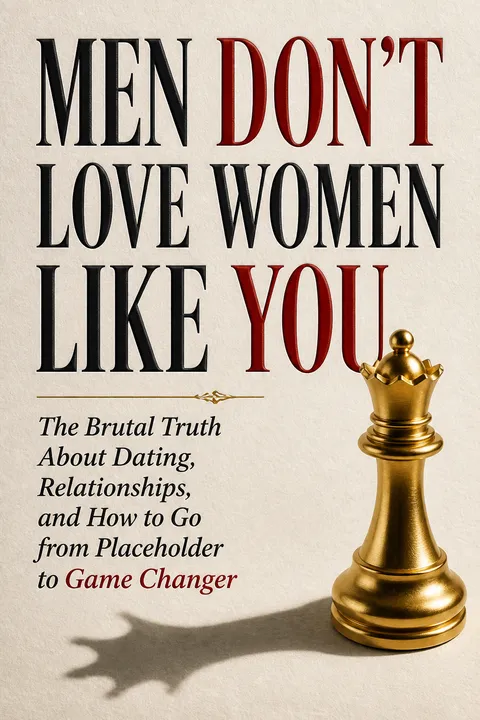
"Men Don't Love Women Like You" is a genre hybrid: part dating manual, part harsh-truth motivational tract, part pop-metaphysics. Its structure moves from diagnosis (women are interchangeable "placeholders") to identity overhaul ("Spartanhood") to a highly scripted tactical playbook for dating and relationships. What makes it hard to summarize is that its most quotable material is deliberately abrasive and sexually explicit, while its actual load-bearing ideas are fairly conventional self-esteem and behavioral-economics principles dressed in shock language.
The book's real intellectual spine is signaling and leverage. Lambert intuitively grasps that in a saturated dating market, common credentials fail to differentiate, that observed behavior beats stated intentions as evidence of character, and that whoever is less dependent holds negotiating power. These are defensible, even sophisticated, observations that align with mate-selection research, the principle of least interest, and costly-signaling theory. His "let him talk" advice is the single best-supported tactic in the book, consistent with decades of persuasion and rapport research.
The weaknesses are three. First, sampling bias: advising heartbroken women for years produced a model of men skewed toward manipulative players, then generalized to all men. Second, the quantum-physics metaphysics is pseudoscience, and its "thoughts create reality" logic risks self-blame. Third, the framework is relentlessly adversarial, coaching women to run manipulation playbooks and endless tests, which can select for combative dynamics and undercut the reciprocity that longitudinal research shows sustains real intimacy.
The most valuable transformation for a reader is separating the psychology from the packaging: build self-worth independent of any man, read behavior over words, negotiate from abundance rather than fear, and refuse to tolerate disrespect. Those lessons are genuinely empowering. The gendered war metaphor and the promise that these steps "always work" in 75 days are the parts to hold at arm's length.
Review Summary
Men Don't Love Women Like You receives mixed reviews. Many praise its blunt, no-nonsense advice on dating and relationships, finding it empowering and eye-opening. Readers appreciate the author's emphasis on self-respect and high standards. However, some criticize the book's harsh language, perceived misogyny, and contradictory messages. The explicit content and aggressive tone are off-putting to some. Overall, reviewers either love or hate the book's approach, with little middle ground. Many find it a valuable resource for building confidence and navigating the dating world, while others see it as offensive and problematic.
People Also Read





FAQ
What's Men Don't Love Women Like You about?
- Brutal Truth on Relationships: The book delves into the harsh realities of dating, highlighting how women often settle for less and are seen as placeholders by men.
- Empowerment Through Self-Discovery: G.L. Lambert encourages women to awaken their inner strength, redefine their self-worth, and transform into empowered "Spartans."
- Practical Dating Strategies: It offers actionable advice on attracting and maintaining the interest of high-quality men, emphasizing self-awareness and confidence.
Why should I read Men Don't Love Women Like You?
- Realistic Perspective: The book provides a no-nonsense view of modern dating, challenging common misconceptions and encouraging personal growth.
- Empowerment Focus: Lambert's approach empowers women to take charge of their dating lives, embrace their worth, and demand respect.
- Transformative Advice: It offers strategies to break free from typical dating patterns, aiming for better results in love lives.
What are the key takeaways of Men Don't Love Women Like You?
- Self-Reflection is Crucial: Understanding oneself and recognizing negative dating behaviors is the first step toward transformation.
- Men's Mindset: The book explains how many men view women as placeholders until they find someone they truly want to commit to.
- Becoming a Spartan: Women are encouraged to reclaim their power by being confident, assertive, and unapologetically themselves.
What are the best quotes from Men Don't Love Women Like You and what do they mean?
- “You don’t need a hug; you need a kick in the ass.”: This emphasizes the need for tough love and honest self-assessment to make meaningful changes.
- “Typical Bitches get Typical Results.”: It suggests that predictable behaviors lead to unsatisfactory outcomes, encouraging women to break free from the norm.
- “You are not your career.”: This reminds women that their worth is not defined by their job or achievements but by their personality and character.
How does Men Don't Love Women Like You define a "Spartan"?
- Empowered Woman: A Spartan is a woman who embraces her power and refuses to settle for less in relationships.
- Rejecting Typicality: Spartans challenge societal norms and expectations, creating their own paths in love and life.
- Self-Discovery and Growth: Becoming a Spartan involves deep self-reflection and personal growth, shedding insecurities to embrace one's true self.
What are the five reasons women fail at dating according to Men Don't Love Women Like You?
- Lack of Understanding: Many women do not understand how men date and the games they play, leading to frustration.
- Fear of Rejection: Fear often dictates actions, causing missed opportunities and preventing assertiveness.
- Settling for Less: Women frequently settle for men who do not meet their standards, leading to unfulfilling relationships.
- Insecurity: Insecurities cloud judgment and lead to poor dating choices, requiring confrontation and overcoming.
- Playing it Safe: Avoiding risks in dating results in missed opportunities for genuine connections.
How can I attract men without even trying, as suggested in Men Don't Love Women Like You?
- Embrace Your Confidence: Confidence is key to attracting men; self-assurance naturally draws them in.
- Set Clear Intentions: Clearly stating relationship goals helps attract the right kind of men and filter out others.
- Be Authentic: Authenticity is attractive; being true to oneself resonates with potential partners.
What is the "Spartan Secret" mentioned in Men Don't Love Women Like You?
- Mindset Shift: The Spartan Secret involves shifting from a passive participant to an active, empowered player in dating.
- Self-Branding: Creating a personal brand that reflects one's true self projects confidence and attracts the right partners.
- Emotional Independence: Spartans do not rely on men for validation, making them more attractive.
How does Men Don't Love Women Like You suggest women should handle rejection?
- Embrace It as Growth: Rejection is a natural part of dating and an opportunity for growth, not a setback.
- Don’t Take It Personally: Rejection often reflects the other person’s issues, not one's own worth.
- Move On Quickly: Swiftly moving on from rejection prevents negative feelings from hindering future opportunities.
What practical steps does Men Don't Love Women Like You recommend for dating?
- Set Clear Goals: Establish what you want from dating to guide actions and decisions.
- Be Proactive: Take initiative in dating rather than waiting for men to approach, creating opportunities.
- Screen Potential Partners: Vet men to ensure they meet your standards, being discerning and not settling.
How does G.L. Lambert define a Spartan mindset in Men Don't Love Women Like You?
- Confidence and Control: A Spartan mindset involves confidence and controlling the dating narrative.
- Self-Love and Independence: Prioritizing self-love and independence over seeking validation from men.
- Proactive Approach: Being proactive in dating, setting standards, and asking the right questions.
What are some practical dating strategies from Men Don't Love Women Like You?
- Screening Potential Partners: Carefully screen men before committing, asking deep questions to gauge character.
- Setting the Date: Take initiative in planning dates, choosing activities that reflect personal interests.
- Maintaining Mystery: Keep an air of mystery, not revealing too much too soon, to keep men intrigued.
About the Author
Other books by G.L. Lambert

Download PDF
Download EPUB
.epub digital book format is ideal for reading ebooks on phones, tablets, and e-readers.








































