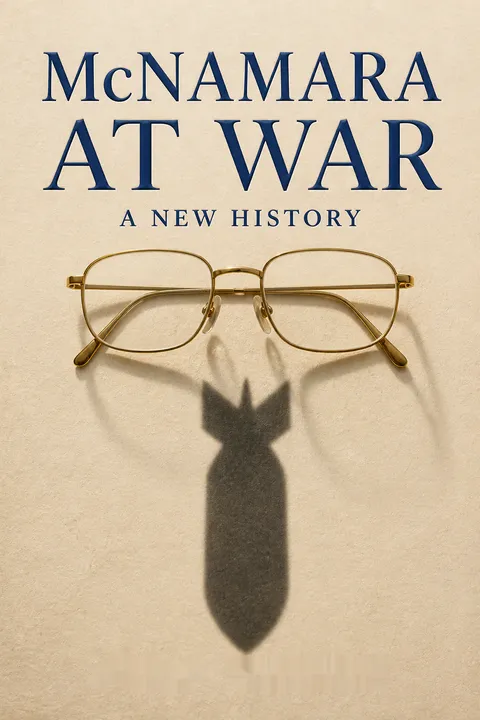

Key Takeaways
1. Early Ambition Forged by Contrasting Parental Influences
McNamara himself struck his friends as smart, even brilliant, incredibly hardworking, serious, and ambitious—but certainly not as “the human machine” a high school girlfriend, Annalee Whitmore, later read about.
Driven to excel. Robert S. McNamara's early life was shaped by a relentless drive for excellence, instilled by his parents. His father, Robert James McNamara, a self-made shoe salesman, exemplified hard work and cultural appreciation, despite being emotionally distant. His mother, Claranel Strange McNamara, was intensely ambitious for her son, pushing him to achieve impossibly high academic standards and adhere to strict moral codes.
Contrasting influences. While his father's aloofness left McNamara without a "role model of a loving father," it also fostered a deep-seated insecurity that he masked with outward confidence. His mother's "helicopter parenting" in a pre-helicopter age, though sometimes stifling, ingrained in him a powerful work ethic and a desire to excel. This blend of ambition and hidden insecurity would define much of his later career.
Early signs. From first grade, where he "worked like heck" to be in the top seat, through high school, McNamara consistently sought academic distinction and leadership roles. His high school friends remembered him as "gay, fun-loving, adventurous, intelligent," and a "great talker, a good dancer," contrasting sharply with the "human machine" image he later acquired. This early period hinted at the complex, often contradictory, personality beneath his disciplined exterior.
2. The "Whiz Kid" Rises: Mastering Quantitative Management
Although Harvard Business School was filled with talented, hard-driving students, as many as 12 percent were known to flunk out in the first year.
Academic prowess. McNamara's intellectual brilliance shone brightly at the University of California, Berkeley, and Harvard Business School (HBS). He excelled in mathematics and philosophy, becoming one of only three students in his class to be elected to Phi Beta Kappa by his sophomore year. His favorite course, "Moral and Civil Polity," focused on "conflict of obligation," foreshadowing his later ethical dilemmas.
Quantitative approach. At HBS, McNamara immersed himself in "managerial accounting," a revolutionary system for analyzing business operations through detailed cost analysis, budgeting, and financial forecasting. This quantitative approach, which he later applied to "nonprofits, or governmental or intergovernmental or international operations," became a cornerstone of his management philosophy. He quickly became the top student in his HBS class.
Wartime application. World War II provided McNamara with a grand stage to apply his skills. Recruited by "Tex" Thornton, he helped establish the Army Air Forces Statistical Control Officers School at Harvard, streamlining operations and developing systems to track personnel, matériel, and target destruction. His work earned him a Legion of Merit, with the citation noting his "brilliant series of statistical planning" that "made possible the greatly increased striking power of the Twentieth Air Force."
3. Transforming Ford, Masking Personal Insecurities
“I hate to say this. After all, I came from a company of pretty good size. And when you get up to this size, much greater size doesn’t mean very much.”
Ford's disarray. Post-World War II, the Ford Motor Company was in chaos, losing millions weekly due to outdated management practices and a lack of financial controls. Henry Ford II, unprepared to lead, desperately needed the "Whiz Kids" team, led by Thornton and including McNamara, to modernize the company. McNamara's initial assessment was grim: "The extent of decay which existed throughout the organization defies description."
Ruthless efficiency. McNamara, rising from assistant director of planning to company president, implemented rigorous "Planning-Programming-Budgeting System" (PPBS) principles, bringing financial discipline and accountability. He championed:
- Safety features: Like the "Lifeguard" system, despite internal and industry resistance.
- Quality and efficiency: Improving gas consumption and engineering for long life.
- Cheaper cars: Such as the highly successful Falcon, against internal skepticism.
His efforts dramatically increased Ford's profits and market share.
"Puritan in Babylon." Despite his success, McNamara remained an outsider at Ford, choosing to live in Ann Arbor rather than the affluent Detroit suburbs, and conspicuously supporting liberal causes. His "tremendous drive to succeed" and "intimidating sense of confidence" masked a deep insecurity, leading him to meticulously document conversations with Henry Ford II and to weep openly at a performance of "Death of a Salesman," identifying with Willy Loman's desperate but doomed efforts.
4. From Ford to Pentagon: Kennedy's Trust, McNamara's Naivete
“Well, you know, there isn’t any school for presidents either.”
An unexpected call. In 1960, President-elect John F. Kennedy, impressed by McNamara's reputation and recommendations from figures like Robert Lovett and John Kenneth Galbraith, offered him the position of Secretary of the Treasury, then Secretary of Defense. McNamara, despite his Ford presidency, initially felt "absurd" and "not qualified" for the defense role, citing his lack of military and strategic experience.
Kennedy's charm. Kennedy's understanding and forgiving nature quickly won McNamara's "undying respect, loyalty, and affection." JFK's willingness to overlook McNamara's political naivete—such as his public gaffe about the "missile gap" or his initial dismissal of Franklin D. Roosevelt Jr. as Navy Secretary—deepened their bond. McNamara later confessed, "It still amazes me that my naivete never seemed to annoy President Kennedy."
A new social circle. McNamara's initial intention to avoid Washington's social scene quickly dissolved as he was drawn into the Kennedy inner circle. He became a frequent guest at White House dinners and Robert Kennedy's Hickory Hill seminars, even participating in touch football games. This immersion, though initially awkward, allowed him to forge an improbable, deep friendship with Jacqueline Kennedy, who saw in him a sensitive and reliable confidant.
5. Vietnam's Early Grip: Cold War Consensus and Escalation
“In the final analysis, it is their war. They are the ones who have to win it or lose it. We can help them, we can give them equipment, we can send our men out there as advisers, but they have to win it, the people of Vietnam, against the Communists.”
Cold War axioms. The Kennedy administration inherited a deeply entrenched Cold War consensus, believing that Communism must be contained globally, including in Southeast Asia. The "domino theory"—that the fall of one nation to Communism would lead to others—was widely accepted, making intervention in Vietnam seem a geopolitical necessity. McNamara, like his colleagues, initially shared this view, seeing the conflict as a "sideshow" in the larger Cold War.
Initial optimism. Despite his lack of direct experience in Vietnam, McNamara quickly became the administration's primary manager for the conflict. His early trips to Saigon, though brief, led him to optimistic conclusions based on quantitative data provided by military commanders. He famously declared, "Every quantitative measurement we have shows that we’re winning this war," and even set a target for American withdrawal by 1965.
Seeds of doubt. However, Kennedy himself harbored deep ambivalence, fearing a "quagmire" and privately confessing he couldn't withdraw until after his reelection. McNamara, too, began to sense the "complexity of the situation and the uncertainties of our ability to deal with it by military means." Yet, he failed to "insist that we present the president with an exhaustive analysis of the pros and cons" of intervention, a critical lapse he later regretted.
6. Johnson's Torment and McNamara's Divided Loyalty
“If I got word that Bob had died or quit,” Johnson confessed to his wife, “I don’t believe I could go on with this job.”
A jarring transition. John F. Kennedy's assassination thrust Lyndon B. Johnson into the presidency, creating a profound shift for McNamara. He admired Kennedy deeply and had developed a close personal bond with the family. Johnson, in contrast, was a "complex, intelligent, and hardworking individual" with a "kaleidoscopic personality" whom McNamara initially found difficult to connect with.
Johnson's insecurity. Johnson, plagued by deep insecurities and a fear of being seen as weak, desperately needed McNamara's competence and loyalty. He showered McNamara with extravagant praise, calling him "the most unbelievable man I know" and "the best utility man." This flattery, combined with Johnson's own psychological struggles and fear of losing Vietnam, created a powerful dynamic that McNamara found hard to resist.
Divided loyalties. McNamara found himself walking a "psychologically and emotionally treacherous tightrope," trying to serve Johnson loyally while maintaining his deepening friendships with Jackie and Robert Kennedy, who increasingly opposed the war. Johnson, aware of these ties, even enlisted McNamara to "inform" on the Kennedys' intentions. This internal conflict, coupled with Johnson's volatile moods, intensified the stress on McNamara.
7. The War's Unwinnability: Private Doubts, Public Equivocation
“The fact is,” McNaughton continued, “he believes we never should have gotten into a combat role out there.”
Escalation's turning points. 1964 and 1965 marked critical escalations: the Tonkin Gulf incident, the sustained bombing campaign (ROLLING THUNDER), and the fateful decision to send hundreds of thousands of combat troops. McNamara, despite his growing private doubts, championed these decisions, often presenting optimistic assessments to Johnson and the public that contradicted his internal analyses.
Private disillusionment. By late 1965, McNamara reached a personal turning point, concluding that the war was "unwinnable militarily." His closest aide, John McNaughton, recorded McNamara's anguish: "Bob, in an unguarded moment said, ‘I want to give the order to get our troops out of there so bad that I can hardly stand it.’" This realization was intensified by the horrifying self-immolation of Norman Morrison outside his Pentagon office.
Equivocal actions. Despite his profound doubts, McNamara remained in his post, believing he could limit escalation and push for negotiations. He argued for bombing pauses and diplomatic initiatives, but his efforts were inconsistent and often undermined by Johnson's determination to win. His public statements continued to mask the war's true trajectory, creating a stark contrast between his private convictions and his public role.
8. Emotional Collapse and a Forced Exit from the Pentagon
“I’ve killed people—hundreds, thousands, tens of thousands—by my mistakes,” he confessed in a December 14, 1993, conversation with Brian VanDeMark.
Mounting pressure. By 1967, McNamara's internal torment became increasingly visible. His family's opposition to the war, particularly his son Craig's silent protest, and Jackie Kennedy's impassioned pleas to "stop the slaughter," intensified his anguish. He began taking sleeping pills, grinding his teeth, and showing physical signs of stress, including significant weight loss.
Public breakdown. His emotional state erupted publicly at the 1964 Medal of Honor ceremony, where he wept uncontrollably, and again at a New Year's Eve party in 1965. In a startling 1966 meeting with Harvard faculty, he confessed his "frustration" and "childishness" in questioning military doctrine, revealing a "profoundly sensitive, subtle, and humane personality" beneath his "inhuman" public image.
The final straw. In November 1967, McNamara sent Johnson a decisive memo, condemning the war's "dangerous, costly in lives and unsatisfactory to the American people," and proposing de-escalation. Johnson, already distancing himself, saw this as the final break. He arranged for McNamara to become president of the World Bank, effectively firing him while offering a prestigious exit. McNamara, though devastated, accepted, later admitting, "He eased me out. He loved me. He really did."
9. Redemption at the World Bank: A Global War on Poverty
“The Bank was, to me, the most satisfying adventure—and it was an adventure—the most satisfying adventure of my life.”
A new mission. McNamara's appointment as World Bank president in 1968 offered a chance for redemption, allowing him to apply his managerial skills to "lifting the lives of the global poor." He embraced this mission with messianic zeal, aiming to "abolish absolute poverty" by the year 2000. This role provided him with a sense of purpose and fulfillment that had eluded him in the Pentagon.
Transforming the Bank. He revolutionized the Bank's operations, introducing rigorous "country program papers" and "annual country allocation exercises" to strategically direct lending. He expanded the Bank's focus beyond infrastructure to include social development, health, and nutrition, famously championing the fight against riverblindness in Africa. His moral and economic arguments for aiding the poor were powerful and inspiring.
Personal healing. The World Bank years were a period of personal healing for McNamara. His wife, Margy, thrived in her role, traveling with him and expanding her "Reading Is Fundamental" program. While public protests occasionally reminded him of Vietnam, and his relationship with Jackie Kennedy remained close, the Bank offered a more congenial environment where his "hyperactivity" could be channeled toward constructive ends.
10. Confronting the Past: Seeking Absolution Through Critical Reflection
“I owe an explanation to those I killed,” he added to VanDeMark and Peter Osnos on September 16, 1994.
A life of introspection. After retiring from the World Bank in 1981, McNamara dedicated the rest of his life to a relentless, often painful, re-examination of his role in the Vietnam War. He participated in "critical oral history" conferences on the Cuban Missile Crisis and Vietnam, confronting former adversaries and scholars, driven by a desperate need to understand his mistakes and prevent future tragedies.
Cuban Missile Crisis revelations. The Cuba conferences revealed that the world had been far closer to nuclear war than previously understood, with Soviet tactical nuclear weapons in Cuba and delegated authority to use them. This revelation profoundly shook McNamara, leading him to formulate "McNamara's Law" about the unpredictability of military force and to campaign for nuclear abolition.
Vietnam's enduring torment. His 1995 memoir, "In Retrospect: The Tragedy and Lessons of Vietnam," was a public confession that "we were wrong, terribly wrong." Though criticized for its belatedness and lack of a direct apology, it was a profound act of self-reproach. He later confronted Vietnamese leaders face-to-face, seeking to understand mutual misperceptions, and concluded that the war could have been avoided or ended sooner.
11. A Legacy of Unresolved Guilt and Unheeded Lessons
“I don’t believe we ever should have gone into Iraq.”
Unresolved anguish. Despite his strenuous efforts at self-reflection and public confession, McNamara remained a "tormented being," unable to fully absolve himself of guilt for the Vietnam War. His emotional outbursts, his obsessive pursuit of answers, and his continued struggle with depression underscored the profound personal cost of his career. He often said he was "cursed if you do and [cursed] if you don't."
Unheeded wisdom. McNamara's hard-won lessons from Vietnam—emphasizing understanding nationalism, culture, and politics, recognizing the limits of military technology, and leveling with the public—were largely ignored by subsequent American leaders. The parallels between Vietnam and later interventions in Iraq and Afghanistan were "uncanny," demonstrating a tragic failure to learn from history.
A complex final chapter. In his twilight years, McNamara sought companionship, remarrying Diana Masieri, who provided warmth and care. Yet, his relationships with his children remained strained, and his final wishes regarding his burial were complicated by family discord. His life ended with a mix of personal love, professional achievement, and an enduring, public struggle with the moral weight of his past decisions, leaving a legacy of both profound wisdom and deep, unresolved pain.
People Also Read



Download PDF
Download EPUB
.epub digital book format is ideal for reading ebooks on phones, tablets, and e-readers.








































