
Key Takeaways
1. Fraud is an Inevitable Equilibrium of Trust and Cost.
Since checking costs money and trust is really productive, the optimal level of fraud is unlikely to be zero.
Cost of vigilance. Fraud is an inherent part of any complex economic system, existing at an "equilibrium quantity" determined by the trade-off between the cost of prevention and the benefits of trust. We cannot check every single transaction or verify every claim, as doing so would make commerce prohibitively expensive and inefficient. This creates unavoidable "blind spots" that fraudsters exploit.
Trust vs. checks. Societies must decide how much effort to spend on checking and how much to rely on trust. High-trust societies, like Canada, benefit from efficient transactions but are more susceptible to sophisticated commercial fraud because people assume honesty. Conversely, low-trust societies, like Greece, have less fraud but also less efficient commerce, often relying on close-knit networks.
Systemic vulnerability. The nature of fraud means it works outside our field of vision, subverting normal checks and balances. It's a "tail risk"—a rare, catastrophic event that normal businesses are ill-equipped to anticipate or price into their operations. This constant pressure to economize on fraud prevention creates persistent opportunities for those willing to deceive.
2. Modern Economies Thrive on Trust, Making Them Vulnerable to Fraud.
The more a society benefits from the division of labour in checking up on things, the further you can go into a con game before you realise that you’re in one.
Division of trust. Just as prosperity arises from the division of labor, modern economies also feature a "division of trust." Individuals and businesses delegate verification tasks, assuming others will perform due diligence. This specialization, while efficient, means fewer people personally verify facts, creating opportunities for fraudsters.
Exploiting assumptions. Fraudsters don't primarily target moral weaknesses like greed; they exploit systemic weaknesses in checks and balances. They create transactions that look as normal as possible, relying on the assumption that if an offer is public or comes from a seemingly reputable source, it is legitimate. This makes it harder for victims to realize they are being conned until it's too late.
Psychological barriers. High-status individuals, often white-collar criminals, are frequently given the "benefit of the doubt," creating powerful psychological barriers against detecting fraud. This deference means that even when red flags appear, they are often dismissed as administrative errors or misunderstandings, allowing the fraud to persist and grow.
3. Long Firms: The Foundational Fraud of Unpaid Debts.
Stealing things by getting them on credit and then not making the payment is the essence of the long firm.
Credit as opportunity. The "long firm" is a basic commercial fraud where goods or money are obtained on credit with no intention of repayment. This exploits the fundamental reliance on trade credit in modern business, where suppliers extend terms (e.g., 30 or 90 days net) to customers, allowing them to sell products before paying for inputs.
Building legitimacy. Fraudsters like Leslie Payne, the Kray twins' accountant, would establish seemingly legitimate businesses, paying bills promptly for months to build a strong credit history. They would even offer below-market prices to generate rapid sales and cash flow, creating an illusion of prosperity. Once a substantial credit line was established, they would place massive orders, sell the goods cheaply, and then declare bankruptcy.
Bankruptcy as escape. The legal concept of "limited liability" and the process of bankruptcy provide a convenient exit for long firm fraudsters. By using "fronts" or "patsies" as company directors, the true orchestrators can disappear, leaving suppliers to absorb the losses and the front-men to face investigation for "wrongful trading."
4. Counterfeits: Deceiving Through False Certification.
The interesting questions are never about individual psychology. There are plenty of larger-than-life characters. But there are also plenty of people like Enron’s Jeff Skilling and Baring’s Nick Leeson: aggressively dull clerks and managers whose only interest derives from the disasters they caused.
Attacking certification. Counterfeiting is not just about faking physical objects; it's about falsely certifying authenticity or value. This fraud exploits trust in systems designed to economize on checking, such as:
- Banknotes (e.g., Portuguese Banknote Affair)
- Assay reports (e.g., Bre-X mining fraud)
- Product safety and purity (e.g., pharmaceutical counterfeiting, Vioxx)
Exploiting weak links. The key to certification fraud is identifying and exploiting the weakest link in the verification chain. In the Bre-X scandal, geologist Miguel de Guzman tampered with drill core samples in a remote jungle camp, ensuring that subsequent, seemingly independent assays would confirm fraudulent gold reserves. Once a fraudulent certification is obtained, it is used to promote the operation as fully legitimate.
Beyond physical fakes. The concept extends to "counterfeited images" of how business is conducted. The Vioxx scandal, where Merck aggressively marketed a painkiller while downplaying its cardiac risks, was a breach of the trust that pharmaceutical products are managed on a scientific, not purely commercial, basis. When certification systems fail, especially in medicine, the consequences can be deadly.
5. Control Fraud: When Insiders Exploit Their Authority.
A control fraud differs from the simpler kind because the means by which the value is extracted to the criminal is generally legitimate – high salaries, bonuses, stock options and dividends, but the legitimate payments are made on the basis of fictitious profits and unreal assets, and the manager tends to take vastly higher risks than those which would be taken by an honest businessman.
Delegated trust. Control fraud occurs when individuals in positions of authority exploit their delegated trust to run a business for personal gain. Unlike direct theft, value is extracted through seemingly legitimate means like inflated salaries, bonuses, or dividends, all justified by fictitious profits and unreal assets.
Rogue traders. Nick Leeson's collapse of Barings Bank exemplifies this at a branch level. Given control over both trading and back-office record-keeping, he concealed losses in a secret "88888" account. To cover these losses and maintain the illusion of profitability, he took increasingly massive, unauthorized risks, ultimately bankrupting the 200-year-old institution.
S&L crisis. The Savings and Loan (S&L) crisis of the 1980s saw fraudsters like Charles Keating take control of banks. They used rapid growth, fueled by high-risk loans to connected real estate developers, and "appraisal fraud" to inflate asset values. This allowed them to extract cash through legitimate-looking channels, while systematically undermining internal controls and external oversight.
6. Market Crimes: Undermining the Integrity of the System.
The final cause of law is the welfare of society.
Systemic harm. Market crimes differ from other frauds because their victim is often the market itself, rather than a specific individual. These crimes undermine the overall framework of trust and fair play that makes markets function efficiently, even if individual transactions appear consensual.
Insider trading. The prohibition on insider dealing, for example, aims to ensure a "fair battlefield" for all investors. While it might not directly defraud a specific counterparty, it erodes confidence, particularly among retail investors, who are crucial for market liquidity. The gradual criminalization of insider trading reflects a commercial decision to attract more participants by ensuring perceived fairness.
Cartels and pollution. Price-fixing cartels, like those in the US electricity equipment industry, are market crimes because they distort competition and harm consumers, even if individual sales contracts are honored. Similarly, toxic waste dumping, while a crime of violence, is also a market crime. It undermines the regulatory framework that balances environmental costs with economic benefits, allowing polluters to gain an unfair advantage by externalizing costs onto society.
7. The Snowball Effect: Frauds Must Grow or Collapse.
The thing that makes pyramid schemes crash is a crucial feature of any fraud which persists longer than a short-term hit-and-run long firm – they snowball.
Exponential growth. Unlike legitimate businesses, frauds do not generate enough real returns to sustain themselves. To avoid detection and meet promised payouts, fraudsters must constantly raise new money or commit more deception, leading to a "snowball effect" where the fraud grows exponentially over time.
Ponzi schemes. Charles Ponzi's original scheme, and its modern imitators like the "Pigeon King" Arlan Galbraith, exemplify this. Ponzi promised 50% returns in 90 days, which mathematically required ever-increasing inflows of new investor money to pay off earlier investors. The longer the scheme runs, the larger the fictitious liabilities become, making collapse inevitable.
Covering losses. This dynamic also applies to other frauds, such as embezzlement or rogue trading. Initial small deceptions create a gap between real and reported finances. This gap must be continually filled, often by taking out new loans to pay old ones, or by taking increasingly reckless risks, until the scale of the deception becomes unmanageable.
8. Criminogenic Systems: How Organizations Accidentally Foster Fraud.
The PPI scandal shows us that you do not need a bad controlling mind to make a company criminogenic; there might even be a natural tendency toward criminogenesis which needs to be counteracted from the top.
Accidental criminality. Organizations can become "criminogenic" without a single malicious mastermind, simply through dysfunctional management, perverse incentives, and weak controls. This creates an environment where employees, often under immense pressure, engage in widespread fraudulent behavior.
PPI mis-selling. The UK's Payment Protection Insurance (PPI) scandal is a prime example. Aggressive sales targets, combined with a de-professionalized branch network, led thousands of bank staff to mis-sell unsuitable or worthless policies. While no single executive ordered the fraud, the system inadvertently incentivized widespread deception.
Unprosecutable fraud. This distributed control fraud is particularly insidious because it's difficult to prosecute. Low-level employees, under pressure, may not fully grasp the illegality, while senior managers, though benefiting from inflated profits, can credibly claim ignorance. This lack of clear criminal intent at the top, despite massive societal harm, erodes public trust in the justice system.
9. Governments are Uniquely Vulnerable to Fraud.
The government has one attractive property as a target for someone aiming to commit a fraud – it is prepared to take on nearly anyone as a customer.
Universal engagement. Governments are uniquely susceptible to fraud because, unlike private businesses, they cannot refuse "customers" (citizens, taxpayers, beneficiaries). This universal engagement means they must interact with a broader spectrum of individuals and entities, including those with dishonest intentions.
Tax fraud. Tax systems are a prime target. Tax evasion (providing false information) and avoidance (exploiting legal loopholes) are widespread. Bradley Birkenfeld's UBS scheme, which helped wealthy Americans hide assets in Switzerland, exploited the distinction between "tax evasion" and "tax fraud" in Swiss law, which historically protected bank secrecy.
Carousel fraud. Value Added Tax (VAT) "carousel fraud" is another example, exploiting the VAT-free status of intra-EU trade. Fraudsters create circular transactions of goods (e.g., mobile phone SIM cards) between shell companies, claiming VAT refunds on exports while a "missing trader" disappears without remitting the VAT collected on domestic sales, effectively stealing from the government.
10. The Fraud Triangle Explains Why People Commit White-Collar Crime.
The fraud triangle model is the equivalent of the classic murder triangle beloved of detective novelists. Rather than means, motive and opportunity, it suggests that a fraud happens when the following conditions are simultaneously met:
Three conditions. Donald Cressey's "Fraud Triangle" posits that white-collar crime occurs when three elements converge:
- Need: A perceived financial pressure or desire for money (e.g., greed, institutional pressure, fear of failure).
- Opportunity: A weakness in control or checking systems that can be exploited.
- Rationalization: A psychological justification that allows the perpetrator to commit the act without seeing themselves as a criminal (e.g., "it's only temporary," "everyone else is doing it").
Psychological barriers. White-collar criminals, often trusted individuals, must overcome internal moral barriers. Rationalization allows them to redefine their actions as less reprehensible, making it easier to exploit opportunities arising from systemic blind spots or delegated trust.
Predicting behavior. The Fraud Triangle helps explain why fraudsters often repeat their crimes; once the ability to rationalize is established, it tends to persist. Understanding these three components is crucial for designing effective fraud prevention strategies, as addressing any one element can disrupt the conditions necessary for fraud to occur.
11. Rapid Growth is the Ultimate Red Flag for Fraud.
Anything which is growing unusually quickly needs to be checked out, and it needs to be checked out in a way that it hasn’t been checked before.
Beyond risk management. Traditional risk management models often fail to detect entrepreneurial frauds because they treat them as random events. However, large-scale frauds are often designed to exploit systemic weaknesses and tend to exhibit a "snowball property," growing rapidly over time.
The Golden Rule. The most critical indicator of potential fraud is unusually rapid growth. Whether it's a company's profits, a bank's loan book, or a service provider's claims, exponential expansion should trigger heightened scrutiny. This is because fraudsters must continually inflate their operations to cover past deceptions and extract value.
Unconventional scrutiny. When rapid growth is observed, the checks must be unconventional and go beyond existing protocols. For example:
- The S&L crisis was curbed by limiting loan growth rates.
- Medicare fraud was controlled by systems identifying rapid increases in provider claims.
- Auditors should question how inflated sales occur without corresponding inventory or cash.
This meta-management approach, capable of adapting its own structure to new threats, is essential to counter fraudsters who design their crimes around existing controls.
Review Summary
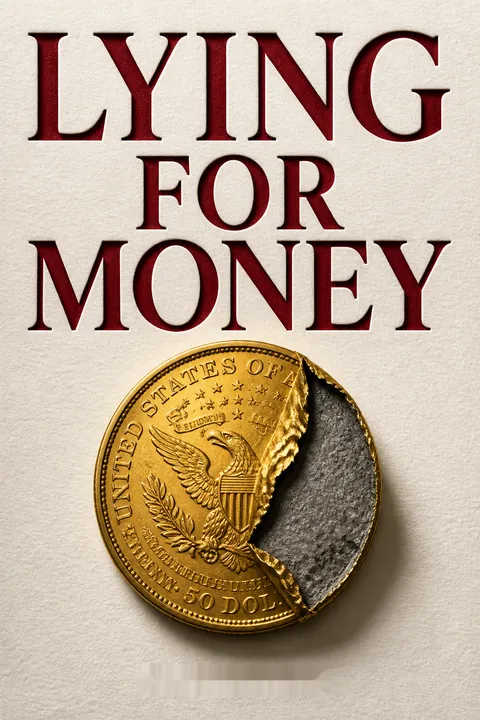
Lying for Money by Dan Davies explores fraud through a taxonomy of four types: long firms, counterfeiting, control fraud, and market crimes. Reviewers praise Davies' insider knowledge, wit, and entertaining case studies like the Great Salad Oil Swindle. Key themes include the "Canadian Paradox"—that high-trust societies enable more fraud—and that the optimal fraud level isn't zero. While many found it informative and readable, some criticized the lack of overall thesis, confusing structure, and jumps between cases. The book examines trust networks underlying commerce and how fraudsters exploit systemic weaknesses rather than relying on personality alone.
People Also Read


About the Author
Download PDF
Download EPUB
.epub digital book format is ideal for reading ebooks on phones, tablets, and e-readers.








































