
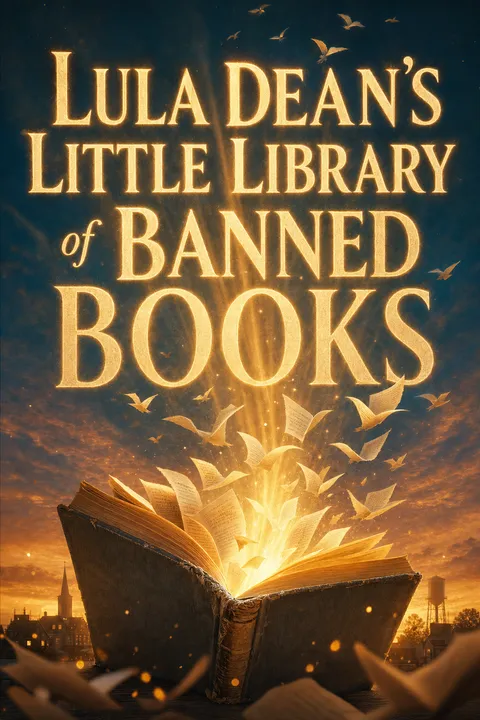


Plot Summary
The Midnight Book Swap
Late one night in the Georgia town of Troy, Lindsay Underwood1 recruits Ronnie Childers,20 a mushroom-loving Piggly Wiggly clerk and old friend, to help her tamper with Lula Dean's2 prim purple lending library.
Furious that Lula's2 Concerned Parents Committee has stripped local shelves of Anne Frank, Beloved, and dozens of other titles, Lindsay1 empties Lula's wholesome books into a suitcase and slides banned works inside the original dust jackets. To passersby the library looks untouched.
Before leaving town the next day, Lindsay1 hands her old babysitting charge, Bella Cummings,4 a copy of The Southern Belle's Guide to Etiquette, promising it shaped who she is. The disguised books scatter into unsuspecting hands, and Troy's carefully buried secrets begin, quietly, to detonate.
The opening establishes the novel's central mechanism: subversion through camouflage. Lindsay's prank weaponizes the very tactic censors fear, that a book can change a reader, but reverses its polarity. By hiding truth inside respectable covers, she literalizes the theme that ideas cannot be contained by appearances. The framing through Ronnie, a self-described felon high on psilocybin, signals the book's comic-populist register and its sympathy for the marginalized. Miller sets up dramatic irony: readers know the swap; the townspeople do not. This gap becomes the engine of every subsequent vignette, transforming a private act of defiance into a communal reckoning that no single character can predict or control.
Beverly Backs Down
Beverly Underwood,3 head of Troy's school board and Lindsay's mother,1 watches helplessly as Lula Dean2 rebrands herself from town crank to righteous censor. After a teenager's prank cake cookbook made Lula2 briefly famous, she assembled a committee, ransacked four libraries, and posted photos online where followers cried for a bonfire.
At a packed auditorium press conference, Beverly3 demands to know how the books were chosen, only for Lula2 to brandish Anne Frank's diary as smut. Fearing Lula2 will target her openly gay daughter,1 Beverly3 retreats, storing the confiscated books in her own basement rather than fighting.
That cowardice, and Lula's2 threat to run against her, drives Lindsay's midnight rebellion.1 Lula2 then unveils her own little library as proof she loves reading.
This flashback reframes the swap as a daughter completing what a mother could not. Beverly's retreat is not weakness but strategic self-sacrifice: she absorbs Lula's fire to shield Lindsay, choosing love over principle. Miller dissects the psychology of the moral panic, how a bored, attention-starved woman discovers that manufactured fear grants power that decency never did. The scene indicts institutional timidity: boards that defer, principals who capitulate, neighbors thrilled by cruelty. Lula's counter-library, stocked with Goodwill castoffs, is pure performance, an aesthetic of virtue masking intellectual emptiness. The chapter plants the mother-daughter tension and the stakes of the mayoral rivalry that will structure the entire novel.
The Penis Cake Verdict
Wilma Jean Cummings,7 a retired district attorney whose grasping children have declared her demented and eyed her assets, has stopped speaking to punish them. When her rebellious great-granddaughter Bella4 is dumped at her house after a dress-code suspension, the two forge an alliance.
Bella4 carries a book she found in Lula's2 library, seemingly an etiquette guide but actually A Girl's Guide to the Revolution. Reading it reignites Wilma,7 who teaches Bella4 about Title IX and marches her to challenge the sexist school code.
For her birthday, Wilma7 bakes a four-foot phallus cake, sprays whipped cream over her scheming relatives, and introduces her towering Atlanta attorney to prove she is neither dead nor demented, demanding the return of her stolen portrait.
Wilma's arc is a comic resurrection: the swapped book restores not information but appetite, the will to fight that her family mistook for senility. Her feigned deafness satirizes how society renders old women invisible, then exploits that invisibility. The obscene cake is transgressive theater, using the grotesque to reclaim dignity and expose her heirs as the true vultures. Bella becomes Wilma's inheritor, a young avatar of justice whose dress-code protest mirrors Wilma's own girlhood humiliation seventy years prior. Miller links generations of women through shared indignation, arguing that consciousness, once awakened by the right words, is contagious and rejuvenating rather than corrupting.
Anne Frank's True Cover
Dawn Dugan,12 cowed wife of collector and roofer Nathan,13 borrows what she thinks is a breezy travel novel from Lula's2 library. It is Anne Frank's diary, and Dawn,12 undereducated and sheltered, reads it as revelation. Meanwhile her thirteen-year-old son Nate, radicalized in Nathan's13 basement group and by the follower Logan Walsh,11 spray-paints a swastika on the door of kind old Mr. Stempel, the Jewish shopkeeper who once treated Dawn12 like family.
Stempel, having caught Nate on camera, deletes the evidence and trusts Dawn12 to act. Learning Anne Frank was murdered shatters Dawn.12 She hauls Nathan's13 Nazi memorabilia onto the front lawn for all Troy to see, then empties the bank account and flees town with Nate.
Dawn's chapter is the novel's moral fulcrum, dramatizing how ignorance is engineered, not innate. Nathan controls her mind by controlling her reading; the swapped diary breaks his information monopoly. Stempel's mercy, choosing a mother's intervention over the police, embodies the book's faith that hate is a curable disease and children are not beyond rescue. Dawn's public exhibition of the memorabilia inverts Nathan's secret shrine into evidence, transforming a victim into a whistleblower. Miller refuses easy villainy: Nate is a frightened boy mimicking his mother's learned servility, and his redemption begins the moment someone finally tells him the truth rather than a comforting lie.
Beloved in Disguise
Delvin Crump,8 a Troy mail carrier and Afghanistan veteran who has grown into a bitter recluse cataloging the town's hidden bigotry, spots a book titled Our Confederate Heroes in Lula's2 library and takes it home to burn. Peeling back the jacket, he discovers Toni Morrison's Beloved instead.
The realization that someone in Troy is secretly smuggling truth into Lula's2 shrine restores his faith and gives him a cause. Delvin8 becomes the library's unofficial curator, adding his own titles, including a copy of The Art of the Deal that actually hides Maus, which lands with Jeb Sweeney.10 Delvin8 also grows determined to see the Confederate statue of Augustus Wainwright torn down at last.
Delvin's transformation reverses the corrosive isolation that surveillance of hatred breeds. Where he once catalogued only rot, the hidden Beloved reveals a conspirator for good, and community becomes possible again. Miller uses the swapped covers as a metaphor for coded resistance, echoing how oppressed people have long concealed forbidden knowledge to survive. The disguised Maus reaching Jeb extends the network of accidental enlightenment. Delvin's veteran's oath to defend free speech complicates his impulse to burn a racist book, staging the novel's genuine tension between principle and rage. His renewed activism seeds the statue-removal plot that will converge with the Wainwright bloodline revelation.
The Witch in the Woods
Crystal Moore,15 a rule-following second-grade teacher, discovers her husband Russell, manager of the Piggly Wiggly, caressing a cashier. Seeking a love spell, she borrows a book she believes is The Rules but is really All Women Are Witches. Following its guidance, she hikes to a hidden spring, strips, swims, screams her rage into the trees, and smashes her phone rather than rush home to cook dinner.
She sleeps in the woods and wakes knowing her marriage has been over for years, without bitterness. A hunter, Logan Walsh,11 finds her with the incriminating book and brands her a witch. Crystal15 walks out reborn, unbothered by the label, having chosen her own freedom over the script she was handed.
Crystal's chapter reframes midlife rupture as liberation rather than tragedy. The swapped witchcraft manual functions less as magic than as permission, granting a woman conditioned toward endless self-suppression the right to want, to rage, to refuse. Her wilderness immersion is a secular baptism, shedding decades of performed propriety. Logan's fearful accusation reveals the ancient masculine terror of ungoverned women, the same impulse that fuels book banning. Miller connects private domestic awakening to the town's larger political ferment, and plants Logan as a genuine menace whose contempt for autonomous women foreshadows danger. Crystal declares her marriage a success even in ending, refusing the culture's insistence on blame and grievance.
Speak Breaks the Silence
Darlene Honeywell,14 once poor Darlene Cagle of Troy, was gang-raped at a lakeside party in high school and saved from despair only by Beverly,3 who gave her a cheerleading spot and lifelong loyalty. Now a Savannah psychiatrist visiting her mother-in-law, Darlene's14 daughters bring home a book from Lula's2 library disguised as a Nancy Drew mystery: it is Speak, about a raped teenager.
Finally able to tell her twins the truth, Darlene14 writes her own story and posts it publicly. Though she names no names, everyone recognizes her attackers, one of whom, Randy Sykes, is now Troy's mayor. Within a day Randy resigns, cable news descends, and the town's long-buried rot spills into daylight.
Darlene's chapter demonstrates the delayed detonation of testimony, how a single book can grant the vocabulary that silence stole for decades. Miller traces the machinery of victim-blaming: a drunk girl deemed responsible, a mother who locked the door, a town that protected rapists into positions of power. The swapped Speak completes a circuit begun with Beverly's teenage kindness, repaying a thirty-year debt of sisterhood. Randy's resignation is the first concrete political consequence of Lindsay's prank, shifting the narrative from private awakenings to public power. The chapter argues that shame thrives in enforced quiet and that naming, even without names, is a revolutionary act of collective recognition.
Beverly Runs for Mayor
With Randy Sykes disgraced and the mayor's seat suddenly open, Beverly's3 old cheerleading sisters, gathered at Val's salon, goad her into running. Beverly,3 a direct descendant of Confederate general Augustus Wainwright, publicly vows that if elected she will remove his statue from Jackson Square.
Salon owner Val ambushes waiting news crews and announces Beverly's3 candidacy on the spot. The declaration goes national. It draws the attention of Mitch Sweeney,9 a Troy-born Hollywood actor turned right-wing provocateur, who flies home to back Lula Dean2 instead.
Beverly's3 stand also reflects her private education years earlier, when a librarian handed her the brutal truth about her slaveholding ancestor and urged her to choose better forebears to follow.
Beverly's candidacy converts personal shame into civic purpose, embodying the librarian's counsel that heritage is a choice among ancestors rather than a fixed inheritance. Her pledge to topple her own bloodline's monument dramatizes accountability without self-flagellation. Miller stages the collision of local grassroots courage against imported culture-war spectacle: Mitch represents the outside profiteers who inflame small towns for clout. The salon, a female commons of Black and white women bound by decades of friendship, becomes the unlikely war room of change. The statue emerges as the novel's central symbol, a stone lie about the past that the living must decide whether to keep worshipping or finally reckon with.
The Movie Star and the Brother
Mitch Sweeney,9 an aging character actor who went viral defending straight white men, arrives to boost Lula's2 campaign and his own political ambitions, though Lula2 quickly sees he wants only visibility. He visits his estranged brother Jeb,10 a decent veterinarian and volunteer firefighter who has been anonymously trolling Mitch9 and protesting Lula's2 book bans.
Mitch9 coerces Jeb10 to stop by threatening to sell the family farm Jeb10 caretakes. Jeb10 warns him that his new host, Logan Walsh,11 and Logan's mentor Nathan Dugan13 are actual Nazis, not harmless collectors. Mitch9 shrugs it off. As a parting gift Mitch9 hands Jeb10 The Art of the Deal, which secretly contains Maus, an omen that ugliness is coming.
The Sweeney brothers embody America's fraternal split: hollow performance versus quiet integrity. Mitch's narcissism, a bottomless pit no praise can fill, makes him a perfect vector for a movement that runs on grievance and attention. Jeb's warnings articulate the novel's thesis on complicity: the slippery slope from tolerating Nazis to becoming one. Miller resists caricature by giving Mitch genuine talent and buried fear, making his eventual capacity for change plausible. The disguised Maus, landing in the hands of the one man already alarmed, tightens the web of the swapped books and confirms that Lindsay's prank keeps delivering truth precisely where it is needed most, even as real danger gathers.
The Banner at the Rally
Isaac Wright,5 Troy High's gay Black valedictorian, has used DNA testing and his family Bible to prove that Augustus Wainwright raped an enslaved ancestor, making the general his fifth great-grandfather and Beverly3 his cousin. His journey began with a swapped library book, The Hemingses of Monticello.
At Lula's2 Confederate rally, Isaac5 and his brother Elijah6 unfurl a banner naming Wainwright a rapist and demanding the statue's removal. Chaos erupts. Lula2 spots Logan Walsh11 reaching for an ankle gun and screams for Mitch9 to stop him. Mitch,9 missing Logan,11 charges the boys, trips, and knocks Bella Cummings4 off the stage, concussing her. Elijah6 tackles Mitch.9 The rally collapses in blood and smashed cupcakes.
This is the novel's public climax, where hidden genealogy becomes weaponized truth. Isaac's discovery collapses the fiction that heritage belongs only to the powerful, reclaiming Wainwright as the shared, shameful root of both oppressor and oppressed. His decision to come out and to expose the rapist simultaneously links personal and historical honesty as inseparable acts of courage. Miller orchestrates farce and menace at once: Mitch's clumsy violence injures the innocent while Logan's concealed gun signals lethal intent barely averted. Lula's scream, later parsed, reveals she knew about the weapon, seeding her deepest guilt. The rally transforms a manufactured tribute into an accidental unveiling of the town's true lineage.
Logan Walsh's Last Chapter
Radicalized, abandoned by his mentor Nathan,13 and consumed by lifelong abuse, Logan Walsh11 plots a massacre at the upcoming Wainwright family reunion, mapping Jackson Square as a battlefield. Delvin Crump,8 suspicious after Nathan13 flees town, teams with Jeb Sweeney10 to plant hog-monitoring cameras near Logan's11 compound, using a mail delivery as cover.
Inside, Delvin8 sees the tactical map, the duffel bags of rifles, and a copy of The Catcher in the Rye, another swapped book. He tries to reach the broken young man, learning Logan11 killed his abusive judge father years earlier. When Logan11 raises his gun, Jeb10 appears. Logan,11 crushed by the vet10 he once wished were his father, turns the weapon on himself.
Logan is the novel's tragic counterweight, the child no swapped book could save in time because no adult intervened early enough. Miller complicates the mass-shooter narrative by revealing tenderness beneath menace: a boy who prayed for rescue, protected an abused mother, and was groomed by men exploiting his loneliness. Delvin's veteran empathy insists such young men are made, not born, and that the town's neglect shares the blame. The Catcher in the Rye, later clarified as coincidental rather than causal, becomes the hinge for the book's argument that stories do not create killers; abandonment and hate do. His suicide averts atrocity while indicting everyone who looked away.
Lindsay Arrested for Theft
Learning that Lindsay Underwood1 swapped her library's books, Lula Dean2 presses charges, valuing the stolen paperbacks high enough to make it a felony, aiming to destroy Beverly3 through her daughter.1 The sheriff, Nathan's13 cousin, gleefully arrests Lindsay.1 Wracked by guilt that a book she planted may have inspired Logan,11 Lindsay1 pleads guilty and sinks into despair, even as loyal Ronnie Childers20 offers to take the blame.
Bella Cummings4 and great-grandmother Wilma7 mount a defense: Bella4 traces the books to a Macon Goodwill where Lula2 paid only seven dollars and seventy-five cents for all of them, collapsing the felony. But Lula2 refuses to relent. Delvin8 then assures Lindsay1 that no book, only Logan's11 abusers, caused his violence.
Lindsay's arrest tests the novel's faith in consequences, showing that speaking truth carries real cost and that spite can wield the law as a cudgel. Her survivor's guilt dramatizes the very lie censors peddle, that books make people dangerous, and Delvin's counsel becomes the thematic antidote. Wilma and Bella's investigation turns Lula's cheapness into her undoing, exposing the fraud beneath the crusade: books she called priceless treasures were dime-store junk. Miller stages generational solidarity as Wilma, once revived by a swapped book, now defends the swapper. The chapter withholds resolution, building toward the reckoning that only Lula's own abandoned children can deliver.
The Drag Queen Comes Home
Betsy Wright21 advises that only Lula's2 vanished children can stop her, and music teacher Elliot Minter, whom Lula2 once ran out of town, persuades them to return. On the packed First Baptist steps, Lula's2 daughter Talia19 and her sibling Taylor, now the fabulous drag queen Moxie Laguerre,18 confront their mother.
Talia19 displays the erotica Lula2 kept openly at home while banning far tamer titles. Moxie18 recounts how Lula2 called her a pervert at twelve, blackmailed innocent Mr. Minter, and destroyed his life out of jealousy. They offer Lula2 one chance: disband the committee, quit the race, drop Lindsay's1 charges, and never spew hate again. Facing her children and the crowd, Lula2 surrenders.
Lula's downfall arrives not through her enemies but through the children her cruelty exiled, making the reckoning intimate and devastating. Miller inverts the drag-queen panic that fuels the culture war: the actual predator is the respectable mother, while the drag performer preaches forgiveness and truth. Moxie's declaration that no twelve-year-old is a pervert cuts to the novel's heart, that hate is projected shame. The revelation that the persecuted gay teacher himself urged the twins to grant Lula redemption reframes justice as mercy rather than annihilation. Public hypocrisy, once exposed by the very erotica she hid, dissolves Lula's manufactured authority, proving performance cannot survive the people who knew you before the mask.
The Wright-Wainwright Reunion
Troy assembles in Jackson Square for the family reunion, with the entire town helping set up and dozens of newly discovered cousins arriving from across Georgia. James Wright22 reconciles with his sons, telling Isaac5 he would change nothing about him. Mitch Sweeney,9 transformed by a night of stitches and honesty with Dr. Chokshi,23 apologizes publicly, pays to remove the statue, and greets guests.
Melody Sykes16 seeks to apologize to Darlene;14 Beau Sykes24 celebrates the period book that eased his fears. Beverly3 asks the crowd who found meaning in a swapped library book, and half the town's hands rise, streaming toward a stunned, healing Lindsay1 to thank her for changing their lives.
The reunion resolves the novel's central lie by replacing a monument to a rapist general with a communal act of truth-telling and kinship. Isaac's family, the descendants of the harmed, become the moral center of the town that once erased them. Mitch's conversion argues that even the vainest can choose the right side when shown their reflection honestly. The raised hands vindicate Lindsay's prank: books did not corrupt Troy but liberated it, granting courage, exposing crimes, and mending families. Miller stages secular grace, forgiveness extended to Melody, to Mitch, to Lula, insisting that a community heals not by purging its sinners but by daring, finally, to see itself clearly.
Epilogue
A decade later, in 2034, realtor Melody Sykes16 gives a tour to an incoming doctor replacing the beloved Dr. Chokshi.23 Troy now boasts a heritage museum in a donated mansion, an education fund from the late Wilma Cummings,7 and a gleaming library funded by Logan Walsh's11 seized fortune. Beverly Underwood3 became governor; Isaac Wright5 is a young congressman.
A bronze statue of an unnamed enslaved woman, called Justice, stands where Augustus Wainwright once loomed. The house for sale is Lula Dean's2 old Victorian, its little library still bolted to the fence, now holding a hand-bound book: The Heroes of Troy, Georgia, written by Nahla Crump.25
The epilogue delivers the utopian payoff of collective truth-telling, projecting how honest reckoning compounds into institutional transformation: museums, scholarships, libraries, and progressive leadership. Replacing the general with an anonymous enslaved matriarch named Justice completes the novel's argument that monuments encode values, and that a town chooses whom to revere. Logan's fortune funding anti-disinformation work redeems tragedy into prevention. The persistence of Lula's little library, now dispensing a child's homegrown history, closes the circle: the instrument of one woman's censorship became the town's engine of enlightenment. Miller offers hope without erasing memory, insisting the past stays visible in the Hall of Shame so it need never repeat.
Analysis
Kirsten Miller's novel is a comic mosaic that mounts a sustained argument against book banning by dramatizing, chapter by chapter, what the right book does to the right reader at the right moment. Its ingenious structure, one disguised volume rippling through a Georgia town, lets Miller braid ensemble vignettes into a single causal chain: a college student's prank1 topples a mayor, exposes a Nazi, reunites families, and unearths a slaveholder's descendants. The device embodies the thesis that ideas resist containment; camouflage a truth inside a respectable cover and it still detonates. Miller's targets are precise. She frames censorship not as sincere protection but as opportunism and social control, a way to keep people frightened, ignorant, and governable, and she names its beneficiaries: those who scapegoat Jews, whitewash slavery, and demonize queer people to distract from guns, poverty, and inequity. Yet the book resists easy triumphalism. Its most humane insight is that hate is a curable disease and that villains are made by neglect, so redemption is possible for the battered Nazi's son, the vain movie star,9 even the monstrous censor2 granted grace by the children she exiled. Logan Walsh11 anchors the tragic counterweight, the child no book could save because no adult intervened. Miller writes in a Southern voice both affectionate and unsparing, insisting these are American problems, not regional ones. Her recurring metaphor, sunlight as disinfectant, treats truth-telling as the antidote to shame that festers in silence. The genealogical revelations argue that heritage is a choice among ancestors, and the replaced monument insists communities can revise whom they honor. Ultimately the novel is a love letter to libraries and to the ordinary, principled people who quietly outnumber the loud, waiting only for permission, or a well-placed book, to speak.
Review Summary
Lula Dean's Little Library of Banned Books is a satirical novel about a small Southern town's battle over banned books. While many readers found it entertaining and timely, addressing issues like censorship and social justice, some felt it was heavy-handed and overly partisan. The story follows multiple characters affected by a secret plot to replace "wholesome" books with banned ones in a little free library. Most reviewers appreciated the book's humor and message about the power of reading, though some found it unrealistic or preachy.
Characters
Lindsay Underwood
The midnight book-swapperA gay Duke junior and Beverly's3 fiercely principled daughter, Lindsay drives home from college to confront Troy's book bans and, when her mother3 hesitates, takes matters into her own hands. Confident, mischievous, and morally certain, she believes stories can crack open closed minds, and she is proven right in ways she never anticipated. Beneath the bravado lies deep tenderness and a vulnerability to guilt: when her prank's ripples reach dark places, she nearly drowns in self-blame. Raised by a mother3 who defended her from first grade onward, Lindsay carries both privilege and a survivor's awareness of the traps small towns set for kids without her advantages, especially her old friend Ronnie20.
Lula Dean
Attention-starved censorA widowed, orange-haired Troy busybody from the fallen Lambert milling family, Lula reinvents herself as a righteous book-banning crusader after discovering an erotic cookbook. Psychologically, she is a bottomless well of need for recognition, humiliated in youth and abandoned by her children, who weaponizes moral panic to finally command fear and attention. She is a hypocrite who hoards the very filth she condemns and has likely never finished a serious book in decades. Her lifelong obsession with Beverly Underwood3, rooted in a high school disgrace, fuels her vindictiveness. Lula genuinely believes she is a late bloomer chosen by God, a self-flattering narrative that lets her rationalize cruelty as calling and jealousy as virtue.
Beverly Underwood
Reluctant reformer candidateHead of Troy's school board, former cheerleading captain, and direct descendant of Confederate general Augustus Wainwright, Beverly is a dimpled Southern lady whose sweetness masks steel. Educated out of her family's mythology by a trusted librarian, she has spent decades quietly improving Troy while carrying the shame of her bloodline. Her defining drive is fierce maternal protection, especially of her gay daughter1, which sometimes reads as caution but springs from love. Warm, funny, and prone to putting her foot in her mouth, she nonetheless possesses more courage than anyone in town. Her long, mysterious feud with Lula Dean2 traces back to a moment when Beverly chose a wronged girl14 over social advantage.
Bella Cummings
Rebel prom queen sleuthTroy High's head cheerleader, prom queen, and valedictorian-caliber firebrand, Bella weaponizes her popularity for justice, staging a dress-code protest that gets her suspended. Bright, fearless, and drawn to any righteous fight, she bonds with her great-grandmother Wilma7 over a smuggled feminist book and becomes her investigative partner. Bella is beloved by both Wright brothers and by Isaac5 as a best friend, moving easily across Troy's divides. Her intelligence and moral clarity mark her as the town's next generation of women who refuse to accept an unjust order, and she suspects some deeper force of justice has been unleashed upon Troy.
Isaac Wright
Valedictorian genealogistTroy High's gay Black valedictorian, Isaac is a cautious, brilliant, deeply brave young man who came out to his devout parents and fractured his family. Reserved where his brother6 is impulsive, he studies situations and calculates risks, yet refuses to live a lie. Using DNA testing and his family Bible, he uncovers a truth about his ancestry that reframes the town's history. Driven by an unbending commitment to honesty, he takes those revelations public despite mortal danger. His quiet moral authority and refusal to bow to tyrants make him a natural leader, and his love for his motormouth younger brother6 anchors him.
Elijah Wright
Besotted football starIsaac's5 younger brother, a charming, filterless football player hopelessly in love with Bella Cummings4. Fearless and warm-hearted, Elijah reads an entire novel he finds boring purely to help his brother5, then persuades their grieving mother21 to read it too. His impulsive courage and pure devotion to family reunification make him both comic and deeply moving.
Wilma Jean Cummings
Reawakened retired prosecutorAn eighty-four-year-old former district attorney and Bella's4 great-grandmother, Wilma feigns deafness to punish her grasping heirs who think her senile. Sharp, profane, and formidable, she once bankrupted the crooked Lambert mill owner. A swapped book reignites her lost will to fight, and she returns to lawyering to defend the young, proving her mind and her fury remain lethally intact.
Delvin Crump
Truth-smuggling mail carrierA Black Troy postman and Afghanistan veteran who has retreated into bitter isolation, cataloging the town's hidden hatred. A swapped book restores his sense of allies and purpose, and he becomes the little library's secret curator. His military empathy for lost young men and his determination to topple the Confederate statue place him at the center of the town's dangers and its healing.
Mitch Sweeney
Provocateur movie starA Troy-born Hollywood character actor typecast as villains who went viral defending straight white men. A raging narcissist with a bottomless hunger for attention and political ambition, Mitch returns to back Lula2 for his own visibility. Beneath the bluster lies genuine talent, buried fear, and a capacity for change when someone finally challenges him honestly rather than flattering him.
Jeb Sweeney
Decent veterinarian brotherMitch's9 estranged younger brother, a veterinarian and volunteer firefighter of quiet integrity who anonymously trolls Mitch9 online. Grounded, compassionate, and clear-eyed about the real Nazis in town, Jeb refuses to flee or capitulate. He recognizes danger where others see harmless collectors and steps directly into it to protect his community.
Logan Walsh
Radicalized lonely heirA wealthy, isolated young man in his mid-twenties, abused by his powerful judge father and groomed into white nationalism by Nathan Dugan13. Desperate for belonging and a father figure, Logan is at once pitiable and terrifying, a broken product of neglect whose loneliness curdles into lethal grievance. He embodies the tragedy of the child no one rescued in time.
Dawn Dugan
Awakening battered wifeThe undereducated, cowed wife of Nazi collector Nathan13 and devoted mother to Nate. Sheltered and controlled through her reading, Dawn is not stupid, only starved of truth. A swapped diary shatters her ignorance and ignites a courage she never knew she had, transforming a servile victim into a woman who acts decisively to save her son's soul.
Nathan Dugan
Basement Nazi mentorDawn's12 controlling husband, a roofer who hosts a white-nationalist discussion group, advises Lula's2 committee, and grooms both his son and Logan Walsh11. A coward who feels large only by making others small, he keeps a hidden shrine of Nazi memorabilia and rules his household through fear and information control.
Darlene Honeywell
Survivor turned psychiatristOnce poor Darlene Cagle, gang-raped as a teenager and rescued from despair by Beverly's3 fierce loyalty, she became a Savannah psychiatrist. A swapped book gives her the words to finally tell her daughters and the town her story, repaying a thirty-year debt and toppling a powerful man who thought himself untouchable.
Crystal Moore
Awakened schoolteacher witchA rigidly rule-following second-grade teacher whose discovery of her husband's affair, paired with a swapped witchcraft book, sends her into the woods and out again transformed. She sheds decades of performed propriety, chooses her own freedom without bitterness, and embraces the witch label the town pins on her.
Melody Sykes
Disgraced mayor's wifeBeautiful, smart, and taught since childhood to hide her intelligence, Melody is the wife of resigned mayor Randy. Betrayed and isolated by his exposed crimes, she flirts with desperate schemes before a librarian17 and her own young son24 redirect her toward reinvention and belated moral honesty.
Mara Ocumma
Cherokee head librarianTroy's Methodist, Cherokee head librarian, keeper of a discreet watchlist for patrons in crisis and a fierce defender of readers' freedom. Raised by a grandmother who taught her that knowledge is power and few things are truly wicked, she talks a would-be poisoner16 off the ledge and champions books as everyone's right.
Taylor / Moxie Laguerre
Lula's drag-queen childLula Dean's2 exiled child, now Georgia's celebrated drag queen Moxie Laguerre. Once called a pervert at twelve by their own mother2, Moxie channels wit and fabulousness into a mission of justice, returning home to expose Lula's2 hypocrisy while preaching, at a wronged teacher's urging, the possibility of forgiveness.
Talia Dean
Lula's twin daughterMoxie's18 twin sister, who resented being forced into beauty pageants and switched places with her sibling in a legendary act of rebellion. She partners with Moxie18 to confront their mother2 and monitors Lula's2 escalating extremism from afar.
Ronnie Childers
Loyal stoner accompliceA convicted felon and Piggly Wiggly clerk who helps Lindsay1 swap the books and later offers to take the fall for her. Kind, self-deprecating, and gifted at finding and using mushrooms, he dreams small only because life has crushed larger hopes.
Betsy Wright
Florist matriarch motherIsaac5 and Elijah's6 mother, owner of Fairview Florist, and a woman of deep faith and hard-won wisdom. Initially devastated by Isaac's5 coming out, she is guided by a swapped book and a postman's8 gentle counsel back toward unconditional love, and she knows Lula2 better than anyone from years of working together.
James Wright
Conservative devout fatherIsaac5 and Elijah's6 father, a repair-shop owner whose faith and family are bedrock. Shaken by his son's5 coming out, he joins Lula's2 committee seeking control, having long carried a secret about the family's ancestry passed down through generations.
Dr. Hank Chokshi
Wry immigrant physicianA Queens-born doctor of Indian descent who took Troy's unfillable practice to pay off loans and do good. Witty, unflappable, and country-music-loving, he refuses to let bigots intimidate him and, through blunt honesty, sparks Mitch Sweeney's9 unlikely change of heart.
Beau Sykes
Curious spying boyMelody16 and Randy's ten-year-old, an amateur detective who eavesdrops on the town's secrets. His innocent quest to understand a mysterious feminine mystery, aided by a swapped book, produces one of the story's most disarming moments of truth.
Nahla Crump
Aspiring young writerDelvin's8 sharp twelve-year-old daughter, determined to become a force to be reckoned with. Frustrated that classic hero tales exclude girls like her, she resolves to write the untold stories of Troy's real heroes, apprenticing herself to the florist Betsy Wright21.
Plot Devices
The Swapped Dust Jackets
Truth hidden in plain sightThe novel's central engine: Lindsay1 strips wholesome covers off Lula's2 Goodwill books and slips banned titles inside them, then reshelves them in the little library. Each chapter follows a different resident who unknowingly borrows a disguised book that speaks precisely to their crisis, an etiquette guide holding a feminist manual, a travel novel holding Anne Frank, a Confederate hagiography holding Beloved. The device structures the interwoven vignettes, delivering catalytic truth to each character while sustaining dramatic irony, since readers know the swap and the townspeople do not. It literalizes the book's thesis that ideas cannot be contained by appearances and that the right words find the right reader at the right moment.
The Wainwright Statue
Symbol of the buried pastA monument in Jackson Square to Confederate general Augustus Wainwright, a slaver and rapist who stole his own noble-sounding epitaph. It looms over the courthouse as a coded message of exclusion, and its potential removal becomes the political axis of the mayoral race. The statue embodies the town's willingness to worship a comforting lie about its history. Its fate hinges on revelations about who truly descends from Wainwright, making the monument a battleground where genealogy, shame, and justice collide. What eventually replaces it crystallizes the novel's argument that communities choose whom to revere and can revise those choices when they dare to see clearly.
DNA and Genealogy
Excavating hidden bloodlinesConsumer DNA testing linked to digital family trees lets characters fill the blank brackets where enslaved ancestors and unnamed fathers were erased. Beverly3 uses it to trace her monstrous forebears and choose better ones to follow; Isaac5 uses it to prove a shattering connection between the oppressed and the oppressor. The device weaponizes modern technology against historical erasure, converting private saliva swabs into public reckonings. It dramatizes how the documented lineages of the powerful and the deliberately obscured lineages of the harmed can suddenly be reconciled, forcing a town to confront that its divided families were always, biologically and morally, one.
The Little Free Library
Vessel of unintended powerLula's2 lavender, flower-painted cabinet, built to showcase her wholesome taste and campaign image, becomes the ironic instrument of her undoing. Fixed to her picket fence, it invites the whole town to browse, making it the perfect delivery system for Lindsay's1 disguised banned books. The postman Delvin8 later curates it, adding his own hidden titles. The library frames the entire novel, opening with its subversion and closing decades later with it still standing, dispensing a child's homegrown history. It embodies the story's core reversal: an object of censorship transformed into an engine of enlightenment, proving books cannot be controlled by those who fear them.
The Catcher in the Rye
Debunking the corrupting-book mythAmong the swapped titles, this novel lands with Logan Walsh11, who wraps it in the cover of a senator's book on manhood. When found beside his massacre plans, the media and censors seize on its historical link to famous shooters as proof that dangerous books create killers. The device sets up the novel's most pointed refutation: the postman8 who spoke with Logan11 confirms he never read it and was driven by abuse and abandonment, not literature. It crystallizes the book's central argument against censorship, that stories do not manufacture violence, while also easing a guilt-stricken character's1 fear that her prank caused a tragedy.
FAQ
Synopsis & Basic Details
What is Lula Dean's Little Library of Banned Books about?
- Subversive book swap: A seemingly angelic figure, Lindsay, enlists a stoned Ronnie to swap out the books in Lula Dean's little library with banned titles, sparking a quiet rebellion in a small town.
- Community upheaval: The book swap triggers a series of events that force the town's residents to confront their prejudices, hidden histories, and personal demons, leading to unexpected alliances and confrontations.
- Personal journeys: The story follows the individual journeys of several characters as they grapple with their pasts, challenge societal norms, and seek to define their own truths, all while navigating the chaos caused by the book swap.
Why should I read Lula Dean's Little Library of Banned Books?
- Thought-provoking themes: The novel tackles complex issues like censorship, white nationalism, and the power of knowledge, prompting readers to question their own beliefs and biases.
- Compelling characters: The story features a diverse cast of characters, each with their own unique struggles and motivations, making for a rich and engaging reading experience.
- Unexpected twists: The plot is full of surprises and unexpected turns, keeping readers on the edge of their seats and challenging their assumptions about the characters and their motivations.
What is the background of Lula Dean's Little Library of Banned Books?
- Small-town South: The story is set in a small town in Georgia, a location that highlights the deep-seated traditions and prejudices that often exist in such communities.
- Book banning movement: The novel is a direct response to the recent rise in book banning across the United States, using fiction to explore the dangers of censorship and the importance of intellectual freedom.
- Confederate legacy: The town's history and its reverence for Confederate figures serve as a backdrop for the story, highlighting the ongoing struggle to reconcile with the past and create a more inclusive future.
What are the most memorable quotes in Lula Dean's Little Library of Banned Books?
- "You're better than all this, you know.": Lindsay's words to Ronnie highlight her belief in his potential and serve as a catalyst for his personal growth, emphasizing the power of encouragement.
- "I am exactly as God made me. I will not question God's wisdom and neither should you.": Isaac's defiant statement to the preacher encapsulates his unwavering self-acceptance and challenges the town's narrow-minded views on identity.
- "It's never too late.": This recurring phrase, spoken by multiple characters, underscores the novel's theme of hope and the possibility of change, even in the face of seemingly insurmountable obstacles.
What writing style, narrative choices, and literary techniques does Kirsten Miller use?
- Multiple perspectives: Miller employs a multi-POV narrative, allowing readers to see the story through the eyes of various characters, each with their own unique voice and perspective, creating a rich and complex tapestry.
- Satirical tone: The novel uses satire to critique the absurdity of book banning and the hypocrisy of those who seek to control others, adding a layer of humor and irony to the story.
- Interwoven storylines: Miller skillfully weaves together multiple storylines, creating a sense of interconnectedness and highlighting the ripple effects of individual actions on the community as a whole.
Hidden Details & Subtle Connections
What are some minor details that add significant meaning?
- The book covers: The swapped book covers symbolize the hidden truths and perspectives that are often suppressed, highlighting the importance of looking beyond the surface.
- The names: The names of the characters, such as "Underwood" and "Wright," subtly hint at their social standing and the historical context of the story, adding layers of meaning to their actions.
- The weather: The weather patterns, such as the sudden thunderstorm during the rally, mirror the emotional turmoil and chaos that the characters are experiencing, adding a symbolic layer to the narrative.
What are some subtle foreshadowing and callbacks?
- The "angel": Lindsay's initial appearance as an "angel" foreshadows her role as a catalyst for change and a force for good, while also hinting at her own internal struggles.
- The "butt plugs": The recurring mention of "butt plugs" as a symbol of moral decay foreshadows the hypocrisy of those who seek to ban books, highlighting their obsession with sexuality and their fear of the unknown.
- The "red velvet cake": Wilma Jean's penis cake is a callback to the "dirty cake book" that started the book banning movement, subverting the original intent and reclaiming the narrative with humor and defiance.
What are some unexpected character connections?
- Beverly and Isaac: The revelation that Beverly and Isaac are related through a shared ancestor, Augustus Wainwright, creates an unexpected bond between them, highlighting the interconnectedness of the community and the shared legacy of oppression.
- Ronnie and Lindsay: The unlikely friendship between Ronnie and Lindsay, forged in a moment of rebellion, reveals the power of connection and the potential for change when people from different backgrounds come together.
- Wilma and Bella: The bond between Wilma and Bella, two women from different generations, demonstrates the importance of intergenerational wisdom and the power of mentorship in challenging societal norms.
Who are the most significant supporting characters?
- Mara Ocumma: As the head librarian, Mara serves as a voice of reason and a champion of intellectual freedom, guiding characters like Melody and Dawn toward self-discovery and empowerment.
- Jeb Sweeney: Mitch's brother, Jeb, acts as a moral compass, challenging his brother's views and highlighting the importance of empathy and understanding in a divided community.
- Delvin Crump: As the town's mailman, Delvin's observations and actions reveal the hidden tensions and prejudices that exist in Troy, making him a key figure in the town's journey toward self-awareness.
Psychological, Emotional, & Relational Analysis
What are some unspoken motivations of the characters?
- Lula's need for validation: Beneath her self-righteous facade, Lula is driven by a deep-seated need for validation and recognition, stemming from her past experiences of being overlooked and marginalized.
- Beverly's fear of judgment: Beverly's initial reluctance to challenge the book bans is rooted in her fear of judgment and her desire to protect her daughter from the town's prejudices, highlighting the complexities of motherhood and social pressure.
- Ronnie's desire for purpose: Ronnie's willingness to participate in Lindsay's book swap stems from his desire for purpose and connection, revealing his longing for a life beyond his mundane existence.
What psychological complexities do the characters exhibit?
- Mitch's insecurity: Despite his bravado and fame, Mitch is deeply insecure and driven by a need for validation, making him susceptible to manipulation and prone to impulsive actions.
- Logan's rage: Logan's anger and resentment stem from a history of abuse and neglect, highlighting the destructive power of unresolved trauma and the dangers of unchecked rage.
- James's internal conflict: James's struggle to reconcile his faith with his son's sexuality reveals the internal conflict that many people face when their beliefs are challenged, highlighting the complexities of faith and family.
What are the major emotional turning points?
- Dawn's discovery of Anne Frank's diary: This moment marks a turning point for Dawn, as she confronts the harsh realities of prejudice and oppression, prompting her to break free from her oppressive marriage.
- Wilma's birthday cake: Wilma's defiant act of baking a penis cake is a major emotional turning point, symbolizing her refusal to be silenced and her determination to live life on her own terms.
- Isaac's DNA revelation: The discovery of his connection to Augustus Wainwright forces Isaac to confront his family's history and his own identity, leading to a profound shift in his perspective and his actions.
How do relationship dynamics evolve?
- The Wright brothers' bond: The relationship between Isaac and Elijah evolves from one of protection to one of mutual support, highlighting the power of brotherhood and the importance of accepting each other's differences.
- Beverly and Lindsay's understanding: The relationship between Beverly and Lindsay evolves from one of tension to one of mutual understanding, as they learn to respect each other's beliefs and support each other's choices.
- The town's collective awakening: The town's journey from division to unity is marked by a growing sense of empathy and understanding, as residents begin to challenge their prejudices and embrace a more inclusive future.
Interpretation & Debate
Which parts of the story remain ambiguous or open-ended?
- Lula's true motivations: While the story reveals Lula's insecurities and desire for recognition, her true motivations remain somewhat ambiguous, leaving readers to question whether she is a victim or a villain.
- The future of Troy: The ending of the novel leaves the future of Troy open-ended, suggesting that the town's journey toward progress is ongoing and that the struggle for justice is never truly over.
- The nature of change: The novel raises questions about the nature of change and whether it is possible to truly overcome deeply ingrained prejudices, leaving readers to ponder the complexities of social progress.
What are some debatable, controversial scenes or moments in Lula Dean's Little Library of Banned Books?
- The book swap: The act of swapping books in Lula's library can be seen as both a subversive act of resistance and a violation of private property, raising questions about the ethics of civil disobedience.
- Logan Walsh's death: The circumstances surrounding Logan Walsh's death are open to interpretation, prompting readers to question the nature of justice and the role of individual responsibility in preventing violence.
- The use of humor: The novel's use of humor to address serious issues can be seen as both effective and problematic, raising questions about the appropriate tone for discussing sensitive topics.
Lula Dean's Little Library of Banned Books Ending Explained: How It Ends & What It Means
- Lula's downfall: The ending sees Lula's power and influence crumble as her hypocrisy is exposed, highlighting the importance of authenticity and the dangers of unchecked ambition.
- Community healing: The town of Troy begins to heal as residents confront their past and embrace a more inclusive future, emphasizing the potential for change and the power of collective action.
- Hope for the future: The ending offers a sense of hope, suggesting that even in the face of adversity, it is possible to create a better world through empathy, understanding, and a commitment to truth.
About the Author


Download PDF
Download EPUB
.epub digital book format is ideal for reading ebooks on phones, tablets, and e-readers.








































