
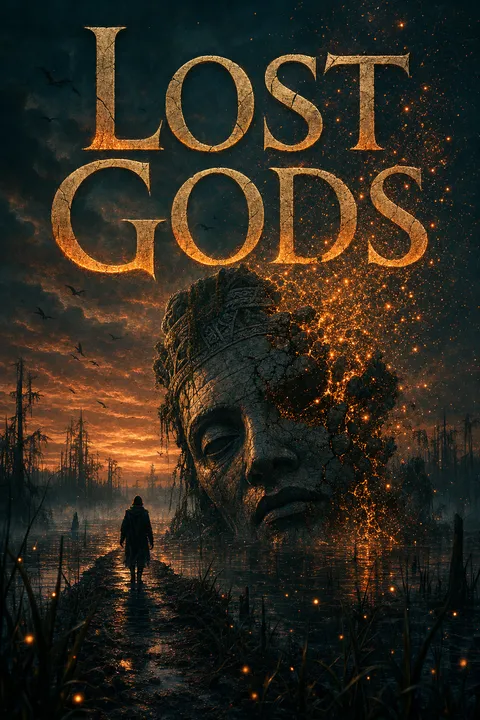


Plot Summary
Prologue
On Moran Island, South Carolina, 1976, a ghost boy named Joshua15 sits in a neglected family cemetery, keeping company with a rabbit he cannot touch. Two shadow-children with sputtering yellow eyes rise from the treeline, demons who cannot enter the iron-fenced graves.
They torment Joshua,15 drop the terrified rabbit into a swirling black hole in the earth, and taunt him with a secret: Chet1 is coming home. Chet1 is a daddy now. They intend to peel his skin and drag him down to the Burning Man, and they invite Joshua15 to help. When they leave to wait for Chet,1 the boy crawls to the fence, finds the rabbit dead, and sobs, alone with his endless waiting.
The prologue establishes the island as a spiritual trap through the smallest possible lens: a dead child who cannot comfort a rabbit, let alone save it. Brom introduces the demonic economy of souls fed to a Burning Man before any living protagonist appears, framing the coming tragedy as inevitable rather than accidental. Joshua's loneliness and moral innocence set the emotional register: this is horror that cares about tenderness. The demons' announcement that Chet is coming home seeds dread, retroactively poisoning the joyful reunion the next chapter celebrates. Death here is not release but stasis, an eternity of being unable to touch what you love, a condition the whole novel will labor to undo.
Selling the Mustang for Trish
Chet Moran,1 twenty-four and just out of county jail, backs a traded-for Pinto into Judge Wilson's driveway before dawn. He has sold his cherished restored Mustang and bought a plain gold band, determined to prove he has changed. He wakes Trish2 through her window, learns her father means to force their unborn child into adoption, and persuades her to run.
As they slip away, his old bully of a PE teacher, Coach,12 and the judge's brother arrive; Chet1 floors the car and strikes Coach12 in a tire-iron collision, fearing he has killed him. The couple ditch the Pinto, steal a station wagon, and drive across two states toward the one refuge Chet1 trusts: his estranged grandmother's remote island off the South Carolina coast.
The opening inverts the ex-con cliche by making redemption tangible and costly: Chet liquidates the one possession that defined his adolescent identity to fund a future. Brom frames manhood as sacrifice rather than swagger. Yet the collision with Coach plants the seed of Chet's damnation, converting an act of love into manslaughter and demonstrating the novel's central cruelty: good intentions accrue lethal consequences. The flight toward the grandmother's island reads as hope but functions as doom, the classic horror movement toward a false sanctuary. Trish's demand that he swear devotion to their child raises the personal stakes to a sacred vow he will spend the whole book trying to honor.
Grandmother on Moran Island
A weather-beaten bridge strung with bone-and-claw totems leads to the antebellum house where Lamia,3 Chet1's snow-white-haired grandmother, waits as if she already knew they were coming.
She heals Trish2's barbed-wire gash with a foul blood-honey salve and reads the unborn child's health in a drop of blood, pronouncing it a healthy girl. Charmed, Trish2 agrees to stay and learn the old herbcraft. Lamia3 recounts how Gavin,4 Chet1's grandfather, rescued her from a wartime pyre, then went mad, murdered their sons, and shot her in the head.
Chet1 glimpses a shadowy boy in the family cemetery and hears a faint voice urge him to run. That night a barefoot child lures him outside with a jar of what look like fireflies but glow with something far worse.
The homecoming sequence weaponizes nostalgia. Lamia embodies the archetypal nourishing grandmother, which makes her a perfect predator, since love disarms suspicion. Brom layers folk-horror signifiers (bone totems, iron, bells) that the couple dismiss as harmless eccentricity, dramatizing how the modern rational mind shrugs off ancestral warnings. Lamia's confession performs a sly misdirection, casting herself as victim and Gavin as monster, an arrangement the reader will later see violently reversed. The miraculously healed wound and the divined daughter bind Trish emotionally, converting her into a willing guest before any cage appears. Chet's ghost-glimpse and the whispered command to run function as the story's suppressed truth, audible only to the one carrying the family's cursed blood.
The Serpent Knife at His Throat
The two boys who lure Chet1 into the fog, Davy15 and Billy,15 shed their skin to reveal charred, needle-toothed demons who burn and bite him, calling their game Kill Chet. Lamia3 appears and the ghouls run to her, crying for their mother.
She cradles Chet,1 whispering comfort, then draws her serpent-handled knife across his throat. He wakes weightless and gray, watching a goat-limbed Lamia3 crouched over his own corpse, lapping his blood, ringed by hundreds of pleading child-ghosts who murmur Mama.
The truth crashes down: his grandmother is no healer but an ancient thing that summoned him home to feed. Trish2 and the unborn girl are still upstairs, alive, while Chet,1 now dead and damned, finds himself powerless behind a barrier of jangling silver bells.
The murder enacts the horror of maternal love turned cannibalistic. Lamia's tenderness is not performance but genuine, which is the deeper terror: she cherishes what she consumes. The child-ghosts crying Mama transform predation into a grotesque family, a perverse Pieta. Chet's death is also a birth into perception; only as a corpse can he see reality's true architecture. Brom stages damnation as helplessness rather than punishment, Chet trapped behind bells while his living family sleeps. The scene fuses Southern Gothic decay with vampiric myth, relocating the ancient lilith from legend to a peeling antebellum porch, and converts the safe haven of Chapter One into the mouth of the trap.
The Angel's Desperate Bargain
A gaunt, blue-black man crowned with a thin gold band drives the demons back with a glowing sigil and names himself Senoy,5 an angel of God trapped on the island. He shows Chet1 the beast-mark branding his palm, damnation earned by killing Coach.12 His account: Gavin4 brought the demons here, traded his own children's souls to Lucifer, murdered Senoy,5 and stole the sacred key that could free them all.
To save Trish2 and the baby, Chet1 must sink into the land of the dead, find Gavin4's soul, seize the key, and return it. Senoy5 presses a pouch of old pennies and a divine knife into Chet1's hands, warns him to hide his mark and show Gavin4 no mercy, then has the ghost boy Joshua15 teach him how to descend.
Senoy's arrival introduces the novel's engine of unreliable authority. He looks like salvation, a literal angel, and offers a hero's quest with tidy moral coordinates: virtuous Senoy, monstrous Gavin. Brom baits the reader into the same trust Chet extends, setting up the later reversal as an epistemological trap. The palm-mark literalizes guilt, converting manslaughter into a metaphysical brand. The pennies and iron blade are folkloric passage-tools drawn from Charon's obol and old ward-lore. Crucially, love rather than righteousness motivates Chet; he accepts damnation's risks purely to reach Trish, establishing the paternal devotion that will define and ultimately transfigure his entire descent.
Toll of Flesh and Pennies
Chet1 slides through endless tunnels of the dead into gray Erebus, scooping up an abandoned infant and meeting Ana,6 a Puerto Rican suicide carrying two orphaned babies. A ferry bears them across the River Styx, where the drifting dead thicken back into cold, aching flesh.
On the far bank a brute named Dirk18 and his green-coated Defenders demand a toll paid in coins or severed hands. Chet1's pennies suffice, but Dirk18 seizes his glowing knife and threatens the children, until three black-robed sisters led by Mary13 arrive with the towering sphinx called the Red Lady.14
The guards scatter before her. Mary13 tells Chet1 to seek a bloodseeker in the Old City to find his grandfather, and to keep his damned mark hidden from the soul hunters who trade heads for bounty.
The Styx crossing renders the afterlife as bureaucratic extortion, a customs checkpoint run by thugs who monetize flesh. Brom's underworld is not theological order but a lawless frontier, the old gods displaced by racketeers. The transformation from spirit to painful flesh insists death offers no anesthesia. Ana's refusal to surrender the orphaned babies establishes the novel's counter-value: caretaking as resistance to a merciless cosmos. The Red Lady introduces the fading old gods as reluctant protectors, and Mary's warning about the hidden mark turns Chet into permanent prey, a fugitive whose very soul carries a price. Briefly, fragile community becomes the only shelter in a world engineered to devour.
The Spider God's Verdict
In a burned temple beneath Calvary Hill, Chet1 finds Yevabog,7 a forgotten spider-goddess with six arms and seven eyes. Tasting his blood, she recognizes the lineage of Lamia,3 a lilith, and reveals the horror Senoy5 withheld: Lamia3 feeds only on her own bloodline, breeding children to drink and daughters to inhabit.
She will raise Chet1's baby girl, drain her, then cast out her soul and steal her body, making her one more ghost in the endless following throng. A seeking spell locates Gavin4 executing prisoners at Lethe. Then Carlos9 and his Defenders storm in, kill Chet1's cheerful companion Johnny16 by splitting his skull, and torture Ana,6 until Yevabog7's hurled fire-potion lets Chet1 cut himself free and drag the wounded goddess out with them.
Yevabog is the reversal's first tremor, exposing Senoy's omission and reframing the quest. The lilith mythology weaponizes reproduction: motherhood as harvest, daughters as future flesh, immortality bought by devouring one's own descendants. This literalizes intergenerational trauma, the ancestor who eats the child's future. Yevabog herself embodies the pathos of obsolescence, a god starved of worship, mourning forgotten husbands; in Brom's cosmos, to be forgotten is to truly die. Johnny's abrupt, brutal death punctures the adventurer's optimism that made him endearing, insisting the stakes are permanent oblivion. Chet's choice to rescue the crippled goddess signals his emerging refusal to abandon the doomed.
Enslaved to the Stag God
Fleeing Carlos,9 Chet,1 Ana,6 and the crippled Yevabog7 stumble into the stockyards of Veles,8 a towering stag-god assembling a caravan for the gods' annual Gathering. Chet1's attempt to steal a horse ends with the beast dead against a gate, and the enraged god claims him and Ana6 as slaves for the arena games, hauling Yevabog7 away in a cage.
Chained to a coal-belching iron golem named Priscilla, Chet1 reunites with Coach,12 the man he killed, now damned and burning for revenge, and befriends Ado,11 a devoted servant of the goddess Oya. Ado11 begins teaching Chet1 and a grudging Coach12 the fluid defensive footwork that might keep them alive against the monstrous, god-crafted champions they will soon be forced to face.
Enslavement to Veles dramatizes the commodification of souls, bodies chained to a furnace, existence reduced to labor and spectacle. Coach's reappearance forces Chet to confront his crime made flesh, the man he killed now sharing his chains, collapsing victim and perpetrator into fellow sufferers. Ado introduces a theology of devotion: service to a god as the source of meaning and vitality in a dead world, modeling the mentor archetype through patience rather than despair. Brom uses the caravan to widen the canvas, revealing a purgatory of fading gods and rising thugs, a civilization in twilight, while sharpening Chet's raw survival instinct into transferable skill.
Six Rings in the Coffer
In the arena, ring-bearing slaves must survive three days against god-crafted champions while gathering copper rings that mean freedom. Chet,1 Coach,12 and Ado11 fight as a unit, feinting past the berserker giant Mortem,19 Queen Hel's undefeated killer.
Mortem19 crushes Coach12's skull, and on the final day he cuts down Ado11 when the older man charges to protect his friends. Enraged and cornered, Chet1 snatches six loose rings from a fallen champion and slams them into the coffer himself, a move no slave has ever dared.
Queen Hel, delighted by his audacity, crowns him Grand Victor and grants his freedom, along with a sword, coins, and copper rings. Chet1 uses his winnings to buy Ana6's freedom and passage to Lethe, killing the cruel goblin Seet17 to recover his stolen knife.
The arena crystallizes the book's meditation on spirit versus flesh: victory belongs not to the strongest but to those who endure pain and refuse to surrender. Ado's self-sacrifice completes his devotional arc, dying for friends as an act of faith rather than futility, prefiguring the paternal love Chet will later be forced to enact. Coach's death denies him the reconciliation he sought, a bleak note on redemption's uncertainty. Chet's rule-breaking win reframes agency: the disregarded slave seizes the game's own logic and turns it against its makers. Hel's delight suggests the gods hunger for genuine spirit, that audacity itself is a kind of worship reviving a moribund order.
Boarded Windows and Bell Strings
Back on the island, Trish2 wakes to find Chet1's body already buried and herself locked in a boarded room, drugged with Lamia3's poppy tea. She pries the window nails loose one by one, but every escape fails: Lamia3 parades the swarming ghost children and their demon shepherds before her, force-feeds her under a hypnotic spell, and murders a churchwoman and her teenage son who stop by the house.
Trish2 gives birth to a daughter she names Amy, only to discover tiny puncture wounds where Lamia3 has been drinking the infant's blood. Realizing the old woman means to carry the child off to Brazil and discard or kill her, Trish2 resolves to break free, never guessing that her rescue is already clawing its way back from the land of the dead.
Trish's imprisonment runs the horror in a domestic register: isolation, drugging, gaslighting, the abuser who insists captivity is protection. Brom mirrors the underworld's coercion inside the earthly house, as Lamia force-feeds Trish exactly as the gods force flesh on souls. The boarded window and the patiently loosened nails render agency as slow, bloody persistence. The murdered churchwoman and son display Lamia's pure amorality and demolish any hope of outside rescue. The discovery of punctures on Amy converts abstract dread into visceral maternal terror. The arc argues that the living and the dead fight the same monster, and that motherhood is both the target and the last weapon.
Ambush at the Edda Gathering
Carlos9 and the human rebel leader called the Colonel,10 armed with muskets and the golden God Slayer spear bought from the demon Lord Kashaol,20 ambush Veles8 during his firework celebration for the Edda, the underworld's first people.
Gavin,4 the Colonel10's coldest gunman, cuts the stag-god down, and Carlos9 hauls the mutilated Veles8 away in chains. Chet1 and Ana6 flee into the obsidian canyons, then watch the Red Lady14 tear through Kashaol20's demons to save them, only to be blasted by gold-tipped bullets that wound the supposedly invincible sphinx and send the demon lord fleeing.
Rescued by Mary13's sisters, Chet1 helps feed ka and precious god-blood to the collapsing Red Lady14 and the ruined Veles,8 and the whole caravan limps on toward Lethe, seeking a god who can heal them.
The Veles ambush escalates the political plot: humans, armed by demons, hunting gods for a liberation that is really conquest. Brom interrogates revolution itself, the Colonel's idealism laundering Carlos's naked ambition, freedom-rhetoric masking a power grab. The god-slaying weapons literalize a world where the sacred has become killable, disenchantment rendered as violence. The Red Lady's wounding, the invincible made vulnerable by fallen-angel gold, signals the twilight of the old order. Chet's choice to spend his hard-won god-blood healing wounded enemies rather than hoarding it reaffirms his deepening ethic of care. The convergence of every faction toward Lethe assembles the machinery for the coming reckoning.
The Grandfather's True Confession
At Temple Lethe, Carlos9 springs a second ambush with the demon cannon, mangling the Red Lady14 and the sisters. In the chaos Chet1 corners Gavin4 and beheads him, only for the severed head to keep talking, taunting that the key lies hidden elsewhere.
Gavin4's confession reverses everything: on that terrible night he came home to find Lamia,3 the demon-boys, and Senoy5 draining his daughter Cynthia's soul, and shot them all in horror. Senoy5 is no righteous angel but Lamia3's lover, who let her weave his blood into living flesh; both crave the granddaughter's blood.
The key sits concealed inside the grip of Gavin4's revolver. To save the child, grandfather and grandson must work together, and Chet1 must kill Senoy5 on sight rather than trust a single word.
The confession is the novel's structural fulcrum, a peripeteia delivered through a talking severed head, grotesque and Shakespearean at once. Every moral coordinate inverts: the murderer grandfather becomes a grieving father; the rescuing angel becomes a predatory lover. Brom rewards the reader's suspicion and punishes credulity, retroactively recoding Senoy's every kindness as manipulation. The revelation deepens the tragedy of Cynthia and reframes Gavin's decades of self-destruction as penance. The key hidden inside the revolver literalizes how truth was concealed within the very instrument of violence. Alliance replaces vengeance, and the quest's original command, return the key to Senoy, stands exposed as the trap it always was.
Gods Unleashed at the Iron Mother
Reunited, Chet1 and Gavin4 shoot their way through Kashaol20's demons in the canyons, Gavin4 teaching his grandson to fight and read the wind-carved trails. They are cornered at the iron statue called Osiris's Mother, where Carlos9 learns his demon patron Kashaol20 has been overthrown by the crueler Lord Beelbeth, who demands the rebels serve him.
Gavin4 fakes a betrayal, cutting off Chet1's hands to deliver him and free the caged captives, then Veles,8 the Red Lady,14 and Yevabog7 break loose and turn the battle into slaughter.
Veles8 burns Carlos9 and the Colonel10 alive; Chet1 finishes Carlos9 with a bullet. But Gavin4 throws himself into the cannon blast meant for Chet.1 Dying, he gives Chet1 the key and asks that Gavin4's own name be the last thing Senoy5 ever hears.
The battle collapses the human rebellion under demonic betrayal, dramatizing the folly of bargaining with Hell: Carlos, who dreamed of becoming an emperor, is discarded and incinerated. Brom stages poetic justice as the caged gods turn predator, spectacle reversed upon its stagers. Gavin's faked betrayal, mutilating Chet to smuggle him in, weaponizes apparent cruelty for love, a final inversion of the murderer image the novel opened with. His death absorbing the blast completes his redemption: the man who killed his own children dies saving his grandson's child. The dying request to speak his name fuses vengeance with a plea to be remembered, the deepest need in a world where forgetting is death.
Crossing Back Over the Bridge
Carrying the key, Chet1 hurls the brutal toll-taker Dirk18 into the tormenting hands of the River Styx and uses the divine key to unlock the ancient bridge that no dead soul may recross. He walks into the living world, rising through his own buried bones into the moonlit island cemetery, still solid flesh.
There he confronts the demons Davy15 and Billy,15 who have haunted the ghost boy Joshua15 for decades, and cuts them down with the angel knife. Finding Senoy5 withered nearly to nothing, Chet1 drives the blade into the angel's eye, lets the demon-boys maul him, then beheads him, speaking Gavin4's name as the last sound the treacherous seraph ever hears. One monster of the island still remains: Lamia,3 waiting in the house.
The return crossing inverts the entire journey, a soul defying the one-way law of death through a Heaven-forged key. Brom grants Chet an eerie, unpunished passage, subverting the expected divine retribution and implying a cosmos more negligent than vigilant. The reunion with Joshua threads back to the prologue and exposes Senoy's petty cruelty: an angel who kept a child from Heaven merely for company. Chet's execution of Senoy is both justice and the fulfillment of Gavin's dying wish, the name spoken as curse and memorial at once. Killing the demon-boys who murdered innocents closes a circle opened in the prologue, leaving only the ancient mother to face.
The Daughter Who Was Never His
Inside the house Chet1 frees the drugged Trish2 and lifts the infant Amy from her crib, but Lamia3 and her hulking silent handyman Jerome21 ambush them on the porch. Trish2 tears apart the bell-string barrier, and the freed ghost children swarm their mother. Chet1 shoots Jerome,21 then Lamia,3 who flees with the baby and dies; he beheads her to be certain.
Then the children turn their pleading eyes not on Trish2 but on the infant, murmuring Mama. Amy's eyes pulse silver: Lamia3's soul has already leapt into her chosen vessel. Remembering Gavin4's own impossible choice, Chet1 chases the crawling, hissing infant to the graveyard and cuts off his daughter's head, ending the lilith forever and destroying the very child he descended into death to save.
The climax delivers the book's cruelest reversal: rescue arrives too late because the prize is already poisoned. Trish's destruction of the bell-string, an act of liberation, unleashes the swarming children as an accusing chorus. The revelation that Amy is Lamia's vessel forces the ultimate paternal horror, mirroring Gavin's own filicide and crystallizing the novel's thesis that love sometimes demands unbearable destruction. Chet's beheading of the hissing infant is the emotional nadir, redemption purchased at the price of the very thing he crossed worlds to protect. Brom refuses the sentimental rescue, insisting that some evils can only be stopped, never undone, and that the deepest heroism can look identical to atrocity.
Guardian of the Lost Children
Chet1 carries Trish2 to a neighbor's shack, tells her Lamia3 is destroyed and their sacrifice meant something, and begs her to live fully before a final goodbye. Then he descends once more with the severed heads, feeding Davy,15 Billy,15 and Senoy5 to the tormenting hands of the River Styx.
Crossing back, he becomes shepherd to the hundreds of freed child-souls and finds Ana6 alive, having chosen purpose over oblivion, while Mary13 gathers the sisterhood and the Red Lady14 hunts the last demons. Cradling his daughter's freed infant spirit, no longer the lilith but Amy herself, Chet1 asks Mary13 the road to the Elysium Fields, the paradise the key can still open, choosing to escort his child rather than claim his own rest.
The resolution reframes tragedy as vocation. Chet cannot secure Trish's future by staying, so love becomes release: he commands her to live, transferring his sacrifice into her survival. His guardianship of the child-souls converts private grief into communal care, echoing Ana's chosen purpose and Mary's sisterhood, a counter-economy of tenderness set against a devouring cosmos. By escorting his daughter's soul toward Elysium instead of seizing paradise for himself, Chet completes his arc from selfish drifter to selfless father. Brom ends not with restoration but with meaning wrested from loss, arguing that the afterlife's only true redemption is the deliberate choice to shepherd the helpless through unavoidable sorrow.
Epilogue
With Senoy5 dead and his shroud fallen, the ghost boy Joshua15 finally dares to leave the island cemetery for the first time in decades. He walks past the demons' smoldering remains, crosses the bone-totem bridge unharmed, and follows an overgrown path to the ruined shack where his mother once shelled peas on the porch.
A light rises from the trees, and his mother, smelling of honey and sunshine, gathers him into her arms and asks if he is ready to come home. He nods through his tears, takes her hand, and together they walk into the light.
The epilogue resolves the prologue's ache, granting Joshua the release that Chet's entire ordeal made possible. By ending on the least powerful character rather than the protagonist, Brom reframes the whole violent saga as, ultimately, about freeing the innocent and the forgotten. The fallen shroud literalizes how one soul's sacrifice can lift a decades-long imprisonment. The reunion is rendered in sensory warmth, honey and sunshine, and answers the prologue's central deprivation directly: the dead boy who could not touch a rabbit now feels his mother's embrace. It is a quiet benediction, insisting that even in Brom's merciless underworld, love occasionally, and hard-won, delivers someone home.
Analysis
Lost Gods reworks the descent-into-the-underworld myth into a Southern Gothic meditation on guilt, memory, and the terrible arithmetic of love. Brom fuses Orpheus, Dante, and vampire folklore with the sun-bleached poverty of 1976 Alabama and the pluff-mud marshes of the Carolina coast, building an afterlife that runs not on divine justice but on extortion, spectacle, and the cannibal economy of ka. The cosmology is the argument: the monotheistic One Gods have exiled the ancient gods underground, where they fade as memory abandons them, and to be forgotten is the truest death. Into this twilight walks Chet,1 a fuck-up chasing one last promise. The book's engine is reversal. Senoy5 the luminous angel and Gavin4 the murderous grandfather trade moral places at the midpoint, and Brom uses the swap to indict credulity itself, our instinct to trust the beautiful and condemn the scarred. Appearances lie: the grandmother who bakes bread drinks children; the killer who shot his sons did it to save them. This structural cruelty culminates in the darkest inversion of all, when Chet1 suffers everything to save his daughter only to learn that saving her means destroying her. Yet the book resists nihilism. Against a merciless universe Brom sets a counter-economy of caretaking: Ana6 gathering orphaned babies, Mary13's sisters shepherding infants to mercy, Chet1's final choice to guard the lost children rather than seize paradise. Redemption here is not restoration but the decision to shepherd the helpless through unavoidable loss. Love does not conquer; it endures, sacrifices, and wrests meaning from ruin. The Joshua15 frame, opening and closing on a lonely dead child finally carried home, insists that even in the pits of death, the smallest mercy can be the entire point of the descent.
Review Summary
Lost Gods by Brom is a dark fantasy novel set in purgatory, blending mythology and horror. Readers praised the vivid worldbuilding, stunning artwork, and imaginative storytelling. The book follows Chet Moran's journey through the underworld to save his family. While some found the pacing slow in parts, many appreciated the unique take on the afterlife and complex characters. The novel's graphic violence and philosophical themes resonated with fans of dark fantasy, though some felt it lacked subtlety at times.
People Also Read
Characters
Chet Moran
Ex-con underworld pilgrimChet is twenty-four, wiry, auburn-haired, with pale silver-gray eyes that mark him a Moran. A small-time drug runner fresh out of jail, he has spent seven months resolving to become the father and husband he never managed to be. His defining act, selling his beloved restored Mustang for a wedding ring, signals a man trying to trade adolescent identity for adult responsibility. Chet is impulsive, quick-tempered, and prone to old habits, but beneath the fuck-up runs fierce loyalty and a capacity for love bordering on the reckless. His grandmother3's rare blood grants him strange sensitivities. Driven above all by a vow sworn to his unborn daughter, he proves willing to endure any torment to keep a promise, discovering a courage and endurance he never suspected he owned.
Trish
Pregnant runaway brideTrish is Chet1's high-school sweetheart, a judge's daughter with bright green eyes and a quirky laugh, eight months pregnant when the story opens. Fiercely independent, she has repeatedly forgiven Chet1's failures while refusing to be naive about them, demanding sworn change before she will trust him again. Her choice to flee her controlling father, who intends to force her baby into adoption, reveals a woman willing to gamble everything on love and motherhood. Curious and open-hearted, she is drawn to Lamia3's old healing arts. Trish's core drive is a protective ferocity toward her child, a maternal will that makes her both terribly vulnerable to and quietly dangerous against the forces gathering around her.
Lamia
The devouring grandmotherLamia presents as Chet1's frail, elegant grandmother: snow-white hair, silvery eyes, a bullet scar at her temple, an Eastern European lilt, and a genius for herbs, potions, and midwifery. She radiates warmth and welcome, glowing at the sight of family reunited. Beneath the doting exterior lives something impossibly ancient, a being that has prowled the earth since before mankind, whose faith in her own craft is total and contagious. She frames herself as a persecuted healer, victim of a violent husband4 and a cruel world. Her love is genuine, and that is precisely what makes her monstrous: she cherishes what she consumes. Possessive, patient, and utterly certain of her own righteousness, Lamia is the gravity around which the entire tragedy orbits.
Gavin Moran
Haunted gunslinger grandfatherGavin is Chet1's grandfather, a tall, hard man in a fitted long coat and battered porkpie hat, twin revolvers on his hips and dead, unreadable eyes. A WWI veteran turned Prohibition muscle in life, in death he is a peerless warrior who fights on through wounds that would fell anyone else, having learned that survival here is a matter of how much pain you can endure. He drinks the memory-dissolving waters of Lethe to forget a night of unspeakable horror, and rides with a rebel band that hunts and kills gods. Gavin is defined by guilt, self-loathing, and a slow campaign of self-destruction. Cold and taciturn, he nonetheless harbors a buried tenderness and a ferocious protectiveness that the right cause, and the right blood, can still awaken.
Senoy
The trapped fallen angelSenoy is an angel, or so he claims, with skin so black it seems blue, a thin gold band crowning his gaunt head, and the desperate frailty of a being slowly starving. Once a mighty hunter of gods and monsters, Gabriel's sword, he is now trapped and withering on Moran Island, consumed by a longing he cannot master. He speaks with the weary authority of the divine and offers Chet1 salvation through a quest. Proud, manipulative, and pitiable in equal measure, Senoy embodies the danger of trusting appearances; his true motives run far deeper and darker than his righteous words ever suggest.
Ana
Grieving suicide seeking mercyAna is a young Puerto Rican woman with short-cropped hair who took her own life after a fire she caused killed her infant son. Consumed by guilt, she arrives in the underworld seeking only oblivion, yet cannot stop herself from gathering lost, orphaned babies along the way. Compassionate despite her self-hatred, she becomes Chet1's steadfast companion, and her wrenching search for penance mirrors his own struggle to find meaning in a merciless afterlife.
Yevabog
Forgotten spider goddessYevabog is a forgotten spider-goddess, six-armed and seven-eyed, corseted in silk webbing, once worshipped with blood and children and now bitter and starved for remembrance. She hoards silk-wrapped husbands and mourns her burned temple. Devious, vain, and dangerously seductive, she nonetheless becomes an unlikely guide and truth-teller for Chet1 after tasting his blood and recognizing his lineage. Her arc traces a god torn between despair and reawakened fire.
Veles
The showman stag-godVeles is an ancient stag-god, towering when he wishes, with graceful human hands, a golden corona, and a showman's love of spectacle: animals, fireworks, dancing. He travels temple to temple keeping his fading worshippers, the Neanderthal-like Edda, in thrall. Vain, theatrical, and casually cruel to slaves, Veles is also genuinely devoted to keeping life alive in a dead world, a proud old god raging against his own obsolescence.
Carlos
Ambitious green-coat schemerCarlos leads the Defenders, the green-coated thugs who have seized Styga's docks and coin trade. A former convict who worships no one but himself, he masks naked ambition behind the language of liberation, scheming with demon lords to crown himself an emperor of the dead. Ruthless, vain, and coldly intelligent, driven by a lifetime of being beaten down, Carlos is the human face of the underworld's corruption.
The Colonel
Idealist rebel leaderTurner Ashby, a former Confederate cavalry officer, leads the ragtag rebel Rangers in a crusade to free souls from the gods' tyranny. A charismatic idealist dreaming of a civilized purgatory, he is dangerously blind to how his revolution is being hijacked, and haunted by a life spent tearing down rather than building. His good intentions pave a treacherous road.
Ado
Devoted arena mentorAdo is a lean, ritually scarred African soul, once a devoted servant in the guard of the goddess Oya, enslaved for trying to steal god-blood to heal her. Wise, warm, and philosophical, he finds meaning in service and teaches Chet1 and Coach12 the fighting arts that might win their freedom. His unwavering faith in his goddess gives him a serenity rare among the damned.
Coach
Vengeful dead teacherLarry Wagner, known as Coach, was Chet1's brutal high-school PE teacher, a bully nursing old grudges. Killed during Chet1's escape, he arrives in the underworld consumed with vengeance, only to be drawn into an uneasy alliance. Beneath his rage lies a lifelong shame rooted in childhood cowardice and a desperate wish to find his dead mother and beg her forgiveness.
Mary
Leader of the sistersMary leads the black-robed sisters who rescue lost infant souls and guide them to the river's mercy. A Salem-accused woman haunted by her own daughters' deaths, she bears a jewel in her forehead that lets her see into hearts. Compassionate, resolute, and quietly commanding, she offers Chet1 aid, warning, and a living model of redemption found through selfless care.
The Red Lady
Sphinx guardian of godsSekhmet, the Eye of Ra, called the Red Lady, is a towering winged sphinx with a woman's fierce face and a lion's body, created by the ancient gods to guard their realms. Divine yet mortal, with living blood in her veins, she is the last true bulwark against the encroaching demons: wrathful, regal, and increasingly vulnerable as belief in the old gods fades.
Joshua
Lonely cemetery ghost boyJoshua is the ghost of a young Gullah boy, burned to death decades ago alongside the demon-boys, now bound to the island's graveyard. Gentle, lonely, and aching for his mother and for Heaven, he befriends both the trapped angel5 and the newly dead Chet1, offering guidance and a heartbreaking innocence that frames the whole novel.
Johnny
Freed paralyzed teenA cheerful teenage suicide, paralyzed for fifteen years in life, who delights in his restored mobility and treats the grim underworld as a grand adventure. His stubborn optimism briefly lightens Chet1 and Ana6's bleak early journey.
Seet
Cruel goblin slaverSeet is a horned, reptilian Trow, Veles8's sadistic slave-driver, who wields a bludgeon-lash he calls Agony and nurses a vindictive grudge against Chet1 from their first violent encounter.
Dirk
Brutal river toll-takerDirk Robertson is the swaggering, brutal toll-taker at the River Styx crossing, a former carwash worker who relishes his petty power and extorts coins or severed flesh from the terrified newly dead.
Mortem
Undefeated arena championMortem is Queen Hel's undefeated arena champion, a hulking, tusked, bluish berserker who has slain more ring-bearers than any monster in the games' history and is feared even by the other champions.
Lord Kashaol
Scheming demon lordKashaol is a tattered, scheming fallen angel, a demon lord operating outside Lucifer's favor, who arms Carlos9 with Hell-forged weapons in a desperate bid to seize the river realms and reclaim his lost standing.
Jerome
Lamia's silent handymanJerome is Lamia3's hulking, wordless handyman, an unnervingly obedient presence who carries out the old woman's bidding without question, speech, or hesitation.
Plot Devices
The Key
Unlocks worlds and spellsThe red copper key is the object of Chet1's entire descent. Forged of Heaven's power and stolen long ago by Gavin4 from the angel Senoy5, it channels divine sorcery: pressed against any lock, door, or barrier, it finds its own way open, and it can unbind spells and shackles alike. Gavin4 conceals it inside the grip of his revolver, having used it for decades to slip into places no soul should reach, even the temples of gods. Most crucially, the key can open passages between the living world and the dead, including the sealed bridge that no departed soul may recross. Every faction, god, demon, and damned soul alike, would kill to possess it, making it at once Chet1's salvation and a constant, dangerous target.
The Angel's Knife
Blade that kills the divineSenoy5 presses a foot-long, bronze-hilted knife into Chet1's hands, its blade a bright, unscratched gold. Unlike ordinary weapons, it slices through steel, stone, and even the flesh of gods and demons as easily as through meat. Forged in Heaven's ancient wars and meant for the divine, it is one of the few things that can permanently harm immortal beings. Its faint glow lights Chet1's way through lightless tunnels. Across the journey the knife is coveted, stolen, and hard-won back, and it ultimately becomes the instrument by which Chet1 confronts every monster standing between him and his family, from arena beasts to the ancient powers of the island itself.
Ka and God-Blood
Physiology of the deadBrom's underworld runs on a grim economy of flesh. Souls are made of ka, a clay-like substance housing the true self, the ba, which is caged in the skull; crush the skull and the ba drifts away forever into oblivion. Wounds heal by eating ka, minted into leathery brown coins pressed from the bodies of other souls, so healing itself is a form of cannibalism. Rarer and far more potent is god-blood, silver spikes that can restore even a dying god yet poison an ordinary soul. These substances govern survival, combat, and power throughout Chet1's journey, and possessing them repeatedly marks the difference between endurance and final, permanent death.
The Mark of the Damned
Brand that draws demonsWhen Chet1 dies having killed a man, Lucifer's mark brands his right palm, a horned beast's head visible only to those with special sight. It condemns him to Hell and makes him prey: demons can smell the damned, and soul hunters pay handsome bounties for damned heads. Chet1 must keep the mark hidden with copper and spellcraft to survive the crossing and the cities beyond. The brand externalizes guilt as a metaphysical fact, transforming his accidental manslaughter into a hunted condition that shadows every step, and raising the stakes of capture far beyond mere death to eternal torment.
The Bell-String Barrier
Bells that cage the deadStrands of colored yarn hung with tiny silver bells wind around Lamia3's porch and steps, threaded through the posts. The bells torment demons and ghosts, who cannot bear their ringing and cannot cross the barrier they create, keeping the house sealed against the swarming child-spirits and their ghoulish shepherds. The local Gullah folk use similar bone totems and blessed oil at the island's bridge, believing spirits cannot cross running water. This fragile line of folk-magic recurs at pivotal confrontations, both protecting and imprisoning, and its severing at a crucial moment turns the trapped dead loose upon those who bound them.
Download PDF
Download EPUB
.epub digital book format is ideal for reading ebooks on phones, tablets, and e-readers.








































