
Key Takeaways
1. Cars Ruin Everything: The Hidden Costs of Autocentric Life
Far from serving as a figurative and literal vehicle for freedom and independence, cars exclude vast numbers of people from full enfranchisement in society—children, older people who have lost the ability to drive, people with disabilities that prevent them from driving, people who can’t afford to buy or operate a car.
Beyond the fantasy. The automobile industry has long sold a fantasy of freedom and independence, but the reality is a host of hidden costs and burdens. This rose-colored vision obscures the profound collective damage cars inflict, extending far beyond mere convenience. The industry spends billions annually on advertising, perpetuating a dream that is, in truth, running on empty.
Demolished dreams. The proliferation of automobiles has led to the demolition of neighborhoods for expensive infrastructure like freeways and sprawling, desolate parking lots. These asphalt wastelands amplify urban heat and generate toxic runoff. Car dependence enforces financial servitude, causes an epidemic of violent deaths and chronic illnesses, wastes countless hours in traffic, and fosters isolation, loneliness, and societal polarization.
Existential crash. The true face of cars is the opposite of the advertised image. They are driving us towards an existential crash, destroying the natural world and excluding many from full participation in society. This book aims to illuminate the scale of this damage, the forces perpetuating it, and the tools needed for transformative change towards a more equitable, sustainable, and just society.
2. The "War on Cars" is a Century-Old Battle for People-Centered Streets
From this moment on, I declare war on reckless drivers—henceforth, homicidal drivers answer to me!
Superman's early fight. In 1939, Superman declared war on reckless drivers, highlighting a shocking reality: cars were the biggest threat to Metropolis citizens, causing more deaths than the World War. This early fictional narrative reflected a very real public health crisis, with motor vehicle fatalities skyrocketing from 4,700 in 1914 to over 32,000 in 1939 in the U.S.
Early outrage. The initial reaction to the rise of cars was anything but subtle. Cities erected monuments to child traffic victims, and newspapers labeled motorists as "killers." Campaigns like Detroit's "bell ringing" for every traffic death and Brooklyn's "Death-O-Meter" underscored the horror. This period saw widespread public anger, with calls to tame cars by slowing them down, such as Cincinnati's proposed speed-governor ordinance.
Motordom strikes back. The burgeoning auto industry, or "motordom," successfully fought back against these early efforts. They coined "jaywalking" to shift blame from drivers to pedestrians and launched sophisticated PR campaigns to normalize car dominance. This historical struggle reveals that the "war on cars" is not new; it's a long-standing fight for people over vehicles, often obscured by corporate narratives and political maneuvering.
3. Car Culture's "Bikelash" Reveals Deep-Seated Resistance to Change
To paraphrase a popular saying, when you’re accustomed to driving, sharing the road feels like oppression.
Predictable outrage. Any effort to reclaim streets for people, especially for bikes, often triggers "bikelash"—a negative and outsized reaction from car culture. This phenomenon is characterized by angry, hyperbolic, and illogical responses, as seen in the Park Slope bike lane controversy where arguments escalated from parking concerns to conspiracy theories and physical altercations.
Misinformation and moral panic. Opponents frequently resort to predictable tropes: "This isn't Amsterdam," or "I like bikes, but..." followed by a litany of complaints, often based on incorrect information. This resistance often stems from a "moral panic," demonizing cyclists for perceived transgressions while ignoring the much larger societal problems caused by cars. Studies show cyclists are no more law-breaking than drivers, and often break rules for safety.
Embrace the bikelash. Bikelash, though frustrating, is a sign of progress. It indicates that a city is challenging car dominance and rethinking its priorities. The stages of bikelash—denial, anger, bargaining, depression, and eventual acceptance—mirror the Kübler-Ross model of grief. As cities implement changes, initial vocal opposition often gives way to widespread public approval once the benefits of safer, more livable streets become evident.
4. Cars Steal Childhood: Limiting Independence and Safety for Kids
Cars have stolen a fundamental part of childhood from children: their ability to experience the world independently.
Lost autonomy. The ability for children to move independently has drastically declined, with only 11% of U.S. kids walking or biking to school today, down from over 40% in 1969. This loss of autonomy is not due to changes in children's capabilities, but rather a world increasingly built for cars, where parents' fears of traffic danger are well-founded.
Traffic's toll on kids. Car-centric environments create a vicious cycle: parents drive kids to school for safety, increasing traffic, which makes streets even more dangerous. This leads to:
- Higher crash rates near schools (57% more crashes, 25% more injuries on school days in NYC).
- Motor vehicle crashes being a leading cause of death for children and adolescents.
- Reduced physical activity, contributing to a global health crisis.
- Limited access to community destinations, impacting development and well-being.
Reclaiming streets for children. The global bike bus movement, inspired by initiatives in Barcelona and Portland, demonstrates a powerful demand for safer streets for children. Historically, movements like the Dutch "Stop de Kindermoord" (Stop the Child Murder) in the 1970s successfully transformed cities like Amsterdam into child-friendly environments. Prioritizing children's needs in urban planning, as seen in successful bike corral campaigns, can lead to more detailed cognitive maps, greater independence, and improved overall well-being for kids.
5. Nature Suffers Silently: From Roadkill to Invisible Toxins
The thing is, when it comes to the way cars ruin nature, roadkill is only the most visible manifestation of a web of pervasive, insidious, destructive effects.
Beyond the visible carnage. While roadkill is a disturbing and omnipresent consequence, the damage cars inflict on nature extends far beyond direct strikes. Scientists estimate hundreds of millions of birds and mammals are killed annually in Europe and the U.S. However, this visible carnage is just the tip of an iceberg of pervasive, insidious, and often invisible destructive effects.
Invisible pollutants. Road runoff is a toxic stew of chemicals, including oil, gasoline, road salt, and tire dust. Researchers discovered that 6PPD-quinone, a byproduct of a tire preservative, is fatal to coho salmon, killing half of those attempting to spawn each year. This chemical, designed to protect tires from ozone pollution, creates even more pollution, highlighting how cars poison ecosystems even without direct contact.
Noise and genetic isolation. The incessant din of traffic, or "traffication," is an invisible pollutant that harms a wide range of animals, causing stress, sleep disruption, and even premature aging. Roads also fragment habitats, creating "genetic traffic islands" that lead to inbreeding and reduced genetic diversity, threatening species like the cougars of the Santa Monica Mountains. These subtle, yet profound, impacts underscore the need for a broader understanding of how cars degrade the natural world.
6. Cars Are Killing Us: A Public Health Crisis We've Normalized
The thing about fatalities, though (the thing about people dying, we should say), is that the per capita or per VMT death rate is meaningless if the person who died on their way to work or coming home from a basketball game is your person—your wife or brother or father or best friend.
A normalized tragedy. Ralph Nader's 1965 book, Unsafe at Any Speed, exposed the auto industry's disregard for human life, leading to safety reforms that initially reduced traffic deaths. However, the U.S. has seen a worrying upward trend in recent years, with over 46,000 fatalities in 2022, including a 41-year high in pedestrian deaths. This "standard American unit of mortality" (SAUM) of 40,000-50,000 deaths annually has become a normalized, accepted price of car dependence, unlike other public health crises.
Invisible health threats. Beyond collisions, cars are a major source of air and noise pollution, causing hundreds of thousands of "excess deaths" annually in the U.S. and 6.7 million globally. Car-generated pollution is linked to:
- Asthma and premature births
- Cognitive delays in children and dementia
- Cardiovascular disease and certain cancers
- Reduced male fertility and sexual function
Sedentary servitude. The reliance on cars also contributes to a global crisis of physical inactivity, leading to noncommunicable illnesses and straining healthcare systems. Long, congested commutes, like the one causing an Achilles' heel injury, highlight the physical toll of car dependence. While electric cars reduce tailpipe emissions, they still contribute to tire dust pollution and require extensive infrastructure, proving that "the problem of cars can't be solved with different cars."
7. Autocentric Design Drives Social Isolation and Injustice
In effect, it appeared that the cars were killing the human social life on heavy- and medium-traffic streets.
Eroding community. Research by Donald Appleyard in 1969 San Francisco revealed that increased car traffic directly correlated with a decline in social interaction and community vitality on streets. Heavily trafficked streets led to residents feeling isolated and unsafe, repelling families and eroding neighborly connections. This phenomenon, often overlooked, contributes to urban decline and the hollowing out of relationships, forcing people into their private dwellings.
The loneliness epidemic. Car-centric sprawl development is a major contributor to the "loneliness epidemic" in American society. The design of our communities, prioritizing cars over people, forces individuals into metallic bubbles, competing for space and speed. This isolation is rarely addressed in discussions about loneliness, despite the fact that most Americans are compelled to navigate a transportation system that inherently separates them.
Motonormativity and power. Cars foster a "motonormativity," a flexible morality where actions deemed unacceptable in other contexts (like screaming at strangers or polluting the air) are normalized when driving. This is exacerbated by cars as status symbols, with drivers of expensive vehicles often showing less courtesy. The political power of the auto industry, coupled with historical figures like Henry Ford's antisemitic "bloodlines" rhetoric, has cemented car dominance, often at the expense of marginalized communities and civic cohesion.
8. Parking is the Root of All Evil (or at least, a major barrier to progress)
I think that parking is one of the deepest problems that we have in the United States, and in the rest of the world.
The high cost of "free" parking. Urban planning professor Donald Shoup argues that our collective obsession with "free parking" is a foundational problem, leading to dysfunctional streets and a cascade of negative effects. With billions of parking spaces in the U.S., the expectation of free car storage has created an enormous sense of entitlement among drivers, who expect to park at their destination's front door.
Flawed priorities. Cities often mandate parking minimums for new developments, based on guesswork rather than actual need. This leads to:
- Vast surface parking lots and garages dominating urban landscapes.
- Higher development costs, hindering affordable housing.
- Prioritizing car storage over human needs, even when people go unhoused.
- Parking becoming a proxy for blocking unwanted development, such as affordable housing, by weaponizing community opposition.
Parking reform is contagious. Despite entrenched resistance, a growing "Parking Reform Network" is successfully advocating for the elimination of parking minimums in cities across North America. This movement, demonstrating exponential growth, frees up valuable curb space for human-centric improvements like:
- Protected bike lanes and bike parking
- Dedicated bus lanes and curbside dining
- Parklets, school play streets, and loading zones
- Curb extensions and daylighting to improve safety and visibility
9. Political Will is the Engine of Transformation: Lessons from Global Cities
If you are in politics, you are in politics to change things, to have results. And at that moment, you can’t hesitate.
Ghent's overnight revolution. In 2017, Ghent, Belgium, under Deputy Mayor Filip Watteeuw, implemented a radical traffic circulation plan, transforming the city center literally overnight. Despite death threats and intense opposition from a "loud minority," the plan reduced car traffic by 20%, improved air quality by 18-20%, and cut crashes by 40%. Cycling trips soared, demonstrating that bold political will can achieve rapid, positive change.
Paris's persistent transformation. Mayor Anne Hidalgo of Paris has steadily reclaimed the city from cars, creating hundreds of kilometers of bike lanes and car-free spaces along the Seine. Despite vilification and social media campaigns like #SaccageParis, Hidalgo's administration has pushed forward, winning re-election and even tripling parking fees for large SUVs. Her deputy, Christophe Najdovski, emphasized that "if you have the political will, then the changes are possible."
Emeryville's bike mayor. John Bauters, "America's Bike Mayor" in Emeryville, California, has championed a comprehensive active transportation plan, linking the small city with bike infrastructure. He emphasizes the importance of engaging and educating the public, believing that "people will change their minds if you give them the spaces to do that." These examples show that leaders willing to risk political capital for their convictions can drive significant, people-first urban transformations.
10. DIY Urbanism: Empowering Citizens to Reclaim Their Streets
You don’t need to hire an architect or a designer or work with the city. Just do it yourself.
Hacking the streetscape. Citizens are increasingly taking matters into their own hands to demonstrate the possibility of change. The anonymous "Bikesy" hacked electronic message boards in Brooklyn to display anti-car messages, highlighting how easily official communication can be repurposed and how quickly cities can act when motivated. This "tactical urbanism" uses low-cost, short-term interventions to advocate for long-term change.
Flowers and plungers. Jonathan Fertig's "flower lane" in Boston, created with traffic cones and potted plants after a cyclist's death, quickly shamed the city into installing permanent protected bike lanes. Similarly, groups like the "Department of Transformation" in New York and "Crosswalk Collective LA" use creative, often humorous, interventions like toilet plungers or rogue crosswalks to:
- Draw attention to dangerous street designs.
- Pressure city officials to act faster.
- Show that safety improvements are simple and inexpensive.
Making the water visible. Tactical urbanism, like Rebar's "Park(ing) Day" initiative, helps people perceive the invisible dominance of cars. By transforming a single parking space into a mini-park, these actions challenge assumptions about public space use and invite collective participation. Park(ing) Day, now a global event, demonstrates that reclaiming streets for people is not just a protest, but a joyous, creative act of imagining and building a better alternative.
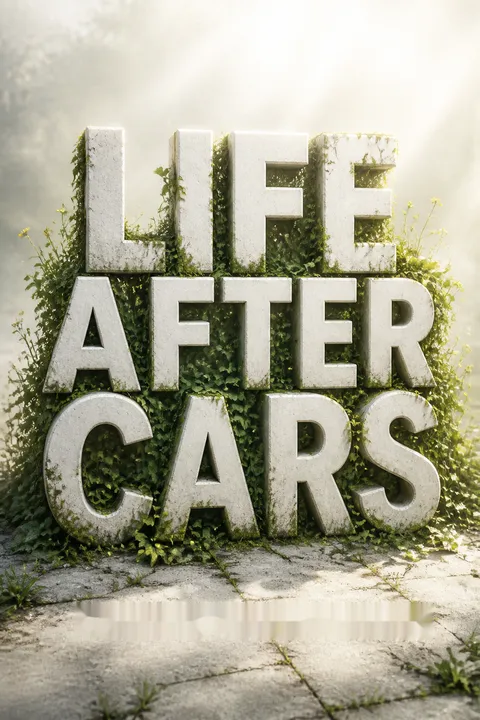
11. Life After Cars: A Quieter, Healthier, More Just Future is Possible
Humanity is not doomed to car dominance. It is no more fanciful to imagine a world in which the car is no longer king than it was to put this malevolent ruler on the throne in the first place.
A fork in the road. We stand at a crossroads: either double down on the catastrophic car-brained choices of the past 125 years or rebuild our societies at a sustainable human scale. The latter path promises a quieter, greener, happier world where cars are tools, not rulers, and full community enfranchisement doesn't require car ownership. This future is one where walking, biking, and public transit are safe, easy, and abundant.
Beyond electric and autonomous. While electric and autonomous vehicles offer some improvements (e.g., reduced tailpipe emissions, potential safety gains), they don't solve the fundamental problems of car dependence. They still demand vast road networks, huge parking spaces, consume rare minerals, and can perpetuate social isolation and surveillance. The core issue remains the car itself, not just its power source or driver.
Steps toward liberation. A post-car world is not a fantasy; it's already emerging in cities worldwide. To accelerate this transition, individuals can:
- Learn to see cars: Recognize their pervasive impact and question their necessity.
- Engage with local government: Advocate for change and support pro-people politicians.
- Find your people: Connect with like-minded individuals and advocacy groups.
- Preach to the unconverted: Share the joys of car-free spaces and challenge car-centric assumptions.
- Believe change is possible: Draw inspiration from global examples of successful transformations.
People Also Read





Download PDF
Download EPUB
.epub digital book format is ideal for reading ebooks on phones, tablets, and e-readers.








































