
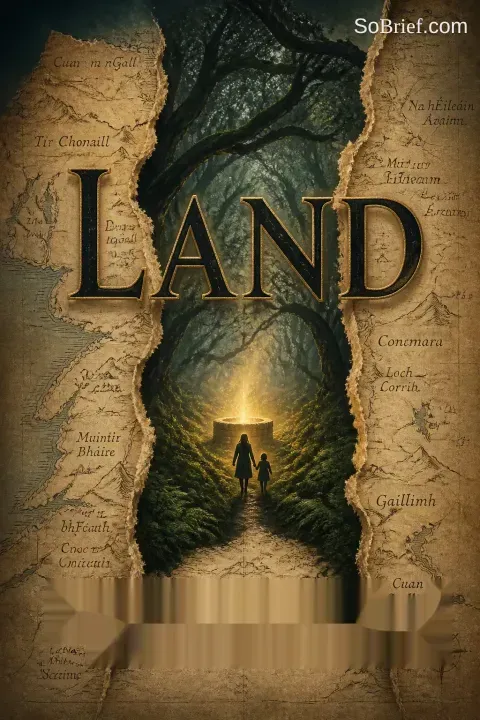


Plot Summary
Prologue
In a sweltering interrogation chamber in Calcutta, a middle-aged man named Liam3 sits before a committee of robed Jesuit fathers. They demand to know when he lost his faith, when he went wrong.
Liam,3 a former priest now facing judgment, deflects their questions with memories of his father, Tomás,1 a map-maker who was ever a man of few words until one astonishing day in 1865 when he drank from a hidden spring on an Irish peninsula and became garrulous, adorned in ferns, speaking of visions and ancient resistance.
Liam3 traces his own unraveling back to that well, to the day his father1 emerged from a copse utterly transformed, to a pebble with a hole given to a frightened boy. He tells his interrogators that perhaps everything traces back to that water, that offering, that moment when the land spoke.
The Calcutta framing device establishes the novel's central tension: faith versus land, institutional religion versus ancestral spirituality. Liam's interrogation is both literal and metaphorical. The committee demands a linear explanation for apostasy, but Liam can only offer a spiral, circling back to the well that changed everything. This opening signals that the novel will resist simple causality. The fathers in robes represent the colonizing force of organized religion, while Tomás, the map-maker who drank from an ancient spring and went mad, embodies an older, earth-bound understanding of the sacred. The juxtaposition of India and Ireland, two colonized lands, underscores the book's meditation on what is lost when one way of knowing the world is forcibly replaced by another.
The Copse's Hidden Spring
In 1865, Tomás1 and his ten-year-old son Liam3 survey a remote peninsula for the British Ordnance Survey. Tomás1 sends the boy into a dense copse to find a stream. Frightened by mossy mounds he fears are famine graves, Liam3 flees, leaving a boot behind.
Tomás1 enters the copse to retrieve it and discovers a deep, circular pool ringed by ancient oaks, fed by underground springs and absent from all maps. He kneels and drinks. A face appears in the water: his father's, long dead, looking at him with dismay. Tomás1 emerges utterly transformed.
He babbles about redrawing maps to resist colonizers, weaves himself a crown of ferns, and hands Liam3 a small pebble with a natural hole, declaring it older than humankind. He has not slept and will not sleep for days. His life's work, he now insists, must honor what lies beneath imposed borders.
The well functions as a portal between worlds: rational and mystical, colonized and ancestral, living and dead. Tomás's transformation is both enlightenment and madness, a rupture that the novel refuses to diagnose. His cartographic rebellion, redrawing maps to restore erased names and pre-colonial boundaries, is a form of resistance through memory. The pebble he gives Liam, small enough to hold but ancient beyond measure, becomes a symbol of deep time and indigenous presence that neither empires nor maps can efface. The copse itself, unmapped and overlooked, represents what survives outside systems of control, a sanctuary the colonizer never found.
The Priest's Dark Cure
Tomás1 remains sleepless and manic, declaring he will burn the redcoats' maps on a bonfire. Terrified for their livelihood, Liam3 and the widow8 hide the precious papers. Father Joseph,7 the parish priest, arrives after hearing rumors of a map-maker possessed by pagan well-spirits.
Finding Tomás1 in a nightshirt, drawing a forbidden map in the Irish language with ancient place-names, the priest declares him demon-haunted. He ties Tomás1 to a table, gags him, and for three days starves him while burning candles drip wax onto his skin.
The priest withholds food, eating colcannon and baked apples before his captive. Tomás1 endures until the smell of food breaks him. He sobs, begging for a morsel. Father Joseph7 declares victory, believing he has cast out the Devil. Tomás1 emerges silent, hollowed, his visionary fire extinguished.
The exorcism is the novel's most brutal depiction of institutional religion as an instrument of torture. Father Joseph, insecure about his English upbringing and desperate for ecclesiastical recognition, treats Tomás's connection to the land as demonic possession. The withholding of food deliberately triggers Tomás's buried Famine trauma, weaponizing his childhood starvation against him. The priest's triumph is a spiritual colonization: replacing indigenous awe with orthodox submission. Tomás's silence afterward is not healing but erasure, the cost of surviving a system that cannot tolerate alternative ways of seeing. The scene implicates the Church in the same project of domination as the redcoats' maps.
Mute as Stone
Liam3 finishes the redcoats' maps alone, using his father1's field books and a steady ten-year-old's hand. When the soldiers arrive, they accept the work and pay. Tomás,1 now withdrawn and barely responsive, makes the journey home to the Lanes clutching Liam3's hand like a lost child.
In their tenement room, Tomás1 takes to bed, facing the wall for weeks. By night he screams about swine and graves and a wooden spoon; by day he is mute. Phina,2 pregnant with their fourth child, shaves him with tender precision, whispering that all will be well.
She uses the last of the mapping money to pay rent and grocers. The neighbors ask what ails him. Phina2 calls it a distemper. Liam3 refuses school, afraid to leave the house, though his mother2 eventually sends him back. Only little Rose5 dares approach her father,1 wiping the silent tears that leak from his closed eyes.
Tomás's collapse reveals the domestic cost of spiritual violence. The exorcism did not cure him; it hollowed him out, leaving a man who cries without sound and cannot name his own suffering. Phina's response, practical and unwavering, is a form of resistance through care. She shaves him, feeds him, talks to him, refusing to treat his madness as shameful. The family's precarity is acute: without Tomás's income, they are one missed rent payment from eviction. The scene also establishes the children's distinct personalities under stress: Liam's anxious vigilance, Rose's brave tenderness, the unborn baby absorbing it all. The 'distemper' diagnosis is a placeholder for what cannot be spoken, the Famine trauma and spiritual violation that language fails to contain.
A Ruined Cottage, A New Root
Tomás1 rises from bed one morning with a plan. He has used their savings to lease a ruined cottage and a plot of land on the peninsula, the very place he and Liam3 surveyed. Phina2 is furious; she will not live in an eviction ruin. At the sight of the roofless, rubble-filled shell, she turns and walks away with her children.
The widow8 intervenes, offering shelter while Tomás1 rebuilds. Over weeks, Tomás1 repairs the walls, clears the chimney, and hires a thatcher. Phina2 negotiates terms: she will stay only if Tomás1 returns to mapping for the redcoats, keeping wages coming.
He agrees, swallowing his anti-colonial fury for his family's survival. They move in on a windless day. The house, standing on a flat shelf of land between two hills, with an ancient standing stone built into its gable, welcomes them with the smell of new thatch and lime-wash. Eugene,6 the baby, is born soon after.
The move to the peninsula is the family's first act of collective self-determination, a compromise that neither Tomás nor Phina fully wins. Tomás gets his dream of land and independence from landlords, but must continue serving the colonizers' mapping project. Phina secures financial stability but must leave the city and accept a life of subsistence farming. The cottage itself, built on layers of previous habitation going back to ancient times, embodies the novel's theme of land as palimpsest. The standing stone in the wall, a sacred menhir repurposed as building material, suggests that the sacred can be incorporated but never erased. Eugene's birth here roots the family in this specific soil.
Enda's Deception, Liam's Fall
Liam,3 now a student of Father Joseph,7 follows Enda4 to the copse one night. He drops his saint's medallion into the well as an offering, praying not to be sent on his father1's next mapping expedition. Enda,4 hidden in a tree with her fiddle, hears him confess he wants to be a priest.
When she mockingly sings his secret, Liam3 climbs the tree in a fury and grabs her foot. She kicks free, sending him crashing to the ground with a shattered shin. The bonesetter sisters splint his leg; he cannot travel. Desperate not to lose the wages, Phina2 suggests Enda4 go in Liam3's place.
She dresses in his clothes and meets Tomás1 at the harbor. On the boat to the remote island, Tomás1 discovers the deception, but it is too late. Enda4 serves as chainboy all winter, and in the islanders' evenings, she learns fiddle tunes from local musicians.
This episode crystallizes the siblings' divergent paths. Liam's offering at the well, a medallion from Father Joseph, is answered: he does not go to the island, but the cost is a broken leg and a deepened entanglement with the priest who will shape his future. Enda, excluded from formal education and her father's trade, seizes opportunity through disguise and audacity. Her months on the island expose her to a community where music is currency and women's labor is valued equally with men's. The secret she overhears, Liam's priestly ambition, becomes the wedge that will eventually separate them. Their fight in the tree literalizes their rivalry: Enda ascends while Liam falls, a pattern that will define their adult lives.
Phina Falls on the Boreen
Walking home from the widow8's with young Eugene,6 Phina2 feels a strange sensation in her chest. She clutches at her son's jacket, then collapses to the ground. Eugene,6 who cannot speak, repacks her overturned basket and waits. When she does not rise, he wanders to a nearby rock outcrop to watch the sea.
Returning, he finds her gone. Neighbors have carried her body to the cottage. Rose5 weeps; Enda4 burns with silent fury; Tomás1 roars his grief, his face pressed to his wife's body. Liam3 arrives with Father Joseph.7 Tomás1 wants to bury Phina2 on their land, but Liam3 insists on a church service.
Father Joseph7 presides. Eugene6 refuses to say goodbye, shaking his head violently at the grave. In the weeks that follow, Rose5 tries to hold the household together, but her stitches unravel and her bread burns. The family of six is now five, and the center cannot hold.
Phina's death is the novel's great rupture, the loss from which no character fully recovers. Her role as the family's hinge becomes painfully visible in her absence: without her, Tomás retreats into silence, Rose exhausts herself trying to mother everyone, Enda's restlessness sharpens into something desperate, and Eugene loses his primary translator. The conflict over her burial, church versus land, reignites the war between Tomás and Father Joseph, with Liam caught between. Eugene's refusal to say goodbye, rendered through his head-shaking and his hiding in a chest, captures a grief that language cannot process. The novel does not sentimentalize her death but traces its practical and emotional wreckage through each family member.
Liam Turns His Back
Weeks after his mother2's burial, Liam3 announces he will leave for the House of First Formation. Rose5 begs him to delay; she cannot bear another loss. Enda,4 furious, retreats to the roof to avoid the arguments. Tomás1 produces emigration papers he and Phina2 had arranged: passage to Québec, a chance at a new life of freedom and land.
He begs Liam3 not to wall himself away with the Jesuits. Liam3 refuses both his father1's offer and his father1's grief. On the morning of his departure, Tomás1 stands at the haggard wall sharpening his loy, refusing to turn around.
Rose5 and Eugene6 cling to Liam;3 Enda4 follows him to the end of the boreen, playing her fiddle. As Liam3 walks down the road, he passes the viscount's phaeton without deference, a small act of defiance from a man who is no longer a tenant. He arrives at the novitiate and renounces the world.
Liam's departure is the most overt rupture between father and son, and between the old ways and the new. Tomás's emigration papers represent an alternative future, one where Liam remains connected to family and land, even across an ocean. Liam chooses instead the institutional father, Father Joseph, over his biological father. His refusal to look back, to feel too much, is a form of self-protection that will calcify into decades of estrangement. Tomás sharpening his loy with his back turned is an image of irreconcilable pain: the man who cannot say goodbye, who has never been able to, repeating a meaningless motion while his son walks away. The viscount encounter shows Liam already inhabiting a new identity beyond the tenant-landlord hierarchy.
Enda Steals Across the Sea
Enda,4 restless and trapped by domestic labor, searches Liam3's abandoned belongings and finds the Québec emigration papers Tomás1 had purchased, along with money for passage. She cuts off her long hair, dresses in Liam3's old clothes, and walks to the harbor.
Presenting herself as Liam,3 she boards a ship bound for Canada. Rose5 discovers the severed hair near the copse and understands the depth of her sister4's betrayal. Enda4 survives the Atlantic crossing, playing fiddle on deck for coins and to lift spirits. When ship fever strikes, dozens die and are buried at sea.
At the Grosse Île quarantine station, she meets a Baltic musician named Anatole9 and his sister, who help her pass the medical exam by lending her a skirt to conceal her male papers. She enters Canada as both herself and her brother,3 a spliced identity that will define her new life.
Enda's escape is both theft and liberation, an act of self-authorship that the novel treats with moral complexity. She takes what Liam rejected, claiming the freedom he would not use, but at the cost of devastating Rose and severing herself from home without farewell. Her disguise literalizes the constraints on women: she can only access adventure, education, and autonomy by becoming a man. The hair-cutting is a ritual of transformation, a shedding of the self that was expected to stay and serve. Anatole's immediate perception that something is 'not quite right' about her foreshadows both his role as her ally and the way her disguise will shape their relationship. Her grandfather, the elderly piper in the Trois Rivières inn whom she never recognizes, adds a layer of tragic dramatic irony.
The Hand That Drew Maps
Needing money after the viscount raises their rent, Tomás1 takes a surveying commission in Cavan. A sapper, impatient with a stuck cart, yells at Tomás1 and drags him into the ditch to push. Tomás1's right hand, the one that draws coastlines with exquisite precision, is trapped between wheel and road.
The cart rolls forward. His hand is crushed to pulp. A drunken country doctor doses him with laudanum and sends him to hospital, where surgeons amputate at the wrist. Infection streaks up his arm in red lines; they amputate again at the elbow.
Rose5 and Eugene6 receive him back at the cottage, delivered unconscious by soldiers, a bandaged stump where his mapping hand used to be. When he wakes, he touches the absence and weeps. He mutters that this is punishment for a lifetime of working for the enemy, a retribution long deserved.
The loss of Tomás's hand is both literal dismemberment and symbolic castration. The hand that inscribed the colonizer's maps, that also secretly corrected them to honor the land's true history, that held Phina's when he rescued her from the workhouse ship, is destroyed by the very forces he served. The sappers' casual brutality and the drunken doctor's negligence indict the empire's disregard for Irish lives. Tomás's interpretation of his injury as divine punishment reveals his internalized guilt over his collaboration. The compensation pension that follows, secured through Father Joseph's letter-writing, is a bitter irony: the Church he despises becomes his economic lifeline. His wandering begins here, a man with one hand, searching for the origin he can no longer draw.
Fiddle and Accordion
In Québec, Enda4's savings are stolen on her first night, leaving her destitute. She sleeps under a park bench, washes in a fountain, and begs for work. An elderly French priest finds her curled in his confessional and arranges a position as a hired girl for a fur-trader's family.
Her spiritedness disrupts the household; she names the taxidermied animals and teaches the children Irish songs. Later, working at a Trois Rivières rooming house, she re-encounters Anatole,9 the man from Grosse Île, now a cook. He recognizes her immediately.
They begin playing fiddle and accordion together on street corners, their music drawing crowds and coins. One night in an alleyway, he reaches into her pocket to deposit her share of the earnings, and they become lovers. He promises to return from the summer logging camps and marry her. She gives him a promise to wait.
Enda's North American survival story is a chronicle of resilience through music and strategic self-disclosure. Her homelessness is rendered without sentimentality, a factual accounting of hunger and cold. The fur-trader's house, with its taxidermied animals and rigid class protocols, is a museum of colonial wealth that Enda cannot help but disrupt. Her reunion with Anatole is one of the novel's rare moments of mutual recognition and joy. He sees through her disguise without threatening to expose her, and their musical partnership becomes the foundation for intimacy. His promise to return in autumn is the romantic hinge on which her future will turn, a hope she clings to through the long summer of waiting.
Faith Dissolves in India
Now Father Gulielmus, Liam3 serves in Cochin, India. He teaches mathematics, weeds the mission garden, and visits the swamp-village where the poor live in clay shacks. Watching a grand new church rise from the ground, built by laborers whose children break stones with tiny hammers, he feels his faith eroding.
A distraught man brings him a stillborn infant, begging for the priest's magic to restore life. Liam3 can only offer prayer. The man spits a curse at him and shoves him to the ground. Then a letter arrives from Father Joseph:7 Tomás1 is dead.
Reading the news, Liam3 realizes he feels no concern for his father1's soul, no belief in Purgatory or Hell. His faith, he understands suddenly, was merely topsoil over his father1's bedrock atheism. Standing in his classroom, watching parakeets burst from an almond tree, he knows he can no longer be a priest.
Liam's crisis of faith is not a single cataclysm but an accumulation of dissonances. The opulent church built on the backs of the poor mirrors the colonial extraction he once helped map. The stillborn child tests his religion against human need and finds it useless. His father's death, arriving a year late via a letter from the very priest who tormented Tomás, catalyzes the realization that has been building since his first doubts in Rome. The geological metaphor of topsoil versus bedrock is crucial: his faith was a thin layer imposed over his father's deeper, older way of knowing the world through land and stone. The parakeets, wild and irrepressible, embody the freedom he is about to claim.
The Valley at Last
With one hand and a compensation pension, Tomás1 becomes a wanderer. He carries a smudged map of Ireland and walks the country, following every lough and valley, searching for the place of his origins: a V-shaped valley with a grey lough, a road he walked as a starving child after the eviction, the last time he saw his family alive.
For months he walks out and returns, walks out and returns, his children accustomed to absences they cannot explain. Rose5 assumes he is simply restless. Only Eugene6 understands there is a quest.
One day, in a neighboring county, Tomás1 lies down beneath a tree, his blanket roll under his head, and does not rise again. Passersby assume he is sleeping. He has found the valley at last, the road of his childhood trauma, the place where pigs rooted up his father's grave. He dies there, alone, reunited with his memory.
Tomás's death completes his lifelong journey toward origins. The valley he sought was not just a geographical location but the container of his deepest trauma: walking that road as a starving child, the siblings who died, the pigs that desecrated his father's grave. Finding it is an act of narrative completion, a mapping of the self that no theodolite could achieve. His death, peaceful and solitary under a tree, contrasts sharply with the violent disruptions of his life. The passersby who do not recognize death for what it is echo the novel's theme of unseen suffering. Rose will never know he found what he was looking for; Eugene, in his silent knowing, perhaps already understands.
Blood on the Strand
Walking to the strand to gather mussels, Rose5 comes upon the viscount's son11 and another gentleman whipping a grey wolfhound puppy strung up by its neck. She intervenes, cradling the animal. The men turn on her. They chase her down, strike her to the ground, and begin to tear at her skirts.
Bran, her great grey dog, lunges to defend her and is shot dead. But Eugene6 has been uneasy all day, sensing something wrong in the wind. Carrying his father1's spade, he follows Rose.5 He finds the men on top of his sister.5
Without hesitation, he brings the spade down on the viscount's son11's head, then the other man's. He kills them both. Rose5 lies in the marram grass, her face bruised, her clothing torn, but the worst has been prevented. Around her, three bodies: two gentlemen and her beloved dog.
This sequence is the novel's most visceral intersection of gender violence, class privilege, and protective violence. The gentlemen's casual cruelty to the puppy, a stand-in for the Irish tenant they consider similarly disposable, escalates into attempted rape because Rose dares to object. The viscount's son's sense of entitlement, his belief that her body is his property, distills the logic of colonialism into sexual predation. Eugene's killing is swift and wordless, an act of pure protection from a man who cannot speak but understands exactly what is happening. The spade, Tomás's tool for working the land, becomes an instrument of justice. Bran's death protecting Rose echoes the ancient dog buried with Brith, linking this violence to the peninsula's deep history of sacrifice.
Eugene Leaps Homeward
The widow8 takes charge. She and Eugene6 haul the bodies to the cliff and push them into the sea, making the deaths look like a fall. A timely storm washes away the tracks. She gives Rose5 and Eugene6 her life savings and sends them to the port to buy passage to Québec, to find Enda.4
On the ship, Rose5 holds Eugene6's hand and tells him stories of their new life. But when the vessel rounds the final headland of Ireland, and the passengers gather to bid their homeland farewell, Eugene6 does something Rose5 cannot anticipate.
He places the rescued puppy in her arms, grips the rail, and vaults over it, plunging into the cold Atlantic. Sailors restrain Rose5 from following. She screams his name as the green water closes over his head. She is now utterly alone, clutching the last living link to her brother,6 sailing toward a sister4 she has not forgiven.
Eugene's leap is the novel's most shocking and emotionally devastating turn. It defies rational explanation yet feels inevitable. He cannot leave the land; he is the land, the one who hears its voices, who found the bog-girl, who killed to protect his sister. The ship represents a second exile he cannot endure. His choice is not suicide but a radical return, a refusal of the narrative of emigration that has defined his family. Rose's devastation is compounded by guilt, grief, and the impossible task of explaining what happened. The puppy he left her, Bran's descendant, becomes a living thread connecting her to home, to Eugene, to everything she has lost. The moment literalizes the book's central theme: some bonds to place cannot be severed, only submerged.
Two Sisters, One Doorstep
Anatole9 does not return from the logging camp. Enda,4 now pregnant with his child, goes to the timber company office and learns the truth: he drowned freeing a logjam in the river. Worse, the clerk mentions a wife and children in Québec. Anatole,9 the man who promised to marry her, had a family he never disclosed.
Devastated, Enda4 takes to her bed, unable to eat or speak. Days later, a knock at the back door rouses her. She opens it to find a gaunt, shabby woman with a puppy on a string. It is Rose.5 Her sister5 is furious, calling her a turncoat and a deserter.
Then Rose5 tells her about Eugene:6 the attack, the killing, their flight, and Eugene6's leap into the sea. The anger drains from both of them. They hold each other on the doorstep, two women who have each lost nearly everything, reunited in a foreign country, neither able to promise the other safety.
The sisters' reunion is the novel's emotional fulcrum, a collision of separate griefs that briefly become shared. Enda's romantic tragedy (betrayal by a married man, pregnancy, abandonment) and Rose's trauma (attempted rape, exile, witnessing her brother's death) are different in kind but equal in devastation. Neither sister can fully comfort the other; their bond is tested by the years of separation and Enda's original betrayal. But Rose's arrival also saves Enda, pulling her from the paralysis of abandonment. The puppy, Bran's descendant, present at both the original violence in Ireland and this reunion in Canada, links the two worlds. Their future, raising Enda's child together, is uncertain but no longer solitary.
The Apostate Returns
After confessing his loss of faith, Liam3 is sent to Calcutta for interrogation by senior Jesuits. For days, robed fathers demand definitions of his apostasy. He tells them Father Joseph7 was to blame, a vengeful priest who turned a son against his father.1 The Superior Provincial strips Liam3 of his crucifix and points to the door.
Liam3 sails back to Ireland, arriving in Dublin with nothing. Too ashamed to face his family as a failed priest, he applies at the Ordnance Survey office, citing his father1's name and his own apprenticeship. He is hired.
He writes letters to his siblings on the peninsula; they are returned marked 'GON AWAY' and 'BOTH DECEASED.' He marries an innkeeper's daughter, fathers sons, and rises in the mapping office, following in Tomás1's footsteps after all. But his letters to his siblings never receive replies. He does not know who lives and who has died.
Liam's return to secular life and to his father's profession is an ironic homecoming. The priesthood he chose to spite Tomás has rejected him, or he has rejected it, and he ends up doing exactly what his father wanted: mapping. His shame at his 'failure' prevents him from seeking his siblings directly, and the bureaucratic cruelty of 'GON AWAY' and 'BOTH DECEASED' condemns him to decades of not knowing. His marriage and children offer a new kind of belonging, but the wound of his lost family never closes. The novel frames his trajectory as a circle: the boy who refused to be a mapper becomes a mapper; the son who chose the Church over his father becomes a father himself, in a Dublin house not far from where he was born.
The Brother Who Hid
Years later, a mapping assignment brings Liam3 near the peninsula. He walks the familiar road to the village, finding the fishermen's cottage reduced to foundations, the widow8's house occupied by strangers. A woman tells him the young ones from up the hill went across the sea long ago.
Liam3 climbs the boreen, now overgrown with brambles he must fight through. The cottage is inhabited: tidy vegetable rows, stacked turf, smoke rising. He knocks; no one answers. Not wanting to disturb whoever lives there now, he wanders to the copse instead.
At the well, a crack behind him and a flash across the water send him fleeing once more, his hat left behind. He never knows that Eugene6 was watching him from an oak tree, that his brother6 is alive and has been here all along, the gruagach the village children whisper about.
This near-miss reunion is the novel's most poignant demonstration of how close and yet how far the siblings remain from each other. Liam stands at his childhood home, knocks on the door his father rebuilt, and his brother hides twenty feet away. The well, which started everything, frightens Liam away at the very moment he might have discovered Eugene. His flight is both comic and tragic: the rational surveyor, the former priest, still terrified by a pool in the woods. Eugene's decision to hide, conditioned by years of secret living and the widow's rules, is a survival instinct so deeply ingrained it overrides any possibility of recognition. Neither brother knows the other is there. The hat Liam leaves behind, which Eugene hangs on a tree, becomes the silent evidence of their almost-meeting.
The Gruagach Remains
After leaping from the ship, Eugene6 swam to shore and walked across Ireland back to the cottage. The widow8 discovered him and established the rules of his hidden life: stay on the hill, never come down by day, keep the fire small. He followed these rules for the rest of his life.
Villagers left offerings at the base of the path; he left gifts in return. He kept goats, tended the garden, and knew without being told that his siblings were alive across the sea. One evening, after the stranger in the straw boater fled, Eugene6 went to the pool.
A spotted fish spoke to him, demanding the gold ring he wore on his thumb, the ring he had found years ago in the bog. He dropped it into the water. A figure of a man rose from the pool and sprinted away up the hill, as if freed. Eugene6 lived past a hundred, the last custodian of the land.
Eugene's survival and longevity reframe him as the novel's spiritual center. He is the one who could not leave, who belongs to the land as completely as the standing stone or the streams. His muteness, treated by others as disability, is recast as a form of deep listening. He hears what others cannot: the whispers of walls, the reluctance of streams to merge, the presence of the bog-girl. The talking fish and the man rising from the pool are not hallucinations but culminations of the novel's magic-realist thread, suggesting that Eugene has completed something ancient. The ring he gives back, Brith's father's ring swallowed and lost millennia ago, is returned to its source. The man who rises may be Brith's father, freed at last, or Tomás, or all the vanished men of the first people. Eugene, the one who never spoke, becomes the seanchaí, the custodian of tradition who holds the land's memory in his silent body.
Epilogue
The cottage on the hillside passes through more hands after Eugene6's long life ends. Holidaymakers from the city arrive in summer, and if their shoes go missing from the doorstep or laundry vanishes from the line, the local people offer the same explanation: there is one among us who needs such things, a gruagach so old and wise he could tell you all the history of the land, should he wish to speak.
Enda4 and Rose5 raise a boy with copper hair named Eugene in a small Canadian town, where Enda4 plays fiddle until the end of her life and Rose5 fashions felt flowers for fine ladies' hats.
Liam,3 a Dublin surveyor with a wife and sons, follows his father's path into the mapping office, occasionally signing his name to ledgers that still bear Tomás1's slanting hand. None of the siblings ever reunite. But the land remembers them all, holding their stories in its peat and stone and streams, layer upon layer, nothing ever truly gone.
The epilogue distributes the surviving siblings into separate but parallel lives, none knowing the others' fates. The tragedy of their permanent separation is tempered by the knowledge that each found a form of survival and even fulfillment: Enda in music, Rose in craft and motherhood, Liam in the profession his father wanted for him. Eugene's transformation into local folklore, the gruagach who can tell you the land's history, elevates him from a 'simple' mute boy into a mythic figure, the embodiment of the place itself. The final image of the land holding all stories in its layers, like the peat that preserved Brith for millennia, returns to the novel's deepest conviction: that nothing disappears, that every life lived on this soil becomes part of its ongoing narrative. The seanchaí, the custodian of tradition, is finally not a person but the land itself.
Analysis
Maggie O'Farrell's 'Land' is a novel about what the earth holds and what it surrenders. Structured around a single family across three generations and two continents, the book argues that human lives are not discrete narratives but layers in a continuous strata, like the peat that preserved Brith10's body for two thousand years. The novel's recurring image, the sacred well hidden in a copse, functions as a portal where past and present, living and dead, colonized and indigenous briefly touch. Every major character's trajectory bends around this water: Tomás1 drinks and sees his father; Liam3 drops a medallion and is answered; Eugene6 returns a ring and releases a ghost. The book's political consciousness is woven through its domestic drama. The Ordnance Survey's mapping of Ireland is presented as an act of epistemic violence, translating the layered Gaelic names for places into flattened English approximations. Tomás1's secret alternative map, labeled with pre-colonial kingdoms and sacred sites, is his life's true work, the one his missing hand can never complete. The Church, in the person of Father Joseph,7 practices a parallel form of colonization, exorcising indigenous spirituality as demonic and claiming gifted children like Liam3 for its own institutional purposes. Both empire and Church are revealed as systems that sever people from land and from each other.
Yet the novel refuses despair. Its characters survive through forms of continuity that official records cannot capture. Enda4's music carries Irish tunes across the Atlantic and into Canadian logging camps. Rose5's felt flowers, crafted from the skills her mother2 taught her, adorn the hats of women who will never know her story. Eugene,6 the brother who could not speak, becomes the land's most faithful listener, living a century on the hillside and entering local folklore as the gruagach. Liam,3 the apostate priest, ends his life doing the work his father1 wanted for him, his handwriting slowly becoming indistinguishable from Tomás1's in the mapping office ledgers.
The novel's deepest insight is that nothing is ever truly lost. People vanish, emigrate, die, but the land remembers. The peat holds bodies. The well holds rings. The cottage stones hold the mortared remnants of ancient standing stones and bundled rags from famine times. To live on the land, the novel suggests, is to be in constant conversation with everyone who lived there before. The seanchaí, the custodian of tradition, is finally not a person but the place itself, speaking in a language of streams and stones that only a few, like Eugene,6 can still hear.
Review Summary
Readers overwhelmingly praise Land as a sweeping, lyrical masterpiece of historical fiction, set in post-famine Ireland in 1865. The novel follows mapmaker Tomás and his family across generations, weaving Irish history, folklore, and magical realism into deeply moving prose. Most reviewers highlight O'Farrell's breathtaking writing, vivid sense of place, and richly drawn characters. Some note slow pacing and demanding structure as occasional obstacles. Many predict award recognition and call it a favorite of 2026.
People Also Read


Characters
Tomás
Map-maker, father, survivorA civilian assistant to the British Ordnance Survey who grew up in the workhouse after losing his family to the Great Hunger. Tomás is taciturn, rigorous, and haunted by fragmentary memories of the road he walked as a starving child. He has suppressed his early trauma so thoroughly that he cannot recall his parents or siblings, only a long frosty road through a V-shaped valley. His skill with maps and languages makes him indispensable to the colonizers he privately despises. When he drinks from a sacred spring, he experiences a visionary madness that reveals his suppressed grief and his father's unquiet spirit. His life oscillates between periods of intense productivity and withdrawn silence. He loves his wife Phina2 with a desperate, inarticulate devotion, having rescued her from being shipped to a penal colony. His relationship with his children is strained by his inability to express affection, and he is perpetually at war with the institutional Church that claims his eldest son, Liam3. The loss of his right hand, the one that drew maps, accelerates his final years of wandering in search of his origins.
Phina
Mother, seamstress, anchorBorn Seraphina, she survived the Great Hunger and was sent to the workhouse, where her hair was cut and her name changed to Frances. Tomás1 rescued her from a ship bound for an Australian penal colony, cutting a tassel from her mother's shawl as a keepsake. Phina is the emotional center of the family: practical, shrewd, and capable of extraordinary tenderness. She negotiates the family's survival with clear-eyed pragmatism, insisting Tomás1 return to mapping for the redcoats despite his hatred of them. Her death from a sudden collapse while walking with Eugene6 is the rupture from which the family never recovers. She carries the memory of her own lost family with quiet dignity, reciting prayers for their souls each morning.
Liam
Eldest son, former priest, surveyorThe firstborn, who as a child witnessed his father1's transformation and exorcism and was shaped by terror. Liam is studious, anxious, and deeply susceptible to the approval of authority figures. Father Joseph7 recognized his intellect and groomed him for the priesthood, successfully separating him from Tomás1. Liam enters the Jesuit novitiate despite his father1's desperate offer of emigration papers. He trains in Rome and serves in India, where exposure to colonial poverty and a stillborn child's death erode his faith until he realizes his belief was always a thin layer over his father1's worldview. He leaves the Order, returns to Dublin, and becomes a surveyor like Tomás1, marrying and fathering sons. His letters to his siblings go unanswered, and he lives decades without knowing their fates.
Enda
Fiddler, emigrant, survivorFierce, impulsive, and musically gifted, Enda chafes against the limitations placed on girls. When Father Joseph7 refuses to admit her to his hedge school, she teaches herself by reading Liam3's books in secret. The widow8 gives her a fiddle, and she becomes a natural musician, collecting tunes across the countryside and playing at weddings and dances. Denied her brother3's opportunities, she steals Liam3's emigration papers and sails to Québec disguised as a man. She survives homelessness, ship fever, and exploitation, building a life through music and fierce self-reliance. Her love affair with Anatole9, a Baltic accordionist, ends in betrayal and his death, leaving her pregnant. Rose5's arrival on her doorstep gives her a reason to keep living. She raises her son, named Eugene, with Rose5, and plays fiddle until the end of her life.
Rose
Younger sister, caretaker, artisanThe beautiful, tender-hearted second daughter who clings to her mother2 and fears the wild openness of the peninsula. Rose finds solace in animals, especially the donkey and later Bran, the great grey wolfhound who adopts the family. After Phina2's death, Rose exhausts herself trying to hold the household together, her stitches unraveling and her bread burning. She is devastated by Enda4's secret departure and Liam3's choice of the priesthood. Her intervention to save a puppy from the viscount's son11 triggers an attempted rape that Eugene6 stops by killing both men. She flees to Canada with Eugene6, only to watch him leap from the ship at the last sight of Ireland. Arriving at Enda4's door, she carries grief, fury, and a puppy that is all that remains of her brother6 and their dog. She eventually marries and makes felt flowers for ladies' hats, raising Enda4's son alongside her own children.
Eugene
Youngest son, mute custodian of the landThe fourth child, born on the peninsula and named for Phina2's father. Eugene never learns to speak, communicating through gestures, sounds, and an uncanny ability to understand without words. What others perceive as simplicity is actually a profound attunement to the land itself: he hears the whispers of walls and streams, senses the emotions of trees and bogs, and knows things without being told. He finds a prehistoric gold ring in the peat and a bog-body of a girl buried with her dog. When the viscount's son11 attacks Rose5, Eugene kills both men with a spade. He flees with Rose5 to Canada but cannot leave Ireland, leaping from the ship and swimming back to shore. He returns to the cottage and lives as a hidden hermit for the rest of his very long life, trading with villagers by night, guarding the sacred well, and becoming the gruagach of local folklore.
Father Joseph
Parish priest, exorcist, manipulatorA priest born in Sligo but raised in England, Father Joseph is insecure about his origins and desperate for ecclesiastical recognition. He performs a brutal three-day exorcism on Tomás1, using starvation and burning candles to break the map-maker's visionary state. His unrequited letter to the bishop about his 'triumph' festers into resentment against Tomás1 for never showing gratitude. He deliberately cultivates Liam3 as a protégé, seeing in the gifted boy a way to punish Tomás1 for his disrespect. He establishes a hedge school, writes the compensation letter that secures Tomás1's pension after the amputation, and sends news of Tomás1's death to the scattered children. His meddling shapes the family's dissolution, though he sees himself as an instrument of God's will.
The Widow
Landlady, protector, benefactorAn elderly woman who lost her entire family, including her children, to the Great Hunger. She lives alone in a lime-washed longhouse on the peninsula, taking in lodgers. When Tomás1 and Liam3 first arrive, she is the one who hides their maps from the maddened Tomás1 and later shelters the family when Phina2 refuses to live in the ruined cottage. She gives Enda4 her late husband's fiddle, recognizing the girl's musical gift. After Tomás1's death, she insists Rose5 and Eugene6 live with her to stave off loneliness. When the viscount's son11 is killed, she orchestrates the cover-up with ruthless efficiency, pushing the bodies off a cliff and giving the siblings her life savings to escape. Her final act of care is establishing the rules that allow Eugene6 to survive in hiding on the hillside.
Anatole
Baltic musician, lover, loggerA Lithuanian (or Russian, or Austro-Hungarian, depending on the decade) musician and language teacher who emigrated to Canada with his sister. He meets Enda4 at the Grosse Île immigration station and recognizes that her papers do not match her person, but helps her pass the medical exam. They reconnect months later in Trois Rivières, where he works as a cook and Enda4 plays fiddle on street corners. He becomes Enda4's musical partner and lover, promising to return from the summer logging camps and marry her. He never returns. The timber company reports he drowned disentangling a logjam, and reveals he had a wife and children in Québec. His accordion, left with Enda4 for safekeeping, becomes a silent artifact of her loss.
Brith
Ancient girl sacrificed at the wellA child of the Iron Age, daughter of a wandering hunter who joined a hill fort and then disappeared. She finds her father's gold ring in a stream near a sacred spring and, when a talking fish demands it, accidentally swallows it. Years later, after crops fail and sickness spreads, the elders sacrifice her to appease the gods. She is buried with her faithful wolfhound in the bog, where peat preserves her body for millennia. Her ring, still inside her, is found by Eugene6, and her dog is the ancestor of Bran. She represents the deep past that the land holds, the violence that underlies settlement, and the continuity of animal loyalty across time.
The Viscount's Son
Predatory heir to the estateThe eldest son of the landlord who owns the peninsula. Described as having moist, slack lips and a cruel reputation, he once horsewhipped his groom and tied burning sticks to dogs' tails as a boy. He and a friend are whipping a puppy on the strand when Rose5 intervenes. They chase her down and attempt to rape her. Eugene6 kills both men with a spade. His death echoes earlier violence on the estate, including the evictions during the Great Hunger, making his killing feel like a long-delayed reckoning for generations of landlord cruelty.
Plot Devices
The Well (Tobar)
Sacred spring, portal between worldsA deep circular pool hidden in a copse between two hills, fed by underground springs, absent from all official maps. It predates Christianity on the peninsula, serving as a site of pagan offerings and visions for millennia. Brith10 encounters a talking fish here and swallows her father's ring. Tomás1 drinks from it and sees his dead father's face, emerging with visionary knowledge. Liam3 drops his saint's medallion into it as a votive offering. Eugene6 encounters the talking fish and drops Brith10's ring into the water, releasing a spectral figure. The well resists all attempts at co-optation, whether by druids, monks who 'blessed' it, or the priest7 who denounced it as demonic. It represents a form of indigenous spirituality that organized religion cannot colonize.
The Maps
Instruments of colonization and resistanceThe Ordnance Survey maps function as the novel's central political symbol. Tomás1 and other Irish laborers create the maps that enable British control of the land, translating ancient Gaelic place-names into English approximations and erasing evidence of the Great Hunger's devastation. Tomás1 secretly preserves the true names and records mass graves in his field notes. His visionary madness produces an alternative map labeled with pre-colonial kingdoms, dolmens, and sacred sites, a cartographic act of resistance. The maps also represent a family trade passed from father to son, though Liam3 initially rejects it for the priesthood before ultimately becoming a surveyor himself. The tension between official maps and the lived, remembered landscape mirrors the novel's broader conflict between imperial order and indigenous memory.
The Gold Ring
Token of lost fathers, cycles of returnA ring of beaten gold with interlocking beasts swallowing each other's legs, made in the Iron Age. It belonged to Brith10's father, a wandering hunter who disappeared. Brith10 found it in a stream near the sacred spring, was commanded by a talking fish to give it up, and accidentally swallowed it. Her body, preserved in the bog, carried the ring in her stomach for millennia. Eugene6 discovers it while digging in the peat and wears it on his thumb for years. In the novel's climax, Eugene6 returns the ring to the sacred well at the fish's command, and a man rises from the water and runs away, as if freed. The ring connects the ancient and modern timelines, functioning as a symbol of what the land holds, what is lost and occasionally returned.
Bran and the Wolfhounds
Protective spirit across generationsAn enormous grey wolfhound appears in multiple timelines: first as Brith10's companion, buried with her in the bog; then as the dog of the man with the ash stick who built the first house on the cottage site; finally as Bran, the dog Enda4 and Rose5 find at the rath who adopts their family. The dogs are characterized by their fierce loyalty, their refusal to enter the house (preferring to sleep near the copse or haggard wall), and their protective instincts. Bran fathers many pups on the peninsula; when he is shot defending Rose5 from the viscount's son11, one of his descendants, a puppy Rose5 rescues, accompanies her to Canada. The wolfhounds represent an unbroken lineage of guardianship that predates and survives human conflicts.
The Emigration Papers
Documents of escape and stolen identityTomás1 and Phina2, fearing the priesthood will consume their son, secretly purchase emigration papers and passage money for Liam3 to go to Québec. Liam3 refuses them, choosing the Jesuits. Enda4 later finds the papers hidden under Liam3's pallet and uses them to escape, cutting her hair and dressing as a man to pass as 'Liam3' at the harbor and immigration station. The papers grant Enda4 entry to Canada but also lock her into a male identity that complicates her life. They represent both the parents' thwarted hope for Liam3 and Enda4's audacious claim to a freedom not offered to daughters. The papers' existence also means that somewhere in Canadian records, Liam3 is officially recorded as having emigrated, a bureaucratic ghost that mirrors the novel's themes of erasure and transformation.
Download PDF
Download EPUB
.epub digital book format is ideal for reading ebooks on phones, tablets, and e-readers.








































