

Key Takeaways
A pinch of chemistry turns kitchen failures into repeatable triumphs
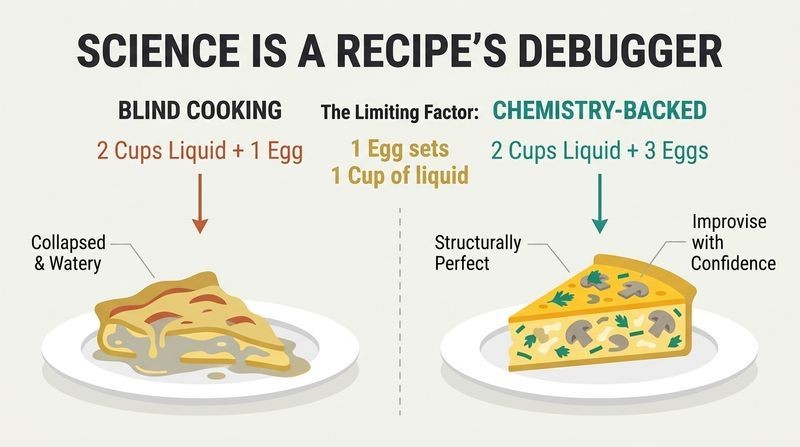
Science is a recipe's debugger. Shirley Corriher trained as a biochemist at Vanderbilt before cooking three meals a day for 148 people at an isolated boarding school. Poring over respected cookbooks, she discovered something heretical: many recipes simply do not work. Rather than waste ingredients, she phoned food scientists and reverse-engineered the failures.
Knowing the limiting factor sets you free. Her signature example: roughly one egg will set one cup of liquid. So a quiche with two cups of cream needs three eggs (or two eggs plus two yolks) to hold together. Once you know that structural constraint, you can improvise wildly with cheese, bacon, or vegetables without the custard collapsing. Understanding the mechanism, not memorizing the recipe, is what makes a cook reliable.
This is the promise behind the whole genre that Harold McGee pioneered and Corriher popularized: cooking as applied chemistry. The framing echoes what educators call transfer of learning. Memorized procedures fail the moment conditions change, but principles generalize. A physician diagnoses rather than pattern-matches symptoms, and Corriher wants cooks to do the same. The subtle claim worth noting is that many published recipes are genuinely flawed, an indictment of an industry that rarely tests rigorously. Her authority here is unusual: few cookbook writers can call a grain scientist for a second opinion, which lends her diagnostic confidence real weight.
Pair two umami sources and flavor multiplies eightfold, not doubles
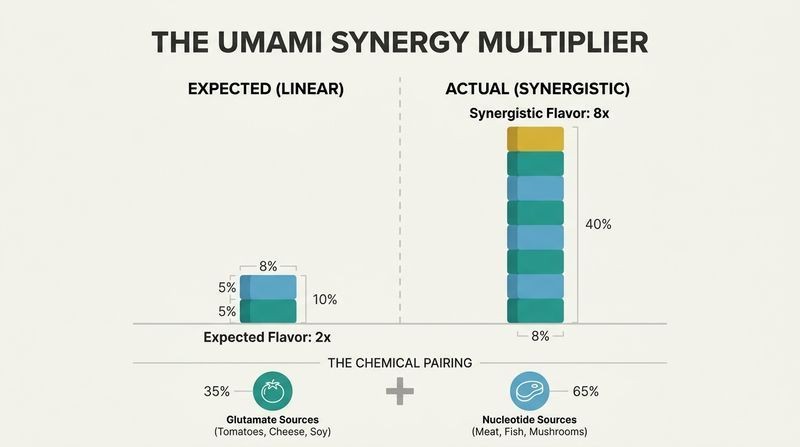
Umami is the fifth taste, and it compounds. Umami, the savory sensation signaling protein, comes from glutamate (an amino acid) and from nucleotides like inosinate and guanylate. Alone, each is pleasant. Combined, they trigger synergism: a roughly 50/50 mix of glutamate and a nucleotide delivers about eight times the flavor punch of either alone.
This explains comfort-food staples. Ketchup on a hamburger works because tomatoes carry glutamate while beef carries a nucleotide. Pizza marries tomato and cheese. Parmesan, dried shiitake, soy sauce, anchovies, and dried tomatoes are glutamate powerhouses; dried sardines, tuna, and pork supply nucleotides. Keep both categories in your pantry, and a sprinkle of shiitake powder or a splash of fish sauce can transform a flat dish into something that seems mysteriously delicious.
The synergy was mapped by Japanese researchers decades before Roper and Chaudhari cloned umami receptors in the late 1990s, giving the fifth taste biochemical legitimacy. The eightfold figure comes from taste-panel studies and is a rough ceiling, not a guarantee, since perception depends on concentration and the food matrix. Still, the practical heuristic is sound and quietly explains global cuisines: Italian ragu (tomato plus meat plus parmesan), Japanese dashi (kombu plus bonito), and Southeast Asian cooking built on fish sauce all stack the two categories. It reframes seasoning as combinatorial rather than additive, a genuinely useful mental model.
Salt erases bitterness; a half teaspoon of sugar unlocks hidden flavor
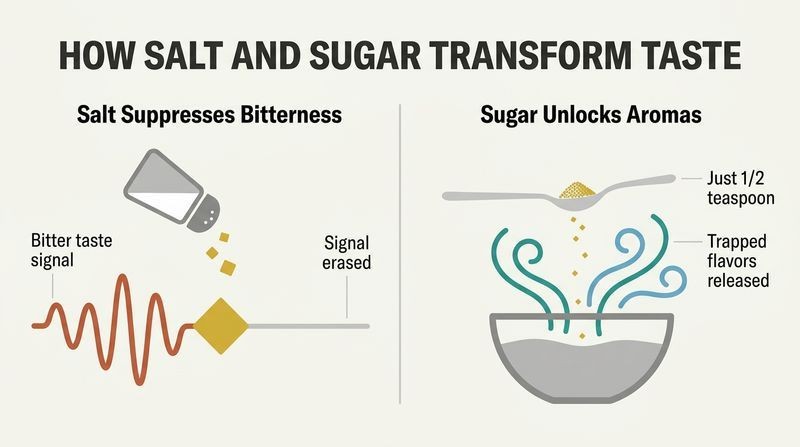
Salt is a bitterness suppressor. Researchers at the Monell Chemical Senses Center showed that adding sugar to a bitter solution cuts bitterness, but adding a little salt can eliminate it almost entirely. Try it: salt a glass of tonic water (which contains bitter quinine) and it tastes nearly like sugar water. This is why some people salt grapefruit and cantaloupe.
Tiny amounts do outsized work. A study at the University of Nottingham found that when chewing gum lost its mint flavor, a dose of sugar brought the mint back, because sugar releases aroma compounds. Corriher argues that as little as half a teaspoon of sugar can meaningfully lift a savory dish. The goal is not to taste salt or sugar directly but to deploy them as flavor amplifiers that let other ingredients emerge.
This overturns the amateur instinct that salt only makes food salty and sugar only makes it sweet. Both act as perceptual modulators, editing which sensations reach consciousness. The mechanism connects to cross-modal flavor research: taste and retronasal aroma are integrated by the brain, so sugar boosting perceived mint is really sugar altering volatile release and central processing. One caution the passage soft-pedals: these tricks nudge flavor but cannot rescue genuinely poor ingredients, and sodium and added sugar carry health tradeoffs. Used sparingly, though, the principle is the difference between a competent cook and a seasoning-savvy one.
Browning needs three things: protein, reducing sugars, and low acidity
The Maillard reaction is flavor's engine. Distinct from caramelization (sugar alone melting above 300F), the Maillard reaction is a cascade between certain sugars and proteins that produces hundreds of rich brown flavor compounds at much lower temperatures. It coats everything from toast to roasts.
Control the big three to control color. For deeper browning:
1. Add protein (an egg yolk, higher-protein flour, or butter basting rather than oil).
2. Use reducing sugars like the glucose in corn syrup, which browns faster than table sugar.
3. Reduce acidity, or add a touch of baking soda.
Refrigerated potatoes brown faster because cold converts their starch to sugar. Browning meat at the end of cooking works better than the start, because surface juices have concentrated protein and sugar. To brown less, strip those same factors away.
Named for Louis-Camille Maillard, who described it in 1912, this reaction is arguably the most important in all of cooking, responsible for the aromas of coffee, bread crust, seared steak, and chocolate. Corriher's genius is converting the biochemistry into three adjustable dials any cook can turn. Modern nutrition adds a caveat she flags briefly: excessive browning generates acrylamide and other compounds of health concern, so the goal is golden, not charred. The counterintuitive tips (corn syrup for color, baking soda to accelerate) are the kind of professional-kitchen knowledge that separates a pale disappointment from a glossy, deeply flavored result.
Cook proteins gently; heat past the sweet spot squeezes water out
Coagulation is a two-stage window. Raw proteins are coiled ribbons. Heat, acid, or air makes them unwind (denature), and the loosened strands link into a moist three-dimensional mesh that traps water. That is a juicy chicken breast. Push further and the bonds tighten, wringing out moisture and turning the food tough and dry. The entire secret, Corriher insists, is gentleness.
Time buys you safety. A custard cooked slowly in a double boiler thickens around 160F and scrambles at 180F, giving a comfortable ten to twelve degree margin. Cook the same custard over direct high heat and it will not thicken until 179F, leaving one degree before disaster. Acid and salt make proteins set sooner; sugar and starch delay coagulation, which is why starch keeps cheese sauces and pastry cream from curdling.
This is the unifying principle beneath eggs, meat, fish, and cheese, and it maps neatly onto protein denaturation as understood in biochemistry. The elegance is treating gentle heat as a way to widen your margin for error, a lesson that anticipates the sous-vide revolution, where precise low temperatures make overcooking almost impossible. The framing also demystifies curdling: it is simply coagulation that went too far. One nuance worth adding is that different proteins have different setting temperatures and collagen behaves oppositely, dissolving into gelatin with long, low heat, which is why tough cuts reward patience while lean cuts punish it.
Heat the empty pan first, then leave the food alone until it releases
Cold pans cook food into their own scratches. Corriher learned this from her German mother-in-law, who fixed her disastrous scrambled eggs by heating the empty skillet first. Hot metal expands and seals its imperfections, so eggs (liquid protein) cook on the surface instead of seeping into pits and welding themselves down.
Sticking is a phase, not a verdict. Drop a chicken breast into a properly heated pan and it will stick instantly. Panic and chisel, and you tear it. Wait about 90 seconds, what she calls a Zen moment, and the surface browns, firms, and releases itself. Then flip and repeat. The rule is universal: proteins bond to the pan while raw and let go once browned, whether on the stovetop or as a cake bottom in the oven.
The advice is deceptively deep because it reframes sticking as a signal rather than a failure. The release happens because the Maillard-browned surface is drier and structurally set, no longer chemically interacting with the metal. This connects to why nonstick coatings, though convenient, produce inferior browning: they prevent the very surface bonding that develops crust. The psychological insight is underrated too. Most home cooks fidget out of anxiety, and the single most effective intervention is often to do nothing. It is a rare cookbook that prescribes patience as technique, backed by a mechanism rather than folklore.
Brine meat for juiciness; marinades add flavor but rarely tenderize
Salt water is a moisture insurance policy. Normal cooking can cost meat up to 30 percent of its liquid; brining can cut that loss to as low as 15 percent. Salt denatures muscle proteins, exposing bonding sites that grab and hold water, and the meat also absorbs 6 to 8 percent of its weight in liquid. The result is a dramatically juicier turkey, chicken, shrimp, or lean modern pork. Always refrigerate while brining, rinse well, and never overcook.
Marinades are flavor, not magic tenderizer. Acidic marinades toughen as often as they soften (think rubbery over-marinated shrimp), and fruit enzymes like pineapple turn only the surface to mush. The lone genuine exception is dairy: the calcium in buttermilk and yogurt activates the meat's own tenderizing enzymes, which is why Southern fried chicken soaks in buttermilk.
Brining is osmosis and protein chemistry working in the cook's favor, and it scales elegantly: small items like shrimp need a concentrated brine for minutes, a turkey needs a dilute one overnight. The marinade myth-busting is the more valuable contribution, because it contradicts decades of recipe folklore promising that citrus or wine will tenderize. Food scientists broadly agree marinades penetrate only a few millimeters, so their real gift is surface flavor. The dairy exception is a genuinely useful and underappreciated distinction. A modern footnote: the salt-first movement (dry brining) achieves similar juiciness with less dilution of flavor, an evolution of the same principle.
Rush green vegetables; add sugar or calcium to hold their shape
Speed protects color and sweetness. Green vegetables carry two forms of chlorophyll, bright green and drab olive. Prolonged heat lets cellular acids leak out and dull the color, so quick cooking (blanching, steaming, stir-frying) keeps them vivid. Cabbage-family vegetables have a second clock: between five and seven minutes of cooking, their pungent hydrogen sulfide (rotten-egg smell) doubles. Sliced thin and cooked under five minutes, cabbage turns sweet and delicate.
Sugar and calcium are firmness tools. Heat normally dissolves the pectic glue between cells, so vegetables and fruits collapse. Both sugar and calcium block that conversion. The proof: navy beans cooked plain become mush, but the same beans cooked with sugar-and-calcium-rich molasses hold their shape as Boston baked beans. Soften a vegetable first, then add sugar to lock the texture.
These are two mechanisms bundled by outcome, and both are chemically robust. The chlorophyll point explains why restaurant vegetables shock in ice water after blanching, arresting the acid-driven color loss. The pectin insight has quiet power for pie makers and jam makers alike, since it is the same chemistry that governs whether fruit slumps or stays intact. Interestingly, commercial canners exploit added calcium (calcium chloride) precisely to keep canned tomatoes and pickles crisp. The takeaway usefully inverts a common frustration: mushy produce is not always overcooking per se but a failure to manage the cell-wall glue that heat, sugar, and minerals collectively control.
Cooking can unlock nutrients, so raw is not automatically healthier
Heat sometimes makes food more nourishing. The raw-is-best assumption is often wrong. Cooking softens the carrot's rigid cell walls, releasing far more carotenes, minerals, and vitamin C than chewing ever liberates. Corn's lysine, an essential amino acid, is locked in an unusable form until treated with alkali, a trick corn-dependent cultures discovered. Carotenoids, the orange and red pigments behind vitamin A, may even increase in availability with cooking.
Losses are smaller than feared. Minerals like iron and calcium drop only 5 to 10 percent regardless of method. Vitamins are more fragile, but adding vegetables to already-boiling water deactivates enzymes that would otherwise destroy 20 percent of the vitamin C in two minutes. Choose fast, low-water methods (stir-frying, steaming, blanching) or dishes that keep the cooking liquid, and most nutrients survive.
This corrects a persistent wellness dogma. The bioavailability argument is well supported: lycopene from tomatoes and beta-carotene from carrots both become more absorbable when cooked, and the nixtamalization of corn (the alkali treatment) prevented pellagra across the Americas for centuries. The honest picture is that cooking trades some heat-sensitive vitamins for gains in others plus improved digestibility, so a mixed diet of raw and cooked wins. Corriher's closing pragmatism deserves emphasis: the most nutritious vegetable is worthless if no one eats it, so palatability is itself a nutritional variable, a point often missing from purist raw-food advocacy.
Fresh and natural can be lethal; plants wage chemical warfare
Plants that cannot flee, poison instead. Because plants cannot run, many defend themselves and their seeds with toxins, and fresh does not mean safe. Apricot pits, peach pits, apple seeds, and lima beans contain cyanide (cooking dissipates it as gas from limas, but raw limas are dangerous). Raw beans carry lectins and enzyme inhibitors that block digestion, and prolonged raw-bean eating can kill.
Preparation is protection. Cassava must be chopped and left to stand so enzymes neutralize its cyanide; roasting it whole leaves the poison intact. Green patches and sprouted eyes on potatoes signal solanine, which spikes from a harmless trace to dangerous levels, so cut them out or discard the potato. Rhubarb leaves can cause fatal organ failure, which is why they are always removed. Nutmeg and some mushrooms are potent hallucinogens.
This is a bracing corrective to the naturalistic fallacy, the assumption that natural equals benign. Evolutionary biology backs Corriher completely: secondary metabolites like glycoalkaloids, cyanogenic glycosides, and lectins are chemical defenses, and traditional food-processing methods are essentially inherited detoxification protocols encoding generations of trial and error. Anthropologists note that cultures dependent on cassava or corn independently developed elaborate soaking, fermenting, and alkali treatments precisely because the untreated staples sicken. The modern lesson is timely amid raw-food and foraging trends: our safe food supply reflects both selective breeding for lower toxins and cooking knowledge, neither of which should be taken for granted.
Two starch molecules, amylose and amylopectin, decide texture and freezing
Every starch is a blend of two shapes. Amylose is a long straight chain; amylopectin is a branched one. Their ratio governs behavior. Long-grain rice is high in amylose and cooks into separate fluffy grains; short-grain rice is high in amylopectin and turns sticky, ideal for sushi. Grain starches (corn, wheat) are amylose-rich and set into a firm, sliceable but cloudy gel. Root starches (arrowroot, tapioca) are amylopectin-rich and stay clear and glossy.
Choose your starch for the job. For cherry pie you want clear tapioca; for coconut cream pie you want firm cornstarch. Crucially, amylose-thickened sauces freeze into a spongy, weeping mess, while amylopectin (root) starches freeze and thaw beautifully. This is why gravies and soups destined for the freezer should be thickened with arrowroot or tapioca, not flour. Cold also converts potato starch to sugar, ruining frying and baking.
This molecular distinction is one of the most practically powerful ideas in food science, and Corriher extends it further than most home references dare. The freezer implication alone can save a holiday make-ahead disaster. Food manufacturers rely on the same chemistry, engineering waxy (nearly pure amylopectin) and chemically modified starches specifically for frozen and reheated products. The rice application connects cuisine to agronomy: the reason a paella clumps or a risotto turns creamy is the variety's amylose content, not merely technique. The cold-sweetening of potatoes even matters industrially, since low-temperature storage raises sugars that then over-brown and produce more acrylamide when fried.
Chocolate has two enemies: a few degrees of heat and a drop of water
Overheating separates it forever. Melted chocolate is dry cocoa and sugar particles suspended in cocoa butter. Push dark chocolate past about 120F (115F for lighter types) and the fat splits from the particles into a grainy sludge in golden oil, an irreversible ruin. Since most thermometers run off by up to 10 degrees, use your body: dab melted chocolate above your lip and it should feel merely warm, never hot.
Moisture makes it seize. Paradoxically, a tiny splash of liquid glues the dry sugar particles together into a dull solid mass, like the clump a wet spoon leaves in a sugar bowl. The professional workaround is to never melt chocolate near a stray drop, or better, melt it with enough liquid from the start: at least one tablespoon per two ounces of chocolate. That is why expert recipes melt chocolate together with cream, butter, or corn syrup.
The seizing paradox (a little water ruins, more water rescues) is genuinely counterintuitive and beautifully explained by the sugar-bowl analogy: below a threshold, liquid bridges particles into paste; above it, everything dissolves. This is why ganache, which combines chocolate with plenty of cream, is forgiving while a stray water droplet is catastrophic. The body-temperature gauge is a clever low-tech hack, though tempering for glossy, snappy chocolate demands real precision because cocoa butter crystallizes in six polymorphs and only one sets properly. Corriher's pragmatic shortcut, keeping chocolate below 92F to preserve the good crystals, is the kind of insider tip that saves both ingredients and frustration.
Analysis
KitchenWise belongs to the applied-food-science lineage that Harold McGee academized and that Corriher, a Vanderbilt biochemist turned professional cook, translates into troubleshooting. Structurally it is a reference organized by material (flavor, proteins, produce, starches, sauces, freezing, baking, desserts, safety) rather than a thesis-driven argument, which makes it hard to summarize: its value lies in dozens of discrete mechanisms, not a single narrative arc. Yet a unifying philosophy runs throughout: understand the mechanism and you can diagnose any failure and improvise any success.
What distinguishes Corriher from a mere recipe collector is epistemic. She treats recipes as hypotheses to be tested, phoning grain scientists and produce experts when results disappoint, and she is unafraid to declare respected cookbooks wrong. This scientific humility, admitting she still has much to learn about gluten, for instance, coexists with hard-won authority earned cooking for 148 people daily. The book's implicit argument is that culinary tradition encodes real chemistry but also real error, and only mechanism-level understanding separates the two.
The strongest through-lines are protein coagulation (the gentle-heat window that unifies eggs, meat, fish, cheese, and custard), the Maillard browning triad, umami synergism, and the amylose/amylopectin starch distinction. These are transferable models, not tips. The weaker moments are the encyclopedic stretches (freezing charts, exhaustive umami tables) that serve reference over insight.
A modern reader should note tensions Corriher navigates gracefully: her flavor-amplifier advocacy for salt and sugar sits alongside public-health concerns, and her enthusiasm for browning brushes against acrylamide worries she acknowledges only lightly. Still, the book's core contribution endures. It democratizes the professional's diagnostic mindset, replacing anxious recipe-following with confident causal reasoning. That shift, from obedience to understanding, is the genre's highest gift, and Corriher delivers it with a chemist's rigor and a grandmother's warmth.
People Also Read





Download PDF
Download EPUB
.epub digital book format is ideal for reading ebooks on phones, tablets, and e-readers.








































