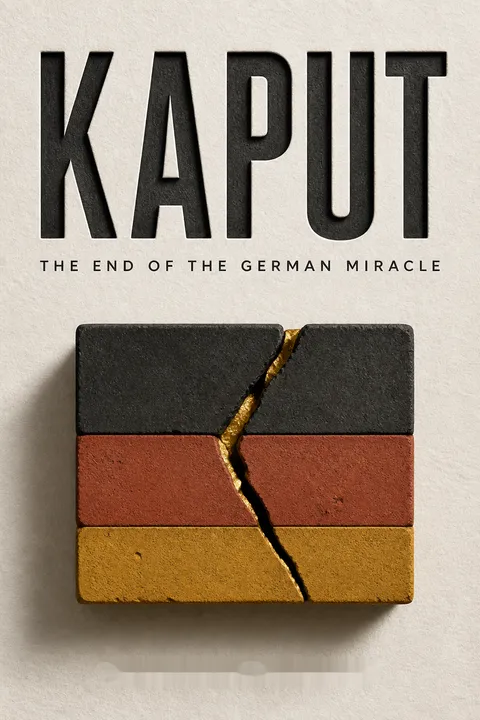

Key Takeaways
1. Germany's Industrial Model: From Miracle to Structural Slump
This book is the story of the rise and decline of a hugely successful industrial giant.
A fading powerhouse. Germany, once Europe's industrial engine and a global export champion, is now grappling with a structural economic slump, not merely a cyclical downturn. Its post-war "economic miracle" was built on two pillars: corporatist heavy industry (pipelines, nuclear reactors) and entrepreneurial discount retail (Aldi), but the entrepreneurial spirit has waned, and the industrial model faces unprecedented challenges. This decline, evident since around 2017, is deeper than previous periods of weakness, as it stems from fundamental shifts in technology, geopolitics, and global competition.
Vulnerabilities exposed. Germany's specialization in analogue-era manufacturing created critical dependencies and vulnerabilities. It became reliant on Russia for cheap gas, China for export markets, and struggled to adapt to the digital revolution. The country, once a leader in scientific innovation, failed to invent or embrace key digital technologies like computers, smartphones, or electric cars, clinging instead to its legacy strengths.
Beyond the "sick man" label. While Germany may emerge from its current recession, the underlying malaise will persist. The traditional German economic model, characterized by a narrow focus on manufacturing exports and a resistance to diversification into services, has become unstuck. This isn't just about cost competitiveness; it's about the product itself, as industries like gas heaters and diesel engines face obsolescence, and new global competitors emerge in what was once Germany's unchallenged industrial fiefdom.
2. The Financial Sector's Decline Foreshadowed Broader Economic Crisis
The rise and fall of Germany’s corporatist financial sector – the ultimate power behind the neo-mercantilist system – foreshadowed the crisis that would later befall the wider German economy.
A lopsided system. Germany's unique three-pillar banking system—private, state, and mutual banks—combined underdeveloped capital markets with an overdeveloped state banking sector. This structure, deeply intertwined with political influence, was geared towards large, stable corporate environments, not disruptive start-ups or modern financial markets. The state-owned Landesbanken, once protected from bankruptcy, engaged in reckless risk-taking, including investments in sub-prime US mortgages, leading to massive losses.
WestLB's collapse. The most prominent example was WestLB, the largest Landesbank in North Rhine-Westphalia, which became a "cesspit of German corporatism." Its politically influenced leadership supported heavy industry clusters but was blind to global risks, ultimately leading to its dissolution in 2012 at a cost of €18 billion. This demonstrated how the state guarantee encouraged the "wrong type of risk" and how a lack of transparency and accountability was a "feature, not a bug" of the system.
A toxic legacy. The demise of WestLB and other Landesbanken, coupled with scandals like the cum-ex tax fraud involving state-owned banks, revealed a deeply flawed financial sector. Despite consolidation, the fundamental problem persists: a banking system that discourages diversification into new sectors and starves high-tech start-ups of capital. This "toxic banking system" with its "political selection bias" has left Germany with a disproportionately large number of banks, yet none in the global top rankings, reflecting a broader reluctance to adapt.
3. Digital Aversion: Germany's "Original Sin" in the Tech Race
The refusal to adopt modern technologies is, in many ways, the original sin.
Lost scientific edge. Germany, once a cradle of quantum mechanics and mathematics, experienced a decisive break in scientific capability after WWII, leading to a focus on classical engineering. This historical context, combined with a pervasive "digital illiteracy" and technophobia, has left Germany a technological laggard. Public figures like neuroscience professor Manfred Spitzer, who compares digital content to drugs, exemplify a broad cultural rejection of all things digital, closing off opportunities.
Crumbling infrastructure. Despite early plans in the 1970s to connect every household with fiber-optic cable, Germany doubled down on analogue cable TV and copper wires under Helmut Kohl. Today, it lags significantly in digital infrastructure:
- Only 10% of internet connections are fiber optic (OECD average: 35.5%).
- Mobile phone networks are notoriously poor, with coverage prioritized for revenue over universal access.
- Schools, unprepared for digital learning, struggled during the pandemic, with only 33% of pupils having access to digital platforms (OECD average: 54%).
Betting on the wrong horse. The German government's AI strategy, for instance, focused on outdated "expert systems" from the 1980s, ignoring modern machine learning and deep learning. This misjudgment, coupled with a lack of venture capital and a brain drain of AI experts, has left Germany far behind the US and China. The car industry, too, treated electric vehicles as a "sideshow," clinging to fuel-driven engines and even resorting to fraud, rather than investing in the digital future.
4. Corporatism and Geopolitical Naivety Fueled Risky Dependencies
When the economic strategy of an entire country is framed in such a delusional way, it should not be surprising that further delusions are built on top of existing ones.
The corporatist nexus. Germany's neo-mercantilist model is deeply rooted in corporatism, where governments of both left and right have historically subordinated national politics to the interests of specific "champion industries." This created a system where industry chiefs had "private keys to the chancellery," amplifying errors of judgment across the entire economy. This collusion between politicians, bankers, and industrialists, often behind closed doors, fostered a lack of transparency and accountability.
Externalizing risk. A key feature of this system was the externalization of political risk. The government's Hermes export credit scheme insured companies against geopolitical risks, fostering an "apolitical thinking" among businesses. This meant that as long as lucrative contracts flowed, the political implications of dependencies on authoritarian regimes were largely ignored.
Delusional foreign policy. The "business first" approach, epitomized by figures like Helmut Schmidt and Gerhard Schröder, led to a "monumental collective national misjudgement" regarding Russia and China. The belief that "change through trade" would democratize these nations persisted despite clear evidence of human rights abuses and authoritarianism. This naive approach created dangerous dependencies, as Germany became increasingly reliant on these partners while they pursued their own strategic interests.
5. The "Autokanzler" Era: Doubling Down on Fossil Fuels and Russia
Nobody contributed more to making this a reality than Schröder, especially after he left office.
Schröder's legacy. Gerhard Schröder, known as the "Autokanzler," epitomized German corporatism and its deep ties to industry, particularly Volkswagen. His political network, the "friends of Gerhard," cultivated close relationships with energy and industrial leaders, often securing lucrative deals and nationalizing struggling companies like Salzgitter AG to save jobs. This approach, while politically popular, entrenched Germany's reliance on traditional industries.
The Russia nexus. Schröder's most significant geopolitical misjudgment was his strategic partnership with Vladimir Putin, which began with personal visits and deepened energy cooperation. He became the "godfather of German-Russian relations," later taking a role as supremo of the Nord Stream pipeline company after leaving office. This relationship, championed by the powerful German Eastern Business Association, led to Germany's "toxic dependency" on Russian gas, which rose to nearly 55% of imports by 2018.
Blindness to risk. Despite Russia's aggression in Georgia (2008) and Crimea (2014), and numerous political assassinations, German politicians and business leaders, including Merkel (albeit reluctantly), continued to believe in "modernizing Russia through trade." They dismissed warnings from the US and Eastern European partners, and even ridiculed economists like Benjamin Moll who predicted manageable consequences from cutting off Russian gas. This collective delusion persisted until the Nord Stream pipelines were sabotaged in September 2022, brutally ending the "business as usual" fantasy.
6. China's Rise Exposed Germany's Unsustainable Export Model
German neo-mercantilism has found its match, and what comes next is the backlash.
From opportunity to threat. Germany's relationship with China evolved from a low priority in the 1970s to one of extreme dependence, driven by a "business-first" foreign policy. The 1990s saw German companies integrate China into their "just-in-time" supply chains, with Germany as the senior partner. However, China's rapid development, fueled by German machinery, transformed it into a systemic competitor, challenging Germany in core areas like electric cars, solar panels, and robotics.
Deepening dependencies. German chancellors, from Kohl to Merkel and Scholz, cultivated close ties with China, often accompanied by large business delegations. Lobbyists like Karl-Theodor zu Guttenberg and Rudolf Scharping actively promoted Chinese interests, even intervening directly with Merkel on behalf of companies like Wirecard. This led to critical dependencies:
- China is Germany's largest importer (€192 billion) and fourth-largest export market (€107 billion).
- Over 80% of German laptops and 70% of mobile phones are imported from China.
- Critical raw materials like rare earths (98%) and solar cells (87%) are overwhelmingly sourced from China.
The backlash begins. The Comprehensive Agreement on Investment (CAI) between the EU and China, pushed by Merkel, faced pushback and was ultimately frozen by the European Parliament due to human rights concerns and Chinese sanctions. This marked the end of the "business as usual" approach. Now, China's shift to subsidizing manufacturing exports directly confronts Germany, leading to EU tariffs on Chinese EVs and a potential trade war that would disproportionately harm overexposed German companies.
7. Self-Imposed Fiscal Rules Crippled Public Investment
German economic policy’s primary objective is not to maximise welfare, but to protect the business model of industry.
Ordo-liberal straitjacket. Germany's economic philosophy, ordo-liberalism, combined laissez-faire economics with a strict legalistic framework, prioritizing industrial competition and competitiveness. This ideology, deeply embedded in constitutional law, shaped a macroeconomic policy infrastructure focused exclusively on price stability and balanced budgets, rather than welfare maximization or counter-cyclical stimulus.
The disastrous debt brake. The "debt brake," a constitutional fiscal rule introduced in 2009, limited annual deficits to 0.35% of GDP and lacked a "golden rule" for investment. This self-imposed austerity, championed by the SPD under Finance Minister Peer Steinbrück, led to a significant reduction in net public investments, leaving Germany with crumbling infrastructure and lagging digital development.
- Germany's net capital stock declined between 2005 and 2015.
- Investment was sacrificed first during austerity, as non-discretionary spending was protected.
A legacy of missed opportunities. While the eurozone crisis (2009-2012) temporarily benefited Germany through euro devaluation and safe-haven status for its bonds, the debt brake prevented crucial domestic investments that could have diversified the economy. The consensus across the political spectrum, even among some Greens, to prioritize fiscal restraint over investment, meant that Germany "goofed" by applying rigid rules without considering changing global economic realities or the need for strategic public spending.
8. Cultural and Bureaucratic Barriers Deter Skilled Immigration
Germany is an attractive and rich country. But is has a real problem in the global marketplace for skilled workers because it treats them like illegal immigrants.
A paradox of need. Despite severe skilled labor shortages—with unfilled jobs quadrupling to 633,000 by 2023, particularly for highly qualified workers—Germany struggles to attract and retain the talent it desperately needs. This paradox stems from a combination of cultural resistance and bureaucratic hurdles, rather than a lack of legal frameworks.
"Software" over "hardware." While Germany has made efforts to liberalize immigration laws (the 2000 green card, 2005 Immigration Act, 2023 Skilled Labour Immigration Act), the "software"—informal norms and attitudes—remains a significant barrier:
- Discrimination: Examples include professors denied jobs due to "overqualification" or children of foreign-educated parents being shunted into lower-tier schools.
- Language obsession: Impeccable German is often demanded even for roles where English proficiency is sufficient, pushing talent to more accommodating countries like the Netherlands or the UK.
- Technophobia: Poor digital infrastructure and a preference for cash create daily frustrations for immigrants.
Uncompetitive wages and bureaucracy. Wage moderation, a cornerstone of the neo-mercantilist model, has made German salaries uncompetitive in the global market for skilled labor. Furthermore, a "Kafkaesque bureaucracy" traps applications in permanent procedures, with one immigration office head noting that 99.9% of applicants are subjected to complex, months-long processes to catch a tiny fraction of potential fraudsters. This hostile environment is reflected in Germany ranking last among 52 countries in a global expat survey for two consecutive years, with many complaining about unfriendliness and difficulty forming social networks.
9. Political Fragmentation Undermines Germany's Path to Renewal
The political landscape has become too fractured to enact the reforms needed for Germany to end the structural slump.
The cost of consensus. Decades of "grand coalitions" under Angela Merkel, which left Germany without an effective opposition, contributed to public unhappiness and anger. This created fertile ground for extremist parties like the far-right AfD and Sahra Wagenknecht's BSW, which now collectively command significant electoral support (around 25%). These parties often advocate for a return to the old industrial model, including reopening Russian gas pipelines and opposing NATO, further fracturing the political landscape.
A distracted coalition. The Scholz government, initially promising modernization and digital investment, became distracted by external crises and internal squabbles.
- The "Zeitenwende" (epochal change) speech, pledging increased defense spending, was largely symbolic, with the underlying goal to save the old model.
- The nuclear phase-out, a Green party totem, proceeded despite the energy crisis, increasing reliance on more expensive LNG and coal.
- The "heating bill" controversy, forcing expensive heat pump installations, caused political damage and an "anti-green backlash."
Fiscal self-sabotage. The final blow came from a constitutional court ruling that invalidated the government's diversion of COVID-19 funds to climate projects, creating a €50-60 billion fiscal hole. This self-inflicted austerity, a direct consequence of the SPD's co-invention of the debt brake, crippled investment in modern technology and exposed deep fissures within the coalition. The government, caught in a cycle of "bad policy rules," lost its strategic direction, prioritizing technical targets over the "big picture" of economic renewal.
People Also Read





Download PDF
Download EPUB
.epub digital book format is ideal for reading ebooks on phones, tablets, and e-readers.








































