

Key Takeaways
Treat inexplicable experiences as data to investigate, not madness to hide
A businessman became his own laboratory. In 1958, Robert Monroe, a successful radio executive with no mystical leanings, was seized by a hard band of cramp across his diaphragm, then weeks later a strange full-body vibration that pinned him motionless. Doctors found nothing wrong. A psychologist friend told him the only sane response was to keep going until he understood it.
Rather than seek psychotherapy or bury the experience, Monroe did something rare: he took systematic notes on hundreds of episodes over twelve years, logging temperature, body position, physiological state, and results. He classified 589 experiments statistically. His whole stance is that phenomena beyond current science deserve careful observation, not automatic dismissal or a psychiatric label.
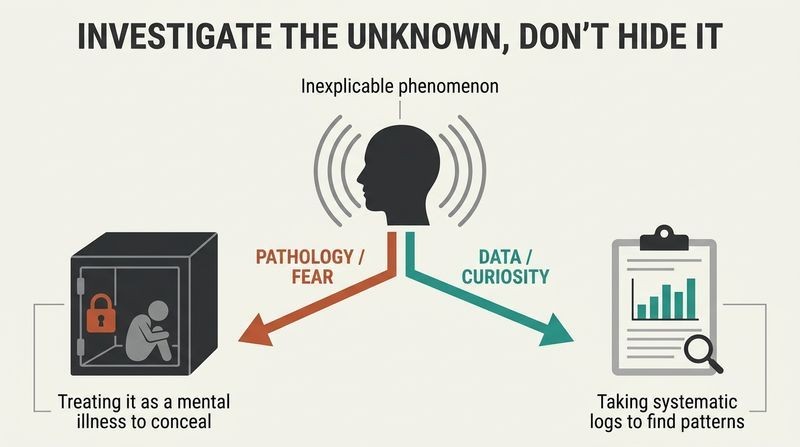
What's striking is Monroe's methodological instinct. Parapsychologist Charles Tart, who tested him in an EEG lab, praised him precisely because he reported what happened rather than what he thought it meant, a discipline most mystical writers lack. This distinction between raw observation and interpretation echoes phenomenology and modern qualitative research. The weakness is obvious: a single subject, self-reporting, cannot rule out elaborate self-deception. Yet the history of science includes many anomalies dismissed because no instrument existed to measure them. Monroe's refusal to either mythologize or pathologize his experience models a genuinely scientific temperament applied to deeply unscientific territory.
A steady internal vibration is the reliable gateway out of the body
The vibrations are the doorway. Monroe found that leaving the body never happened randomly; it always followed a specific sensory precursor he called the vibrational state, an electric-shock-like buzzing that swept through his whole frame, initially rough and around ten cycles per second, later smoothing into pure warmth as its frequency climbed. Only during this state could he separate.
He reverse-engineered a repeatable induction method:
1. Achieve deep relaxation while staying fully conscious
2. Breathe through a half-open mouth
3. Focus on the blackness behind closed eyes, extending a point of concentration outward
4. Angle it upward parallel to the body and reach until the vibrations roar in
5. Learn to smooth and speed them up mentally
He advised lying head to magnetic north, slightly too warm, free of metal and interruption.
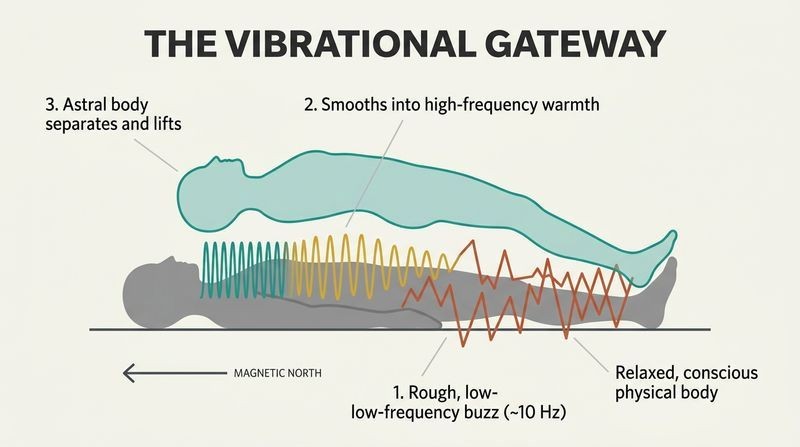
The vibrational precursor Monroe describes overlaps intriguingly with what sleep researchers now call sleep paralysis and hypnagogia, the border zone between waking and sleep where the body immobilizes but the mind stays alert. Reports of buzzing, humming, and electrical sensations are documented in that literature. Where mainstream science reads these as neurological artifacts of REM intrusion, Monroe reads them as a functional threshold to be trained and controlled. His step-by-step protocol resembles biofeedback and meditation induction more than occult ritual. The magnetic-north detail invites skepticism, but the core insight, that a specific reproducible bodily state precedes the experience, is testable and genuinely useful.
You may possess a Second Body that acts independently of the physical one
The book's central claim. Monroe coined two terms for lack of better ones: the Second Body, a non-physical duplicate we seem to carry, and the Second State, the condition of operating within it. Through hundreds of tests he catalogued its properties. It has slight weight and drifts downward like a feather. It is normally invisible but can glow faintly at its edges or appear to observers as gray, filmy fabric. It feels solid to its own touch, passes through walls after slight initial resistance, and stretches like elastic to whatever shape thought demands.
He also found a connecting cord, a warm, two-inch-thick cable of tendon-like strands running from between the shoulder blades, presumably keeping physical and Second Body in communication across any distance.
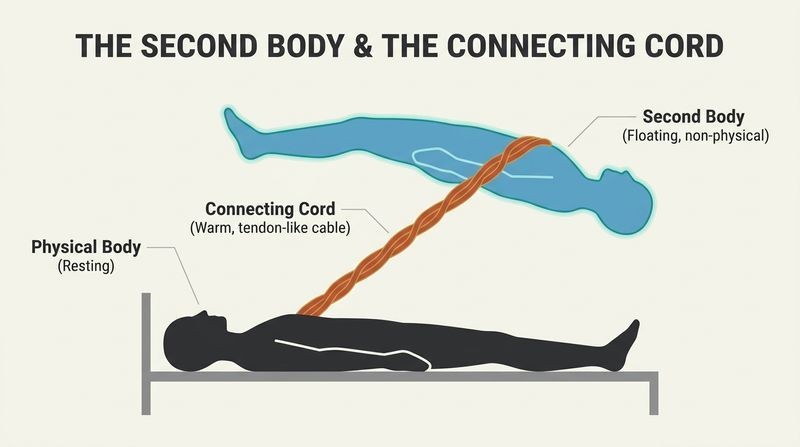
The Second Body is essentially the ancient astral body reframed in engineer's vocabulary, and Monroe knew it, tracing the idea through Egyptian, Indian, and biblical sources. What differs is his empirical framing: weight, density, surface tension, plasticity. His observation that the body defaults to human shape unless thought reshapes it, and his speculation that werewolf and vampire myths could be Second State shapeshifting, is a bold if unfalsifiable move. Cognitive neuroscience offers a competing account: the body schema, our brain's internal map of the body, can be disrupted to produce vivid out-of-body sensations, as Olaf Blanke demonstrated by stimulating the temporoparietal junction. Monroe experiences as external what may be internally generated.
Map the beyond as three distinct territories, not one vague afterlife
Three Locales, three rule sets. Monroe organized his destinations into a mental map.
1. Locale I, the Here-Now: the ordinary physical world at the present moment, where verifiable perceptions occur but which the Second Body finds hard to navigate
2. Locale II: a non-material realm where thought is instantaneous action and the natural home of the Second Body
3. Locale III: a parallel earth-like world, technologically similar but with no electricity, steam locomotives on narrow track, and enormous wide cars
In Locale III he repeatedly merged with a specific other self, a lonely architect he called I-There, living out a whole biography with a woman named Lea. He speculated Locale III might be an antimatter counterpart of our world, citing physicist Leon Lederman on anti-worlds of anti-matter.
The taxonomy is Monroe's real intellectual contribution, imposing order on chaotic experience. Locale I gives him his only verifiable data because it can be checked against consensus reality. Locale III is the strangest and most novelistic: the sustained parallel-life narrative reads less like a dream and more like a coherent alternate biography, which is either evidence of something or evidence of a richly generative unconscious. The parallel-earth idea anticipates the many-worlds interpretation of quantum mechanics and later multiverse speculation, though Monroe's version is populated and psychologically intimate. Skeptics will note that dreams routinely construct detailed, internally consistent worlds we mistake for real while inside them.
In the thought-world, your deepest emotions decide your destination
Like attracts like. Monroe's governing law for Locale II is that thought is the wellspring of existence: you think movement and you move, you think of a person and you arrive at them, never at a place. Crucially, your innermost, often unconscious drives steer you, overriding conscious intent. He found the region nearest the physical world crowded with emotionally driven, half-insane beings, both sleeping humans out in their Second Bodies and the recently dead still ruled by raw appetite.
Heaven and hell, he argues, are not locations but resonance: a remorseless killer ends up among his own kind, which becomes hell precisely because there are no victims left. Your character is your homing device. There is no hiding your inner self, which radiates like a spectrograph.
This is a moral physics, and it rhymes with ideas far older than Monroe: karmic resonance in Hindu and Buddhist thought, Dante's contrapasso where sinners inhabit the shape of their sin, and Swedenborg's claim that souls gravitate to communities matching their loves. The psychological reframing is powerful: hell as the logical endpoint of one's own untransformed character rather than external punishment. It also resembles how emotional states shape dream content. The uncomfortable implication Monroe draws, that you cannot fake your way to a better afterlife because your true motivations broadcast themselves, is a more demanding ethics than any confession-and-absolution model. Character, not belief, becomes destiny.
Verify the paranormal by predicting checkable details before confirming them
The pinch that left bruises. Monroe knew subjective conviction proves nothing, so he chased evidential cases: perceptions he could verify afterward. He visited a colleague, R.W., vacationing on the New Jersey coast, correctly described her indoor setting with two teenage girls, and pinched her side; she later reported jumping from a sudden sharp pinch and showed him two bruise marks at the exact spot. He described Dr. Bradshaw and his wife walking to their garage in specific clothing when he had expected to find Bradshaw sick in bed. He detailed Agnew Bahnson loading a Van de Graaff generator into a car at the precise time it happened.
He rigorously noted where prior knowledge could have contaminated results, marking each detail negative, indeterminate, or possible.
Monroe's evidential rigor is his strongest suit and his greatest vulnerability. In the lab, Tart recorded genuinely unusual EEG and blood-pressure signatures but could never confirm a clean paranormal hit; Monroe's home cases are more dramatic but uncontrolled. The bruise anecdote is the kind of story that resists both proof and easy dismissal. Modern parapsychology, from J.B. Rhine's card tests that Monroe cites to contemporary meta-analyses, has struggled with exactly this: suggestive effects that fail to replicate under tightened controls. The bar Monroe sets, describing details impossible to know normally, is the right one. Whether his uncontrolled anecdotes clear it remains, honestly, unresolved.
His visits to the dead suggest personality survives, but perhaps not forever
Reunions beyond the grave. Monroe reported traveling to people he loved after their deaths. He failed to recognize his deceased doctor, Dr. Gordon, until he realized the eager, big-haired young man who had glanced at him was Gordon at twenty-two, not seventy, later confirmed by an old photograph. His father, dead and paralyzed in life, swung him overhead as he had in childhood and said the pain was gone. A dead former homeowner, Mrs. W, took his hand palm-to-palm in a gesture her neighbor confirmed was her signature habit.
Yet Monroe resisted easy comfort. He speculated that personality might survive death like an eddy that gradually loses energy and dissipates into Locale II, so immortality could be real but not eternal, stronger personalities lasting longer.
The detail that makes these accounts unusual is the dead appearing younger and shedding their final suffering, which fits reports gathered decades later by near-death researchers like Raymond Moody and Bruce Greyson, where the deceased are seen restored and painless. Monroe's eddy hypothesis is more philosophically daring than standard religious immortality: it treats consciousness as a pattern that persists only as long as its organizing energy holds, closer to information theory or thermodynamics than to the eternal soul. This reframes survival as a matter of degree and coherence, raising a haunting question about what actually persists and for how long, a question most afterlife traditions avoid entirely.
Blind, unreasoning fear is the single greatest barrier to leaving the body
The fear barrier has layers. Monroe identified terror as the one obstacle present in everyone, hidden beneath conditioning but always there. It has distinct faces:
1. The death fear: separation feels like dying, triggering a panicked scramble back into the physical
2. The fear of being unable to return
3. The fear of the unknown, of a realm with no rulebook and no authority to consult
He overcame the first only after roughly eighteen to twenty repetitions dissolved it through familiarity. For the second, he developed an infallible return signal: to snap back instantly, simply think of moving a physical finger, take a deep breath, or swallow. Any deliberate physical act reintegrates you immediately, an emergency reserve rather than a routine.
Monroe's psychology of fear is sound and generalizes far beyond OOBEs. His central technique, repeated controlled exposure until terror decays into boredom, is precisely how modern clinical psychology treats phobias and trauma through systematic desensitization. The observation that fear turns to panic then terror given the smallest push describes the amygdala's runaway threat response. His reassuring anchor, that a physical action always returns you, functions like a safety cue that lets the nervous system tolerate an alarming state. Sleep paralysis sufferers report the same terror and the same relief on moving a finger, which suggests Monroe intuited a real feature of the waking-sleep boundary decades before it was well studied.
Don't deny the sex drive; postpone it, or it hijacks the journey
Delay, never deny. Monroe found that on early separations an overwhelming sexual urge would flood him and trap him in the room. Fighting it, ignoring it, and denying it all failed. What finally worked was acknowledgment plus postponement: agreeing the desire was good and promising to satisfy it soon, then shooting off elsewhere. He compared it to old Gene Autry Westerns where the hero always sang a song before the kiss that never came.
He argued that Second State sexuality is not physical at all but a full-body intermingling, atom for atom, like opposite magnetic poles rushing together and equalizing charge. In parts of Locale II a brief sex charge functioned as casually as a handshake greeting. Physical sex, he suggested, is a dim echo of this.
Monroe's practical trick, recognizing a drive rather than suppressing it, aligns with acceptance-based therapies and with what meditation traditions teach about noting a craving without acting on it or resisting it. Suppression tends to amplify; acknowledgment defuses. His larger claim, that erotic union is really a memory of a non-physical merging of whole selves, echoes Plato's Symposium myth of split beings seeking wholeness and Tantric notions of union beyond the body. He notes Gurdjieff called sexuality the great obstacle to mystical attainment. The magnetic-pole metaphor is elegant, though it conveniently sidesteps the messier evolutionary and relational functions of human sexuality that a purely energetic account cannot explain.
Prayer and orthodox religion failed him, while unnamed helpers arrived unbidden
Faith didn't rescue him. When Monroe hit a steel barrier blocking his return, he prayed every prayer he knew with total sincerity. Nothing. He escaped only by trying a counterintuitive maneuver, moving away from the barrier rather than through it. When small rubbery entities tormented him, invoking God, Jesus, and saints only made his attackers laugh harder and work him over more enthusiastically.
Yet help did come, just not on request. Invisible hands boosted him uphill, steadied him, and once firmly insisted he return from a state of blissful union. These helpers were rarely friendly in a warm sense, offered no comfort, and acted on their own timing and judgment. He could not identify them, could not summon them, and doubted they were guardian angels.
This is one of the book's most subversive threads: a man raised in orthodox Christianity reporting that ritual prayer was useless in the very realm where an afterlife supposedly operates. It reframes conventional religious practice as a garbled inheritance, like children singing London Bridge without knowing its meaning. The helpers, competent, impersonal, and selectively responsive, resemble the guides of shamanic and near-death literature more than Sunday-school angels. What makes the account credible on its own terms is that it disappoints expectation: a fantasist would have staged the rescuing angel. Monroe instead reports indifference to his pleading, which is the texture of experience rather than wish fulfillment.
Consider that humanity may be farmed by higher intelligences for psychic energy
The laboratory-animal hypothesis. In his most unsettling chapter, Monroe offers a premise that explains more than it comforts. During three separate episodes a powerful, cold, impersonal intelligence descended along a beam from the north, entered his forehead, and coldly searched his memories, unmoved by his emotions. It left him with the conviction that he tended a kind of pumping station, extracting a high-energy substance vital elsewhere in the universe, a dirty ordinary job he was stuck with.
He extrapolated a grand hypothesis: Earth is an anomalous, poorly shielded planet whose intense radiation and magnetism produced a psi-blind civilization. Advanced beings monitor us, occasionally probing individuals who get labeled insane or dreaming, treating us essentially as laboratory animals in an ongoing experiment.
Monroe weeps in the text upon concluding that the God of his childhood does not exist as worshipped, and this grief gives the passage weight most speculative cosmology lacks. The farming hypothesis prefigures ideas that later saturated popular culture, from the simulation argument to Gnostic-flavored notions of humans harvested for energy. It resonates with ancient Gnosticism, where a flawed demiurge rules a trap-like material world, and with the perennial mystic complaint that ultimate reality is indifferent rather than loving. As explanation it is unfalsifiable and shaped by mid-century anxieties about experiments and radiation. As phenomenology it is memorable precisely because it offers no consolation, which is not how comforting fantasies usually end.
Your mind forces a familiar label onto the unknown, distorting what you report
The identify command corrupts perception. Monroe's sharpest analytic insight explains why paranormal reports are so unreliable. In the Second State the mind is under a strong compulsion to identify whatever it perceives, and rather than accept an unknown, it substitutes the nearest match from memory. His most vivid proof: what he experienced as being a passenger in a low-flying airplane crash was actually a precognition of his own coming heart attack. His mind, unable to accept the impossible image of his own heart failing, translated it into a survivable plane crash instead.
Similarly, a Van de Graaff generator became a child's toy car, and mail being handed out became oversized playing cards. Only careful after-the-fact analysis recovered what was actually there.
This is genuinely ahead of its time and applies far beyond OOBEs. Monroe essentially describes what cognitive scientists call top-down predictive processing: the brain does not passively record but actively guesses, fitting sensory noise to prior expectation, which is why we misread ambiguous words and see faces in clouds. His heart-attack example is a striking case of symbolic substitution under threat, resembling how dreams disguise unacceptable content. The methodological payoff is profound and self-undermining in the best way: Monroe uses this principle to distrust his own reports, warning that every account, including his, is filtered and distorted. Few writers in this genre build in their own epistemic humility so explicitly.
Analysis
Journeys Out of the Body occupies a strange and durable place in twentieth-century culture: a paranormal memoir written in the voice of an engineer. Its lasting influence, seeding the Monroe Institute, the hemispheric-audio Hemi-Sync technology, and even documented interest from military remote-viewing programs, rests on Monroe's temperament rather than his conclusions. He brought a businessman's log-keeping and a skeptic's residual doubt to material usually handled by ecstatics. That tension is the book's engine.
Read today, the work sits at a productive crossroads of three interpretive frames. The neuroscientific frame, unavailable to Monroe, now explains many features he reported: sleep paralysis and hypnagogic vibrations, REM-state vivid imagery, and the body-schema disruptions that Olaf Blanke and others induced by stimulating the temporoparietal junction, producing textbook out-of-body sensations in a lab. From this angle, Monroe mapped the phenomenology of an altered brain state with unusual care while misattributing its cause. The psychological frame, supplied in the book's own epilogue by psychiatrist Stuart Twemlow, portrays a high-functioning, self-actualizing man who compartmentalizes intense emotion and trusts his inner experience, precisely the profile that generates and tolerates such episodes. The parapsychological frame, championed by Charles Tart, takes the evidential cases seriously and finds them tantalizing but never clean.
What elevates the book above its genre is Monroe's epistemic honesty. He documents failures, marks where prior knowledge could have contaminated results, and articulates the identify-command principle that undermines the reliability of all such reports, including his own. His deepest conclusions offer no comfort: an indifferent cosmic intelligence, an afterlife that may slowly dissipate, a God unlike the one he was taught. That refusal of consolation is why the book unsettles rather than merely entertains. Whether one reads it as cartography of consciousness or of the brain, it remains a rigorous record of one man refusing to look away.
Review Summary
Journeys Out of the Body is a pioneering work on out-of-body experiences by Robert Monroe. Readers praise Monroe's scientific approach, detailed accounts, and the book's potential to change one's perspective on consciousness and reality. Many find it captivating and thought-provoking, though some struggle with its complexity. The book's exploration of astral projection and alternative states of consciousness resonates with those interested in spiritual and metaphysical topics. While some readers remain skeptical, many appreciate Monroe's honesty and the book's potential to expand understanding of human consciousness.
People Also Read



FAQ
What's Journeys Out of the Body about?
- Exploration of OOBEs: The book details Robert A. Monroe's personal experiences with out-of-body experiences (OOBEs), where he describes his ability to separate his consciousness from his physical body.
- Research and Insights: Monroe shares insights from his research at the Monroe Institute, studying OOBEs and their implications on consciousness and existence beyond physical life.
- Philosophical Themes: The narrative delves into philosophical questions about life, death, and reality, challenging conventional beliefs and encouraging readers to explore their own experiences.
Why should I read Journeys Out of the Body?
- Unique Perspective: Monroe provides a firsthand account of OOBEs, combining personal narrative with scientific inquiry, making it both engaging and informative.
- Encourages Exploration: The book encourages readers to explore their own consciousness and consider the possibilities of existence beyond the physical realm.
- Influential Work: As a pioneering work in the study of OOBEs, it has influenced many researchers and practitioners in psychology, spirituality, and consciousness studies.
What are the key takeaways of Journeys Out of the Body?
- Existence Beyond Death: Monroe posits that consciousness can exist independently of the physical body, suggesting life continues after death.
- Second Body Concept: He introduces the idea of a "Second Body," a non-physical aspect of a person that can travel and explore different realms.
- Mind and Supermind: The book discusses the distinction between the conscious mind and the "Supermind," a higher state of awareness accessing deeper truths.
What are the best quotes from Journeys Out of the Body and what do they mean?
- “If it works, use it.”: Reflects Monroe's pragmatic approach to exploring consciousness and OOBEs, emphasizing practical results over theoretical debates.
- “You are not your body.”: Suggests that one's identity and consciousness extend beyond the physical form, encapsulating the core message of the book.
- “Like attracts like.”: Highlights the idea that thoughts and emotions shape experiences in both physical and non-physical realms, reinforcing interconnectedness.
What is an Out-of-Body Experience (OOBE) as defined in Journeys Out of the Body?
- Definition of OOBE: An event where the experiencer perceives their environment from a location outside their physical body, while maintaining awareness that they are not dreaming.
- Characteristics: Individuals often report vivid experiences, a sense of floating or flying, and the ability to observe events happening at a distance.
- Common Triggers: OOBEs can occur spontaneously during sleep, illness, or extreme emotional stress, but can also be induced through specific techniques and practices.
How does Robert A. Monroe describe the process of achieving an OOBE?
- Relaxation Techniques: Emphasizes deep relaxation and mental focus to prepare the mind and body for the OOBE experience.
- Vibrational State: Describes entering a vibrational state, a precursor to separation from the physical body, often accompanied by sensations of warmth and energy.
- Mental Techniques: Techniques such as visualization, intention-setting, and the "roll-out" method are detailed as effective ways to facilitate the transition into the Second Body.
What is the significance of the "Second Body" in Journeys Out of the Body?
- Concept of the Second Body: Described as the non-physical aspect of a person that can travel and explore different dimensions or realities.
- Connection to Consciousness: Suggests that the Second Body is a manifestation of consciousness existing independently of the physical form.
- Implications for Identity: Challenges traditional notions of identity, suggesting individuals are more than just their physical bodies, with true essence tied to consciousness.
What role does the Monroe Institute play in the exploration of OOBEs?
- Research Facility: Established by Robert Monroe to conduct research on consciousness, OOBEs, and related phenomena, attracting interest from various scientific and academic fields.
- Training Programs: Offers training programs designed to help individuals learn techniques for achieving OOBEs and exploring their consciousness in a structured environment.
- Community of Explorers: Serves as a community for those interested in consciousness exploration, providing support and resources for individuals seeking to understand their experiences.
How does Journeys Out of the Body address the concept of life after death?
- Personal Experiences: Monroe shares his own experiences during OOBEs that suggest a continuation of consciousness beyond physical death.
- Philosophical Reflections: Encourages readers to reflect on their beliefs about mortality and the nature of existence, challenging them to consider the possibility of an afterlife.
- Cultural Perspectives: Discusses how different cultures and religions have interpreted life after death, suggesting these beliefs may be rooted in universal human experiences.
What are some common misconceptions about OOBEs discussed in Journeys Out of the Body?
- Hallucination vs. Reality: Addresses the misconception that OOBEs are merely hallucinations or dreams, arguing they can be valid experiences of consciousness outside the physical body.
- Fear of the Unknown: Many people fear OOBEs due to their unfamiliar nature, but Monroe emphasizes these experiences can be enlightening and transformative.
- Skepticism from Science: Highlights the skepticism surrounding OOBEs in the scientific community, suggesting this skepticism often stems from a lack of understanding rather than empirical evidence.
What is the vibrational state in Journeys Out of the Body?
- Precursor to OBEs: A critical condition necessary for achieving an out-of-body experience, characterized by a sensation of energy or vibrations throughout the body.
- Induction Techniques: Outlines various techniques to induce this state, including relaxation methods and mental focus, preparing the individual for separation from the physical body.
- Sensory Experience: During the vibrational state, individuals may experience heightened awareness and sensations that signal the onset of an OBE.
How does Monroe differentiate between dreams and OBEs?
- Conscious Awareness: Asserts that during OBEs, individuals maintain a level of conscious awareness and control absent in typical dreams.
- Sensory Input: Notes that sensory experiences during OBEs are more vivid and multi-faceted compared to dreams, which tend to be limited to one or two senses.
- Intentionality: OBEs are characterized by intentional exploration and decision-making, whereas dreams often lack coherent structure and are more reactive in nature.
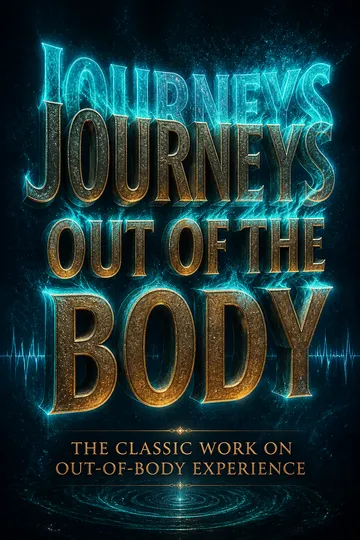
The Journeys Trilogy Series

Download PDF
Download EPUB
.epub digital book format is ideal for reading ebooks on phones, tablets, and e-readers.








































