

Key Takeaways
Treat your body as a vehicle, not the whole of who you are
The central creed of the Monroe Institute. Every exploration session opened with an affirmation that began, "I am more than my physical body." Rosalind McKnight, a theology graduate turned laboratory "Explorer," spent eleven years testing this claim by leaving her body under controlled conditions and reporting back in real time to researcher Robert Monroe.
The physical is framed as a temporary encasement. The book insists the material world is a "reflection of the real world," a slower, denser vibration of an energy self that predates and outlasts the body. McKnight describes feeling "freer than I had ever felt," moving anywhere by thought alone, with her mind sharper outside the body than in it. The premise reframes ordinary waking life as the limited state, and expanded consciousness as the fuller reality.
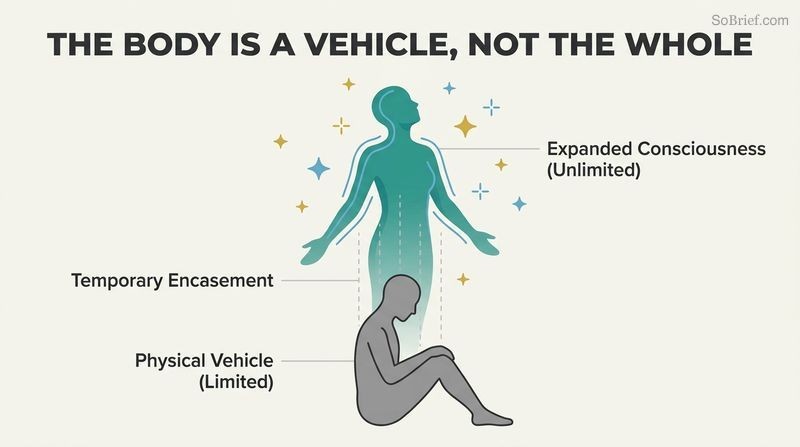
What's striking is how this inverts the materialist default: instead of consciousness being a byproduct of the brain, the brain becomes a receiver for consciousness. That framing echoes philosopher William James and later Aldous Huxley's "reducing valve" theory of mind. Readers should note the epistemic caveat, though. Everything rests on subjective first-person reports gathered in a darkened chamber, unverifiable from outside. The value here is less as proof than as a disciplined phenomenology of altered states, a domain neuroscience now studies seriously through meditation, psychedelics, and near-death research.
Play two slightly different tones and your brain manufactures a third
Hemi-Sync, Monroe's signature discovery. Feed one ear a tone at 440 hertz and the other at 434 hertz, and the brain itself generates a pulsing beat at the 6-hertz difference. This is a binaural beat. Monroe used it to drive a Frequency Following Response, coaxing brainwaves into chosen states and synchronizing the two hemispheres, hence "Hemi-Sync" (hemispheric synchronization).
The practical payoff was speed. Monroe claimed the technology could drop a subject into a meditative state "in minutes" that monks pursue for years in ashrams. He built numbered target states: Focus 10 (mind awake, body asleep), Focus 12 (expanded awareness), Focus 15 (no time), and Focus 21 (other energy systems). McKnight was wired with electrodes tracking brain waves (EEG) and muscle tone (EMG) so Monroe could see her physiological state while she narrated her experience aloud.
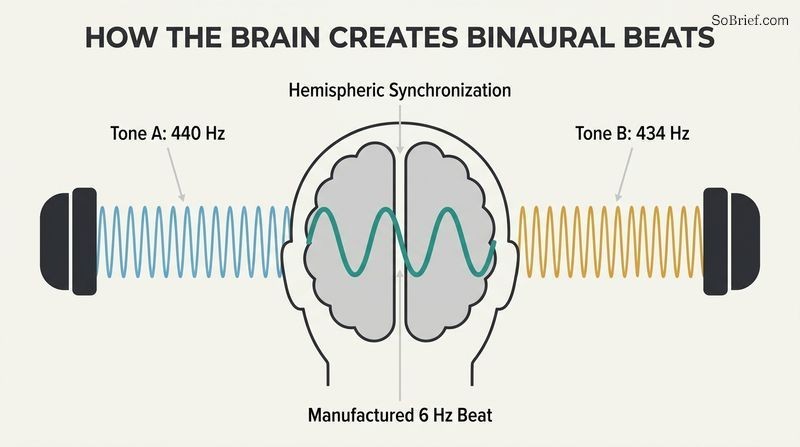
The underlying acoustics are real and well documented since Heinrich Wilhelm Dove described binaural beats in 1839. Whether they reliably alter consciousness is more contested: controlled studies show modest, inconsistent effects on relaxation and attention, and a genuine "frequency following response" in the cortex is debated. What deserves credit is Monroe's instinct that consciousness could be engineered rather than merely awaited, an idea now mainstream in neurofeedback and contemplative science. The numbered Focus levels also gave practitioners a shared vocabulary, which likely mattered as much psychologically as the tones did acoustically.
You never leave your body; you change frequency inside it
A radical reinterpretation of the out-of-body experience. The guiding voices told Monroe his famous book title, Journeys Out of the Body, was misleading. There is no travel through space because, in their telling, space and time do not truly exist. What feels like flying through a tunnel is actually the self shifting to a higher rate of vibration within.
Different exits, different bodies. The book maps five layers of self (physical, etheric, emotional, mental, spiritual) and says people separate at different levels. Leave from the etheric level and you view your own body and roam the physical world, often perceived by others as a ghost. Leave from the mental level and you travel timeless dimensions with little risk of interference. The deeper the layer, the more protection and the less vivid the earthly detail.
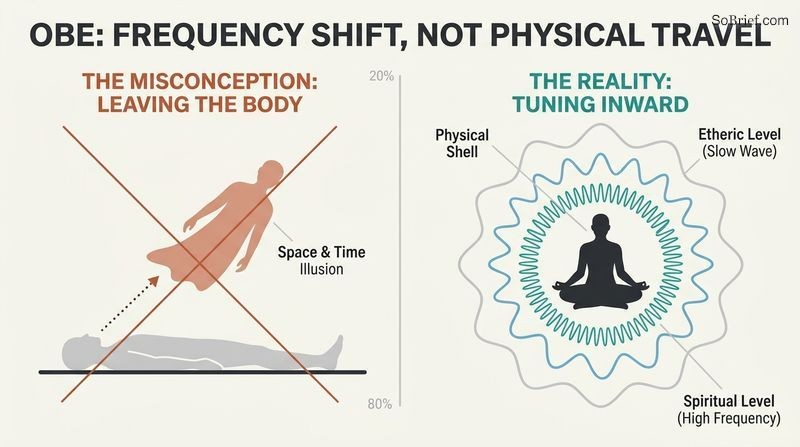
This "it's all within" move is philosophically elegant because it sidesteps the hardest objection to astral travel: no measurable thing actually goes anywhere. By relocating the whole phenomenon to shifts in internal state, the claim becomes closer to a report about consciousness than about physics. Modern research on the sense of self supports the plausibility of the felt experience: neuroscientists like Olaf Blanke have induced out-of-body sensations by stimulating the temporoparietal junction, showing the brain can generate vivid disembodiment. The metaphysical interpretation remains a leap, but the underlying experience is neurologically genuine.
Death is a change of station, and some souls miss the signal
Death reframed as transformation, not termination. The Invisibles describe dying as a shift of vibration into the etheric body, landing the soul at the highest level it reached in life. McKnight reports reunions with her deceased brother Larry and father, both vividly alive, traveling by thought, even building homes with their minds.
But strong emotion can trap a soul. Those locked into fear, grief, or attachment stay stuck in an earth-time loop, unaware they have died. These are the "earthbound" souls, what folklore calls ghosts. The book stresses there is no eternal hell and no punishing God, only self-imposed stagnation until the soul chooses to move. Grief on the living side, they add, can slow a departed soul's transition, so releasing loved ones is itself an act of help.
The comforting architecture here maps closely onto reports catalogued in near-death studies by researchers like Raymond Moody and Bruce Greyson: the tunnel, the light, deceased relatives greeting the dying. That cross-cultural consistency is intriguing whether one reads it as evidence of an afterlife or as a shared feature of the dying brain. The "stuck soul" model also mirrors psychological truths dressed in metaphysical clothing: unprocessed trauma and refusal to let go genuinely do trap the living. Skeptics will note grief bargaining can make such frameworks emotionally seductive precisely because they are unfalsifiable and consoling.
Thoughts are physical energy that travel, attract, and shape reality
You become what you think, literally in this cosmology. The Invisibles insist thought is "more real than your physical body" because every thought goes somewhere, instantly reaching whoever it targets, alive or dead. Two universal laws recur: like attracts like, and you are what you think. Polluted thoughts, they claim, produce polluted spots in the earth's own energy field.
Humans are miseducated, in their view. The core complaint is that people are taught what to think rather than how to think, and belief systems install limits that then become real. Free the mind from those limits and it can, they say, access all knowledge, since every cell contains a pattern of the whole. The proposed practice is inward: prayer as speaking, meditation as listening, and daily self-examination, treating criticism of others as a mirror of what you reject in yourself.
The psychological kernel is sturdier than the metaphysics. "You are what you think" anticipates cognitive behavioral therapy's premise that beliefs generate emotional reality, and the mirror observation about projection is straight out of Jungian shadow work. "Like attracts like" later became the marketing engine of The Secret and law-of-attraction culture, which is where caution is warranted: the same idea, pushed too far, implies victims attract their suffering, a morally troubling conclusion. Read as a discipline of attention and intention, it is useful. Read as literal physics of manifestation, it outruns any evidence.
Treat rivers, trees, and soil as conscious partners, not resources
Everything in nature is portrayed as alive and aware. In one long session McKnight enters the consciousness of a snake, rose, blade of grass, pine tree, raindrop, and the earth itself, each delivering a message. The four elements are assigned roles: earth is the physical level, water the mental, air the spiritual, fire the emotional. She also meets nature's "hierarchy": fairies tending flowers, gnome-like "woodchucks" healing trees, and "sunbeings" or devas channeling the sun's nourishment.
The recurring warning is imbalance. Mother Earth, spoken of as a living entity going through puberty, describes "diseased" gray patches in her aura where humans took without giving back. Cities dull the energy; forests and lakes glow. The prescription is reciprocity: give and receive rather than merely extract, because a purely "taking" consciousness breeds stagnation and eventual breakdown.
Stripped of the fairies, this is a strikingly early articulation of Gaia theory, which James Lovelock formalized in the 1970s, the same decade as these sessions, proposing the earth as a self-regulating living system. The reciprocity ethic also converges with Indigenous land philosophies and with Robin Wall Kimmerer's later "grammar of animacy," which argues that treating nature as a subject rather than an object changes behavior. The literal claim that grass and raindrops narrate messages is unverifiable, but the functional insight, that perceiving nature as sentient curbs exploitation, is now supported by environmental psychology research on nature-relatedness and conservation behavior.
A dying soul may need a living voice to admit it has died
The Patrick Event, the book's most dramatic scene. Through McKnight's vocal cords, a panicked voice cried out in a Scottish accent: Patrick O'Shaunessy, a ship's cook who believed he was still clinging to a log in freezing water after an explosion, though he had drowned in 1879. Monroe gently talked him through the realization that he had died, told him to let go of the log, and Patrick suddenly saw his deceased parents reaching for him and moved into the light, weeping with relief.
Why the living are needed. The Invisibles explain that earthbound souls stuck in a time warp often cannot perceive their spirit guides or dead relatives, so a person still tied to earth energies can break the illusion. The technique: let them tell their story, then shock them into recognizing the body they speak through is not theirs. Monroe built an entire training program, Lifeline, around this rescue work.
Whatever its ontological status, the scene is a masterclass in something therapists know well: you cannot force insight, you must meet a person inside their own frame of reality and lead them out gently. Patrick's refusal to see rescuers who were present the whole time is a vivid metaphor for how trauma and denial blind people to available help. Critics will reasonably read this as dissociative role-play or cryptomnesia, the surfacing of forgotten information. Yet the therapeutic architecture, honoring the story before challenging it, is precisely how modern grief and trauma work proceeds.
Eat living foods, fast to reset, and bless what you consume
When discipline slipped, the guidance pushed back. After holiday indulgence, the Invisibles bluntly warned Monroe and McKnight to respect their bodies or lose the connection. Their dietary counsel: favor natural, unprocessed "live" foods that still carry vital energy, since like attracts like and living cells crave living nutrients. Artificial ingredients throw off the body's energy balance and breed disease even amid abundance.
A hierarchy of practical rules emerged.
1. Take on one discipline at a time to avoid overloading the body
2. Emphasize fresh juices, citrus, and green and yellow vegetables for cleansing
3. Do not mix fruits and vegetables in the same meal
4. Minimize meat, especially red meat, as heavy and slow in vibration
5. Fast periodically to invert the body's energy and let organs regenerate
They also urged blessing all food and even clothing with thanks, claiming gratitude itself cleanses vibration and creates a circular flow of giving and receiving.
Beneath the vibration language sits advice that reads as remarkably prescient nutrition science. Emphasizing whole plants over processed foods and limiting red meat aligns with decades of subsequent epidemiology, and intermittent fasting has moved from fringe to laboratory, with work on autophagy (cellular self-cleaning) earning a Nobel Prize in 2016. The food-combining rule about not mixing fruits and vegetables, by contrast, has no solid physiological basis and echoes 1970s fad diets. The gratitude practice, meanwhile, connects to real findings: mindful eating and gratitude interventions measurably improve well-being and may curb the emotional overeating the passage explicitly warns against.
You cannot pour love outward until you first accept yourself
The golden level of love. In a session dominated by warm gold light, McKnight's helpers taught that before a soul can truly love another, it must experience "total and complete love for self." She describes a circle of radiant, gender-integrated beings radiating pure joy, teaching self-acceptance without fear or self-criticism. They gave her a symbolic "golden button" at heart level to press whenever doubt, hatred, or fear crept in, instantly shifting her into a state that transforms negativity.
Love is defined as an energy, not an emotion. The book distinguishes the two sharply: emotions belong to the lower self, but love is the highest vibration, the force that recognizes itself in all life. Fear, by contrast, is named as the fuel of every war, the ego being described as "an encapsulated fear-form." The remedy offered for a violent planet is not policy but a shift from fear to love.
"You cannot love others until you love yourself" has become self-help wallpaper, but the framing here predates its ubiquity and gives it a sharper mechanism: self-rejection leaks outward as criticism and control. That tracks with attachment research showing self-compassion predicts healthier relationships, and with Kristin Neff's finding that self-compassion, unlike self-esteem, does not require feeling superior to others. The love-versus-fear binary is emotionally powerful and echoes thinkers from the Stoics to A Course in Miracles. Its limitation is oversimplification: reducing all conflict to fear ignores resource competition, injustice, and structural causes that love alone rarely resolves.
Humanity is a child species, watched and nudged toward adulthood
Earth as a planet in puberty. Across sessions, the guidance frames our world as a young, emotionally intense growing organism, monitored by more evolved beings. In vivid detail McKnight describes a "mother ship" whose crew tracks Earth's collective thought-vibrations on a living map, waiting for humanity's fear levels to drop enough for open contact. Their principle: intervene only if a planet nears self-destruction, since a planet's violent death sends destructive energy rippling across galaxies.
A hopeful long arc. Peering to the year 3000, she sees a healed, unified Earth where people travel out of body at will, communicate freely with the dead, live past 100 by choice, and understand Jesus not as a being to worship but as a demonstration of every human's potential ("greater things will you do than I"). The through-line: fear keeps us small and isolated, and the species grows by learning reciprocity, love, and how to use its own dormant energies.
This is where the book is most a product of its 1970s moment, when UFO contactee culture, the dawning environmental movement, and New Age optimism converged. The "space brothers" as benevolent guardians mirror a recurring human tendency to externalize hope onto superior parental figures, a pattern anthropologist saw in cargo cults and that Carl Sagan critiqued in demon-haunted terms. Yet the underlying framing, that a civilization's survival depends on lowering collective fear and aggression, resonates with real existential-risk thinking today. The specific 1988 and twenty-first-century predictions serve as a useful reminder to hold all such dated prophecy loosely.
Analysis
Cosmic Journeys is a spiritual memoir wrapped around laboratory transcripts, and that hybrid form is both its charm and its challenge. Written by Rosalind McKnight, a Union Theological Seminary graduate who became one of Robert Monroe's longest-serving "Explorers," it documents eleven years of guided out-of-body sessions conducted from the early 1970s at what became the Monroe Institute. The book braids three genres: a warm biographical portrait of Monroe, a technical account of Hemi-Sync brainwave technology, and channeled metaphysical teachings delivered through McKnight while she lay wired to monitors in a dark chamber.
The work sits squarely in the New Age contactee tradition, and its content should be read as testimony rather than evidence. Nothing in it is falsifiable; the anomalies it cites, dead car batteries near a chamber, blown-out wiring during the Patrick session, are anecdotal. A careful reader will recognize familiar psychological mechanisms at work: hypnagogic imagery, dissociation, cryptomnesia, and the powerful narrative coherence the mind imposes on altered states. The doctrine itself is a syncretic blend of Theosophy (the five bodies, group souls, reincarnation), Christian mysticism (McKnight's Pauline "through a glass darkly"), proto-Gaia ecology, and 1970s UFO lore.
What elevates it above pure fringe material is coherence and humility of tone. The teachings hang together as a system, and several converge with ideas that gained scientific traction afterward: binaural beats and neurofeedback, intermittent fasting and autophagy, Lovelock's living Earth, and the neuroscience of induced out-of-body states. The recurring ethical core, that fear fuels violence, that reciprocity sustains ecosystems, that self-acceptance precedes compassion, holds practical value independent of the cosmology.
Its durability is real: the Monroe Institute still runs Gateway, Lifeline, and related programs worldwide. The honest way to read this book is as a phenomenology of consciousness at the edge, valuable for the questions it dramatizes about mind, death, and meaning, not as a map that has been verified.
People Also Read




Glossary
Hemi-Sync
Synchronizing both brain hemispheres with soundShort for hemispheric synchronization, Monroe's audio technique that feeds each ear a slightly different tone so the brain generates a third signal, the difference between them. This is claimed to coax the two hemispheres into working in unison and to shift the listener into targeted states of consciousness between waking and sleep.
Frequency Following Response (FFR)
Brainwaves matching an induced toneThe proposed effect in which the brain's electrical rhythm falls into step with the binaural beat created by Hemi-Sync sound. Monroe used it to hold a subject in a stable state of consciousness, for example keeping the body asleep while the mind stays awake, for extended periods.
CHEC Unit
Soundproof dark chamber for sessionsControlled Holistic Environmental Chamber, a small enclosed booth roughly eight by ten feet containing a water bed, used at the Monroe lab. It isolates the Explorer from outside light and sound so they can relax deeply, wear headphones and electrodes, and narrate their experience through a microphone.
Focus 10, 12, 15, 21
Numbered states of consciousnessMonroe's ladder of induced mental states. Focus 10 is mind awake with body asleep; Focus 12 is expanded awareness; Focus 15 reaches a state of "no time"; and Focus 21 moves into other energy systems. Explorers used the numbers as shared shorthand for how deep they had gone.
Explorer
Volunteer subject exploring consciousnessMonroe's term for a select subject who ventured out of body under laboratory conditions and reported findings back in real time. Explorers were given code names; McKnight was ROMC and Monroe was RAM, both drawn from their identical initials, Robert A. Monroe and Rosalind A. McKnight.
Invisible Helpers
Nonphysical guiding beingsThe light beings McKnight perceived as guides, teachers, and protectors during sessions. She equated them with angels. Their spokesman, whom Monroe nicknamed "Ah, So," refused to give a name, saying it would tie his energy to the earth plane, and claimed to have lived on Earth centuries earlier.
The Affirmation
Opening statement of every sessionThe declaration recited to begin Explorer and training sessions, starting "I am more than my physical body." It states the desire to expand, experience, and use greater energies while requesting guidance and protection, and it functions as both a mental primer and the organizing spine of the entire book.
Earthbound souls
Spirits stuck after deathSouls that have dropped the physical body but remain locked in an earth-time vibration, usually through strong fear, grief, or attachment, often unaware they have died. Folklore calls them ghosts. The book describes "rescue work," in which a living person helps such a soul realize its situation and move into higher energy.
The Journeys Trilogy Series
Download PDF
Download EPUB
.epub digital book format is ideal for reading ebooks on phones, tablets, and e-readers.








































