
Key Takeaways
1. John Paul II: A Spiritual Father and Witness Through Suffering
His suffering was his witness.
A profound connection. For many, including the author, John Paul II transcended the role of a religious leader to become a spiritual father, offering guidance and inspiration in the deepest aspects of life. His public persona, especially in his later years, was marked by a visible frailty that paradoxically amplified his message. This physical decline, far from diminishing him, transformed him into a living testament to the meaning of suffering.
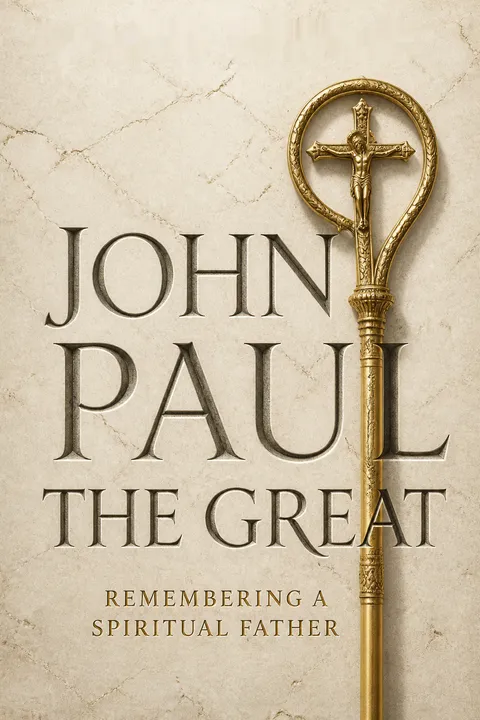
Suffering as a gift. The Pope's physical struggles, particularly his Parkinson's disease, were not hidden but openly displayed, prompting reflection on the fragility of all human life. He presented himself "broken and bent, as broken as the Christ on the cross he carried on his crozier," embodying a profound lesson: the beauty and purpose found even in the old, the infirm, and the imperfect. This public suffering became a "parting gift," encouraging tenderness towards life and contemplation of its ultimate meaning.
A victim soul. The author perceived John Paul II as a "victim soul," whose suffering held meaning and was offered to help others, echoing the tradition of Saint Therese of Lisieux. This perspective suggests a deep interconnectedness in human experience, where individual pain can contribute to a larger "circuitry of love." His public dying prompted a collective reflection on life and death, fostering a more tender appreciation for existence itself.
2. The Unforeseen Pope Who Changed the World
“God forced us to break with history to elect Karol Wojtyla.”
An unexpected election. In October 1978, after the brief papacy of John Paul I, the College of Cardinals made a historic choice, electing Karol Wojtyla, a Polish cardinal, as Pope John Paul II. This was a radical departure from centuries of Italian popes, and his election was met with initial confusion, then astonishment, as he hailed from the Communist bloc, a region thought to be antithetical to the papacy. His youth, athleticism, and intellectual prowess immediately set him apart.
Catalyst for freedom. John Paul II's visit to his homeland, Poland, in June 1979, proved to be a pivotal moment in modern history. Despite the Communist government's attempts to suppress enthusiasm, millions flocked to see him, chanting "We want God!" His sermons, particularly in Victory Square and Blonie Field, subtly but powerfully challenged the atheist regime by asserting Poland's Catholic identity and the inseparability of Christ from its history.
A wall falling. The Pope's message, though not a direct call to uprising, exposed the government's lies and galvanized the Polish people. Lech Walesa, leader of the Solidarity movement, noted that the Pope's visit transformed his "twenty who followed me" into "ten million." This spiritual awakening in Poland is widely credited with initiating the long fall of Soviet communism, demonstrating the profound impact of faith on political realities.
3. A Profound Interior Life: The Power of Prayer and Mysticism
“The pope prays as the Holy Spirit permits him to pray.”
Constant communion. John Paul II's life was characterized by an intense and continuous prayer life, often lasting many hours a day. His prayer was not merely a ritual but a deep, interior "conversation" and "contact" with God, where he would often lose himself completely, sometimes forgetting the presence of others. This profound immersion in prayer was a central pillar of his existence.
Geographical dimensions. His prayer extended beyond personal petitions, encompassing global concerns. His press aide observed him muttering Polish words during walks, realizing he was praying for countries afflicted by war, famine, or want, demonstrating a "geographical dimension" to his spiritual intercession. Each morning, before Mass, he would review overflowing lists of prayer requests from people worldwide, praying for their specific and concrete human circumstances.
Mystical depth. Beyond structured prayer, John Paul II's spiritual life had a mystical dimension, with aides reporting finding him prostrate on his chapel floor, arms outstretched like Christ on the cross. This deep connection to the divine, noted even by the Polish Communist government and the CIA, informed his understanding that "in the designs of Providence there are no mere coincidences," suggesting a hidden, purposeful order to events.
4. The Dignity of Man and the Sanctity of Work
Through work we take part in “the very action of the Creator of the universe.”
Imitating the Creator. John Paul II believed that man, created in the image of God, is called to imitate the Creator through work. His encyclical "Laborem Exercens" (On Human Work) presented a "gospel of work," asserting that labor is not merely an economic activity but a vocation, a participation in God's ongoing creation of the world. This perspective elevates work to a spiritual act, reflecting human dignity and fostering personal fulfillment.
Worker over capital. The Pope emphasized that the worker is always more important than capital, advocating for humane treatment and just conditions. He strongly supported unions as "movements of solidarity" that advance not only worker rights but also the "humanity" of the worker and their place in "the development of the Kingdom of God." This stance, particularly relevant during the rise of Solidarity in Poland, underscored his commitment to the human person over abstract economic models.
A moral edifice. Michael Novak, in "The Spirit of Democratic Capitalism," elaborated on the Pope's teachings, arguing that capitalism, while effective in alleviating poverty, requires an underlying moral framework. This framework includes:
- Appreciation for the human person
- Contribution to community and family
- A "sense of sin" and moral responsibility
Business, seen as a vocation, becomes a platform for ethical action, contributing to human joy and progress, and strengthening democracy.
5. Reclaiming the Body's Sacredness: A New Theology of Love
The sexual giving of oneself, he says, makes the world a better place; it is, in fact, a way to sanctify the world.
Unity of body and soul. John Paul II challenged the notion that the body is a "wicked thing" to be mastered by the soul, asserting instead their inseparable unity. He taught that the particular body and soul given to each person are meant for each other, forming a complete human being. This holistic view emphasizes that physical actions are deeply intertwined with one's will and spiritual essence.
Sexuality as worship. In his "Theology of the Body," the Pope spoke of human sexuality, particularly within marriage, as an act of profound self-giving and worship. He described it as a "language of the body" that provides a way of encountering the sacred and, ultimately, God. This perspective elevates marital sexual love beyond mere pleasure, seeing it as a deeply creative and sanctifying act that enriches the world.
Redeeming eros. John Paul II argued that the Christian sexual ethic, far from prohibiting desire, actually "liberates eros" for "full and mature spontaneity" in mutual self-giving. He traced the origins of shame to the "fear" of being treated as an object, rather than a person, and saw lust as shattering communion. His teachings aimed to redeem sexuality from superficiality and restore its profound significance, countering the "jading of everyday life" caused by its devaluation.
6. Unyielding Defense of Life: Confronting the Culture of Death
“Abortion and euthanasia are . . . crimes which no human law can claim to legitimize. There is no obligation in conscience to obey such laws; instead, there is a grave and clear obligation to oppose them by conscientious objection.”
Sanctity of life. John Paul II fiercely championed "the culture of life," warning against "the culture of death" that sees moral wrongs as human rights. He unequivocally condemned abortion and euthanasia as gravely immoral, asserting that no human law can legitimize the deliberate taking of innocent life. He believed that a society failing to uphold the inviolability of human life courts its own destruction.
Right to natural end. The Pope emphasized that all individuals, regardless of their vulnerability—whether unborn, ill, handicapped, or elderly—have an inherent right to life until their "natural end," which should be left to God. He argued that judging human beings as "useful" or "useless" leads down a dangerous path, coarsening conscience and potentially leading to atrocities like genocide.
Pro-woman stance. While uncompromising on the sanctity of life, John Paul II also expressed deep empathy for women facing difficult pregnancies. He recognized that women are often victims of male selfishness, left to bear the sole responsibility for a conceived child. He called for a "radical solidarity" with women, advocating for societal support that is "courageously 'pro woman'," promoting choices that truly favor women and their well-being.
7. Freedom, Conscience, and the Splendor of Truth
“We should not fear the truth about ourselves.”
God-given questions. John Paul II taught that the fundamental questions about life's meaning, purpose, and happiness are not merely products of human anxiety but originate from God, serving as a "preparation for God." These questions initiate a journey of freedom, making individuals aware of choices and setting the stage for morality.
Freedom in God's law. Contrary to modern secular philosophies that equate freedom with absolute personal autonomy, John Paul II argued that true human freedom finds its fulfillment in accepting God's law. This law, he asserted, does not restrict but rather protects and promotes freedom, guiding individuals toward what is good. He quoted Saint Augustine: "To the extent to which we serve God we are free, while to the extent that we follow . . . sin, we are still slaves."
Conscience as divine dialogue. The Pope defined conscience as "the sanctuary of man, where he is alone with God, whose voice echoes within him." He taught that conscience is not a supreme tribunal for independently determining good and evil, but a dialogue with God that summons individuals to love good and avoid evil. Losing sight of a universal truth about good leads to relativism and the illusion that being at peace with oneself is sufficient.
8. The Dark Night and the Human Struggle for Faith
“God seemed absent, heaven empty, and bitterest of all, her own suffering seemed to count for nothing, ‘. . . just that terrible pain of loss, of God not wanting me, of God not being God, of God not really existing.’ ”
Loss of consolation. John Paul II, deeply familiar with the writings of mystics like Saint John of the Cross and Saint Teresa of Avila, understood the spiritual phenomenon known as "the dark night of the soul." This is a period where even ardent believers, having committed their lives to God, experience a profound loss of spiritual consolation, certitude, and even the interior sense of God's existence.
Mother Teresa's example. The Pope, a close friend and supporter of Mother Teresa, knew that she experienced such a "spiritual darkness" for decades, despite her outward radiance of faith and love. This revelation, from her private writings, showed that her heroic work among the poorest of the poor was sustained not by ecstatic mystical union, but by an objective relationship with God, shorn of sensible awareness of His presence.
Heroism in desolation. Mother Teresa's enduring faith amidst profound spiritual desolation offered a powerful lesson: it is possible to persist in radiating love and service even when God "seemed absent." This heroic perseverance, without the comfort of internal joy or security, demonstrated that spiritual infirmities, like physical ones, can be transformed into a gift, allowing participation in Christ's suffering and a deeper encounter with Him in the suffering of others.
9. The American Church's Great Shame and Hope for Renewal
“The worst thing ever to happen in the history of the American church.”
A growing crisis. The sex abuse scandals that swept the Catholic Church in America during John Paul II's papacy represented a "great shame," growing in scope and number throughout his tenure. By 2003, thousands of priests had been accused of molesting minors, leading to numerous resignations, hundreds of lawsuits, and threatening the financial stability of archdioceses. This crisis, rooted in decades of cover-ups and reassignment of offenders, deeply demoralized the faithful.
Administrative shortcomings. While John Paul II was not a gifted administrator and prioritized evangelization over Curia control, his perceived failure to act decisively against the scandals is a painful part of his legacy. Some argue he was too old or ill, or not fully informed, but his background as a Polish hero who saw the priesthood as a noble institution may have blinded him to the depth of sexual decadence infecting parts of the American church.
Path to regeneration. Despite the profound damage, there is hope for renewal. A new generation of priests, entering the priesthood out of genuine belief and ardor amidst scandal, are committed to rectifying past wrongs. The author also suggests that American nuns, often unsung heroes, could play a crucial role in the church's regeneration, serving as "mothers of the church" and figures of respect, uncompromised by the hierarchy's failures.
10. The Miraculous Tapestry of Providence
“ [I] n the designs of Providence there are no mere coincidences.”
Fateful occurrences. John Paul II's life was marked by a series of seemingly miraculous and providential events, reinforcing his belief that "in the designs of Providence there are no mere coincidences." From his birth accompanied by singing prayers and Poland's miraculous victory against the Soviets, to his survival of an assassination attempt on the anniversary of Fatima, these occurrences suggested a divine hand guiding his path.
The guided bullet. On May 13, 1981, the day he was shot, John Paul II was convinced that the Blessed Mother had literally "guided the bullet" away from his main abdominal artery, saving his life. He later placed the recovered bullet in the crown of the statue of the Virgin Mary at Fatima, a powerful symbol of his conviction in supernatural intervention.
Prophecies and signs. His life was intertwined with prophecies, such as Juliusz Slowacki's 19th-century poem foretelling a "Slavic Pope" and Padre Pio's alleged prediction of his papacy. Even his death was surrounded by mystical suggestions: a partial solar eclipse on both his birth and burial dates, and his passing on the vigil of the Feast of St. Faustina, who prophesied a "spark out of Poland" to prepare the world for Christ's coming.
11. A Legacy of Love and a Call to Courage
“Silence in the presence of the enemies of a cause encourages them. Fear in an apostle is the principal ally of the enemies of the cause.”
Evangelist to the world. John Paul II was an unparalleled evangelist, traveling to over 120 countries, kissing the ground upon arrival, and bringing the message of Christ to billions. His focus on the young and his unwavering commitment to church teachings, even when unpopular, earned him immense love and admiration, as evidenced by the "Santo Subito" chants at his funeral.
Courage in truth. He consistently urged humanity, "Be not afraid," particularly to confront the truth about oneself and to not fear God. He believed that fear, especially the fear of truth, is the "principal ally of the enemies of the cause." His life demonstrated a strategic courage to speak truth, even at the cost of personal popularity or reputation, knowing that people, deep down, recognize and respond to such conviction.
An enduring impact. John Paul II's death was a global phenomenon, with millions flocking to Rome and billions watching worldwide. His funeral, a "greatest evangelical event," transcended religious boundaries, prompting a collective pause and reflection. His legacy is one of profound spiritual fatherhood, a testament to a life well-lived, inspiring countless individuals to embrace faith, courage, and a deeper understanding of human dignity and divine love.
Review Summary
John Paul the Great receives mixed reviews (3.99/5 stars). Many praise Noonan's engaging writing and insight into the Pope's influence, though critics note the book focuses heavily on Noonan's personal spiritual journey rather than being a traditional biography. Positive reviews appreciate the blend of JPII's life story with personal reflection, while negative reviews find this approach disappointing and unfocused. Most reviewers commend Noonan's honest discussion of Church failures, particularly regarding sex abuse scandals. The audiobook version, narrated by Noonan, is particularly recommended for its conversational tone.
People Also Read





About the Author
Other books by Peggy Noonan
Download PDF
Download EPUB
.epub digital book format is ideal for reading ebooks on phones, tablets, and e-readers.








































