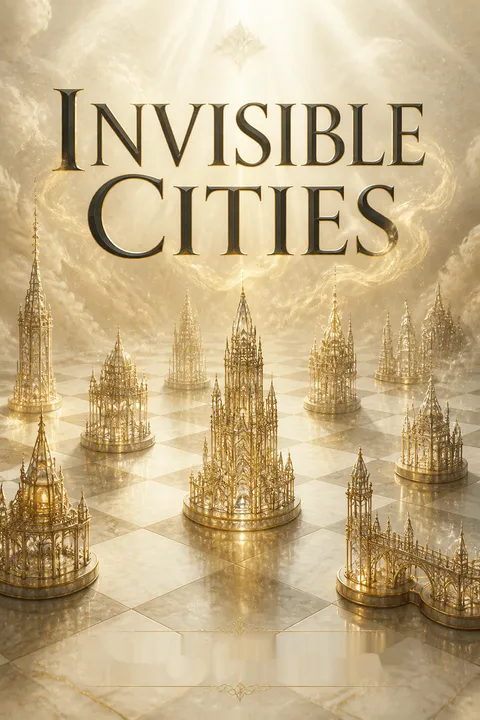

Plot Summary
The Emperor's Restless Mind
The aging emperor Kublai Khan, ruler of a vast and crumbling empire, is haunted by the impossibility of knowing and understanding all he has conquered. Amidst the melancholy of power, he turns to Marco Polo, a Venetian traveler, whose tales of distant cities offer glimpses of order and beauty amid decay. Polo's stories become a lifeline for the emperor, a way to discern subtle patterns and meanings that transcend the physical ruins of his domain. Their conversations, sometimes wordless, sometimes poetic, are less about factual reports and more about the search for meaning, connection, and the elusive essence of cities—real or imagined. Through Polo, Khan hopes to find a thread that binds his empire together, even as he senses its inevitable dissolution.
Cities as Memories
Marco Polo describes cities not as mere collections of buildings, but as repositories of memory. Each city—Diomira, Isidora, Zaira—embodies the interplay between past and present, desire and regret. The city's physical form is inseparable from the events, emotions, and histories that have unfolded within it. For Polo, to visit a city is to encounter versions of himself he might have been, paths not taken, and futures lost. The city becomes a palimpsest, layered with stories, nostalgia, and the ache of what is no longer or never was. Memory is both a burden and a guide, shaping how cities are seen, remembered, and ultimately, how they are lost to time.
Desires in Stone and Water
Cities are born from longing—sometimes fulfilled, often frustrated. In places like Dorothea, Anastasia, and Zobeide, desire is both the architect and the jailer. The city promises pleasure, connection, and fulfillment, but also traps its inhabitants in cycles of yearning and disappointment. The pursuit of happiness, love, or meaning leaves its mark on the city's streets and structures, yet the object of desire always slips away, replaced by routine or regret. The city is a stage for dreams and their inevitable fading, a place where the chase is eternal and the fulfillment always just out of reach.
Signs, Symbols, and Meaning
In Tamara, Zirma, and Hypatia, the city is a language of signs—shop signs, statues, rituals, and gestures. Meaning is layered and elusive; every object points to something else, and the city's true nature is hidden beneath its surface. Travelers and inhabitants alike are caught in a web of interpretations, never certain if they have grasped the city's essence or merely its outward symbols. The city is a text to be read, but its meaning shifts with each reader, each glance, each memory. The act of naming, describing, and interpreting becomes as important as the city itself.
The City as Mirror
Some cities, like Valdrada, are built as mirrors—literal or metaphorical—of themselves. Every action, every gesture, is doubled, reflected, and inverted. The city's inhabitants live with the awareness of being watched, of their lives mirrored in water, glass, or memory. This reflection can elevate or diminish, clarify or confuse. The city becomes a meditation on identity, perception, and the impossibility of perfect symmetry. In the mirrored city, reality and illusion are inseparable, and every attempt to fix meaning is met with its opposite.
The Weight of Empire
Kublai Khan's empire, once a source of pride, becomes a burden—overgrown, overcomplicated, and suffocating. The abundance of cities, goods, and people threatens to crush the very order the emperor sought to impose. In his dreams, Khan imagines cities of lightness, transparency, and endless growth, but reality is a chain of refuse, repetition, and decay. The city's growth is both physical and existential, and the emperor's longing for renewal is shadowed by the inevitability of decline. The empire's true weight is not in its treasures, but in the accumulation of its own past.
Dreams, Models, and Doubt
Both Khan and Polo construct model cities in their minds—one as a norm from which all others deviate, the other as a collection of exceptions and contradictions. Cities are dreams made visible, shaped by desires and fears, yet always slipping beyond the grasp of logic or control. The act of describing a city is itself an act of creation, and every description is haunted by what is left unsaid, what is lost in translation. The city is both a question and an answer, a riddle that reveals as much about the dreamer as about the dreamed.
The Chessboard of Cities
The relationship between Khan and Polo evolves into a silent game, played with objects, gestures, and eventually chess pieces. Each city is a move, a configuration, a possibility on the board. The rules are never fully known, and the meaning of each piece shifts with context and perspective. The game becomes a metaphor for the empire itself—ordered yet unpredictable, governed by patterns yet open to endless variation. In the end, the game's purpose is elusive, and the ultimate prize may be nothingness itself.
Names, Maps, and Loss
The act of naming and mapping cities is an attempt to fix their identity, but every name is provisional, every map incomplete. Cities like Aglaura, Pyrrha, and Irene exist as much in imagination as in reality, and the experience of a city changes with distance, memory, and perspective. The atlas preserves differences, but travel erases them; the city seen from afar is not the city lived in. The loss of the first city—Venice, perhaps—haunts every description, and the act of speaking of other cities is always, secretly, an act of mourning.
The Dead, the Living, the Unborn
Cities like Melania, Adelma, Eusapia, and Laudomia are haunted by the dead and the unborn. The living city is doubled by its cemetery, its past inhabitants, and its future generations. Roles and identities are passed down, repeated, and transformed. The city is a theater of memory, a dialogue between what was, what is, and what might be. The boundaries between life and death, past and future, are porous, and every city contains within it the seeds of its own disappearance and renewal.
The Sky's Blueprint
Some cities, like Eudoxia, Perinthia, and Andria, are built according to celestial patterns, their streets and buildings aligned with stars and constellations. The city becomes a reflection of cosmic order—or disorder. The attempt to impose harmony and meaning through architecture and astrology is always undermined by chaos, mutation, and the unpredictability of life. The city's blueprint is written in the sky, but its reality is shaped by chance, error, and the stubbornness of matter.
The City That Grows
Cities like Olinda and Leonia are in constant flux, growing in concentric circles or renewing themselves daily. The city is a living thing, expanding, shedding, and transforming. Yet growth brings its own dangers—accumulation of waste, loss of identity, and the threat of being buried by one's own past. The city's vitality is inseparable from its vulnerability, and every act of renewal is shadowed by the possibility of collapse.
The Hidden and the Just
Cities like Berenice and Theodora contain within them both the just and the unjust, the visible and the hidden. The struggle for justice is never-ending, and every victory contains the seeds of future injustice. The city is a battleground of competing desires, values, and histories, and its true nature is always double, always in flux. The hope for a more just city is tempered by the knowledge that every ideal contains its own corruption.
The Infinite Outskirts
Cities like Penthesilea and Cecilia defy the notion of clear borders or centers. The city dissolves into its outskirts, its identity scattered across endless suburbs and liminal spaces. The search for the city's heart becomes a journey through ambiguity, repetition, and uncertainty. The city is everywhere and nowhere, and the question of what lies outside is met with silence or more city. The infinite outskirts are both a promise and a threat—a space of possibility and of loss.
The Atlas of Possibility
The Great Khan's atlas contains all cities—real, imagined, past, future, and possible. The act of mapping becomes an act of creation, and every city is a fragment of a larger, endless story. The atlas preserves difference, but also reveals the tendency of all cities to blur into one another. The catalogue of forms is infinite, and as long as new shapes can be imagined, new cities will be born. The end of cities comes only when imagination is exhausted.
The Inferno and the Escape
In the end, Polo and Khan confront the possibility that all cities are infernal, that the world is a web of suffering, repetition, and loss. Yet Polo insists that even within the inferno, there are moments, people, and places that are not inferno—fleeting glimpses of beauty, connection, and meaning. The task is to recognize and nurture these moments, to give them space and let them endure. The city, like life, is a mixture of suffering and hope, and the possibility of escape lies not in denial, but in vigilance, attention, and the search for what is truly human.
Analysis
A meditation on the limits of knowledge, language, and desireInvisible Cities is less a novel than a philosophical tapestry, weaving together stories, images, and dialogues to explore the nature of human experience. Through the interplay of Marco Polo and Kublai Khan, Calvino interrogates the ways we construct meaning—through memory, desire, language, and imagination—and the inevitable failure of these constructions to capture the fullness of reality. The cities are metaphors for the self, for society, for the act of storytelling itself. The book's structure—fragmented, recursive, and open-ended—mirrors the endless proliferation of possibilities and the impossibility of final answers. In a modern context, Invisible Cities speaks to the anxieties of globalization, the loss of identity, and the search for meaning in a world of endless variation and repetition. Its ultimate lesson is one of vigilance and hope: even in the midst of the inferno, it is possible to recognize and nurture what is not inferno, to find moments of beauty, connection, and meaning amid chaos and loss.
Review Summary
Reviews of Invisible Cities are largely positive, with many readers praising Calvino's lyrical, dreamlike prose and imaginative depictions of fictional cities described by Marco Polo to Kublai Khan. Admirers celebrate its philosophical depth, poetic beauty, and unique structure, often calling it a masterpiece of speculative fiction. Critics, however, find it repetitive, overly abstract, or difficult to engage with, noting its lack of conventional plot. Common themes in reviews include memory, desire, identity, and the nature of cities as reflections of human imagination.
People Also Read
Characters
Marco Polo
Marco Polo is the Venetian traveler whose tales form the heart of the narrative. He is both observer and creator, describing cities that are as much products of his imagination and memory as of direct experience. His relationship with Kublai Khan is one of mutual fascination and subtle rivalry; he offers the emperor not facts, but possibilities, riddles, and reflections. Psychologically, Marco is haunted by nostalgia, regret, and the search for meaning in a world of endless variation and loss. His stories are attempts to fix fleeting moments, to understand himself through the cities he describes, and to bridge the gap between self and other, past and present.
Kublai Khan
Kublai Khan is the ruler of a vast, decaying empire, tormented by the impossibility of knowing and controlling all he possesses. His dialogues with Marco Polo are driven by a longing for meaning, pattern, and reassurance. He oscillates between melancholy and euphoria, between the desire for renewal and the fear of collapse. Psychologically, Khan is both powerful and powerless, trapped by the weight of his own conquests and the limits of language, memory, and imagination. His relationship with Polo is both paternal and adversarial, as he seeks in the traveler's tales a way to redeem or at least understand his empire.
The Cities
Each city described by Marco Polo is a character in its own right—embodying a particular aspect of human experience: memory, desire, signs, death, justice, growth, and decay. Cities like Zaira, Zobeide, Valdrada, and Berenice are not just places, but psychological states, metaphors, and mirrors of the self. They interact with the travelers and inhabitants, shaping and being shaped by their dreams, regrets, and longings. The cities are mutable, layered, and elusive, resisting any single interpretation or definition.
The Dead
The dead populate cities like Adelma, Eusapia, and Laudomia, haunting the living with memories, regrets, and unresolved histories. They represent the weight of the past, the inevitability of loss, and the persistence of memory. Psychologically, the dead are both a source of comfort and anxiety, offering explanations and warnings, but also threatening to overwhelm the present with their demands and expectations.
The Unborn
In cities like Laudomia, the unborn represent the future—the unknown, the hoped-for, the feared. They are projections of desire, anxiety, and the longing for continuity. The living seek reassurance or warning from the unborn, but find only ambiguity and the limits of foresight. The unborn are a reminder that every city, every life, is part of a larger cycle of birth, death, and renewal.
The Just and the Unjust
Cities like Berenice and Theodora are divided between the just and the unjust, the visible and the hidden. These characters represent the eternal struggle between ideals and realities, between the desire for justice and the temptations of power, resentment, and revenge. Psychologically, the just and unjust are intertwined, each containing the seeds of the other, and the city becomes a battleground for their competing claims.
The Sibyls, Oracles, and Philosophers
Throughout the narrative, sibyls, oracles, and philosophers appear as guides, questioners, and interpreters. They offer insights, warnings, and riddles, challenging the travelers and inhabitants to look beyond appearances and question their assumptions. Psychologically, they represent the voice of conscience, doubt, and the search for deeper meaning.
The Inhabitants
The inhabitants of the cities—merchants, lovers, workers, the old and the young—are both individuals and archetypes. Their lives, desires, and routines give substance to the cities, but they are also shaped by the city's form, history, and destiny. Psychologically, they embody the tension between individuality and anonymity, freedom and constraint, hope and resignation.
The Atlas
The Great Khan's atlas is more than a book of maps; it is a living, evolving character, embodying the desire to know, categorize, and possess the world. It represents both the power and the futility of knowledge, the tension between order and chaos, and the endless proliferation of possibilities. Psychologically, the atlas is a mirror of the mind—expansive, restless, and always incomplete.
The Game
The chessboard, and the game played between Khan and Polo, is a character in its own right—a symbol of strategy, chance, and the search for meaning. The game is both ordered and unpredictable, a space where possibilities are enacted and erased. Psychologically, it represents the struggle to impose meaning on chaos, the allure of rules and patterns, and the ultimate elusiveness of victory or understanding.
Plot Devices
Framing Dialogue
The entire book is structured as a series of dialogues—spoken and unspoken—between Kublai Khan and Marco Polo. This framing device allows for a fluid, dreamlike movement between stories, reflections, and philosophical debates. The dialogue is recursive, often blurring the line between speaker and listener, reality and imagination. It creates a space where meaning is negotiated, questioned, and always provisional.
Imaginary Cities as Metaphor
Each city described is less a physical place than a metaphor for aspects of human experience—memory, desire, language, death, justice, and more. The cities are plot devices that allow the narrative to explore complex ideas in concrete, evocative images. They serve as mirrors, riddles, and provocations, inviting the reader to question the nature of reality, identity, and meaning.
Repetition and Variation
The book employs repetition—of themes, structures, and motifs—to create a sense of both familiarity and strangeness. Each city is both unique and a variation on a theme, and the act of describing, naming, and mapping becomes an endless, generative process. This device underscores the book's central concern with the limits of knowledge and the endless proliferation of possibilities.
Metafiction and Self-Reference
The narrative is constantly aware of itself as a story, questioning the act of description, the reliability of memory, and the power of language. The characters discuss the nature of their own dialogue, the meaning of their stories, and the impossibility of ever fully capturing reality. This self-referentiality creates a sense of play, irony, and philosophical depth.
Symbolic Objects and Games
Objects—chess pieces, maps, postcards, globes—are used as symbols and tools for understanding the cities and the empire. The chess game between Khan and Polo becomes a metaphor for the structure of the book itself, with each city as a move, a possibility, a configuration. These devices highlight the tension between order and chaos, rule and chance, meaning and emptiness.
About the Author
Other books by Italo Calvino
Download PDF
Download EPUB
.epub digital book format is ideal for reading ebooks on phones, tablets, and e-readers.








































