

Key Takeaways
Chase fullness of life directly, and performance follows as the byproduct
Jim Murphy's central claim, drawn from five years of research and his own washed-out career in the Chicago Cubs organization, is that peak performance and a deeply contented life are the same path, not competing ones. He calls this the wrong-game problem: most of us treat life as a finite, zero-sum contest with winners and losers, chasing trophies we believe will make us feel alive.
The inversion is the engine of the book. Pursue inner strength, joy, and peace first (heart first, performance second), and extraordinary results arrive as a side effect. Water-ski jumper Ryan Dodd, who woke in an alley with a fractured skull, returned to win 87% of his tournaments and three straight world titles after changing not his training volume but his way of seeing.
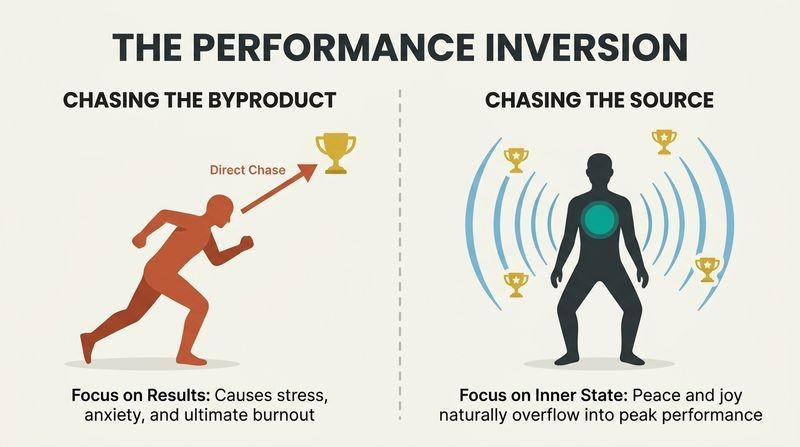
This echoes Viktor Frankl's insistence that success, like happiness, cannot be pursued but must ensue as the unintended consequence of devotion to something larger. It also rhymes with self-determination theory in psychology, which finds intrinsic motivation produces more durable performance than extrinsic rewards. The harder question Murphy leaves open: is the inversion always true, or survivorship bias? Plenty of ruthless, ego-driven competitors also win. Murphy concedes fear can motivate, but argues it caps sustainable excellence and joy. The claim is best read as a probabilistic edge, not a guarantee.
Self-centeredness, not weak nerves, is the true root of fear
Murphy reframes fear as a symptom whose disease is self-preoccupation. Because you have only ever seen the world through your own eyes, filtered through past failures, your default setting is to make yourself the center of the universe (a point he borrows from David Foster Wallace). When you stand at the free-throw line thinking I have to make this, the dread is not just about missing but about being the one who missed.
This preoccupation produces a chain:
1. Self-centeredness narrows vision
2. Narrow vision breeds self-consciousness
3. Self-consciousness amplifies the ego
4. The amplified ego becomes pride and fear
The cure is not confidence but selflessness. Attach your identity to outcomes you cannot control, and neediness plus fear become constant companions.
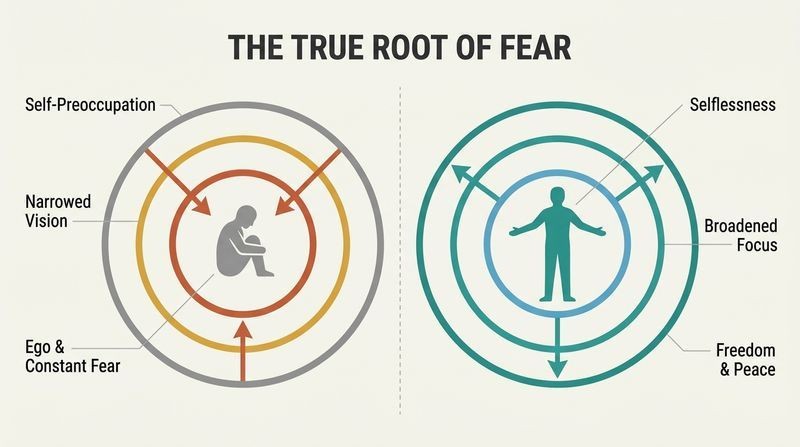
Murphy is careful to say this is not a moral indictment but a structural one: self-focus literally shrinks the aperture through which possibilities become visible. This dovetails with research on attentional narrowing under threat and with Buddhist accounts of suffering as attachment. A useful nuance: some self-focus is adaptive, and clinically, excessive self-blame can tip into shame spirals rather than performance gains. Murphy's framing is strongest as a lens on competitive anxiety, where the evidence that outcome-attachment degrades execution is robust, from the basketball court to the operating room.
Name your three inner saboteurs: the Critic, Monkey Mind, and Trickster
Murphy personifies the mental obstacles to focus as three adversaries. The Critic delivers negative verdicts on circumstances and people, then reacts emotionally; it gains power when you are attached to goals you cannot control. The Monkey Mind floods you with too many thoughts, producing overanalysis and anxiety, and thrives when your heart lacks a single unifying focus. The Trickster lies, deceiving and accusing you into believing your limitations and settling for lesser goals.
His practical wedge is separating circumstance from thought. A circumstance is the fact, free of opinion. A thought carries judgment and emotion. During a pandemic, the circumstance is that life is different and some people die; the spiraling story (everything is hopeless) is the thought. Sort the two, and only then seek solutions.
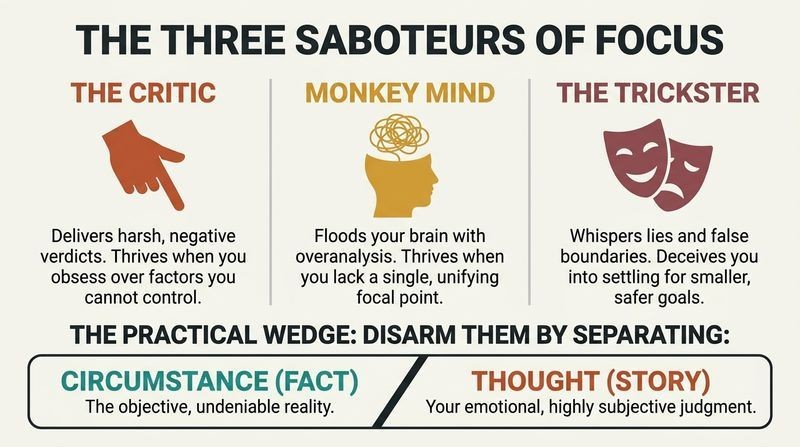
Externalizing inner voices is a recognized therapeutic move, from Internal Family Systems to narrative therapy's practice of naming the problem as separate from the self. Giving anxiety a character creates the observer distance that cognitive defusion (in Acceptance and Commitment Therapy) aims for: you stop fusing with the thought and start watching it. The circumstance-versus-thought split is essentially Stoic (Epictetus: people are disturbed not by events but by their judgments of events) and the cognitive core of CBT. Murphy's contribution is memorability, not novelty, and for performers under pressure, a vivid label beats a clinical concept.
Build your training on love, wisdom, and courage, not talent
The book's positive framework reduces to three resources that become three pillars of performance. Love means leading with your heart and produces freedom. Wisdom means expanding your vision and produces belief. Courage means being fully present and produces focus (Murphy's BFF: belief, focus, freedom). Together they create resonance, a state of effortless, fully engaged excitement where outcomes take care of themselves.
The illustration is Lewis Pugh, who swam a kilometer at the geographic North Pole in water scientists said would kill most people in a minute. Two days before, failed trial swims left him terrified, his hand cells literally bursting. What changed was not his body but his connection to a purpose beyond himself (fighting global warming) and to his 29-person team, whose national flags his coach planted every hundred meters to break the swim into manageable chunks.
The triad maps loosely onto classical virtue traditions and onto modern flow research. Mihaly Csikszentmihalyi found that peak performers tend to have a strongly directed purpose that is not self-seeking, which supports Murphy's claim that a cause beyond the self unlocks fearlessness. Pugh's flag strategy is a textbook case of proximal sub-goals, shown in goal-setting research to sustain effort better than a single distant target. One caution: resonance resembles flow, but Murphy attaches it more tightly to selflessness than the flow literature requires. Flow can occur in purely self-interested pursuits too.
Inoculate yourself against affluenza: possessions, achievements, looks, money, status
Murphy coins affluenza as the cultural virus that fixes your identity on five symbols, abbreviated PALMS: possessions, achievements, looks, money, and status. The danger is not these things themselves but anchoring your worth to them, because they are transient and comparison-driven. As C.S. Lewis noted, pride takes no pleasure in having something, only in having more of it than the next person.
To diagnose your own infection, Murphy offers three questions:
1. What do I dream about?
2. What do I worry about?
3. What do I get upset about?
The answers reveal what your heart is actually built around, and your stability will never exceed the stability of that thing. Former NFL star Joe Ehrmann found his ladder of success was leaning against the wrong building.
The diagnostic questions are genuinely useful because they bypass our self-flattering stories and read our revealed priorities, much as a budget or a calendar exposes real values better than stated ones. Murphy's claim that comparison poisons satisfaction is well supported: hedonic adaptation research shows material gains deliver only temporary mood boosts, and studies of social comparison link it to lower well-being. The David Foster Wallace insight that everybody worships something, the only choice being what, sharpens the point. The weakness is binary framing; ambition and groundedness can coexist, and Murphy himself insists you can pursue the gold medal, just not as your highest good.
Master the ego by becoming unembarrassable, unoffendable, and unirritatable
Murphy operationalizes self-mastery as mastering the ego's three demands: to look graceful (not embarrassed), to be respected (not offended), and to be comfortable (not irritated). The aim is to become unembarrassable (no mistake can shrink your sense of worth), unoffendable (no words can steal your peace), and unirritatable (no circumstance can hijack your presence).
He grounds this in the samurai code of Bushido, built on love, wisdom, and courage, in which warriors trained by imagining they were already dead. Humility is the lever: not thinking less of yourself, but thinking of yourself less. When there is no inflated ego to wound, embarrassment and offense lose their grip, freeing you to take risks and recover fast from failure.
These three negations are a practical reframing of emotional regulation as identity work rather than suppression. The insight that humiliation is a mental construct (two people, same event, one traumatized, one laughing) aligns with appraisal theory in emotion science: the stimulus is neutral until interpreted. Stoicism offers the closest parallel, Marcus Aurelius writing that to be unharmed you need only decide you are not harmed. The risk worth flagging: unoffendable can curdle into doormat passivity. Murphy preempts this by insisting you still use wisdom to discern action against genuine mistreatment; the goal is non-reactivity, not non-response.
Your feelings flow from thoughts, so engineer your environment and attention
Murphy's emotional-control model runs in a chain: results come from behaviors, behaviors from feelings, feelings from thoughts, and thoughts from where you place attention. Since the brain cannot distinguish vividly imagined events from real ones (imagine biting a lemon and you salivate), what you repeatedly picture becomes your felt reality.
Two levers follow. First, organize your environment, because priming is real: a 2008 Yale study found people who briefly held a hot cup of coffee judged a stranger as warmer and more generous than those who held iced coffee, all without awareness. Second, get centered through breath. His basic Reboot: fix your eyes on a spot above the horizon, inhale slowly through the nose for about four counts, exhale longer (about six) while relaxing the jaw, releasing all desires and concerns.
The cognitive chain is essentially the CBT model, and the centering practice exploits the vagus nerve: extended exhalation activates the parasympathetic system and measurably lowers heart rate, which is why longer-out-than-in breathing is a staple of clinical anxiety treatment. The priming claim deserves a caveat: the warm-coffee study is a famous casualty of psychology's replication crisis and has failed several replications. The underlying principle that environment shapes behavior beneath awareness remains well supported by broader research, so Murphy's prescription survives even if his marquee citation is shaky.
Speak failures in past tense so your subconscious stops rehearsing them
Beliefs, Murphy argues, are the thermostat of life: your subconscious works to keep your results inside the range you believe is right for you (homeostasis). Beliefs form from repeated thoughts and feelings, especially feelings, and then attract experiences that confirm them.
His sharpest tactical tool is language about the past. Say I'm struggling with my putting and the subconscious searches memory for proof, drags those failures into the present, and perpetuates them. Say instead, In the past I struggled, but I'm getting better every day, and you deny it that fuel. The principle: speak the truth about the past as past tense to open possibilities in the future. Softball player Callista Balko, who struck out all nine times against an ace, visualized the exact game-winning hit for months and delivered it in the championship.
The mechanism Murphy invokes is overstated (the subconscious is not a literal genie cataloging your sentences), but the underlying practice tracks real findings. Self-talk research shows that how athletes phrase setbacks predicts persistence, and Carol Dweck's growth-mindset work demonstrates that framing struggle as in-progress rather than fixed changes effort and outcomes. The past-tense reframe is a concrete linguistic habit that operationalizes this. The visualization claim is also evidence-backed: mental rehearsal activates overlapping neural and muscular pathways with physical practice, though it complements rather than replaces training, a nuance Murphy honors by pairing Balko's imagery with her weight-room work.
Mental blocks and phobias are a flawless brain overprotecting you
Murphy reframes the yips not as a defect but as the subconscious doing its protection job too well. After an emotionally painful event, the subconscious locks in the context to warn you next time via anxiety or fear. Dodgers second baseman Steve Sax suddenly could not make the routine throw to first (though he did it blindfolded in an empty stadium); pitcher Rick Ankiel unraveled with wild pitches in the playoffs and never recovered on the mound.
The fix is reprogramming, not willpower:
1. Strip the emotion by watching the memory as a sped-up black-and-white film from a projection booth
2. Find the smallest change that would have helped
3. Insert a high-energy positive feeling plus that change
4. Re-experience it first-person until a new association is anchored
The reframe alone is therapeutic: telling a sufferer their brain is working perfectly removes the shame that compounds performance anxiety. The techniques echo established exposure and memory-reconsolidation methods; the dissociative movie-theater exercise resembles a core NLP and trauma-processing tool, and watching a memory from a distanced third-person vantage demonstrably reduces its emotional charge in lab studies. The strong claim that phobias can be cured permanently in a single session is where evidence gets thin. NLP's clinical track record is contested, and serious trauma typically needs more than reframing. Murphy responsibly flags that abuse may require deeper work and intervention.
Treat your opponent as your dance partner, not your enemy
For poise under pressure, Murphy offers four keys to resonance: share your heart not your ego, pursue mastery not the score, love your opponent, and visualize presence not perfection. The counterintuitive one is loving your opponent. The word compete comes from the Latin competere, to seek together. You need a rival better than you to reach your potential, so wishing them mistakes generates negative energy and pulls your mind into the uncontrollable future.
One of Murphy's clients, ranked outside the top, kept losing to the world number one until he shifted to gratitude and respect for that rival as the necessary partner in his growth; he became world champion. The image is two best friends racing to the bottom of a perfect ski run, then someone storming off because the photo finish showed they lost by inches. Absurd, when the run itself was the gift.
This reframes competition through a cooperative lens that game theory and skill-acquisition research both support: strong opposition is the input that drives improvement, which is why training partners and rivalries (Borg and McEnroe, Coe and Ovett) elevate everyone involved. Loving the opponent also serves a focus function, keeping attention on the controllable present rather than the scoreboard. The honest limit: history is full of champions fueled by spite and the desire to crush rivals. Murphy does not deny their success; he argues hatred is a costlier, less repeatable fuel that sacrifices joy and freedom. That is a values claim as much as an efficacy one.
Embrace suffering as the only doorway to your true potential
Murphy insists growth is impossible without discomfort, and that Western culture's worship of comfort and happiness (the Great Pursuit, which he calls the Great Mistake) actually shrinks our joy. He distinguishes happiness (a temporary feeling tied to good circumstances) from joy (a deep well-being independent of circumstances). Much of suffering, he notes, is the secondary belief that we should not be suffering, which doubles the pain.
Viktor Frankl observed that concentration-camp survivors were often not the physically strongest but those with meaning that could not be taken from them. In Wim Hof cold-exposure training in Norway, Murphy faced a lifelong fear of cold by hiking shirtless in sub-zero temperatures using mantras (my body is a sauna), learning that the cold was largely a story his mind told. You are far more powerful than you think.
The happiness-versus-joy distinction maps onto the psychological split between hedonic and eudaimonic well-being, with research suggesting meaning-based well-being is more durable than pleasure-based mood. Frankl's logotherapy is the intellectual backbone here, and his point that the last human freedom is choosing one's response anchors the chapter. The insight that resisting pain amplifies it is precisely the premise of Acceptance and Commitment Therapy, where struggling against discomfort (experiential avoidance) is identified as the real source of suffering. The caveat Murphy includes matters: he distinguishes the productive pain of discipline from the pain of abuse, which calls for intervention, not embrace.
Great leaders redefine success and connect people to a cause beyond themselves
Murphy's leadership model has three moves: redefine success, connect individuals to a vision beyond themselves, and pursue self-mastery while helping others do the same. John Wooden, who won ten national titles, neither scouted opponents nor recruited, focusing entirely on developing his own people. Phil Jackson took a roster of egos and won six titles by teaching selflessness and compassion.
Two practical notes stand out. First, beat yourself, not the competition: Jim Collins found visionary companies focus primarily on outdoing themselves. Second, watch your language, because the brain ignores the word don't and pictures whatever follows it. A coach who says don't fumble plants the image of fumbling; say hold onto the ball instead. Yelling at one player, as manager Davey Johnson noted, is really yelling at the whole team.
The redefinition of success as effort and growth rather than outcome echoes Wooden's actual philosophy and aligns with mastery-goal research, which finds that orienting teams toward improvement rather than beating others raises both performance and intrinsic motivation. The don't-instructional point has real grounding: ironic process theory (Daniel Wegner's white-bear studies) shows that trying to suppress a thought makes it more accessible, and motor-learning research confirms that external, positive cues outperform negative ones. The UCLA 7-38-55 communication statistic Murphy cites is widely misapplied; Mehrabian's original study was narrow, about feelings and attitudes, not all communication. The leadership principles stand regardless.
Analysis
Inner Excellence is a thesis-driven performance-psychology book dressed in the robes of spiritual philosophy. Murphy, a former Cubs minor-leaguer turned coach to PGA Tour golfers and Olympians, advances one counterintuitive claim relentlessly: the path to elite performance and the path to a deeply meaningful life are identical, and both run through the surrender of self-centeredness. The structure moves from diagnosis (affluenza, the ego, the three inner adversaries) to cure (love, wisdom, courage) to mechanics (controlling state, beliefs, presence, mental blocks, poise, leadership).
The book's intellectual lineage is eclectic and largely unhidden: Maslow's self-actualization (rebranded selfless-actualization), Frankl's logotherapy, Stoicism via C.S. Lewis and Marcus Aurelius, CBT's cognitive chain, NLP's reprogramming techniques, and Christian theology. This synthesis is the book's strength and its vulnerability. Strength, because Murphy translates abstract wisdom into concrete tools (centering breaths, the GPS routine, past-tense reframing, the movie-theater visualization) that a nervous performer can actually use at the moment of pressure. Vulnerability, because the explanatory mechanisms are sometimes folk-scientific. The subconscious is anthropomorphized as a literal protector cataloging your sentences, and several flagship citations (the warm-coffee priming study, the 7-38-55 rule) are exactly the claims that have weakened under scrutiny.
What survives the scrutiny is the experiential core, which is well-corroborated by adjacent fields: outcome-attachment degrades execution, meaning buffers suffering, extended exhalation calms physiology, externalizing intrusive thoughts creates useful distance, and mastery goals beat ego goals. The most original move is collapsing the usual performance-versus-fulfillment tradeoff. Where most sports psychology optimizes results, Murphy subordinates results to character, arguing the subordination paradoxically improves results.
The honest limitation is generalizability. Murphy's evidence is testimonial (his clients, famous athletes) rather than controlled, and survivorship bias looms; we never hear about selfless competitors who lost. The book is best read not as proven science but as a coherent, usable philosophy of pressure, strongest for ambitious people whose fear of failure has quietly become the ceiling on both their performance and their peace.
Review Summary
Inner Excellence receives mostly positive reviews, with an average rating of 4.37/5. Readers appreciate its practical exercises, actionable advice, and well-researched content. The book focuses on achieving inner excellence for extraordinary performance and a fulfilling life. Some find it particularly helpful for athletes and coaches. A few criticisms include a lengthy introduction and occasional cheesiness. The book's popularity increased after NFL player AJ Brown was seen reading it during a game.
Glossary
Inner Excellence
Heart-first system for performanceMurphy's name for his training system and philosophy holding that extraordinary performance and a fulfilling life are the same path, achieved by developing your inner world (love, wisdom, courage) before chasing outer results. The premise: heart first, performance second; results follow as byproducts of a transformed inner life.
affluenza
Identity-based virus of consumerismMurphy's term for the cultural sickness of building your identity and worth on transient external symbols, abbreviated PALMS: possessions, achievements, looks, money, and status. Its defining symptom is the endless craving for more than others, producing chronic insecurity because self-worth rests on things that are unstable and comparison-driven.
selfless-actualization
Maslow's peak, reframed as selflessMurphy's relabeling of Maslow's self-actualization. He argues the people Maslow studied reached their potential precisely by looking beyond self, serving a purpose larger than themselves. Selfless-actualization is being your true self while serving others and living with fullness of life, marked by gratitude, presence, authenticity, and a lack of ego defenses.
the Critic, Monkey Mind, and Trickster
Three inner performance adversariesMurphy's three personified mental obstacles. The Critic delivers negative verdicts on circumstances and reacts emotionally. The Monkey Mind floods you with too many unproductive thoughts, causing overanalysis. The Trickster lies, deceiving and accusing you into believing your limitations and settling for lesser goals.
resonance
Effortless fully-present flow stateMurphy's term (borrowed from physics, where aligned frequencies amplify) for the state of being fully engaged in the present moment with a clear mind and unburdened heart. In resonance, performance feels effortless and outcomes take care of themselves. It arises from leading with the heart, expanding vision, and being fully present.
BFF (Belief, Focus, Freedom)
Three pillars of high performanceMurphy's memory device for the three vital elements of performance produced by love, wisdom, and courage. Belief is conviction about who you are and what is possible; Focus is heightened present-moment awareness; Freedom is the boldness to take risks and play unselfconsciously, like a child.
zoe
Absolute fullness of lifeA Greek word Murphy adopts to name the highest goal: a state of vitality, vigor, and genuine, abundant life. It is the culmination of love, wisdom, and courage experienced together in wholehearted, sacred moments, and the deepest thing a person actually wants beneath any tangible goal.
the Reboot
Quick centering breath resetMurphy's basic centering tool for regaining presence when stressed or distracted. You stop, fix your gaze on a spot above the horizon, take a slow nasal inhale (about four counts), and exhale longer (about six counts) while relaxing the jaw and releasing all desires and concerns, repeating once or twice.
expect nothing, prepare for anything
Samurai non-attachment mantraA samurai-derived centering mantra Murphy teaches. Saying I expect nothing tells the subconscious you have no needs and can handle any circumstance, removing the future-oriented tension of expectations. It coexists with expecting abundance: hoping for beauty and good outcomes while staying unattached to any particular one.
speak the truth about the past
Phrase failures in past tenseMurphy's linguistic technique for belief change. Because the subconscious treats present-tense statements of struggle as current reality and searches for confirming evidence, you should phrase failures strictly as past tense (In the past I struggled, but I'm improving), denying old failures fuel to repeat in the present and future.
FAQ
What's Inner Excellence about?
- Mental Toughness Focus: Inner Excellence by Jim Murphy emphasizes the significance of mental toughness for achieving extraordinary performance in life. It explores how thoughts and beliefs shape experiences and outcomes.
- Three Pillars of Success: The book introduces love, wisdom, and courage as essential pillars for overcoming fear and achieving self-mastery. These guide readers in leading with their hearts and being fully present.
- Transforming Adversity: Murphy illustrates how challenges can be transformed into growth opportunities, using examples from athletes and leaders to show that embracing suffering can lead to personal development.
Why should I read Inner Excellence?
- Practical Strategies: The book offers actionable strategies to enhance mental resilience and performance, providing insights into managing thoughts and emotions effectively.
- Inspiring Real-Life Examples: Murphy shares stories of world-class performers overcoming obstacles, making the content relatable and motivating for readers.
- Holistic Success Approach: It encourages a balanced view of success, focusing on the journey and experiences leading to fulfillment, helping readers redefine their understanding of success.
What are the key takeaways of Inner Excellence?
- Self-Centeredness as an Obstacle: The book identifies self-centeredness as a primary barrier to extraordinary performance, emphasizing that focusing too much on oneself limits growth.
- Embrace Fear and Suffering: Murphy advocates embracing fear and suffering as essential for personal growth, leading to greater self-awareness and resilience.
- Cultivating a Growth Mindset: Developing a growth mindset is crucial, allowing individuals to view challenges as learning opportunities, essential for long-term success.
What are the best quotes from Inner Excellence and what do they mean?
- “There is no failure, only feedback.”: This quote encourages viewing setbacks as learning opportunities, promoting a mindset shift towards growth and resilience.
- “Love is to lead with the heart.”: It emphasizes the importance of passion and emotional connection in achieving success, fostering deeper relationships and a fulfilling life.
- “The real test of courage is not to die, but to truly live.”: This highlights living authentically and fully despite fears, reminding readers to pursue true passions and purpose.
How does Jim Murphy define mental toughness in Inner Excellence?
- Overcoming Adversity: Mental toughness is the capacity to face challenges and maintain focus on goals despite setbacks, involving resilience and the ability to bounce back.
- Thought and Emotion Control: It includes managing thoughts and emotions effectively, allowing individuals to remain calm and composed under pressure.
- Commitment to Improvement: Mental toughness involves a commitment to personal growth and self-improvement, requiring a willingness to learn and adapt.
What are the three pillars of extraordinary success mentioned in Inner Excellence?
- Love: Leading with the heart involves connecting with passions and serving others, emphasizing emotional intelligence and empathy.
- Wisdom: Expanding vision means looking beyond immediate goals, encouraging the pursuit of knowledge and insights for growth.
- Courage: Being fully present requires bravery to face challenges without fear, highlighting the importance of mindfulness and engagement.
How can I apply the concepts from Inner Excellence in my daily life?
- Practice Mindfulness: Incorporate mindfulness techniques to stay present and focused, reducing anxiety and improving performance.
- Reframe Negative Experiences: Use reframing techniques to view setbacks as growth opportunities, enhancing resilience and motivation.
- Set Purposeful Goals: Align goals with a purpose beyond personal gain, fostering deeper fulfillment and drive in pursuits.
What role does fear play in achieving excellence according to Inner Excellence?
- Fear as a Limiting Factor: Fear is identified as a significant barrier to performance, often stemming from self-centeredness, preventing risk-taking and potential pursuit.
- Embracing Fear for Growth: The book encourages embracing fear as part of the journey, developing greater resilience and confidence.
- Transforming Fear into Motivation: Fear can be harnessed as energy and motivation, using it to propel toward goals.
How does Inner Excellence address the concept of self-centeredness?
- Self-Centeredness as an Obstacle: It limits growth and narrows perspective, leading to anxiety and fear.
- Shifting Focus to Others: Murphy advocates shifting focus from oneself to serving others, enhancing fulfillment and reducing self-consciousness.
- Cultivating Self-Awareness: Developing self-awareness to recognize self-centered tendencies is crucial for overcoming obstacles and achieving excellence.
What is the "affluenza virus" mentioned in Inner Excellence?
- Definition of Affluenza: It refers to societal pressures equating self-worth with material possessions and status, creating dissatisfaction and anxiety.
- Impact on Growth: Affluenza distracts from genuine fulfillment and personal growth, shifting focus toward meaningful pursuits.
- Overcoming Affluenza: Strategies include cultivating gratitude, focusing on relationships, and redefining success to reconnect with true selves.
How does Inner Excellence define success?
- Redefining Success: Success is "peace of mind" from self-satisfaction in making the effort to become one's best, shifting focus from external achievements to internal fulfillment.
- Inner Satisfaction: True success comes from knowing you did your best for the group, fostering community and shared purpose.
- Long-Term Fulfillment: Focusing on personal growth and the journey leads to deeper satisfaction and fulfillment.
What are the four keys to poise under pressure in Inner Excellence?
- Clear Perspective: Maintaining focus on the process reduces anxiety and improves performance in high-pressure situations.
- Mastery Orientation: Emphasizes personal growth over winning, encouraging learning from failures.
- Positive Rivalry: Viewing opponents as growth partners fosters a positive competitive environment, enhancing motivation.
- Connection with Performance: Being fully engaged leads to resonance, improving focus and performance.
Download PDF
Download EPUB
.epub digital book format is ideal for reading ebooks on phones, tablets, and e-readers.








































