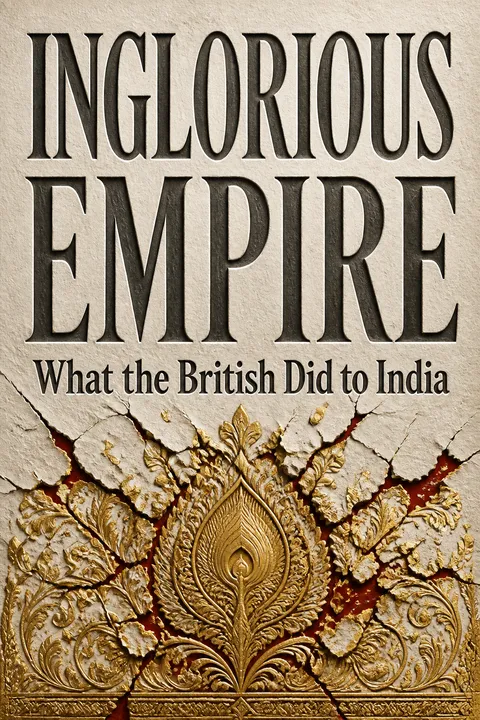


Key Takeaways
India held 23% of the world economy; Britain shrank it to 3%
Colonialism was extraction, not gift. When the East India Company arrived in 1600, India generated roughly a quarter of global economic output, rivaling all of Europe combined. By 1947, when Britain left, India accounted for barely 3%. Tharoor's central thesis: Britain's industrial rise was financed directly by draining India. Britain took an estimated 18 million pounds annually between 1765 and 1815 alone.
A corporation conquered a subcontinent. The Company was a private joint-stock firm with its own 260,000-man army, whose shareholders included Members of Parliament. It displaced rulers, emptied treasuries, and turned a manufacturing powerhouse into a raw-material exporter. Robert Clive alone hauled home a fortune worth roughly 40 million pounds today, marveling openly at his own restraint.
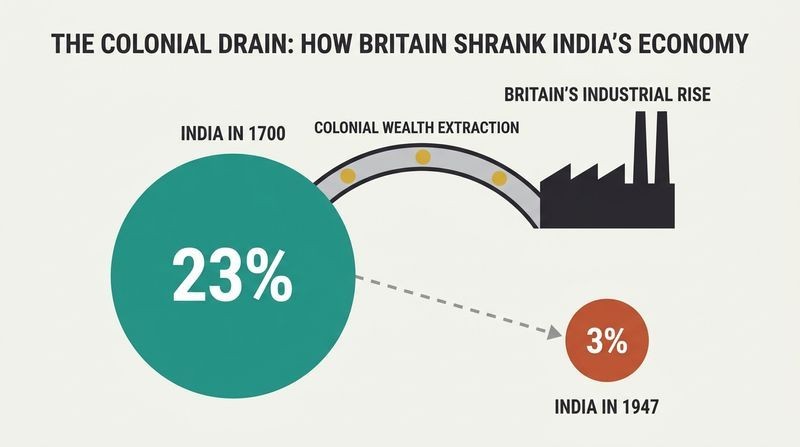
What's striking is how Tharoor reframes empire as history's first hostile corporate takeover, decades before economists coined phrases like state capture. Angus Maddison's GDP reconstructions, which Tharoor leans on, remain debated: some economic historians argue global shares shifted partly because the West industrialized, not only because India was looted. But the deindustrialization argument holds independent force. The deeper provocation is moral: Britain's prosperity and India's poverty were not parallel accidents but a single transaction. This anticipates later dependency theory (Andre Gunder Frank) and Utsa Patnaik's more recent estimate that Britain drained some 45 trillion dollars from India, a figure even larger than Tharoor's cited numbers.
Britain broke India's weavers' looms to sell them British cloth
The first great deindustrialization. Bengal's muslin, so fine it was called woven air, was coveted from Cairo to Japan. Once the Company gained power after 1757, it stopped competing and started coercing. It imposed 70-80% tariffs on Indian textiles entering Britain while flooding India with duty-free British cloth from steam mills. Contemporary accounts describe soldiers smashing looms and, by widespread belief, breaking weavers' thumbs.
Dhaka collapsed as Manchester rose. The muslin capital's population fell from several hundred thousand around 1760 to about 50,000 by the 1820s. India's share of world manufacturing exports fell from 27% to 2%. Governor-General Bentinck himself wrote that the bones of cotton weavers were bleaching the plains of India. Farmers driven off looms crowded onto land, depressing rural wages and deepening famine vulnerability.
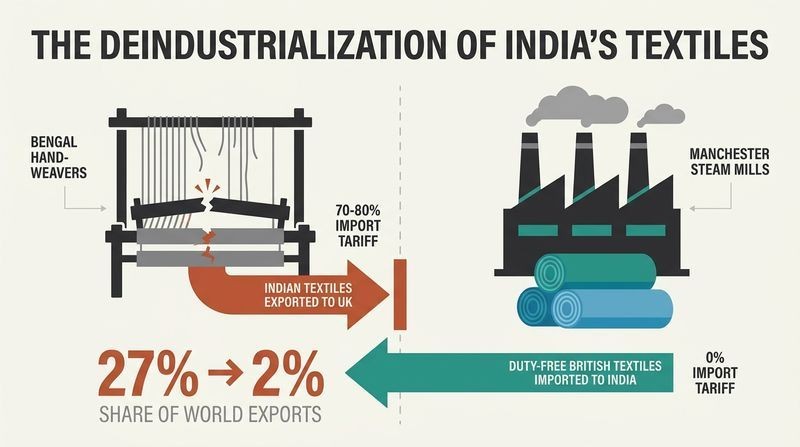
Apologists counter that handlooms everywhere lost to mechanization, so India's weavers were merely obsolete. Tharoor's rebuttal is sharp: the playing field was rigged by tariffs, not technology. The tell is timing and asymmetry. Britain protected its mills while forbidding India protective tariffs, and Indian producers regained 76% of the domestic cloth market by 1945 once wartime disruption loosened British control, proving latent competitiveness. The episode echoes Ha-Joon Chang's Kicking Away the Ladder: powers preach free trade after securing dominance through protection. Deindustrialization also had a demographic tail, pushing artisans into precarious agriculture, a structural fragility that made subsequent famines lethal.
India's political unity predates Britain by two millennia
The unity claim examined. Britain's proudest boast is that it invented India as one entity from warring statelets. Tharoor counters that a unifying impulse ran through Indian history: the Maurya, Gupta, and Mughal empires each sought subcontinental reach, and sages like Adi Shankara mapped a sacred geography from Kerala to Kashmir centuries earlier. Arabs called the whole land al-Hind. The Mahabharata already imagined a pan-Indian landscape.
Counterfactual, not certainty. He concedes counterfactuals cannot be proven, but argues the Marathas or another power would likely have consolidated India, as constitutional monarchies emerged in uncolonized Japan, Thailand, and China. What Britain actually did was dismantle self-governing village republics, centralize judicial power, and destroy indigenous institutions rather than build representative ones from the ground up.
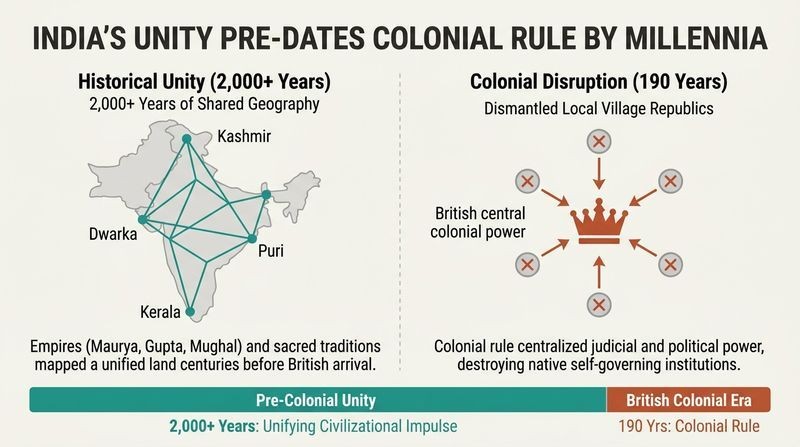
The unity debate hinges on whether one means cultural cohesion or administrative statehood. Tharoor persuasively shows India was never a blank cultural slate, but critics note that continuous bureaucratic unification of the exact 1947 territory did coincide with the Raj. His strongest move is the counterfactual: colonization interrupted an organic political evolution rather than substituting for its absence. Benedict Anderson's imagined communities framework cuts both ways here. Modern nations are constructed, but the raw civilizational materials mattered. The nuance worth holding: Britain accelerated a centralized state apparatus while simultaneously poisoning the communal harmony that might have made that state cohere peacefully.
Divide and rule manufactured the Hindu-Muslim rift that split India
A deliberate colonial strategy. After Hindu and Muslim soldiers rebelled together in 1857, Britain concluded that dividing them was the surest path to control. Governor Elphinstone advised in 1859 that divide et impera should be the guiding maxim. Britain periodized Indian history into Hindu, Muslim, and British eras, implying eternal religious enmity, and engineered separate electorates so Muslims voted only for Muslims.
Fabricated categories hardened into conflict. Scholars cited by Tharoor argue large-scale Hindu-Muslim conflict began under colonial rule. Precolonial India featured syncretic worship: Muslims sang Hindu devotional songs, Hindus thronged Sufi shrines, and at Kerala's Sabarimala pilgrims honor a Muslim disciple. Britain instigated the Muslim League in 1906, partitioned Bengal in 1905 to create a Muslim-majority province, and even authorized separate Shia and Sunni processions in Lucknow. Partition killed over a million and displaced 17 million.
This is Tharoor's gravest indictment and his most contested. The strong version, that Britain invented Hindu-Muslim antagonism, overstates it. Temple desecrations and communal violence existed precolonially. The defensible version, that colonial census-taking, periodization, and separate electorates reified and weaponized fluid identities, aligns with scholars like Gyanendra Pandey and Nicholas Dirks. James Scott's Seeing Like a State illuminates the mechanism: states simplify messy societies into legible categories, and those categories become real. The tragedy is recursive: once people were asked which box they belonged to, many began to believe the boxes. Partition then became the catastrophic proof of the classification's power.
35 million Indians starved while Britain exported their grain
Famine as policy failure, not fate. Between 1770 and 1900, some 25 million Indians died in famines, with the twentieth century pushing the total past 35 million. Britain justified inaction through free-market dogma, Malthusian fatalism, and budgetary thrift. During the 1876-77 Madras famine, Viceroy Lytton banned relief works and forbade lowering food prices, dismissing critics as indulging in humanitarian hysterics, even as India exported grain to Britain.
Democracy ended famine overnight. Economist Amartya Sen's finding anchors the argument: no famine occurs in a functioning democracy with a free press, because accountability forces distribution. Famines stem from lack of access to food, not absolute shortage. India has had no major famine since independence. The 1943 Bengal famine killed nearly 4 million while Churchill diverted food to European stockpiles and asked why Gandhi had not yet died.
The Sen thesis is the intellectual keystone and remains widely accepted, though scholars refine it: electoral democracy plus free media plus functioning relief bureaucracy together prevent famine. The Bengal 1943 case is now heavily documented (Madhusree Mukerjee), showing Churchill's War Cabinet rejected Canadian and American food offers and blocked India from using its own ships. What elevates Tharoor's account beyond atrocity-cataloguing is the causal claim: British ideology, the sanctity of markets and fear of dependency, was not incidental to mass death but its engine. Comparisons to Stalin's collectivization famines are provocative but structurally apt, since both weaponized grain extraction against captive populations.
The railways were a British profit scheme billed to Indian taxpayers
Private enterprise at public risk. The favorite exhibit for benevolent empire was actually a rigged investment. Britain guaranteed investors 5% annual returns paid from Indian taxes, removing all incentive to economize. Each mile cost around 18,000 pounds versus roughly 2,000 in the contemporary United States. Guaranteed Indian railway shares absorbed up to a fifth of British portfolio investment, yet only 1% of the capital came from India. All equipment, steel, and engines came from Britain, so profits flowed back.
Built for extraction, not Indians. Lines moved coal, cotton, and ore to ports for export. Indians were herded into barren third-class carriages that became the railways' profit center, while freight rates stayed low for British traders. A 1912 Act barred Indian workshops from building locomotives, even though Indian mechanics had designed excellent ones since 1878.
The railway is the perfect stress-test of imperial cost-benefit accounting, because it is simultaneously the most cited benefit and, on inspection, a subsidy transfer. Tharoor's point about the locomotive ban is devastating and underappreciated: this was not neglect but active suppression of indigenous industrial capability, so complete that post-independence India had to relearn locomotive manufacture from Britain. Economists Dan Bogart and Latika Chaudhary have quantified the railways' guarantee system as a massive fiscal drain. The broader lesson mirrors modern infrastructure-for-resources deals: physical assets can be real and useful while the financing structure systematically enriches the lender and impoverishes the borrower.
Britain left India 16% literate after 90 years of rule
Education served rulers, not the ruled. At independence, only 16% of Indians could read, and just 8% of women. Macaulay's 1835 Minute made the purpose explicit: create a class Indian in blood and color but English in taste and opinion, to serve as interpreters between rulers and millions. English was taught to a thin elite to run the administration, never to educate the masses.
A tradition was dismantled, not built. Precolonial India had communal village schools and institutions like Nalanda University, which housed 10,000 students and a nine-story library when Oxford did not exist. The Company destroyed village schools without replacing them. By 1930, only about 4% of Indian children were in school, and colonial spending on India's entire education was less than half that of New York state alone.
The English-language legacy is genuinely double-edged, and Tharoor, writing brilliant English himself, concedes it granted Indians access to global ideas and a tool of nationalist mobilization. The sharper insight is intent versus outcome: benefits accrued as by-products, not goals. Gauri Viswanathan's research showing English literature was invented as a colonial subject in India before Britain adopted it academically is a genuinely counterintuitive gem. The comparison to Meiji Japan, which reached 90% literacy in 40 years while educating in its own language, punctures the notion that mass education required colonization. It required a government that valued its own people's minds.
The Amritsar massacre was cold, calculated bureaucracy, not battlefield frenzy
Ten minutes, 1,650 bullets. In April 1919, Brigadier General Dyer marched troops to Jallianwala Bagh, a walled Amritsar garden where thousands had gathered peacefully, many unaware of a ban on assembly. Without warning or an order to disperse, he had soldiers fire into the densest part of the crowd, deliberately targeting the narrow exits, until ammunition ran out. At least 379 died, over 1,100 were wounded. Dyer forbade aid to the wounded and later expressed no remorse, calling the targets good.
Britain rewarded him. The official inquiry found only a grave error. The House of Lords exonerated him, and admirers raised over 26,000 pounds, worth a quarter million today, plus a jeweled sword. Victims' families received 500 rupees per life. This turned loyalists into nationalists overnight.
Tharoor's most chilling reframing is that Amritsar's horror lay in its administrative calm. Hannah Arendt's banality of evil fits precisely: Dyer was a bureaucrat producing a moral effect, not a berserker. The subsequent British lionizing of Dyer did more damage than the massacre itself, converting a colonial crime into a statement of collective contempt for Indian life, which is why Tagore returned his knighthood and Gandhi turned irrevocably against the Raj. The kill-rate arithmetic, over 1,500 casualties from 1,650 rounds, is a grimly effective rhetorical device. It forecloses any defense of chaos or self-defense and exposes the deliberateness.
The British never became Indian; they stayed to extract and leave
The decisive difference from earlier conquerors. The Mughals arrived as foreigners but settled, intermarried, and diluted their foreign blood within generations. Aurangzeb was only one-eighth non-Indian. They spent and invested their wealth inside India, patronizing its arts and industries. The British, by contrast, maintained racial exclusivity, banned Indians from their clubs (signs read Indians and dogs not allowed), shipped their children to English schools, and repatriated their fortunes to London.
Rule by strangers with foreign loyalties. Just 6,000 British officials governed 250 million Indians around 1890, never more than 0.05% of the population. They retired to English cottages named Quetta or Simla on pensions paid by Indian taxpayers. Everything they earned from the sweat of Indian labor was sent home, where their real interests lay.
This is Tharoor's structural explanation for why the Raj impoverished rather than merely exploited. Every previous ruling class, however rapacious, recycled wealth locally, functioning as an economic multiplier. The British operated as a permanent capital drain because their consumption, savings, and loyalties pointed abroad. This connects to the economic drain theory of Dadabhai Naoroji, who calculated the outflow as early as the 1880s. The insight generalizes: extractive institutions (Acemoglu and Robinson's term) are worst when the extractors have no stake in the extracted society's long-term flourishing. Absentee empire, like absentee landlordism, optimizes for short-term siphoning over sustainable development.
Gandhi's nonviolence worked because Britain could be shamed, not against tyrants
Satyagraha's power and its limits. Gandhi coined satyagraha, meaning holding on to truth, an active willingness to suffer punishment to expose an unjust law's injustice. It succeeded against Britain because a democracy with a free press and international image was vulnerable to moral shaming. It inspired Martin Luther King Jr., who called it the guiding light of the American civil rights movement.
Useless against the shameless. Tharoor argues nonviolence would have done nothing for Jews in Hitler's Germany, who vanished into gas chambers far from any camera. Nelson Mandela explicitly rejected it against apartheid. It works only against opponents who care whether they are wrong. Notably, it was mutinying Indian sailors and soldiers in 1945-46, wielding hard power, that convinced Britain the game was up.
Tharoor performs a rare act for an admirer, subjecting Gandhi to cold strategic analysis rather than hagiography. The conclusion, that nonviolence is a conditional tool requiring an opponent with a conscience or a reputation to protect, is well supported by comparative history. Erica Chenoweth's data on civil resistance complicates it: nonviolent campaigns succeed more often than violent ones even against harsh regimes, because they mobilize broader participation. The synthesis worth holding: Gandhi won the moral and soft-power war, but the credible threat of ungovernability, mutinies and a bankrupt postwar Britain, supplied the hard-power push. Moral force and material leverage were complementary, not alternatives.
Colonial-era laws still jail Indians for sedition and love
The dead hand of the Penal Code. Macaulay drafted India's penal code in the 1830s explicitly for a conquered race. Enacted in 1861, much survives today. Section 124A on sedition, added in 1870 to crush criticism of British policy, still lets authorities charge dissenters; students were arrested under it in 2016. Section 377, from 1860, criminalized consensual same-sex relations, though India had no such taboo before Victorian morality imported one. Section 497 punished adultery with a sexist double standard.
Britain outgrew these laws; India inherited them. Britain has since revised all three offenses, so none remain crimes there. The cruel irony: colonialism's worst effect is that its prejudices outlived the empire, entrenched in the statute books of the very society it claimed to civilize.
This is the book's most contemporary and actionable thread, showing that decolonization of institutions lags decolonization of territory by generations. The observation that India now enforces Victorian sexual morality that Britain itself abandoned is a potent illustration of how legal codes ossify. Legal scholars call this colonial path dependency: transplanted law persists because repeal requires political will that entrenched interests resist. Tharoor's parliamentary bills to amend these sections make the point that the fault for retention is now India's own, a rare instance where he assigns present responsibility rather than past blame. The 2018 decriminalization of Section 377 (after the book) vindicated his argument.
Atonement, not cash, is the honest reckoning empire owes
Reparations reframed as apology. Tharoor's viral 2015 Oxford Union speech argued Britain owes reparations, but the book clarifies his real aim: moral atonement, not money. One commentator computed a fair sum at 3 trillion dollars, larger than Britain's entire GDP, a figure so vast it becomes meaningless. His proposal was symbolic: one pound a year for 200 years. What matters is acknowledgment.
Precedents exist. Willy Brandt knelt at the Warsaw Ghetto in 1970, innocent himself yet accepting Germany's collective responsibility. Justin Trudeau apologized for Canada's 1914 Komagata Maru rejection of Indian immigrants. Tharoor hoped a British PM would kneel at Jallianwala Bagh on the 2019 centenary. Best of all, he suggests, would be teaching honest colonial history in British schools, the way German children learn about the camps.
The reparations-as-atonement move is rhetorically shrewd, sidestepping the intractable accounting problem while preserving the moral claim. Critics argued postcolonial India's own failures invalidate the case, but Tharoor's rejoinder is clean: one era's wrongs do not cancel another's, and each period must be judged on its own terms. The Brandt comparison invokes the ethics of collective and intergenerational responsibility, a live debate in political philosophy (Jaspers on German guilt, contemporary work on historical injustice). The most durable proposal is educational: a 1997 poll found most Britons could not identify Clive or what Kipling wrote. Historical amnesia, not malice, may be the enduring obstacle to reckoning.
Analysis
Inglorious Empire is a polemic disciplined by scholarship, born from Tharoor's viral Oxford Union speech and expanded into a systematic prosecution of the British Raj. It is thesis-driven rather than narrative history: Tharoor deliberately warns readers seeking a chronological story that they will not find one. Instead he takes each pillar of the benevolent-empire myth, unity, democracy, rule of law, railways, education, English, and dismantles it in turn. This structure is both the book's strength and its vulnerability. As advocacy it is relentless and cumulative; as history it occasionally flattens complexity to win the argument.
The deepest contribution is economic. By foregrounding Maddison's GDP figures and Naoroji's nineteenth-century drain theory, Tharoor recasts empire not as a civilizing mission with regrettable excesses but as a two-century transfer of wealth that financed Britain's industrial revolution while deindustrializing the richest region on earth. The claim invites scrutiny: some of India's relative decline reflects the West's endogenous industrialization, and figures like Utsa Patnaik and Niall Ferguson bracket Tharoor's numbers on opposite sides. But the qualitative mechanisms, punitive tariffs, the locomotive ban, guaranteed railway returns billed to Indian taxpayers, are hard to dispute and cumulatively damning.
Tharoor is at his most original arguing that colonialism's cruelest legacy is institutional and psychological rather than material: manufactured communal division that produced Partition's million dead, a penal code still criminalizing dissent and desire, and a colonized self-perception that outlasted the colonizers. His concession that he seeks understanding rather than to excuse India's own failures gives the book intellectual honesty.
What a discerning reader should hold: Tharoor occasionally romanticizes precolonial India and underweights indigenous injustices like caste and princely misrule, which he acknowledges but subordinates. Yet his core move, insisting empire be judged by its victims' experience rather than its rulers' self-flattery, is a necessary corrective to a persistent and comfortable British amnesia.
Review Summary
Inglorious Empire is a critical examination of British colonial rule in India, challenging the notion that it brought benefits. Tharoor systematically dismantles arguments supporting colonialism, highlighting economic exploitation, cultural destruction, and divisive policies. The book presents compelling statistics and historical accounts to demonstrate the devastating impact of British rule. While some readers praise Tharoor's passionate arguments and research, others criticize his occasional lack of objectivity and oversimplification. Despite its flaws, many reviewers consider it an important work that sheds light on a dark period of Indian history.
People Also Read
FAQ
What's Inglorious Empire: What the British Did to India about?
- Critique of Colonialism: The book by Shashi Tharoor critiques British colonialism in India, highlighting exploitation and oppression rather than any supposed benevolence.
- Historical Overview: It provides a chronological account from the East India Company's establishment in 1600 to India's independence in 1947, detailing key events like the Sepoy Mutiny and Jallianwala Bagh massacre.
- Legacy of Colonialism: Tharoor discusses the enduring effects of colonialism on modern India, such as economic disparities and social divisions.
Why should I read Inglorious Empire?
- Insightful Perspective: The book challenges the glorification of the British Empire, offering a narrative backed by extensive research and historical evidence.
- Engaging Writing Style: Tharoor's eloquent prose and sharp wit make the book accessible and engaging, blending personal anecdotes with historical analysis.
- Relevance to Current Issues: It resonates with ongoing discussions about colonialism, reparations, and national identity, enhancing understanding of these complex issues.
What are the key takeaways of Inglorious Empire?
- Economic Exploitation: British colonialism systematically looted India's wealth, reducing its global economic share drastically by independence.
- Political Manipulation: The British used a "divide et impera" strategy, exacerbating religious and social divisions to maintain control.
- Cultural Legacy: British rule imposed foreign systems that disregarded India's traditions, leading to ongoing governance and social challenges.
What are the best quotes from Inglorious Empire and what do they mean?
- "The British conquest of India...": This quote underscores the unscrupulous nature of British colonialism, driven by greed and moral bankruptcy.
- "India was governed for the benefit of Britain.": It highlights the exploitative nature of British policies, designed to enrich Britain at India's expense.
- "The moral right of the author has been asserted.": Reflects Tharoor's commitment to truthfully presenting history and the importance of acknowledging colonial injustices.
What is the main argument of Inglorious Empire?
- Colonialism as a Crime: Tharoor argues that British colonialism was a historical crime marked by exploitation and cultural erasure.
- Rejection of Justifications: The book dismantles common justifications for British rule, such as bringing civilization and democracy to India.
- Call for Atonement: Tharoor advocates for recognizing colonial wrongs, suggesting Britain owes a moral debt to its former colonies.
How does Shashi Tharoor address the concept of reparations in Inglorious Empire?
- Symbolic Reparations: Tharoor suggests acknowledgment of wrongdoing and a formal apology as more important than financial reparations.
- Historical Context: He discusses precedents for reparations, urging Britain to recognize its colonial injustices.
- Public Discourse: Emphasizes the importance of public discourse on reparations for greater awareness and understanding of colonial history.
How does Inglorious Empire address the famines in India?
- Systematic Mismanagement: Tharoor details how British policies led to devastating famines, notably the Bengal Famine of 1943.
- Economic Exploitation: The British prioritized exports over local needs, worsening food shortages and causing widespread starvation.
- Lack of Accountability: Tharoor criticizes the British government's indifference and refusal to take responsibility for famine-related suffering.
How does Inglorious Empire explain the concept of "divide and rule"?
- Colonial Strategy: The British maintained control by exacerbating religious and social divisions, weakening the nationalist movement.
- Census and Classification: They used census data to reinforce communal identities, solidifying divisions that were previously more fluid.
- Long-Term Consequences: The legacy of "divide and rule" continues to affect Indian society, contributing to ongoing communal tensions.
What role did Mahatma Gandhi play in the independence movement according to Inglorious Empire?
- Non-Violent Resistance: Gandhi is portrayed as a pivotal figure advocating for non-violent resistance against British rule.
- Moral Authority: His moral authority challenged British imperialism, forcing them to confront their injustices.
- Limitations of Gandhism: Tharoor notes the limitations of Gandhi's methods against the brutal realities of colonial rule.
What does Inglorious Empire say about the British legacy in India?
- Mixed Legacy: While some infrastructure was left behind, it primarily served British interests, with the overall legacy being one of exploitation.
- Cultural Impact: British colonialism disrupted traditional Indian society, leading to a loss of identity and imposition of foreign values.
- Economic Drain: The economic drain impoverished India, stunting its development while fueling Britain's industrial revolution.
How does Inglorious Empire relate to contemporary India?
- Historical Context: Tharoor connects colonial injustices to contemporary issues like economic inequality and communal tensions.
- National Identity: Discusses how colonialism shaped Indian national identity, influencing perceptions of self and other.
- Lessons for the Future: Suggests that lessons from colonialism can inform India's future governance and social cohesion.
What evidence does Shashi Tharoor provide to support his claims in Inglorious Empire?
- Historical Documents: Tharoor references letters, reports, and official records to substantiate his critique of British colonialism.
- Economic Data: Includes statistics illustrating India's economic decline under British rule, highlighting exploitative policies.
- Personal Accounts: Incorporates anecdotes and testimonies from individuals affected by colonialism, providing a human perspective.
About the Author

Download PDF
Download EPUB
.epub digital book format is ideal for reading ebooks on phones, tablets, and e-readers.








































