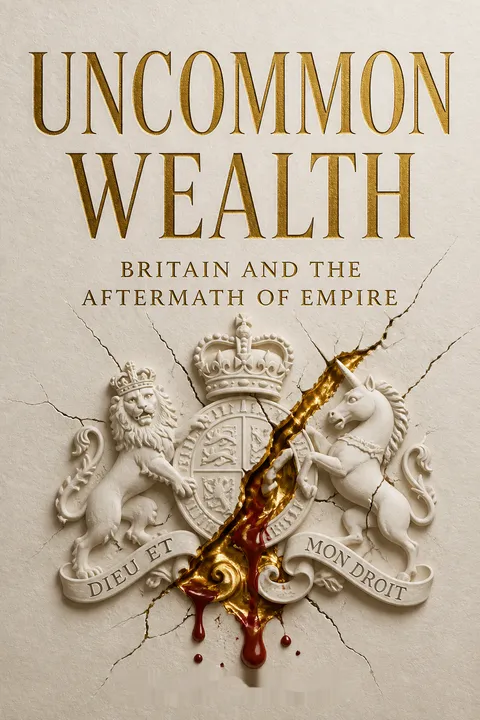

Key Takeaways
1. The "Boomerang Effect": Empire's Aftermath Returns to Britain
The boomerang is most dangerous when you aren’t looking at it, and don’t know that it’s hurtling back towards you.
Hidden connections. The book introduces Aimé Césaire's "boomerang effect," arguing that policies and dynamics tested in the empire's peripheries eventually return to its heartland. This challenges the linear view of history, where Britain is always at the forefront of development, and others are merely "catching up." The striking inequalities observed in Ghana as a child, once dismissed as "developing country" problems, are now mirrored in 21st-century Britain.
Divergent realities. Britain's current national crises—from internal divisions and spiraling wealth inequality to declining faith in democratic institutions—are not isolated but deeply connected to the unacknowledged aftermath of its empire. The UK, despite being an "advanced" European country, exhibits higher income and wealth inequality than many of its European neighbours and even "less developed" nations, suggesting the old narrative of progress is failing.
- UK income inequality is larger than France, Germany, Italy, Greece, and Portugal.
- UK wealth inequality is twice as high as income inequality.
- Credit Suisse's Global Wealth Report 2014 noted the UK as the only "developed" Western country to record a rise in wealth inequality from 2000–2014.
Denial and consequences. Decades of denial about the empire's impact, often framed as irrelevant "culture wars" or "black issues," have blinded Britain to the boomerang's return. Leaders like Tony Blair and Boris Johnson displayed "unapologetic amnesia" about imperial history, even while expressing nostalgia for it. This ignorance prevents an honest examination of how the empire's legal and economic systems continue to produce vast wealth disparities both at home and abroad, shaping the very fabric of modern British society.
2. The British State: Forged by Empire, Defined by Outsourcing
Rather than saying Britain had an empire, it would be more accurate to say that the empire had Britain, as the British political entity was largely born of and sustained by its imperial project.
Imperial origins. The British state, particularly its "unwritten" constitution and institutions, was fundamentally shaped by its imperial realm, not just its national one. Early 20th-century proposals for an "Imperial Federation" aimed to formally integrate colonies into a "Greater Britannia," recognizing the empire's centrality to Britain's identity. However, after decolonization, figures like Enoch Powell propagated a "wilful amnesia," denying the empire's existence and impact to construct a myth of Britain as an exceptional, insular nation state.
Outsourcing's deep roots. This denial obscured the state's long-standing reliance on private companies to administer its vast empire, a practice that continues today. From the 16th-century Muscovy Company to the 19th-century Royal Niger Company, private corporations performed much of the "dirty work" of colonial governance, conquest, and resource extraction. This historical outsourcing allowed the state to remain "one step removed" from the empire's brutalities, fostering a collective amnesia and shrouding violence under "technical legalese."
- Elizabethan colonial corporations like the East India Company were granted royal charters, linking private profit to public purpose.
- These companies owned vast territories, wielded military forces, made laws, and collected taxes.
Contemporary echoes. The legacy of this outsourced state is evident in modern Britain's addiction to privatizing public services, even during crises like the Covid-19 pandemic. Companies like Serco, with histories of scandal (e.g., Yarl's Wood Immigration Removal Centre, failed test-and-trace system), are awarded lucrative government contracts without competitive processes, mirroring colonial-era corporate power. This privileging of private law and corporate interests over public provision has stunted the state's capacity, leaving it ill-equipped to address domestic challenges and contributing to the UK's constitutional fragility.
3. The Commercial Corporation: Empire's Enduring Legacy
Of all the inventions the British Empire gave to the world, perhaps the most significant, despite being rarely mentioned, was the modern, commercial corporation.
Evolution of corporate power. The commercial corporation, initially a legal structure for social good, evolved through imperial voyages into a vehicle for profit and risk protection. Joint-stock companies like the East India Company became "company-states," wielding vast military forces, making laws, and collecting taxes across continents. This corporate model, driven by the pursuit of wealth, was central to the British Empire's expansion and its ability to operate "one step removed" from direct state accountability.
- The Royal African Company, where Edward Colston was a prominent member, transported 84,500 enslaved people.
- The East India Company commanded a private army larger than the British army by the 19th century.
Clash with sovereignty. The post-WWII era saw a clash between newly independent nations asserting sovereignty and these entrenched corporate powers. Mohammad Mosaddegh's nationalization of Iran's oil industry, controlled by the Anglo-Iranian Oil Company (AIOC), exemplified this conflict. Despite Iran's sovereign right, Britain, with US backing, orchestrated a coup (Operation Ajax) in 1953, replacing Mosaddegh with a pro-Western regime. This event set a precedent: democratic Third World governments challenging transnational corporate interests would face severe repercussions.
Corporate triumph. The tragic fates of leaders like Mosaddegh and Ghana's Kwame Nkrumah, who also faced external pressures for his economic policies, demonstrated the limitations of national sovereignty against global corporate power. The "neo-colonialism" Nkrumah described highlighted how economic systems remained externally directed, dependent on international markets and corporate decisions. This triumph of transnational corporations, often rebranded to shed colonial associations (like AIOC becoming BP), laid the groundwork for a world where corporate interests increasingly supersede national democratic control, a dynamic now boomeranging back to Britain.
4. Borders for People, Not for Capital: A Neoliberal Vision
The two strands of Powell’s thought can be summarised as a vision of the world where borders were for people, not for property.
Restricting human movement. Post-WWII Britain, while shedding its empire, simultaneously sought to redefine its national identity through the welfare state and strict immigration controls. The 1948 British Nationality Act initially granted Commonwealth subjects the right to settle in the UK, but subsequent acts progressively restricted this, culminating in the 1971 Immigration Act which tied citizenship to British ancestry. This legislative shift, often fueled by figures like Enoch Powell and his "Rivers of Blood" speech, aimed to create a racially bounded nation state.
- The 1962 Commonwealth Immigration Act covertly targeted non-white migrants.
- Powell's 1968 "Rivers of Blood" speech warned of racial conflict due to immigration.
- The 1971 Immigration Act created "right to abode" tied to British ancestry.
Liberating capital. While human movement was increasingly restricted, a parallel movement championed the free flow of capital. Powell, alongside the Institute of Economic Affairs (IEA), vehemently opposed fixed exchange rates and capital controls, advocating for markets to determine currency values. This vision, embraced by Milton Friedman and eventually Margaret Thatcher, led to the dismantling of the Bretton Woods system in 1971 and the abolition of exchange controls in Britain in 1979. The goal was to liberate wealth from the "tyranny" of state control and taxation.
Globalized inequality. This dual approach—hard borders for people, open borders for money—created a globalized economy where capital could freely seek the lowest labor costs and weakest regulations. The "hostile environment" for immigrants in Britain, exemplified by tragedies like Jimmy Mubenga's death during deportation, contrasts sharply with the ease with which wealth moves offshore. This system, which began in the post-colonial world, has boomeranged back, contributing to precarious work, insecure housing, and rising personal debt in Britain, while obscuring the true causes of inequality by blaming immigrants.
5. Debt as Control: The Third World's Unending Crisis
The best type of debt is the one that can never be paid.
Third World aspirations. The 1970s saw the rise of "Third Worldism," a movement led by figures like Jamaica's Michael Manley, advocating for a "New International Economic Order" (NIEO) to rebalance global trade and assert sovereign control over resources. Manley's government implemented ambitious social reforms (e.g., national minimum wage, free education) and challenged multinational corporations, but his efforts were undermined by the burgeoning "Third World debt crisis." Countries, hit by oil shocks, took out commercial loans, then fell into a cycle of IMF "structural adjustment policies" (SAPs) that mandated public spending cuts and privatization.
Weaponizing debt. This debt became a powerful tool for control, neutralizing the democratic potential of newly independent states. Economists like Peter Bauer, influential in Thatcherite circles, insisted on debt repayment regardless of social cost, arguing that forgiveness would encourage irresponsibility. The 1980s saw the "politicization of life" in the Third World replaced by the dictates of accountants, as debt obligations forced governments to prioritize market discipline over public welfare. This era also cemented the image of "developing" countries as perpetually corrupt and incompetent, detached from historical context.
- Developing countries' debt repayments jumped over 1,000% between 1971 and 1982.
- Jamaica spent 32 of its 57 years of independence under IMF structural adjustment programs.
Boomerang of austerity. The strategies of debt-driven austerity and privatization, first imposed on the Third World, boomeranged back to Europe and Britain after the 2008 financial crash. Governments, facing sovereign debt, justified severe cuts to public services, arguing "there is no alternative." This narrative, echoing Thatcher's earlier stance against the Third World, masked how financial deregulation and speculation, not individual irresponsibility, caused the crisis. Debt, once a temporary condition, became a permanent mechanism to reshape societies, ensuring capital's freedom while eroding social safety nets and democratic accountability, even in the former imperial core.
6. Offshore Havens: Britain's Second Empire of Wealth
Today’s offshore world was created by policy decisions made in the outposts of the British Empire during the era of decolonisation, with the tacit or sometimes explicit consent of London.
Colonial escape valves. The rise of offshore financial centers (OFCs) like the Cayman Islands is a direct legacy of the British Empire. As decolonization threatened to bring greater public accountability and taxation, white business elites fled newly independent territories like the Bahamas, seeking new sanctuaries for their wealth. The Cayman Islands, by remaining a British Overseas Territory (BOT), offered the "best of both worlds": the stability of English common law and British sovereignty, combined with self-governance that allowed for minimal taxation and powerful secrecy laws.
- The 1928 "Egyptian Delta Land and Investment Company" case established the legality of "non-resident" companies for tax avoidance.
- The Cayman Islands' 1960 Companies Act and 1962 constitution facilitated its rise as an OFC.
London's complicity. The City of London played a crucial role in this development, particularly through the "Eurodollar market" of the 1950s and 60s. British banks, like Midland Bank, covertly held vast offshore dollar deposits, circumventing post-war financial controls. The City's unique jurisdictional autonomy within Britain made it an ideal "offshore island" for this unregulated capital. This innovation, initially a response to decolonization, allowed London to re-establish itself as a global financial conductor, directing wealth worldwide and insulating it from democratic demands.
A two-tiered world. This network of BOTs, often called "Britain's Second Empire," continues to entrench global wealth inequality. These jurisdictions, including the British Virgin Islands and Bermuda, are among the world's most corrosive corporate tax havens, enabling billionaires and multinational corporations to avoid taxes and regulations. The UK government, despite calls for reform, has historically been complicit, often claiming inability to control these "self-governing" territories while benefiting from their financial activity. This creates a two-tiered world where those tied to "onshore" territories bear the tax burden, while mobile capital enjoys unparalleled freedom, a dynamic now fueling anti-austerity protests and exposing the deep connections between empire, finance, and domestic inequality.
7. The Global City: Singapore's Model and London's Reality
Perhaps free markets work best in unfree societies.
Singapore's authoritarian path. Singapore, a former British colony, transformed itself into a "global city" by embracing a highly interventionist, authoritarian state model to attract international capital. Unlike the libertarian ideal often presented by British Brexiteers, Singapore's success wasn't solely due to deregulation and low taxes. Its founding leaders, like Lee Kuan Yew and Sinnathamby Rajaratnam, actively crafted laws to prioritize asset holders' freedom over citizens' rights, restricting labor power and suppressing dissent through measures like the Internal Security Act.
- The Economic Expansion Incentives Act 1967 reduced corporate tax burdens.
- The Employment Act and Industrial Relations (Amendment) Act of 1968 restricted workers' negotiating power.
- The government maintains majority ownership in key infrastructure companies and uses sovereign wealth funds to cushion capitalists.
State-led capitalism. Singapore's economic miracle relies on the state acting as a corporation, with government-owned companies and investment agencies propping up national industries and cushioning capitalist risks. This contrasts sharply with the "Singapore-on-Thames" vision promoted by UK politicians like Daniel Hannan and Rishi Sunak, who advocate for a low-tax, lightly regulated Britain. Their admiration often overlooks Singapore's draconian legal system, strict social controls, and the state's active role in managing the economy, rather than retreating from it.
London's metamorphosis. London, too, has become a "global city," reshaped by financialization since Thatcher's "Big Bang" deregulation in 1986. It attracts immense wealth, making it home to the world's highest number of millionaires, yet it also exhibits extreme inequality, with high rates of child poverty (37% in London). This "two-track city" reflects the global trend where wealth accumulates in financial centers while essential workers face precarious conditions. The Brexit project, often framed as "taking back control," risks accelerating these trends, using state power to protect capital while diverting public anger towards other targets, rather than addressing the deep structural inequalities rooted in empire's aftermath.
8. Nationalism as Distraction: Masking Economic Inequality
Turning every political problem into a nationalistic culture war has become the default tactic that politicians employ to cover up the deep structural issues within Britain’s economic model.
Unfulfilled promises. The unfulfilled promise of decolonization, where sovereignty failed to deliver material self-determination, created a blueprint for how nationalism can be used to mask economic realities. In Ghana, despite democratic elections, citizens felt little benefit from the state, as its resources were still extracted on unfair terms and public services were dismantled by structural adjustment. This "strangled" democratic potential, where politics became about negotiating with global corporations, foreshadowed a similar dynamic in the West.
Brexit's false promise. Brexit, framed as "recaptured sovereignty" and an end to "colonial effect" from the EU, became a vehicle for aggressive nationalism. Politicians like Boris Johnson and Jacob Rees-Mogg, while defending the British Empire's legacy, simultaneously used hyperbolic rhetoric to demonize the EU, diverting public anger from domestic inequality. This tactic, turning complex economic problems into simple nationalistic "culture wars," prevents an honest examination of how Britain's own economic model, rooted in empire's aftermath, contributes to insecurity and inequality.
- Jacob Rees-Mogg, a Brexit ideologue, called leaving the EU an end to the "colonial effect."
- Boris Johnson argued that without full regulatory freedom, Britain faced "the status of colony."
The real enemies. The pandemic further exposed this dynamic, with "chumocracy" in government contracts and vaccine nationalism masking systemic failures. Instead of addressing the growing gap between assets and human well-being, politicians blame immigrants or "divisive terms" like white privilege. This strategy, honed in the post-colonial world, uses nativism to protect asset holders while redirecting public anger. The book argues that true sovereignty means empowering working people to challenge global capital, requiring a confrontation with empire's material legacy, not just its symbols.
9. Confronting Empire's Material Legacy: The Path to a Fairer World
Challenging the aftermath of empire in Britain means reinterpreting the British state and its constitution in light of its development through empire, understanding the role that English conceptions of property play in reinforcing global corporate power, placing the never-ending immigration debate in the context of Britain’s global legacy, looking at the role that the City of London and Britain’s overseas territories play in financial globalisation, and asking how many of the problems that Britain itself is now facing are themselves a consequence of the afterlife of empire.
Beyond symbolic gestures. The book concludes that the "aftermath of empire isn't just about race, identity and memory, and neither is it 'dead' history." Instead, it fundamentally explains the economic and material conditions structuring our lives today. The persistent belief that black lives don't matter, or that Third World poverty is due to inherent backwardness, has long obscured the systemic nature of global inequality. This denial has prevented Britain from understanding its own economic vulnerabilities.
Interconnected problems. The "economic violence" of sovereign debt, structural adjustment, and corporatization, first inflicted on post-colonial nations, has boomeranged back to the West. The UK's reliance on foreign investment, the proliferation of offshore secrecy trusts, and the unchecked power of multinational corporations are direct consequences of preserving empire's economic machinery after its political demise. These issues are not separate from domestic problems like wealth inequality, precarious work, and the erosion of the welfare state.
- 82% of Britons believe companies in offshore tax havens should be excluded from government bailouts.
- 64% distrust private outsourcing companies in public services.
- 78% feel the gap between high and low incomes is too large.
A call to action. The growing interest in decolonization, particularly among younger generations, offers a "glimmer of hope" for a more unified public anger directed at entrenched interests rather than scapegoats. To create a fairer world, Britain must dismantle the protective casing around the global financial system, intervene in its overseas territories' offshore roles, tighten laws on corporate power, and campaign for global economic justice. This requires moving beyond symbolic debates to confront the material legacy of empire, recognizing that the security of human life must be valued above the securities traded by global creditors.
People Also Read

Download PDF
Download EPUB
.epub digital book format is ideal for reading ebooks on phones, tablets, and e-readers.








































