

Plot Summary
Prologue
Centuries ago, the cruel taunts of his father4 drive a twelve-year-old boy up Mount Helios, the deadliest peak in Praecepsia, to prove he is not weak. Trapped on a rain-slicked ledge with no way down, he screams defiance at an approaching storm and a bolt of lightning strikes his chest. He falls.
As the ground rushes up, black wings tear from his shoulder blades, slowing his plunge enough to survive. He wakes invigorated and horrified, hiding a deformity that would brand him an aberration to be dissected by the church. He has glimpsed what he is, and learned he must never let anyone see it.
The origin scene fuses trauma and gift, the signature of the whole novel. Paternal cruelty does not merely wound the boy; it manufactures the conditions for his power to manifest, suggesting that monstrousness is often inherited and provoked rather than chosen. The lightning that should kill him remakes him, an early statement of the book's central paradox that pain and transformation are inseparable. His instinct to conceal the wings introduces shame as a structuring force: to survive, he must perform normalcy while harboring an uncontrollable otherness. This is the engine of Jericho's adult psychology, a being perpetually managing the gap between the self he is and the self he dares reveal.
Pregnant By A Ghost
Two months after watching her lover Jericho2 consumed by hellfire, Farryn1 sits sleepless in a gynecologist's waiting room, carrying the child of a being her world calls myth.
The ultrasound shows an empty uterus shadowed by an unexplained mass; the screen glitches, paint peels in waking nightmares, and a nurse seems to breathe black smoke into her mouth. The doctor presses her to terminate a suspected ectopic pregnancy. Farryn1 refuses, certain a half-Sentinel pregnancy obeys no human rule.
Clutching the locket Jericho2 returned to her, she resolves to protect the only legacy of a centuries-old love, even as black vomit, a screaming in her skull, and shadows that crawl across the floor mark her unraveling days. Something is wrong, and it has no name yet.
The opening weaponizes the most clinical of human spaces, the exam room, against a woman whose body has become a battleground between realms. Farryn's refusal to terminate is less maternal certainty than an act of defiance against a universe that keeps taking from her; the baby is both child and relic. The hallucinations seed the novel's epistemological anxiety, inherited from her father's apparent madness: how does one trust perception when reality is porous? By framing pregnancy as eerie rather than tender, Lake signals that this gestation carries something parasitic, recasting the maternal body as haunted vessel and establishing dread where genre convention would offer comfort.
Drowned Into Purgatory
Three nights after clawing free of the void of Ex Nihilo, Jericho2 lies beside Farryn1 at her late aunt's house, his wings gone, his power nearly mortal. When he senses Sentinels breaching the plane, he insists they cross to Nightshade that very hour. The Vale exists between life and death, so he drowns her in a clawfoot tub, using a demon's glamour and his hands to coax her past her terror of water.
They surface in a black sea below Blackwater Cathedral, where a dragon-like serpent drags Farryn1 under. Jericho2 kills it but takes deep gashes, and his sluggish healing proves how diminished he has become. Most chilling: during the crossing he gripped her throat hard enough to bruise, with no memory of doing it.
The crossing literalizes the lovers' bond as a near-death experience, intimacy and annihilation collapsed into one act. Jericho must nearly kill her to save her, a pattern that will recur and define their dynamic. Farryn's drowning trauma, rooted in her father's hands once holding her under, makes the rescue doubly violating, blurring protection and harm. The serpent's wounds and Jericho's halting recovery quietly invert the power he held in the previous book; the predator is now vulnerable. The forgotten chokehold plants the season's central dread, that the man cannot trust his own hands, foreshadowing the demon ascendant within him.
A Killer For A Shadow
At the cathedral, Jericho2 decrees a cruel distance between them, terrified his starving demon half will enslave or devour her. Summoning his old contact Trezhyr,19 he learns the worst: his monstrous father, Claudius,4 holds claim to Farryn's1 damned soul, and the demon council fears crossing him.
To guard her while he hunts a cure, Jericho2 buys two condemned prisoners. Vaszhago,3 a deadly former Knight who once tried to assassinate him, is bound to Farryn1 by a curse that promises him eternal agony should she die.
Vespyr,5 a purple-haired demon-slayer who astral-projects into Nightshade, becomes her attendant. Farryn1 chafes at the constant watching, the cathedral's loyal hellhounds suddenly snarl at her as prey, and the pale blonde woman from her nightmares7 grows bolder.
The revelation that Claudius owns Farryn's soul transforms an external monster into a familial inheritance of evil, recasting the romance as a war between father and son fought over a woman's body. Jericho's solution, purchasing protectors bound by curses, exposes his transactional, possessive love; he cannot trust even himself, so he outsources safety. The hellhounds' hostility is a brilliant somatic clue: animals sense what humans cannot, registering the intruder Farryn herself cannot yet name. Vespyr's arrival introduces a mirror protagonist, another woman defined by trauma and the burden of seeing what others refuse to see.
The Boy Who Healed
Centuries earlier, the young baron who becomes Jericho2 spies his father, Lord Praecepsia,4 shift into a tentacled beast while defiling his own sister. Refusing to confess what he saw, the boy is dragged to the church undercroft and flogged by Bishop Venable,6 only to heal the wounds overnight with lightning sparking from his palms.
His cousin Drystan betrays the secret. His frail mother forbids him to heal openly or to kill his father, whose cursed blood binds them so that one death means both.
She arranges a hidden tutor, Solomon,8 a blind organist and demon-hunting Dra'Akon, who teaches the boy that evil disguises itself as beauty, that a barren shadow-realm called Eradye bleeds into the world, and that he is something rare, powerful, and hunted.
The flashback supplies the mythic architecture beneath the romance and explains Jericho's compulsions. Watching his father's bestial assault fuses sexuality, violence, and revulsion in his developing psyche, a contamination that later distorts his desire. The undercroft scenes frame institutional religion as the true sadist, exorcising difference through torture, a pointed critique of how power pathologizes the aberrant. Solomon's lesson, that monstrousness wears beautiful faces, becomes the book's recurring epistemology and a warning Jericho must apply to himself. The blood-curse binding father and son is tragic determinism: to destroy the monster is to risk destroying oneself, the dilemma that paralyzes him for centuries.
The Witch In The Cell
Imprisoned again, the boy meets Syrisa of Soldethaire,7 an accused witch who slips through walls and claims his father4 cursed the only man she loved. During his torture she forces his hand to his own body, planting a shame that permanently fuses pain with arousal in him. He later witnesses her public soul-stripping, feral dogs tearing her flesh while his father whispers in her ear.
Years on, home from university, Jericho2 finds his mother dying, drained of her lifeblood by his father and Venable's6 elixirs. With her final breaths she reveals he is half Elysiumerian, a Sentinel guardian who must one day choose goodness, and begs him to protect a raven-haired girl named Lustina14 at all costs, and never to reveal what he is.
Syrisa embodies the predatory inversion of victimhood, a woman genuinely wronged who becomes a violator, complicating the novel's sexual politics. Her assault on the boy explains the masochism that shadows Jericho's adult intimacy, trauma transmuted into kink and self-punishment. The soul-stripping spectacle, masked by dogs, exposes how communities ritualize cruelty while denying its horror. The mother's deathbed revelation reframes Jericho's entire identity from cursed aberration to celestial guardian, and her charge to protect Lustina seeds the centuries-spanning love that drives everything. Her sacrifice, staying to be drained rather than fleeing, models the very devotion Jericho will later embody.
Chained Against The Moon
In the present, the full moon ignites Rur'axze, a demon's agonizing mating heat only Farryn1 can soothe. To avoid claiming or killing her, Jericho2 has Vaszhago3 bind him each night in celestial-forged chains. Drawn by his cries, Farryn1 slips into his room to give him relief and witnesses the transformation overtaking him: horns, blackening skin, a serpent's tongue, and a single glowing red eye where blue should be.
When he loses himself and lunges to bite her throat and enslave her, she gasps their reality-anchor incantation, dragging him back, and Vaszhago3 intervenes more than once. Desperate, Jericho2 buys the forbidden angel-blood drug seraphica from a back-alley dealer, hoping to dull the beast surfacing faster than he can suppress it.
Rur'axze externalizes the romance's core tension: desire as both salvation and lethal threat. The chains literalize Jericho's lifelong project of self-restraint, the leash he keeps on the inherited beast. That Farryn repeatedly approaches the danger reveals her own death-courting attraction to his ferocity, the adrenaline she mistakes for love and the love she cannot separate from fear. The red eye, contrasted with his usual black demon form, becomes a diagnostic marker readers learn to read, an external sign of an internal usurpation. His turn to seraphica frames addiction as the lesser evil, a man medicating to stay merciful.
The Oracle And The Intruder
Farryn's1 cat, Camael,12 reveals herself as a shape-drifting free soul and delivers a chilling prophecy: an ancient called Letifer, the Dark-Winged One who feeds on souls, will wake and hunt Farryn1 precisely because she survived the blood moon curse. She is no ordinary human, and both Heaven and Hell are watching her.
Soon after, an Elysiumerian angel named Soreth11 climbs through Farryn's1 bedroom window claiming a message for Jericho;2 Vaszhago3 paralyzes him and locks him in the dungeon. Farryn,1 meanwhile, deciphers the numbers haunting her visions, 137 and 777, reading them as death and creation, and recognizes the labyrinthine asylum called Infernium from her recurring nightmares, sensing something far worse than pregnancy moving inside her.
Camael's prophecy escalates the stakes from personal to cosmic, recasting Farryn as a linchpin of all five realms rather than a damned girl in love. The oracle's earlier advice to abandon Jericho returns ironically, suggesting that survival and love may be incompatible. Soreth's intrusion plants a hook whose true purpose is concealed, rewarding later attention. Farryn's numerology, her professional habit of reading symbols, becomes a survival tool; she is decoding her own fate. The convergence of dream-logic, prophecy, and scholarship insists that meaning is real and legible, even when terrifying, the opposite of the madness her father was condemned for.
Her Father, Burned Away
Guided by his raven Cicatrix, Jericho2 rides to the lawless walls of Dreadmire and finds Augustus,9 Farryn's1 long-vanished father, hiding half-mad in a rocky alcove. Augustus9 refuses to come home, insisting an evil hunts him for a debt he owes. He explains the Omni, a sigil that taps the stored lifeblood of dead angels, translatable only by a chosen human healer called the Met'Lazan, an identity he spent years failing to crack.
As Jericho2 urges him to flee, fire demons erupt from the campfire and drag the old man screaming into the flames. Jericho2 barely brushes his hand before he vanishes. He rides home carrying only a protective ward and the unbearable task of telling Farryn1 her father is gone.
Augustus is the tragic scholar, a man who pursued symbols into damnation and was right all along, vindicating his daughter's lifelong defense of him while confirming her worst fear of inherited fate. His lecture on the Met'Lazan operates as deliberate dramatic irony; the reader and Jericho hunt an identity sitting in plain sight. The fire-demon abduction stages the novel's thesis that debts to the infernal are absolute, foreshadowing the bargains Jericho himself will strike. Augustus refusing rescue to spare his daughter the sight of his suffering mirrors Jericho's mother, devotion expressed as protective absence, a recurring grammar of love in this world.
The Succubus In Her Skin
On the long ride, Jericho's2 mating heat seizes him again in the woods. Three succubi smell his torment and offer relief; he insults their goddess to provoke a beating, preferring pain to surrender. One lingers and shifts into Farryn,1 perfect down to a childhood scar, then flees to bait his predatory chase.
In a blackout, his demon half slaughters her rather than couple with a counterfeit, leaving another silvery soul-mark on his skin and a glowing Nightshade flower where she falls. The episode proves his deterioration is accelerating: every lapse drags him nearer to the father he loathes4 and further from the man capable of safely touching the woman he loves,1 who lies sleeping realms away.
The succubus episode is a study in fidelity tested at the level of instinct. Jericho's beast rejects the imposter because it recognizes Farryn's specific essence, an oddly tender confirmation that his obsession is particular, not merely appetitive. Yet the cost is another murder, another mark, another step toward his father's depravity, dramatizing how even love-driven restraint accrues bloodguilt. His choice of pain over pleasure, provoking the succubi to maul him, externalizes the masochism Syrisa implanted, self-punishment as a coping ritual. The Nightshade flower, a soul denied claiming, ties his private degeneration to the world's mythology of unjust death.
The Empty Cradle
Farryn1 wakes to nightmare made flesh: the pale blonde woman7 at her bedside, blood pooling beneath her, a tentacled demon dragging her toward door 777. She loses the baby. Jericho2 holds her as she shatters, grieving the child she never wanted and then loved fiercely, blaming her own body, begging to reverse time. Worse follows.
A summoned healer, Kezhurah, treating Farryn's1 fevers and black vomit, confirms an unbound soul has been living inside her, invited in when Farryn1 unknowingly signed a deceptive waiver at the doctor's office. Jericho2 names the parasite: Syrisa,7 the witch from his past, who feeds on the unborn to stay youthful and has waited centuries to use him to take vengeance on his father.4
The miscarriage is the novel's emotional nadir, and Lake refuses to let it be merely tragic by revealing its engineered cause, transforming grief into violation. Farryn's self-blame, then her articulation of having resisted loving the child before loving it, is a precise portrait of ambivalent maternity and the guilt it breeds. The unbound soul retroactively explains every uncanny symptom, rewarding the reader's accumulated dread with coherence. Syrisa as a parasite feeding on the unborn literalizes the predatory transmission of trauma across generations and centuries. The reveal also reframes Farryn's whole pregnancy as a hijacked vessel, the horror beneath the romance finally surfacing fully.
The Woman She Truly Is
Adimus,10 leader of the Sentinels, arrives hunting the rogue angel Soreth11 and delivers the secret that recasts everything: Farryn1 is the Met'Lazan, the human conduit able to access all of Heaven's stored lifeblood. Those born to the blood moon curse are her bloodline, killed and reborn so the knowledge passes down.
Worse, Adimus10 admits that Lustina,14 Farryn's1 past self, was murdered by Bishop Venable6 while pregnant, and her soul was banished to Infernium, the asylum built atop the ancient temple of the gods. There she bore Jericho2 a son17 and was abandoned to be tormented by Claudius.4 Jericho's2 grief hardens into murderous rage; the recurring nightmares plaguing Farryn1 are Lustina's14 own memories of that hell.
This revelation collapses the book's mysteries into a single devastating geometry: the hunted human, the haunting nightmares, the sought-after Omni, and the trapped child are all one story. Farryn's identity as Met'Lazan inverts her self-image from fragile victim to the most coveted power in existence, the neutral vessel both Heaven and Hell would enslave. Adimus's confession indicts the angels' cold utilitarianism, their willingness to let Lustina rot for the greater good. The disclosure that a son was born and abandoned in Infernium converts abstract cosmology into intimate horror, giving Jericho a personal stake in hell itself and supplying the rescue mission's moral urgency.
The Witch's Terrible Price
Refused by the Noxerian council, who will not anger Claudius4 by trading away Farryn's1 soul even for a captured angel, Jericho2 seeks the legendary black witch Venefica16 in the caves of Obsidia. She offers an elixir that will expel Syrisa7 by sinking Farryn1 into a deathlike sleep for exactly three nights.
The price is monstrous: Letifer's beating heart, hidden at the center of Infernium's labyrinth, which also sustains the slumbering ancient. Destroying it would close the portal and free the realms but leave Farryn1 comatose forever unless Jericho2 delivers it intact. He drugs Soreth11 to offer as sacrifice, but the scheme buckles, leaving him with an elixir, a three-night deadline, and the certainty that he will walk into hell for her.
Venefica functions as the fairy-tale crossroads demon, the bargain that always costs more than promised. The impossible arithmetic, that saving Farryn's body requires either dooming the realms or stranding her in living death, crystallizes the novel's recurring claim that love is fundamentally selfish, willing to burn everything for one person. Jericho's manipulation of Soreth shows his moral flexibility, the antihero who will betray a friend without hesitation when Farryn is the stake. The three-night clock converts dread into thriller mechanics. The witch's caves, perched on Eradye's border, geographically literalize how close Jericho now treads to the abyss.
Swallowed By The Labyrinth
Lured by a wailing infant17 and a voice begging her to save him, Farryn1 steps through a decaying portal in her bedroom wall and is trapped in Infernium's endless gray maze. Vespyr5 is pulled in with her, and the wall seals shut behind them.
Each room is a weaponized memory: Vespyr's5 childhood torture by the Pentacrux cult that tried to beat the girl out of her, a drowning bathroom that replays Farryn's1 own death, and a widow's hovel where a child hangs cocooned in webbing. Farryn1 slays the spider-witch in a blackout and frees the boy, Elyon,17 who looks uncannily like a young Jericho.2 The rooms only push them deeper, and screeching undead Mortunath stalk them through the corridors.
The labyrinth is psychological architecture made literal, a mind-prison that interrogates each prisoner through her worst memory. Vespyr's torture room exposes the human cruelty that mirrors the demonic, collapsing the distinction between religious zealotry and infernal evil. Farryn's drowning room loops her foundational trauma, insisting that hell is personalized, fashioned from one's own history. The crying child she cannot ignore weaponizes her freshly bereaved maternity against her. Elyon's resemblance to Jericho is a planted recognition the reader decodes before Farryn does. The maze structure, advancing only inward toward the heart, makes escape and confrontation the same direction, a brilliant spatial metaphor for trauma processing.
A Blade For A Friend
Bitten by a Mortunath during their relentless flight, Vespyr5 begins to burn with fever and turn, her consciousness yanked back toward the hospital bed where her catatonic body has lain for years. Knowing she will soon become one of the undead, she begs Farryn1 to kill her, guiding the dagger to her own chest and reciting the demon-slaying sequence of chest, throat, skull that Jericho2 taught her.
Sobbing, Farryn1 drives the blade home and whispers Vespyr's5 true name as her body bursts into white dust, granting in death the recognition the world denied her in life. The killing fractures something in Farryn,1 her first human life taken by her own hand, even as the boy Elyon17 clings to her side.
Vespyr's death is the novel's most humane tragedy, a character whose entire arc was the longing to be seen choosing to die named and witnessed. The mercy killing forces Farryn across a threshold from victim to agent of death, complicating her innocence and deepening her kinship with Jericho, who also kills those he loves to spare them worse. The detail of speaking Vespyr's chosen name redeems the cult's earlier insistence on her birth name, a small restoration of dignity against a lifetime of erasure. The white dust, distinct from demonic black, marks her as a human soul, underscoring that Farryn has killed kin, not monster.
The Carving And The Word
At the labyrinth's heart, Claudius4 has chained and flayed Jericho2 with celestial steel that refuses to heal, while Bishop Venable,6 now an enslaved demon servant, gloats. To break his son, Claudius4 tortures Farryn,1 carving a degrading word into her belly with a heated blade and demanding she speak the Omni to free him.
She refuses through the agony, anchoring herself to Jericho's2 voice as he rages against his bindings. When Vaszhago3 bursts in and severs Claudius,4 Farryn1 drags her broken body to Jericho.2
The drowning memory finally surfaces fully: Lustina's14 dying chant, the Omni itself, the words she spoke to save the child in her womb. Farryn1 whispers them against his ruined back, and a bolt of light restores his wings, his power, and his sanity.
The torture sequence stages the antagonist's deepest strategy, breaking the son through the beloved, weaponizing love as leverage. Farryn's refusal under the blade is her heroic apex, choosing the realms' fate over her own relief. The recovery of the Omni through pain is thematically inevitable in a novel that insists revelation arrives only through suffering; the memory of Lustina's final maternal act becomes the key to salvation. Restoring Jericho's wings reverses the previous book's central sacrifice, but pointedly through her power, not his, relocating agency to the woman long cast as the protected. The mutual rescue redefines their bond as reciprocal at last.
Killing The Father, Waking The God
Restored and incandescent with power, Jericho2 consumes Claudius4 alive with glowing vitaeilem insects, ending the father who blamed him for everything and tormented Lustina14 for centuries.
But Claudius's4 death, combined with Venable6 hurling Letifer's heart to the swarming Mortunath, wakes the ancient Letifer, who descends in red steel armor commanding a horizon of undead. Jericho2 battles him through the sky, taking brutal wounds, and when the Mortunath devour the heart, Letifer detonates into red smoke, leaving behind the skeleton key to Eradye.
As the labyrinth collapses, Jericho,2 Vaszhago,3 and Elyon17 flee goat-horned Hellborn guardians and the closing portal, escaping just before the asylum seals. Outside, Jericho2 calls down lightning and reduces Infernium to ash.
The patricide resolves the centuries-old blood-curse paradox now that Jericho's restored power lets him survive his father's death, but the immediate consequence, Letifer's waking, dramatizes how destroying one evil unleashes another, refusing clean victory. Venable's act of throwing the heart to the horde is petty malice with cosmic fallout, the small treachery that nearly dooms everyone. The skeleton key replacing the destroyed heart becomes the new currency of leverage, repurposing the witch's bargain. The collapsing labyrinth and frantic escape convert psychological horror into kinetic action, while Jericho's annihilation of the asylum cleanses the site of generations of suffering, a purgative finale to his trauma's origin point.
The Key For Her Life
With Letifer's heart destroyed and Farryn1 locked in deathlike sleep from the elixir she drank in despair, Jericho2 cannot pay Venefica16 as bargained. Instead he offers the skeleton key to Eradye, the prize the witch secretly coveted all along. Refusing to surrender it to Adimus10 and the heavens, who insist the key be locked away, Jericho2 hands it to Venefica16 in exchange for Farryn's1 life.
The witch16 wakes Farryn1 with an elixir laced with Jericho's2 own blood, making her immortal and forever changed, then reveals that Syrisa7 was her own sister, whose centuries of vengeance she gleefully thwarted. Three nights later Farryn1 opens her eyes, scarred but alive and claimed as Jericho's2 eternal mate, both survivors of a shared descent through hell.
The climax confirms the novel's unapologetic thesis: Jericho will hand a witch the key to a nightmare realm rather than lose Farryn, choosing one love over universal safety. This is not presented as villainy but as the truest expression of devotion, a radical valorization of selfish love that the genre embraces. Venefica's reveal that Syrisa was her sister recasts the entire haunting as a private family vendetta playing out across centuries, mirroring the Van Croix bloodline and underscoring how vengeance metastasizes through kin. Farryn's transformation into an immortal, changed creature completes her arc from fragile mortal to Jericho's equal, sealing the bond at the cost of her humanity.
Epilogue
In the aftermath, Bishop Venable6 escapes the collapsing asylum only to be cornered on the mountainside by Gabriel, an angel and the lost love of Catriona,13 who has come out of retirement to hunt him for what he did to her, guided by information Farryn1 shared. No escape, no redemption, no mercy.
One year later, Farryn1 and Jericho2 raise the boy Elyon17 in a field of multicolored daisies planted in Vespyr's5 memory. Farryn1 is immortal now, has gained the power to heal, and Vaszhago3 has chosen to stay as their guardian. Elyon17 reveals he speaks mind to mind with Augustus,9 hinting Farryn's1 father may yet be saved, and Jericho2 claims Farryn1 as his eternal mate beneath an endless purgatory sky.
The dual epilogue balances vengeance and grace. Venable's overdue reckoning at Gabriel's hands closes a loop of unpunished cruelty, delivering the justice the institutional church never faced, and notably routed through Farryn's agency rather than Jericho's. The pastoral coda inverts the gothic dread that opened the book: a field of daisies for a murdered friend, a healed family, a guardian who stayed by choice rather than curse. Farryn's new healing gift, glimpsed restoring an ant, transforms the Met'Lazan's power from a hunted liability into quiet grace. Elyon's mental link to Augustus refuses full closure, keeping hope alive and suggesting that love, in this cosmology, can reach even across death.
Analysis
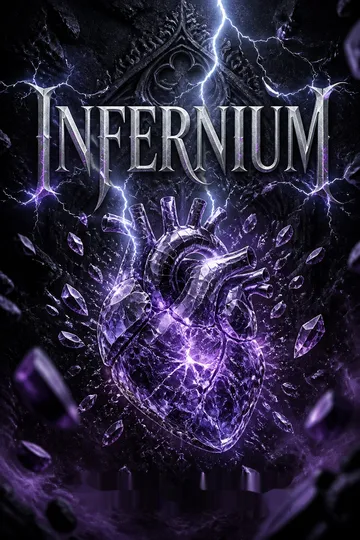
Infernium is a gothic dark romance that argues, without apology, that love is a selfish, devouring force, and that this is its glory rather than its flaw. Across two timelines, Keri Lake builds a theology in which the truest virtue is the willingness to damn every realm for one beloved soul. Jericho's2 defining choice, trading the key to a nightmare world for a single woman's breath, is staged not as moral failure but as the apex of devotion, a deliberate inversion of the heroic calculus that would sacrifice the one for the many. The book repeatedly contrasts angelic utilitarianism, embodied by Adimus10 and the Sentinels who let Lustina14 rot for the greater good, against the messy, criminal loyalty of its antiheroes, and it sides emphatically with the latter. Trauma is the novel's connective tissue. Pain forges power in the prologue, shame fuses with desire through Syrisa's7 abuse, and revelation arrives only through suffering, culminating in Farryn1 recovering the sacred Omni in the moment of torture. The Met'Lazan mythology, women killed and reborn to carry forbidden knowledge, literalizes how trauma and resilience pass down bloodlines and lifetimes. Vespyr's5 arc sharpens the theme of being seen: a person erased by cult and clinic alike, who finds acceptance only in purgatory and dignity only in a named death. The labyrinth of personalized memory-rooms makes the psychological literal, insisting that hell is bespoke, assembled from one's own history. Yet for all its darkness, the book lands on grace: a healed family in a daisy field, a guardian who stays by choice, a father perhaps still reachable through a child's mind. Lake's ultimate claim is that love, in its most obsessive and dangerous form, is the one power capable of transcending both time and death.
Review Summary
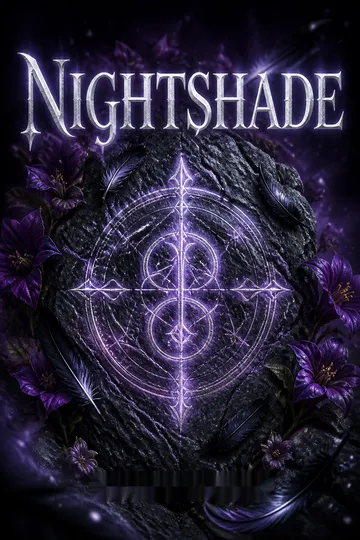
Infernium, the conclusion to the Nightshade duology, is a dark gothic romance that deeply impacted readers. Many praised the intricate world-building, complex characters, and intense emotions evoked by the story. Jericho and Farryn's journey through various realms and challenges captivated readers, though some found the pacing slow at times. The book's explicit content and numerous trigger warnings were noted. While most reviewers gave high ratings, praising the author's writing style and plot twists, a few felt disconnected from the characters or overwhelmed by the darkness.
People Also Read

Characters
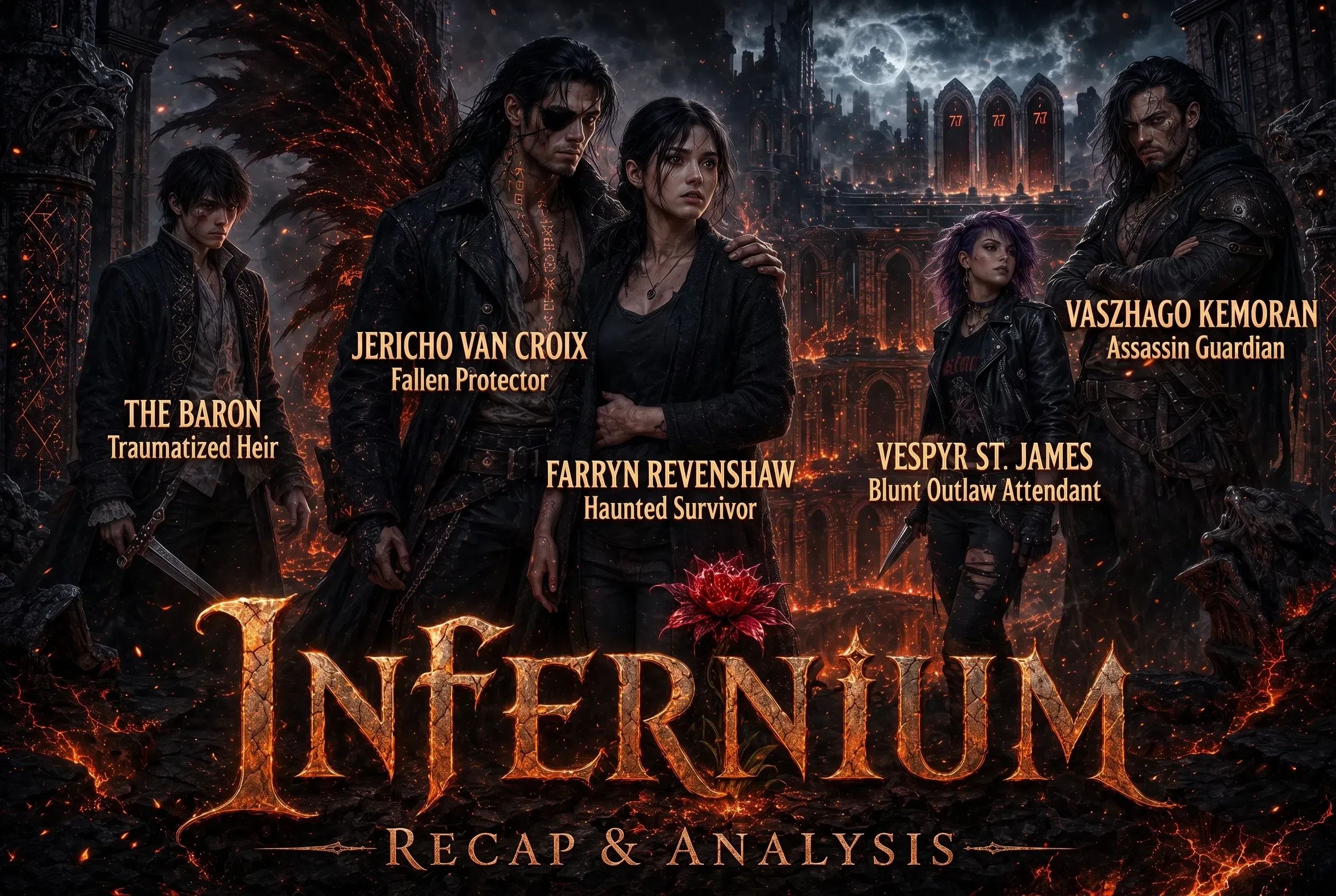
Farryn Ravenshaw
Grieving, hunted heroineA student of iconology raised by a symbol-obsessed father9 and shaped by her mother's early death, Farryn is fiercely independent, cynical, and self-protective, a woman who learned to fortify her heart against a world that keeps taking. She carries the memories and fate of Lustina14, her past self, and a lifetime of feeling like an outsider to the human race. Drawn to Jericho's2 danger as much as his tenderness, she treats love as a masochistic gamble, expecting loss yet refusing to stop loving. Her arc traces a reluctant journey from fragile mortal who doubts her own perceptions to someone forced to wield terrible power, take a life with her own hands, and decide whether she deserves the devotion lavished upon her.
Jericho Van Croix
Half-angel, half-demon lordMaster of Blackwater Cathedral and a centuries-old Sentinel, Jericho is half Elysiumerian angel, half demon, a being who has waged lifelong war between mercy and monstrousness. Trained by an ancient order, scarred by a sadistic father4 and a tormenting bishop6, he is dominant, possessive, and obsessive, a man who sacrificed his wings and power to save the woman he loves. His love borders on the criminal, willing to doom all five realms for her, yet he loathes the depths he is capable of sinking to. Weakened and slipping toward the demon half he fears, he spends the story fighting his own instincts as fiercely as any external enemy, terrified that the hands that protect her1 could destroy her.
Vaszhago
Cursed demon bodyguardA demon of noble infernal blood and a former Knight of the Infernal Order, Vaszhago is an unrivaled killer who once tried to assassinate Jericho2 and later murdered the order's founder. Sprung from a death sentence to guard Farryn1, he is bound to her life by a curse that promises him eternal agony should she perish. Deadpan, cynical, and allergic to sentiment, he claims to live by a simple creed of eating, killing, and indifference to love. Beneath the armor and the cutting remarks lies a reluctant loyalty that deepens as he fights beside Farryn1, his bond with her evolving from grudging obligation into something closer to chosen kinship.
Claudius Van Croix
Monstrous ancient fatherJericho's2 father, a rare and ancient demon lord tied to the barren realm of Eradye, Claudius is cruel, manipulative, and patient across centuries. He despised his son from birth, tormented his dying wife by feeding on her lifeblood, and orchestrated punishments for sport. Bound to Jericho2 by a curse that makes killing one fatal to both, he weaponizes that protection to control and humiliate. He is the novel's central antagonist, driven by a desire for freedom from his obligations and a vengeful obsession with possessing what his son2 loves most.
Vespyr
Traumatized demon-slayerA Dra'Akon demon-hunter with purple hair who astral-projects into Nightshade from a hospital bed where her catatonic body lies, Vespyr becomes Farryn's1 attendant and unlikely friend. Adopted into a cruel religious cult that abused her for being who she was, she carries deep wounds and a longing simply to be seen. Quirky, kind, and brave, she talks to an unseen companion she calls Osiris and finds in Nightshade the acceptance the living world denied her.
Bishop Venable / Barchiel
Sadistic zealot priestA high-ranking clergyman of the Pentacrux in old Praecepsia, Venable tortured young boys under the guise of exorcism, finding pleasure in cruelty. Now a demon's enslaved servant in Nightshade, he has nursed a lifetime of vengeful resentment toward Jericho2. Manipulative and self-serving, he has survived by bargaining his way out of every captivity, peddling drugs and lies, ever the hypocrite cloaking malice in righteousness.
Syrisa of Soldethaire
Vengeful unbound soulAn accused witch from centuries past who slipped through walls and claimed her one true love was cursed away from her, Syrisa is a predator who feeds on the young to remain youthful. Genuinely wronged yet monstrous, she planted shame in the young Jericho2 and harbors a centuries-deep thirst for vengeance. Stripped of her body, she becomes an unbound soul seeking a vessel and a way to settle old scores.
Solomon
Blind mentor, demon-hunterA blind organist who serves the church while secretly belonging to the ancient Dra'Akon line of demon hunters, Solomon becomes the young baron's2 tutor. Patient, cryptic, and wise, he teaches the boy to control his impulses, to recognize evil disguised as beauty, and to understand the hidden realms. He insists that virtue, not power, defines a warrior.
Augustus
Farryn's vanished fatherA professor of religious studies and ancient languages, Augustus spent his life obsessed with deciphering symbols and the mysterious Omni sigil, a fixation that made him seem mad and isolated his daughter1. Driven by grief over his wife and a journey into Nightshade, he hides half-broken on the outskirts of a lawless city, hunted for a debt, refusing rescue to spare Farryn1 from witnessing his fate.
Adimus
Leader of the SentinelsThe arrogant, duty-bound commander of the Sentinels, Adimus once petitioned the heavens to banish Jericho2. He guards Heaven's interests and its secrets, including the identity of the Met'Lazan. Capable of cold utilitarian calculation, he nonetheless harbors his own buried history and loyalties, and his late intervention reveals truths that reframe everything.
Soreth
Arrogant angel scholarA pure-blooded Elysiumerian angel and lifelong academic who knew Jericho2 as a boy, Soreth is vain, fastidious, and proud of his bloodline's supposed superiority. A devotee of forbidden knowledge, he seeks asylum and the secrets of the Met'Lazan, his true allegiances and motives concealed behind a veneer of scholarly detachment.
Camael
Shape-drifting oracle catFarryn's1 seemingly ordinary Sphynx cat is in truth a free soul who drifts between bodies, human, bird, or feline, and possesses the gift of foresight. Regal and mischievous, she delivers cryptic warnings, tests those around her, and links Farryn1 to her past life, never fully revealing what she knows.
Catriona
Witch mother, wraith booksellerLustina's14 mother, a red-haired witch accused of heresy and now a wraith haunting a hidden room above a Nightshade bookstore. Warm, mannered, and maternal, she once carried an angel's child and offers Farryn1 guidance, comfort, and pieces of the puzzle of her past life and the curse that binds them.
Lustina
Farryn's past selfThe raven-haired girl from centuries ago, born of light, whom the young Jericho2 fell for and was charged to protect. Spirited, defiant, and pure of heart, she lived a brief life under the shadow of the Pentacrux. Her memories increasingly merge with Farryn's1, and her fate shapes the present in ways slowly revealed.
Anya
Cathedral housekeeperThe warm, gossipy head of Blackwater Cathedral's staff, Anya welcomes Farryn1 and Jericho2 home, dotes on them, and tends the household, largely oblivious to the supernatural truths of the realm she inhabits.
Venefica
Ancient black witchA reclusive, possibly mythic alchemist dwelling in the caves at Eradye's border, Venefica brews dark medicine and bargains in terrible prices. Cunning and vindictive, she pursues her own centuries-old vengeance, and any deal struck with her costs far more than it first appears.
Elyon
Frightened lost childA skeletal, frightened boy with black hair and stardust eyes who haunts the corridors of the labyrinth, uncannily resembling a young Jericho2. He has wandered the maze alone for a time that defies measure, and he latches onto Farryn1 as though he has always known her.
Cerberus
Loyal hellhound alphaThe leader of Jericho's2 three hellhounds, salvaged as a puppy from a cave. Fiercely loyal to his master, Cerberus once bonded deeply with Farryn1, making his sudden hostility toward her an alarming early omen.
Trezhyr
Demon informant allyA respected member of the demon council and a longtime friend who served as Jericho's2 informant during his knighthood. He risks his standing to reveal who has claimed Farryn's1 soul.
Evie
Spurned former loverA maid once devoted to Jericho2 who, cast aside for Farryn1, nurses bitter resentment and betrays his whereabouts to a stranger, setting dangerous forces in motion.
Plot Devices
The Omni and the Met'Lazan
Hidden identity, ultimate powerThe Omni is an ancient sigil that grants access to all the lifeblood of dead angels stored in Heaven's protective layer, translatable only by a chosen human healer called the Met'Lazan. Augustus9 introduces it early as an untranslatable mystery he pursued for years, and Soreth11 confirms its world-shaking danger. The reader and Jericho2 hunt the healer's identity across most of the book, never suspecting the answer lies in the protagonist herself1. Born to the blood moon curse, the Met'Lazan is killed and reborn so the knowledge passes on, with each incarnation usually forgetting the sigil upon death. The device drives Jericho's2 quest to restore his wings, explains why both Heaven and Hell covet Farryn1, and pays off when she finally remembers the chant.
Vitaeilem and severed wings
Power source, demon balanceVitaeilem is the angelic lifeblood that fuels a Sentinel's power and keeps the demon half in check. Having sacrificed his wings to save Farryn1, Jericho2 can no longer produce it, so his strength wanes and his monstrous nature surfaces, manifesting as blackening skin, horns, and a glowing red eye. He medicates with seraphica, a watered-down angel-blood drug, and harvests vitaeilem from a captive angel. The depletion sets the entire plot in motion, justifying the bodyguards, the separation, the hunt for the Met'Lazan, and his constant fear that he will harm the woman he loves1. The slow restoration of his power and wings tracks his arc from near-mortal weakness back to formidable guardian.
The Vale and Nightshade
Threshold between worldsThe Vale is the fragile barrier between the mortal realm and Nightshade, the purgatorial world where souls who have forgotten their lives reside. Crossing it requires traversing the line between life and death, which Jericho2 accomplishes by drowning Farryn1 in a bathtub. Nightshade operates by demon physics, with hellhounds, sea serpents, fallen angels, and an underground scene of vice. Most human souls there cannot perceive the supernatural unless they choose to, but Farryn1, as one of the living and the Met'Lazan, sees everything. The realm provides the gothic stage for the story and the strategic refuge where Jericho2 holds a slim advantage over the Sentinels hunting them.
Stre vera'tu
Reality anchor, safe wordA Pri'Scucian incantation meaning roughly as real as the stars, taught to Farryn1 by Jericho2 as a tether against the moments her perception fails. It serves double duty as a lover's vow and a safety mechanism: when Jericho's2 demon half overtakes him during mating heat, Farryn1 speaks the words to drag him back to himself. Given Farryn's1 lifelong fear of inheriting her father's9 apparent madness and her escalating hallucinations, the phrase becomes a recurring lifeline that distinguishes what is real from what the unbound soul7, the labyrinth, or the demon would have her believe. It crystallizes the book's theme that reality is partly a choice made through love and trust.
Infernium's labyrinth and the heart
Mind-prison, deadly bargainInfernium is an asylum built atop the ancient temple of the gods, where lost souls and the slumbering ancient Letifer reside, its center holding his beating heart encased in glass. The labyrinth within is a projection of a tormentor's mind, conjuring rooms made from victims' worst memories to break them, while screeching Mortunath hunt the trapped. So long as the heart beats and feeds on lifeblood, Letifer sleeps; destroying it frees the realms but wakes catastrophe. The black witch's16 elixir, which sinks Farryn1 into a three-night deathlike state to expel the parasite within her7, is tied to delivering that heart, binding the rescue mission, the cure, and the apocalyptic stakes into a single ticking confrontation.
FAQ
Synopsis & Basic Details
What is Infernium about?
- A Dark Purgatorial Quest: Infernium plunges readers into a perilous journey through Nightshade, a purgatorial realm, as Farryn Ravenshaw desperately seeks to resurrect her lost lover, Jericho Van Croix, a powerful half-angel, half-demon Sentinel. The narrative explores their struggle against ancient curses, malevolent entities, and the very forces of Heaven and Hell that seek to control their destinies.
- Love Against All Odds: At its core, the story is a dark romance, detailing Jericho and Farryn's fight to preserve their bond amidst supernatural threats, personal demons, and the devastating consequences of their choices. Their love is tested by possession, betrayal, and the unraveling of reality itself, forcing them to confront the true meaning of sacrifice and devotion.
- Unveiling Ancient Secrets: The plot intricately weaves through layers of forgotten history, revealing ancient prophecies, hidden powers, and the true nature of the realms. Farryn discovers her identity as the Met'Lazan, a human destined to wield immense power, while Jericho battles his inherited darkness and the machinations of his monstrous father, whose influence threatens to consume all existence.
Why should I read Infernium?
- Intense Emotional Depth: Infernium offers a raw and unflinching exploration of trauma, grief, and the complexities of love in a dark, supernatural setting. Readers are drawn into the characters' psychological struggles, witnessing their resilience and vulnerability as they navigate unimaginable pain and sacrifice.
- Rich, Immersive World-Building: Keri Lake crafts a unique and intricate cosmology, expanding beyond traditional angelic and demonic lore. The detailed descriptions of Nightshade, its various realms (like Eradyę and Infernium), and its diverse inhabitants create a truly immersive and unforgettable reading experience.
- Compelling Anti-Hero Dynamics: The novel excels in its portrayal of morally ambiguous characters, particularly Jericho, whose internal battle between his angelic and demonic halves drives much of the conflict. His fierce, often brutal, protectiveness of Farryn, coupled with her own evolving strength and defiance, creates a captivating and unconventional romantic dynamic.
What is the background of Infernium?
- A Purgatorial Realm: The story is set primarily in Nightshade, a purgatorial realm existing between the mortal world and the afterlife, where souls often lose their memories and are governed by powerful overlords. This setting is a complex tapestry of ancient cities, desolate landscapes, and hidden fortresses, reflecting the fragmented and often brutal nature of its inhabitants.
- Ancient Conflicts & Bloodlines: The narrative is steeped in a history of ancient wars between Heaven and Hell, and the intricate bloodlines of angels, demons, Sentinels (half-angel, half-demon), Nephilim (half-human, half-angel), and Cambions (half-human, half-demon). These historical conflicts and inherited powers directly influence the characters' destinies and the ongoing struggle for control over souls and realms.
- Prophecies and Curses: Central to the background are the Blood Moon Curse, which targets specific human bloodlines, and the Omni, an ancient sigil of immense power. These elements tie into a long-standing prophecy involving the Met'Lazan, a human chosen to access angelic lifeblood, whose existence is crucial to maintaining the balance (or imbalance) of power across the five realms.
What are the most memorable quotes in Infernium?
- "Any god or devil foolish enough to lay claim to you will suffer my unforgiving wrath. You are mine, Farryn. Mine. There is no compromise, no bargain that could possibly change what has already been decided. Understand?" (Jericho, Chapter 6): This quote encapsulates Jericho's fierce, possessive love and unwavering devotion to Farryn, highlighting his anti-hero nature and the lengths he will go to protect her, even defying divine and infernal powers. It defines his core motivation and the central conflict of their relationship.
- "There is a belief that reality is what we choose to see, even if it doesn't seem real to the rest of the world. Even if all of this is a lie, it doesn't matter. If ever your eyes should deceive you, though, and you're scared of not knowing what is real and what isn't, speak the words and I will bring you back." (Jericho, Chapter 5): This profound statement from Jericho to Farryn offers a philosophical anchor in a world where reality is constantly shifting and deceptive. It speaks to the power of perception, the subjective nature of truth, and the deep trust and connection between them, serving as Farryn's lifeline against madness.
- "My definition of love had evolved into a multifaceted enigma, with endless planes sharp enough to cut me open, but strong enough to heal. From the heights of ecstasy to the abysmal depths of crushing pain, it was the most exquisite dichotomy. The only thing in the world which had the power to transcend time and death." (Farryn, Epilogue Two): This reflective quote from Farryn at the novel's conclusion perfectly summarizes the complex, often brutal, yet ultimately redemptive nature of love as portrayed in Infernium. It highlights the themes of pain, sacrifice, and transformation, showing how her understanding of love has been forged through immense suffering and supernatural experiences.
What writing style, narrative choices, and literary techniques does Keri Lake use?
- Visceral and Immersive Prose: Keri Lake employs a highly descriptive and visceral writing style, immersing readers directly into the characters' sensory and emotional experiences. Her prose is often raw and intense, particularly in depicting violence, sexual encounters, and psychological torment, creating a palpable sense of dread and urgency.
- Dual Perspective & Non-Linear Narrative: The novel primarily alternates between Farryn's and Jericho's first-person perspectives, offering deep insight into their individual struggles and complex inner worlds. The non-linear structure, incorporating flashbacks (especially Jericho's childhood as "The Baron"), enriches the narrative by gradually revealing crucial backstory and character motivations, building suspense and thematic resonance.
- Symbolism and Gothic Elements: Lake heavily utilizes symbolism, such as the recurring motif of "Nightshade" flowers representing unclaimed souls, the labyrinthine asylum of Infernium as a psychological prison, and the contrasting imagery of light and darkness to represent good and evil. The pervasive gothic atmosphere, with its decaying architecture, supernatural entities, and themes of inherited curses and forbidden desires, enhances the dark romance genre.
Hidden Details & Subtle Connections
What are some minor details that add significant meaning in Infernium?
- Farryn's Recurring Numbers (137 & 777): Farryn frequently sees the numbers 137 and 777 in her dreams and hallucinations. The book later reveals 137 signifies "death and creation" ("From death brings life"), foreshadowing her transformation and the baby's fate. 777 is a "warning of change" and "no return to the before," subtly hinting at her irreversible journey into the supernatural world and her role as the Met'Lazan. This numerical symbolism deepens the sense of predestination and cosmic significance.
- The Baron's Healing Touch: Early in Jericho's flashbacks as "The Baron," he discovers his ability to heal wounds, first on a mouse's tail and then his own flogging marks (Chapter 3, 5). This seemingly minor detail foreshadows his later angelic powers and the vital role his vitaeilem plays in Farryn's survival and transformation, establishing his inherent healing capacity long before his full identity is revealed.
- Camael's Shifting Forms: Farryn's cat, Camael, is revealed to be a "free soul" who can take many forms, including a human woman (Chapter 26). This seemingly whimsical detail subtly introduces the concept of unbound souls and their ability to inhabit vessels, foreshadowing Syrisa's later possession of Farryn and the complex nature of consciousness in Nightshade. It also explains Camael's uncanny loyalty and presence in Nightshade.
What are some subtle foreshadowing and callbacks in Infernium?
- Jericho's "Pain as Pleasure": From his childhood flogging (Chapter 5), Jericho experiences a disturbing intertwining of pain and pleasure, a trait he later attributes to his demon half and the Rur'axze. This foreshadows his intense, almost violent, sexual encounters with Farryn, where he uses pain and control to manage his urges, and callbacks to his father's depravity, hinting at the inherited darkness he constantly battles.
- The "Widow in the Woods" Legend: Farryn recalls the local legend of the "Widow in the Woods" who lured young boys (Chapter 54). This is a direct callback to Syrisa of Soldethaire, whose past as a child predator and her eventual soul-stripping are revealed through Jericho's and Soreth's memories. This subtle detail links Farryn's present danger to a historical figure, emphasizing the cyclical nature of evil and vengeance.
- Elyon's Familiarity with Farryn: The young boy, Elyon, immediately recognizes and clings to Farryn in the labyrinth, calling her "Mama" (Chapter 62). This subtly foreshadows his true identity as Lustina's son, born in the labyrinth, and Farryn's reincarnation. His instant connection to her, despite never having met Farryn, hints at the deep, ancient bond that transcends lifetimes and realms.
What are some unexpected character connections in Infernium?
- Jericho's Mother and Adimus: It's revealed that Jericho's angelic mother and Adimus, the Sentinel leader, were lovers (Chapter 55). This unexpected connection adds a layer of personal history to the angelic realm and explains Adimus's conflicted feelings towards Jericho and Farryn, as he grapples with his past love and his duty to the heavens.
- Venefica and Syrisa as Sisters: The black witch Venefica, who aids Jericho, is revealed to be Syrisa's sister (Chapter 67). This familial tie adds a surprising twist to Syrisa's motivations and Venefica's own vindictive nature, explaining her deep-seated desire for vengeance against Claudius and her willingness to manipulate events to achieve it.
- Alaric as Jericho's Mother's Spy: Alaric, Lord Praecepsia's seemingly loyal henchman and Jericho's childhood tormentor, is revealed to be a spy for Jericho's mother (Chapter 48). This unexpected alliance highlights the hidden resistance within Claudius's domain and the lengths Jericho's mother went to protect her son and prepare him for his destiny.
Who are the most significant supporting characters in Infernium?
- Anya, the Cathedral Matron: Beyond her role as a loyal housekeeper, Anya serves as a grounding force and a symbol of the human capacity for adaptation in Nightshade. Her selective memory loss (forgetting her own pregnancy but recalling Aurelia) and her ability to rationalize supernatural events as "natural phenomena" (Chapter 6) highlight the psychological coping mechanisms of humans in purgatory, making her a poignant representation of the realm's effect on its inhabitants.
- Cicatrix, the Raven Familiar: Cicatrix, Jericho's raven familiar, is more than just a pet; he is Jericho's "eyes and ears" in the mortal realm and a crucial informant (Chapter 24). His ability to form a vinculum bond and communicate telepathically with Jericho, even allowing Jericho to "see" through his eyes, emphasizes the unique connection between Sentinels and their familiars, and his loyalty is unwavering, contrasting with human betrayals.
- The Hellhounds (Cerberus, Fenrir, Nero): These three dogs, rescued and trained by Jericho as a boy, represent his capacity for nurturing and loyalty, even in his darkest moments (Chapter 25). Their initial turning on Farryn (Chapter 14) due to Syrisa's influence, and their later fierce protectiveness, symbolize the shifting allegiances and the deep, instinctual bonds that transcend species in Nightshade.
Psychological, Emotional, & Relational Analysis
What are some unspoken motivations of the characters?
- Jericho's Self-Punishment: Beyond protecting Farryn, Jericho's willingness to endure pain (like Rur'axze or chaining himself) and his constant self-deprecation ("I'm a bad man") suggest an unspoken motivation for self-punishment. This stems from his traumatic past, his inherited demonic nature, and the guilt over his past actions (burning Praecepsia, his addiction to seraphica), seeking atonement through suffering.
- Farryn's Addiction to Aftermath: Farryn admits to being "addicted to the aftermath of love's torment" and finding "masochistic pleasure in pain" (Chapter 45). This unspoken motivation reveals a deeper psychological complexity, suggesting that her repeated pursuit of dangerous situations and her attraction to Jericho's darker side are not just about love, but a subconscious coping mechanism for past trauma and a perverse comfort in suffering.
- Claudius's Obsession with the Met'Lazan: Claudius's relentless pursuit of the Met'Lazan (Lustina/Farryn) is driven by more than just power; it's a twisted form of vengeance against Jericho and a desire to control the very source of life and death. His need to "break" Farryn and force her to remember the Omni is a deeply personal and sadistic motivation, aiming to inflict the ultimate pain on Jericho by corrupting what he loves most.
What psychological complexities do the characters exhibit?
- Jericho's Duality and Control: Jericho embodies profound psychological duality, constantly battling his angelic and demonic halves. His struggle for control is central, manifesting in his rigid self-discipline, his use of pain as a coping mechanism, and his fear of succumbing to the "blackness" that leads to violence and sexual enslavement. This internal conflict makes him a deeply complex anti-hero, constantly teetering on the edge of his monstrous nature.
- Farryn's Trauma and Resilience: Farryn exhibits significant psychological complexity stemming from her childhood trauma (drowning, father's madness) and her experiences in Nightshade. Her initial denial and hallucinations, followed by her forced confrontation with her past lives and the horrors of the labyrinth, showcase her remarkable resilience. Her journey is a psychological unraveling and re-integration, as she learns to accept her power and her "darker" capacity for violence and love.
- Vespyr's Acceptance of Madness: Vespyr's catatonia in the mortal realm and her ability to astral project into Nightshade highlight a complex psychological state where she finds freedom and purpose in what others deem "madness." Her "imaginary friend" Osiris, who sees things others don't, further blurs the lines of her sanity, suggesting a unique perception of reality that allows her to cope with profound trauma and find acceptance in a supernatural world.
What are the major emotional turning points in Infernium?
- Jericho's Return from Ex Nihilo: This is a pivotal emotional turning point, not just for Farryn's relief, but for Jericho's own psychological state. His return is marked by a significant loss of power and a heightened struggle with his demon half, immediately introducing new vulnerabilities and straining their relationship, setting the stage for his desperate measures to regain control.
- The Loss of Farryn's Baby: The miscarriage, revealed to be Syrisa's doing, is a devastating emotional turning point for Farryn. It shatters her fragile hope, plunges her into deep grief, and fuels a new, darker resolve within her, pushing her closer to accepting her Met'Lazan powers and embracing a more aggressive stance against her enemies.
- Jericho's Confrontation with Lustina's Memory: In the labyrinth, Jericho confronts a manifestation of Lustina, who reveals the truth of her death and the son he never knew (Elyon). This is a profound emotional turning point, as it forces Jericho to face his deepest guilt and regret, fueling his determination to destroy Claudius and save Elyon, transforming his vengeance into a more redemptive quest.
How do relationship dynamics evolve in Infernium?
- Jericho and Farryn: From Obsession to Amreloc: Their relationship evolves from Jericho's initial centuries-long obsession and Farryn's reluctant acceptance to a profound, all-consuming bond called "amreloc." This transformation is forged through shared trauma, mutual sacrifice, and the acceptance of each other's darkest aspects, moving beyond conventional love to an unbreakable, eternal connection that transcends realms and defies traditional morality.
- Vaszhago and Farryn: From Reluctant Guard to Loyal Ally: Vaszhago initially serves as Farryn's cynical, bound bodyguard, viewing her as a "bumbling human." Over time, their dynamic shifts to one of grudging respect and eventually, deep loyalty. His willingness to stay and protect Elyon and Farryn even after his curse is broken demonstrates a profound evolution from self-serving killer to a trusted, almost familial, protector.
- Farryn and Vespyr: Shared Trauma and Sisterhood: Their relationship quickly evolves from stranger to a deep, empathetic bond forged in shared trauma and vulnerability. Vespyr's openness about her past and her unwavering loyalty to Farryn, culminating in her sacrifice, creates a powerful sense of sisterhood. Farryn's grief over Vespyr's death highlights the profound impact of this unexpected friendship in a world where trust is scarce.
Interpretation & Debate
Which parts of the story remain ambiguous or open-ended?
- The Full Extent of the Met'Lazan's Power: While Farryn is revealed to be the Met'Lazan and can access vitaeilem, the precise limits and full capabilities of this power remain somewhat ambiguous. The Omni is translated, but its broader implications for the realms and Farryn's future role as a "conduit" are hinted at rather than fully explored, leaving room for future stories or reader interpretation.
- The Nature of Elyon's Powers and Future: Elyon, as the son of a Sentinel and Met'Lazan, exhibits unique abilities (vinculum bond, communication with Augustus's soul). However, the full scope of his inherited powers and his ultimate destiny are left open-ended, suggesting he will play a significant role in the future of the realms, but without concrete details.
- **The Long-Term Impact
Nightshade Series
About the Author
Other books by Keri Lake




Download PDF
Download EPUB
.epub digital book format is ideal for reading ebooks on phones, tablets, and e-readers.








































